

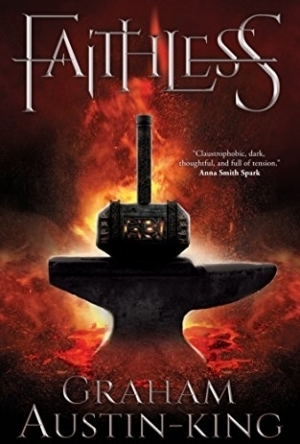

There is a hint of magic here, with chanting at the forge, but until the final few chapters it is unclear whether this is magic or simply a way to mark time and ensure the metal is at the right temperature and worked at the right pace. Not overly labouring the magic here was an excellent choice by the author, as it keeps the attention on the mundane aspects of life, which is excellently told.
The story follows two main characters, firstly Wynn, a young lad sold (or mis-sold in his mind) by his father, a struggling farmer, into the mines for a life of back-breaking work down cramped, dangerous caves, endlessly trying to find enough ore to avoid a beating. His only chance of escaping the mines is to pass the tests and have a chance of ascending to the temple and possibly priesthood. Some way through the book we then meet Kharios, a young adult who appears to have somewhat failed in his first attempts at entering the priesthood (smithing) and is trying to get back to the forge.
The characters' stories are very similar, with hard, thankless, dangerous labour and periods of learning. For some time I struggled to tell the difference between them, thinking they seemed like very similar characters, but I have since re-thought that for reasons.
I found the pacing a little off. There were times I felt like I was reading a biography of a miner, rather than a fantasy novel, as long chapters are essentially that. And then these develop into long chapters learning smithing, was again a bit of a slog. And then all of a sudden we have periods of conflict down the mines, accidents, cave-ins, and the eventual calamity that leads to the second half of the book. The changes in pace were sudden and exciting, but the change was a little extreme at times.
I loved the way the two stories seemed at times independent yet similar, but eventually start to overlap. Though again, we have a change in pace where exciting, cataclysmic events are put aside for another chapter of walloping hot iron.
These pacing issues aside, this was an interesting and well written book with an unusual setting and a good message on belief systems.

Arlo: An MM Age Play Daddy Romance
10.0 Rate It
Book
When this little gets in trouble, it’s Daddy to the rescue THOMAS Since a knee injury forced...

Hazel (1853 KP) rated Red Rising in Books
May 30, 2017
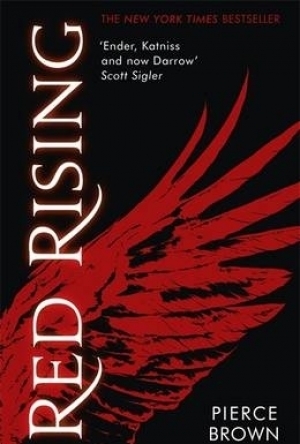

Red Rising by debut author Pierce Brown is a very difficult book to review. It is clear that Brown is an excellent writer with amazing ideas, but at the same time it does not feel possible to rate the book any higher that two or three stars. This first book of three is somewhat alike The Hunger Games Trilogy by Suzanne Collins and has some very exciting themes. However at other times it provoked a range of emotions from disgust to almost verging on boredom.
Set thousands of years in the future, the world has become colour coded. Gold are the elite, the ruling colour, and at the bottom of the pile are the Reds. Darrow is a Red and lives below the surface of the planet Mars in the mines with the responsibility of helping to make the planet’s surface habitable for humans in the future. He soon discovers that the ruling societies have been lying to him all his life, and to the many generations before him. But there is an uprising brewing and Darrow has been chosen to play a vital role in it, even though that means pretending to be the enemy.
Although it was difficult to get into the novel it appeared to be clear what the plot would be about. Wrong! Once Darrow has been trained to behave like a Gold the storyline changes completely. It is almost as though it is a different book altogether. Red Rising suddenly becomes Hunger Games-esque and the situations with the Reds, while being referred to once or twice, was all but forgotten. Presumably those original themes will continue within the final books of the trilogy.
Living under the surface of Mars with no sunlight speeds up the aging process of the inhabitants. People in the thirties are considered old; therefore even though Darrow is a teenager in Earth years, he is portrayed as a man – an image that is difficult to shake off throughout the entire book. Once Darrow is living with the Golds and, supposedly, resembling his true age, it is still easy to forget that he is young. This may change the way the reader pictures the scenes compared with how the author intended them to be imagined. The characters are still only children but may be mistaken for adults due Darrow’s opening scenes.
It cannot be denied that Brown is a very knowledgeable writer. As well as writing in an exceptionally well-structured way, he incorporates a vast amount of high culture into his story. A lot of the novel is influenced by Greek and Roman mythology and he also quotes famous philosophers such as Cicero and Plato. So despite its science fiction genre it also has a slight educational nature.
Something interesting about Red Rising was the character development of Darrow. At the beginning he was rather naïve, believing everything he was told, following orders etc. But soon he becomes more confident, clever, Gold-like. However he then becomes like a wild beast, killing to survive, to win. Thankfully his cleverness takes control and he realises that he needs to become a leader and not a tyrant. Towards the end he even becomes messiah-like. As Darrow progresses through these changes he becomes a more likable character.
I am not sure whether I want to read the next installment of Red Rising. For the beginning storyline to continue and become the main focus, the book would need to be completely different. This could be a good thing because, as mentioned, there were times when it was a little boring, however there’s the risk that it will not feel like a follow on from the first book. I do not want to put anyone off from reading it, but I will honestly say that it was not really what I was expecting.
Till the Trumpet Sounds Again: Volume 1
Book
This is a story of soldiers at war against the background the two battalions of the Scots Guards who...

Blissful Birth by Glenn Harrold & Janey Lee Grace: Advice & Self-Hypnosis Relaxation
Health & Fitness and Education
App
Blissful Birth is the ultimate app to help you before, during and after giving birth. Having a...
Hazel (1853 KP) rated No More Than Mystic in Books
Sep 23, 2017
No Less Than Mystic: A Story of Lenin and the Russian Revolution for a 21st Century Left by John Medhurst is an in-depth historical and political insight to the truth about what really happened in Russia before, during and after the Bolshevik insurrection of October 1917. Beginning with the end of the Tsars rule and ending with Stalinism, Medhurst unearths the fact from the fiction, challenging the information the world has been led to believe.
As mentioned in Medhurst lengthy introduction, previous books on the subject are often biased and inaccurate. Swayed by political beliefs, authors and historians often pass judgement by using the information they have chosen to believe, dismissing anything that goes against their viewpoint. In this book, Medhurst filters through these false histories, preferring to cite from publications written at the time rather than those penned by people who did not witness the events between 1903 and 1921.
Medhurst’s narrative is more political than historical, often going off on tangents. In order to for the reader to obtain some sort of connection with the events described, the author contrasts them with more recent occurrences that readers may have observed or at least understand. These include the British miner’s strike, feminist movements, the Greek economy and a variety of other capitalist struggles.
The Russian revolution is a complex affair that cannot easily be condensed. As a result, No More Than Mystic exceeds 600 pages and covers every event, no matter how big or small, that contributed to the rise of USSR. Russia was a dangerous place to live during the 20th century, particularly when Leninism spiralled into Stalinism. However, Leninism was not all the history books make it out to be.
During GCSE History, one teacher led his class to believe that Lenin was good and Stalin was bad, however, the reality was much more complicated than that. Lenin was not the good guy that many painted him to be. Thousands died as a result of his policies from both execution and starvation. Yet, at the same time, Medhurst tries to point out the reasoning behind the ideas of the communist rulers, refusing to give a personal opinion without laying bare both sides of the argument.
Although this book is accurate and educational, it is not the easiest to sit down and read. Extensive chapters full of mind-numbing information detract from the comprehensive insightfulness of the content. Notwithstanding the fact that the inclusion of contrasting capitalist examples helps the reader to establish some form of familiar ground, the sudden changes in topic, location and time period are often confusing and hard to follow.
No Less Than Mystic is for the intellectual person with a great interest in 20th-century Russian history and communist affairs. Without any prior education on the topic, this book will not mean anything. It attempts to challenge the ingrained beliefs people have about what happened during the Bolshevik insurrection. Those who do not know anything will not benefit from the confronting enlightenment.
In all, No Less Than Mystic is a well-researched academic text that brings a fresh history of Lenin and the Russian Revolution. Those who want an unbiased truth need to read this book and be sceptical about any other on the topic. In order to form opinions, one must know the facts.
FilmIntuition (33 KP) rated The Myth of Perpetual Summer in Books
Jun 19, 2018
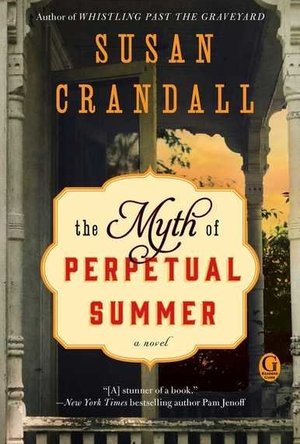

Moving back and forth in time between 1972 and the late 1950s and early '60s, after she learns that her younger brother has been arrested for murder in a crime that's captured national attention, Tallulah James leaves the California home she's made for herself and returns back to her southern hometown where every corner holds dozens of memories.
Wondering where it all went wrong, after she finds unexpected help for her brother's case from an old crush and family friend, Ross Saenger, Tallulah begins seeking out answers for the many mysteries of the past including the truth about her brilliant but unstable father's family tree as well as her parents' turbulent relationship.
After beginning with quite the plot hook, the pace slows down considerably with Myth requiring a good eighty or so pages to establish both its characters and momentum to the point that it's hard to put down.
Having drawn comparisons to both The Secret Life of Bees and Forrest Gump, Crandall's Myth is also reminiscent of Mary Karr's memoirs. But while Myth eventually leads a majority of its characters to well earned conclusions, it's still slightly disappointing to see how quickly the author wraps up certain plot points. In fact, it's a main source of trouble for the otherwise moving last hundred pages of the novel. And nowhere is Crandall's difficulty in judging her reader's interest better epitomized than her decision to spend far more time on a romantic backstory with Tallulah and a character who appears out of thin air (whom we could care less about) than the one that Crandall built for nearly the entire length of the novel that pays off in two pages.
Though limited by the decision to present us with only one character's point-of-view, while the romantic plotline was in great need of either more obstacles or reflection, so were other characters throughout, including the one that's sure to be a reader favorite in the form of Tallulah's protective older brother, Griff. A major protagonist in the novel's extended flashback, I couldn't help but have wished he played an even greater role in the present day '70s storyline as he did in the past.
From the blink and you'll miss it decision for a main character to run away to the solution of a murder – both of which occur in a mere page or two – while there's enough going on in the plot and character heavy book to forgive some of its lopsided storytelling, Myth should've spent less time on extraneous subplots and more ink on what really matters.
Nonetheless a lovely work of Southern Gothic fiction anchored by a strong female protagonist, Crandall's promising Myth may have its flaws. But like a good glass of lemonade on a hot summer day, you can't enjoy the sweet without the sour and thankfully there's enough of both here to keep you coming back for more.
Note – I received an ARC of the novel through Bookish First and if given the opportunity, I would've rated it 7.5 stars.
Inky Books (3 KP) rated These Broken Stars (Starbound, #1) in Books
Jun 21, 2018
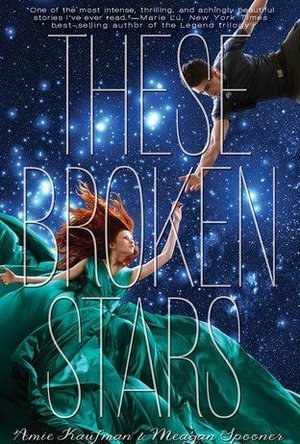
This book was just as amazing the second time as it was the first time. The characters were as fresh and complicated as I remember and I was even surprised by details I had forgotten about them.
Lilac was as privileged, stubborn and as not-crazy as I remember, but now I can appreciate it even more now that I have read the next two books in the series. Despite being a rich and spoiled debutant she certainly pushes through to her very core to survive, especially in the middle and at the end of the book.
And Tarver, he broke my heart. He was wonderfully written, from the beginning, to the interludes where he is being debriefed (where he was so sarcastic I couldn’t help but appreciate his nerve), and then those events at the end. You’ll know what I mean when you read the book.
The main plot is so beautifully simple and can be summed up into one, single word. Survive. There is a larger story arch for the next two books of the series, but just surviving, that’s what this book is about. Well, that and Lilac and Tarver trying not to kill each other while also trying to get the other to stay alive long enough to reach their goal.
Now, this book is almost entirely starring just Lilac and Tarver. Usually, only two characters together, alone would have caused me to whine about how the author was unimaginative but this works really, really well. Yes, I want other people there because the are stranded on an abandoned planet and I don’t want them to suffer, but their dynamic would have been completely ruined if there was someone else there.
Yes, this is considered a romance book, and it didn’t seem at all out of place. It fell in quite easily and it wasn’t a sudden thing forced upon two people who hated each other from the very start. If anything, these two pushed their feelings aside as the tragic accident pulls them closer together without them even knowing it. I think I lived for the moment these two finally accepted each other and I would not have had it any other way. It all just works so well!
So much goes on, yet so little happens. I mean this in the most amazing way possible. There is no one else to interfere with Lilac and Tarver’s mission of surviving, or working towards a goal other than nature and themselves. And when they get to one of the destinations, and what happens to both of them, well, it was hard. But the next place, it is so much harder. They are so sweet and it just breaks my heart.
I knew what was coming, knew what had to happen for the story to move on, and still, it rocked me and almost brought me to tears again. I knew how this book, and the series, ended, but still I couldn’t help the emotions that refused to stay pushed down. I don’t even have words to explain it in a way that will do it justice and not spoil it at the same time. Please, just read it!
Hazel (1853 KP) rated No More Than Mystic in Books
Dec 7, 2018

No Less Than Mystic: A Story of Lenin and the Russian Revolution for a 21st Century Left</i> by John Medhurst is an in-depth historical and political insight to the truth about what really happened in Russia before, during and after the Bolshevik insurrection of October 1917. Beginning with the end of the Tsars rule and ending with Stalinism, Medhurst unearths the fact from the fiction, challenging the information the world has been led to believe.
As mentioned in Medhurst lengthy introduction, previous books on the subject are often biased and inaccurate. Swayed by political beliefs, authors and historians often pass judgement by using the information they have chosen to believe, dismissing anything that goes against their viewpoint. In this book, Medhurst filters through these false histories, preferring to cite from publications written at the time rather than those penned by people who did not witness the events between 1903 and 1921.
Medhurst’s narrative is more political than historical, often going off on tangents. In order to for the reader to obtain some sort of connection with the events described, the author contrasts them with more recent occurrences that readers may have observed or at least understand. These include the British miner’s strike, feminist movements, the Greek economy and a variety of other capitalist struggles.
The Russian revolution is a complex affair that cannot easily be condensed. As a result, <i>No More Than Mystic</i> exceeds 600 pages and covers every event, no matter how big or small, that contributed to the rise of USSR. Russia was a dangerous place to live during the 20th century, particularly when Leninism spiralled into Stalinism. However, Leninism was not all the history books make it out to be.
During GCSE History, one teacher led his class to believe that Lenin was good and Stalin was bad, however, the reality was much more complicated than that. Lenin was not the good guy that many painted him to be. Thousands died as a result of his policies from both execution and starvation. Yet, at the same time, Medhurst tries to point out the reasoning behind the ideas of the communist rulers, refusing to give a personal opinion without laying bare both sides of the argument.
Although this book is accurate and educational, it is not the easiest to sit down and read. Extensive chapters full of mind-numbing information detract from the comprehensive insightfulness of the content. Notwithstanding the fact that the inclusion of contrasting capitalist examples helps the reader to establish some form of familiar ground, the sudden changes in topic, location and time period are often confusing and hard to follow.
<i>No Less Than Mystic </i>is for the intellectual person with a great interest in 20th-century Russian history and communist affairs. Without any prior education on the topic, this book will not mean anything. It attempts to challenge the ingrained beliefs people have about what happened during the Bolshevik insurrection. Those who do not know anything will not benefit from the confronting enlightenment.
In all, <i>No Less Than Mystic</i> is a well-researched academic text that brings a fresh history of Lenin and the Russian Revolution. Those who want an unbiased truth need to read this book and be sceptical about any other on the topic. In order to form opinions, one must know the facts.

Hompath FireFly Prime-Homeopathy & Materia Medica
Medical and Health & Fitness
App
Hompath FireFly Prime is a Homeopathy Repertory Software, with 11 repertories including Q-Rep,...