
Search
Search results
Purple Phoenix Games (2266 KP) rated Cloud Control in Tabletop Games
Dec 31, 2020
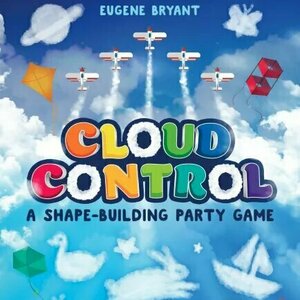

We see so often on TV and movies characters looking up at the sky and picking out figures in the clouds. Maybe they see elephants, or airplanes, or ice cream cones. Usually when I look up into the clouds I see impending rain showers, or snowflakes pelting my face, or merely barricades to the sun. I almost never get the fun shapes that I expect, sadly. But now, with Cloud Control in my arsenal, I can make any shape I wish. For victory points!
Cloud Control is a 3-10 player party game of building unique cloud shapes from cues on cards. By manipulating basic cloud shapes players must get their opponents to guess what they are building to score VP kites.
DISCLAIMER: We were provided a copy of this game for the purposes of this review. This is a retail copy of the game, so what you see in these photos is exactly what would be received in your box. I do not intend to cover every single rule included in the rulebook, but will describe the overall game flow and major rule set so that our readers may get a sense of how the game plays. For more in depth rules, you may purchase a copy online or from your FLGS. -T
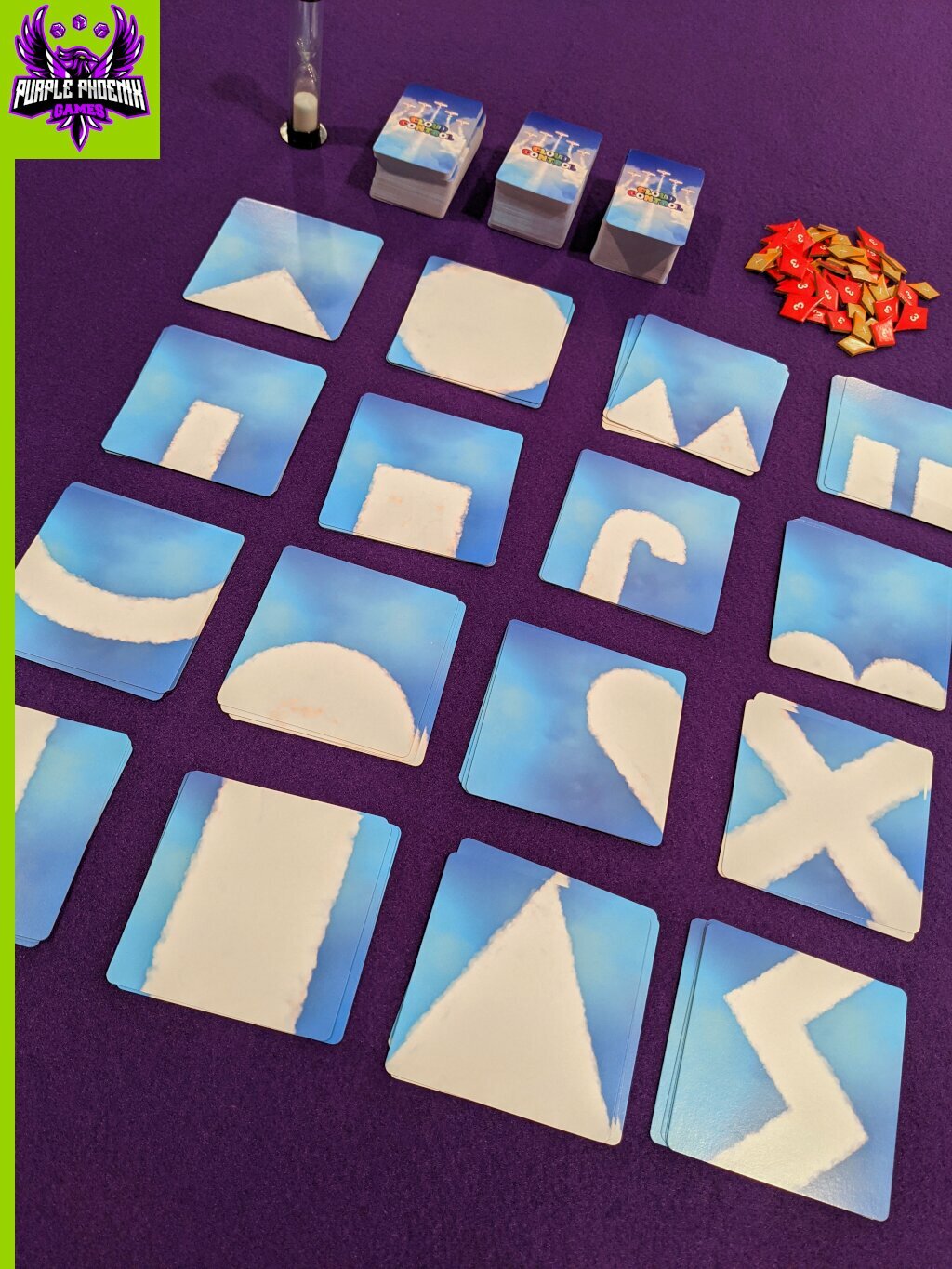
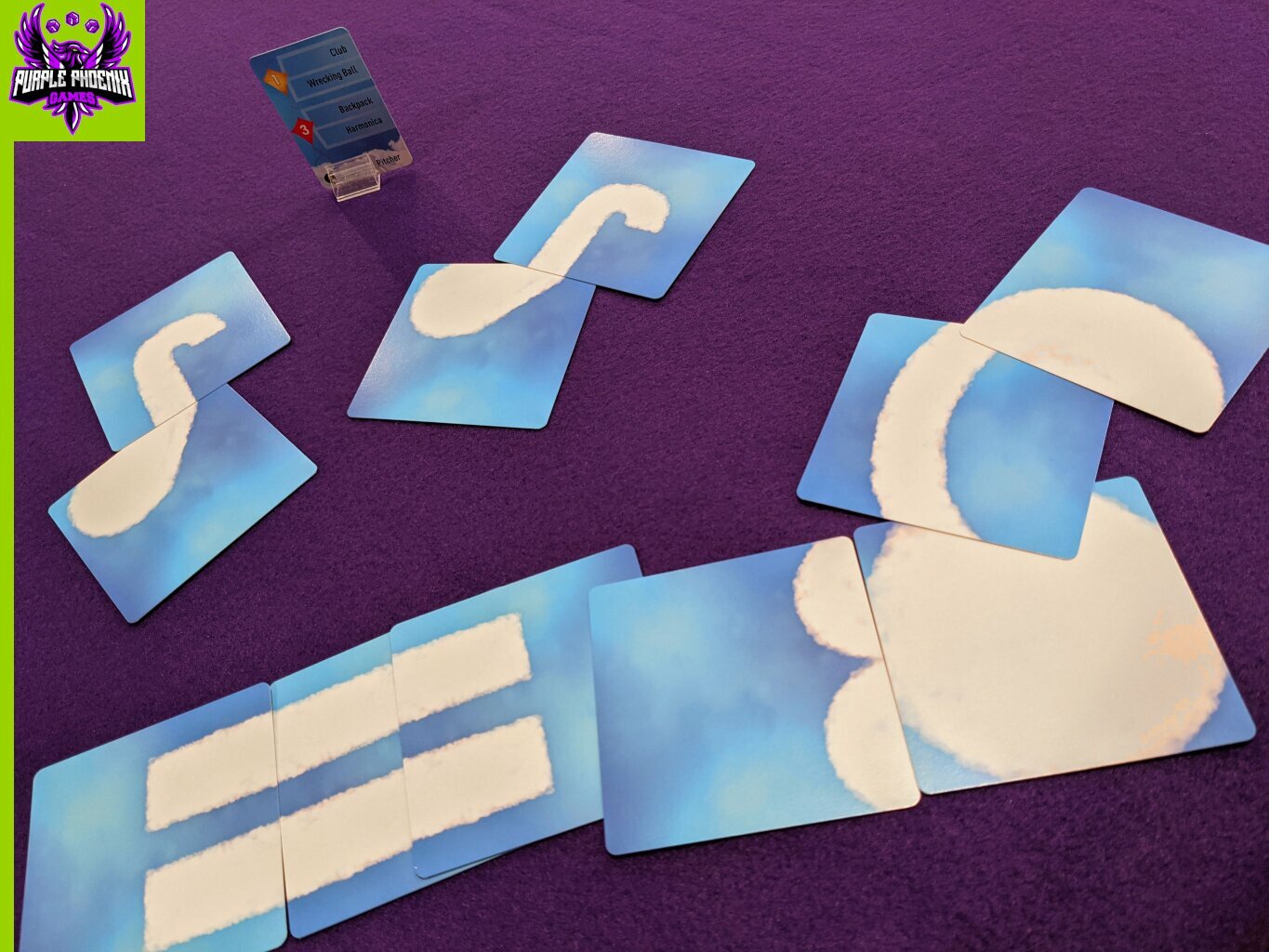
To setup shuffle the cards into one gigantic pile or into smaller stacks, as shown below. Separate the square cloud shape cards by shape and place them into stacks by shape. Place the VP kites and sand timer nearby and determine the starting player. The game may now begin with the first cloud artist!
On a turn the active player will draw a Shape Card, choose one of the shapes and then have someone start the timer. Within the 90 seconds provided the player will need to grab Cloud Cards from the stacks to create their versions of the shapes prompted. Once the timer runs out, or other players correctly guesses what is being built, both the artist and guessers will receive point kites equal to the difficulty of the shapes identified. Easier creations will score 1VP while more difficult ones will score 3VP. Play then proceeds to the next player in table order to take their turn.
Once every player has had a turn to build, a lightning round will commence. The starting player will choose a Shape Card and then announce to all players the shape to be built. The players will have 90 seconds to each build the shape announced by taking only ONE Cloud Card at a time to add to their creation. Once the timer is out of sand, it is flipped once again for players to explain their creations. At the end of this arguing period all players will vote and the shape with the most votes will earn 5VP.
Players will each have one more turn to earn points for Shape Cards, and the winner is the player with the most VPs.
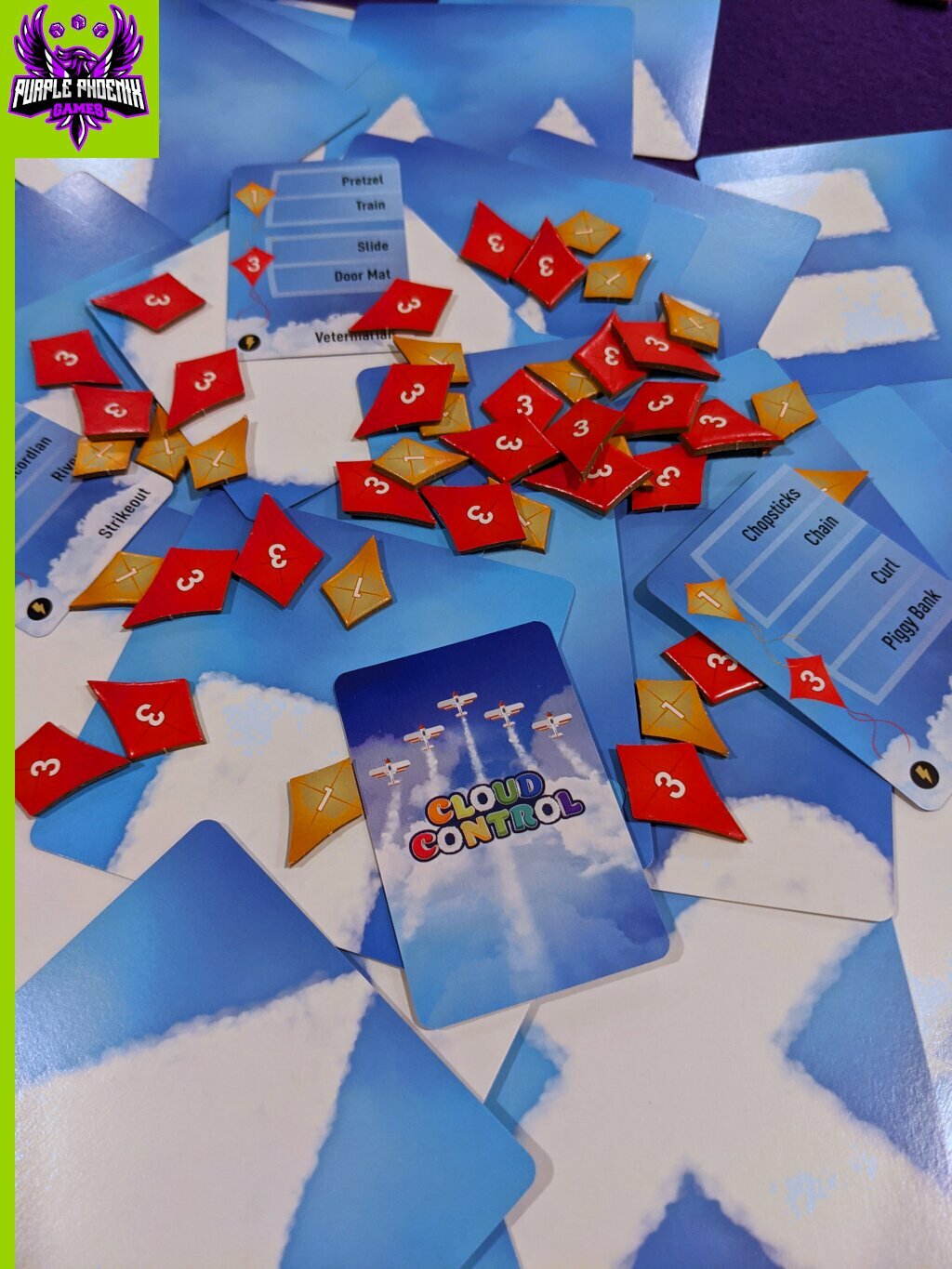
Components. This game is a bunch of Cloud Cards, 300 Shape Cards (plus extra blanks if you received the promos), VP kites, and a sand timer. The timer is normal sand timer quality, the cards used throughout the game are all fine quality, and the kites are cute red and gold tokens. The art style in the game is very light and airy and fits very well with the theme. Again, I have no problems with the components from 25th Century Games.
The gameplay is really fun, and turns (though 90 seconds long) seem like they go by so quickly that one could easily lose track of time playing. Having to work super fast because you are trying to score all the shapes on the card is harrying and stressful, or just a little less so if you decide to go big and detailed for just 3VP on one shape. Finding interesting uses for the basic shapes keeps all players active and on the edge of their seats. This truly is a wonderful party game (for when you can have game nights again).
Why didn’t I rate it higher then if I seem to like it so much? Well, for my typical game group, we tend to gravitate toward games with more meat on their bones. So I really do not see this getting played a ton on a regular rotation. That said, I am basing this on our game nights we had pre-COVID so things may certainly change once we are able to get together as a large group again. While I have played this with different player counts, I haven’t been able to get more than four to play. So I am keeping my rating open for now. I could see it improving down the road when I am able to play this with more people. I just really want to test its limit of 10 players and see how it goes. If it can handle 8+ and still be just as fun as with three or four, I will update this review and the graphic up top.
For now, Purple Phoenix Games gives this one a floaty 8 / 12. I do love being able to bust out my creative side and think more in geometric shapes. Every player I have played with seems to also enjoy it quite a bit. It is simple to teach and learn, plays quickly, and offers so many opportunities to laugh hysterically as players attempt to create common items or concepts from uncommon basic cloud shapes. If you are looking for something a little different to bring to game night or offer your friends and family, check out Cloud Control. And post some photos of your better creations. I want to see them!
Cloud Control is a 3-10 player party game of building unique cloud shapes from cues on cards. By manipulating basic cloud shapes players must get their opponents to guess what they are building to score VP kites.
DISCLAIMER: We were provided a copy of this game for the purposes of this review. This is a retail copy of the game, so what you see in these photos is exactly what would be received in your box. I do not intend to cover every single rule included in the rulebook, but will describe the overall game flow and major rule set so that our readers may get a sense of how the game plays. For more in depth rules, you may purchase a copy online or from your FLGS. -T
To setup shuffle the cards into one gigantic pile or into smaller stacks, as shown below. Separate the square cloud shape cards by shape and place them into stacks by shape. Place the VP kites and sand timer nearby and determine the starting player. The game may now begin with the first cloud artist!
On a turn the active player will draw a Shape Card, choose one of the shapes and then have someone start the timer. Within the 90 seconds provided the player will need to grab Cloud Cards from the stacks to create their versions of the shapes prompted. Once the timer runs out, or other players correctly guesses what is being built, both the artist and guessers will receive point kites equal to the difficulty of the shapes identified. Easier creations will score 1VP while more difficult ones will score 3VP. Play then proceeds to the next player in table order to take their turn.
Once every player has had a turn to build, a lightning round will commence. The starting player will choose a Shape Card and then announce to all players the shape to be built. The players will have 90 seconds to each build the shape announced by taking only ONE Cloud Card at a time to add to their creation. Once the timer is out of sand, it is flipped once again for players to explain their creations. At the end of this arguing period all players will vote and the shape with the most votes will earn 5VP.
Players will each have one more turn to earn points for Shape Cards, and the winner is the player with the most VPs.
Components. This game is a bunch of Cloud Cards, 300 Shape Cards (plus extra blanks if you received the promos), VP kites, and a sand timer. The timer is normal sand timer quality, the cards used throughout the game are all fine quality, and the kites are cute red and gold tokens. The art style in the game is very light and airy and fits very well with the theme. Again, I have no problems with the components from 25th Century Games.
The gameplay is really fun, and turns (though 90 seconds long) seem like they go by so quickly that one could easily lose track of time playing. Having to work super fast because you are trying to score all the shapes on the card is harrying and stressful, or just a little less so if you decide to go big and detailed for just 3VP on one shape. Finding interesting uses for the basic shapes keeps all players active and on the edge of their seats. This truly is a wonderful party game (for when you can have game nights again).
Why didn’t I rate it higher then if I seem to like it so much? Well, for my typical game group, we tend to gravitate toward games with more meat on their bones. So I really do not see this getting played a ton on a regular rotation. That said, I am basing this on our game nights we had pre-COVID so things may certainly change once we are able to get together as a large group again. While I have played this with different player counts, I haven’t been able to get more than four to play. So I am keeping my rating open for now. I could see it improving down the road when I am able to play this with more people. I just really want to test its limit of 10 players and see how it goes. If it can handle 8+ and still be just as fun as with three or four, I will update this review and the graphic up top.
For now, Purple Phoenix Games gives this one a floaty 8 / 12. I do love being able to bust out my creative side and think more in geometric shapes. Every player I have played with seems to also enjoy it quite a bit. It is simple to teach and learn, plays quickly, and offers so many opportunities to laugh hysterically as players attempt to create common items or concepts from uncommon basic cloud shapes. If you are looking for something a little different to bring to game night or offer your friends and family, check out Cloud Control. And post some photos of your better creations. I want to see them!
Sheridan (209 KP) rated Love, Death & Robots in TV
Apr 20, 2019


CGI is amazing (1 more)
The Perfect Mix of Morbid Humour and Gore
A Masterpiece of the Weird and Fantastical
This is going to be a long one, I'm going to review each episode as they aren't linked or related in any way, but just know, they are all gorgeous works of art and you should totally go watch the whole thing ?.
Beyond the Aquila Rift - CGI was beautiful from the moment it started, I was like 'shiiiit this series is going to be everything I love'. This one is about a crew making a delivery in space, however nothing quite goes to plan. For me, it had a very 'Mass Effect' feel with the FTL travel. I was not expecting a full out sex scene in the first 6 minutes but then again the episodes are on average only 16 minutes long. It was rauncy yet somehow, still quite tasteful, but as with most animated stuff there was an excessive amount of topless boob shots. I won't spoil it, but it ended up as a horrific mind fuck that left a shiver down my spine ?.
Secret War - Again, CGI was epic and the story was the perfect mix of unsettling, gory, and tragic. It follows a platoon of Red Army soldiers who are hunting down mysterious 'monsters'. There's blood, there's guts, a guy has an arm off at one point - what more could you ask for?
Sonnie's Edge - Immediately feels hellishly grunge and rave. I absolutely adored the blacklight effects and a strong female styling, the fight is gorgeous, the monsters have almost a Kaju feel which really made me happy as I love Pacific Rim. Of course this epicness is immediately ruined by a sloppy scene (I won't spoil it) which cemented the fact in my mind this was written by a man (I checked later and found I was correct), it does save itself with a fantastic twist at the end though so it was still an amazing short.
Sucker of Souls - This had a great grungy cartooning that felt half Kill Bill, half 2003 TMNT. It ended up being a real bad day for an archaeological expedition. Gore injected with humour is always a favourite of mine and this ticked all those boxes, including a wisecracking explosives expert (looking at you Gary!) If we've learnt anything from Indiana Jones and Rick O'Connell it's, don't fuck with tombs. This time was no different.
Three Robots - There's something just so fucking fantastic about robots going on holiday and speculating about 'human' stuff. It's just the perfect injection of morbid humour and I love it. The twist at the end had me laughing harder than I had any right to ?.
Ice Age - I haven't seen Topher Grace since That 70's Show so I was like 'heeeey cool'. This was the first one that wasn't soley animation so that was really cool. They find a civilization in their freezer - yes, you read that right, their freezer - and the story is awesome ?. It's a neat reflection on humans and our place in the world.
The Witness - Set in a brightly coloured city the animation here feels very Borderlands-y, which is super cool because I fricking love that game ?. There's murder, full frontal nudity, erotic dancing, and an ending that will tear your head right off. Pretty neat all in all.
Suits - Great Googamooga, this is my absolutely favourite so far, a perfectly normal looking farm, complete with adorable hick accents, discovers a breach in their fence. This isn't just any breach, this is an alien style swarm complete with Mech Warrior suits and a woman named Mel, who I'm convinced is Tank Girl as an old lady. 17 minutes of utter badassery you do not want to miss. Utterly LOVED it, and would 10/10 watch this as its own series.
When the Yogurt Took Over - Ok so the name - I was like 'should I take this seriously? Oooor' ?. Weirdly serious - yet hysterical. A five minute journey into what happened when Yogurt became sentient. You will not be disaappointed ?.
Good Hunting - With animation that reminds me of The Last Airbender, it's a story of magic, friendship, and the industrial age. A beautiful and tragic story, with horrific overtones of what greed and 'progress' can do.
The Dump - The animation this reminds me of would be sorta like, if the people at Pixar got high with Tim Burton. There was one random thing - I found Pearly's dick swing in the wind much funnier than any sane person probably would ?. A great story about man's best friend and let me tell ya, everyone needs an Otto ❤.
Shape-Shifter - There's something so deeply interesting about putting the supernatural into regular life. Two men, who are not human, in the US marines. Insanely intense story for under 15 minutes. Gorgeous CGI work too.
Helping Hand - This had a great "Gravity" feel to it, when everything goes wrong you just keep going, give a little and then a little more and you achieve the impossible. Breathtaking space visuals is just an added bonus ?.
Fish Night - Telltale style animation, depicts a story of a father and son on the road. The car breaks down and something both magical and tragic happens. The ending left me reeling ?.
Lucky 13 - The CGI in this one was so good it took me half the time to figure out that it wasn't real. Lucky 13 was to Cutter like the Normandy was to Joker. Just - the best goddamn ship ❤.
Zima Blues - Animated in a style similiar to Archer, this was an interesting piece about art and how it effects us, we search for meaning through it sometimes it's about appreciating the little things ❤.
Blindspot - 90's animation and a rad story about robots. This is my second favourite after Suits, would 10/10 watch as its own movie ?.
Alternate Histories - Did not stop laughing the entire time. Utter gold. I will recommend one thing - pause it at the blue screen bit, you won't be disappointed ?.
The only thing I'm sad about is there wasn't more of this to watch, it was incredible ?.
Beyond the Aquila Rift - CGI was beautiful from the moment it started, I was like 'shiiiit this series is going to be everything I love'. This one is about a crew making a delivery in space, however nothing quite goes to plan. For me, it had a very 'Mass Effect' feel with the FTL travel. I was not expecting a full out sex scene in the first 6 minutes but then again the episodes are on average only 16 minutes long. It was rauncy yet somehow, still quite tasteful, but as with most animated stuff there was an excessive amount of topless boob shots. I won't spoil it, but it ended up as a horrific mind fuck that left a shiver down my spine ?.
Secret War - Again, CGI was epic and the story was the perfect mix of unsettling, gory, and tragic. It follows a platoon of Red Army soldiers who are hunting down mysterious 'monsters'. There's blood, there's guts, a guy has an arm off at one point - what more could you ask for?
Sonnie's Edge - Immediately feels hellishly grunge and rave. I absolutely adored the blacklight effects and a strong female styling, the fight is gorgeous, the monsters have almost a Kaju feel which really made me happy as I love Pacific Rim. Of course this epicness is immediately ruined by a sloppy scene (I won't spoil it) which cemented the fact in my mind this was written by a man (I checked later and found I was correct), it does save itself with a fantastic twist at the end though so it was still an amazing short.
Sucker of Souls - This had a great grungy cartooning that felt half Kill Bill, half 2003 TMNT. It ended up being a real bad day for an archaeological expedition. Gore injected with humour is always a favourite of mine and this ticked all those boxes, including a wisecracking explosives expert (looking at you Gary!) If we've learnt anything from Indiana Jones and Rick O'Connell it's, don't fuck with tombs. This time was no different.
Three Robots - There's something just so fucking fantastic about robots going on holiday and speculating about 'human' stuff. It's just the perfect injection of morbid humour and I love it. The twist at the end had me laughing harder than I had any right to ?.
Ice Age - I haven't seen Topher Grace since That 70's Show so I was like 'heeeey cool'. This was the first one that wasn't soley animation so that was really cool. They find a civilization in their freezer - yes, you read that right, their freezer - and the story is awesome ?. It's a neat reflection on humans and our place in the world.
The Witness - Set in a brightly coloured city the animation here feels very Borderlands-y, which is super cool because I fricking love that game ?. There's murder, full frontal nudity, erotic dancing, and an ending that will tear your head right off. Pretty neat all in all.
Suits - Great Googamooga, this is my absolutely favourite so far, a perfectly normal looking farm, complete with adorable hick accents, discovers a breach in their fence. This isn't just any breach, this is an alien style swarm complete with Mech Warrior suits and a woman named Mel, who I'm convinced is Tank Girl as an old lady. 17 minutes of utter badassery you do not want to miss. Utterly LOVED it, and would 10/10 watch this as its own series.
When the Yogurt Took Over - Ok so the name - I was like 'should I take this seriously? Oooor' ?. Weirdly serious - yet hysterical. A five minute journey into what happened when Yogurt became sentient. You will not be disaappointed ?.
Good Hunting - With animation that reminds me of The Last Airbender, it's a story of magic, friendship, and the industrial age. A beautiful and tragic story, with horrific overtones of what greed and 'progress' can do.
The Dump - The animation this reminds me of would be sorta like, if the people at Pixar got high with Tim Burton. There was one random thing - I found Pearly's dick swing in the wind much funnier than any sane person probably would ?. A great story about man's best friend and let me tell ya, everyone needs an Otto ❤.
Shape-Shifter - There's something so deeply interesting about putting the supernatural into regular life. Two men, who are not human, in the US marines. Insanely intense story for under 15 minutes. Gorgeous CGI work too.
Helping Hand - This had a great "Gravity" feel to it, when everything goes wrong you just keep going, give a little and then a little more and you achieve the impossible. Breathtaking space visuals is just an added bonus ?.
Fish Night - Telltale style animation, depicts a story of a father and son on the road. The car breaks down and something both magical and tragic happens. The ending left me reeling ?.
Lucky 13 - The CGI in this one was so good it took me half the time to figure out that it wasn't real. Lucky 13 was to Cutter like the Normandy was to Joker. Just - the best goddamn ship ❤.
Zima Blues - Animated in a style similiar to Archer, this was an interesting piece about art and how it effects us, we search for meaning through it sometimes it's about appreciating the little things ❤.
Blindspot - 90's animation and a rad story about robots. This is my second favourite after Suits, would 10/10 watch as its own movie ?.
Alternate Histories - Did not stop laughing the entire time. Utter gold. I will recommend one thing - pause it at the blue screen bit, you won't be disappointed ?.
The only thing I'm sad about is there wasn't more of this to watch, it was incredible ?.
Mandy and G.D. Burkhead (26 KP) rated Kushiel's Dart (Phèdre's Trilogy, #1) in Books
May 20, 2018
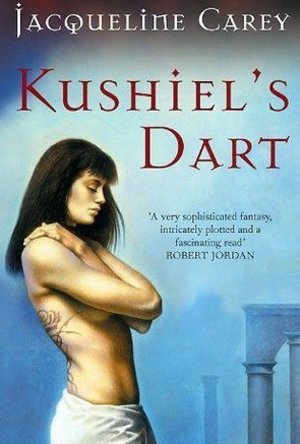

Shelf Life – Kushiel’s Legacy, the Naamah Trilogy, and How Jacqueline Carey Ruined My Ability to Be Impartial About Them
Contains spoilers, click to show
I can honestly say that the nine books that comprise these three trilogies are among the best fantasy available today as well as nine of my all-time favorite books I’ve ever read.
The Spoiler-Free Overview
If you want the shorter, less spoilery answer for what I think of these books: holy crap, yes, they’re as good as everyone says they are. Jacqueline Carey has a way of making me just…feel stuff like no other author can. Plenty of books have caught and held my interest enough that I didn’t want to put them down, but few have made the act of putting them down anyway so torturous. More than once, I hit a point in these stories where I had to drop whatever else I was gonna do that day (that I could realistically drop) just because I had to keep reading to make sure the characters were going to be okay.
This is character-driven fiction at its finest, with people in the pages who come alive and subtly win your heart. More than once, I’ve found reading about their ordeals to be worrying, a little bit painful, and a little bit infuriating (all in a good way, though), and I had to stop and remind myself that these weren’t real people that I was so concerned over and angry for. So if you ever wanted to be really, really invested in the story you’re reading and the people in it, Terre d’Ange is the place to go. All of the eroticism that everyone talks about is just a really nice bonus.
If you want an even shorter answer: do you watch Game of Thrones? Have you read George R.R. Martin’s A Song of Ice and Fire books? Have you at least heard of the fan hype around these stories? The Kushiel and Naamah books are like that, except sexier and with deeper court intrigue. And a lot less incest.
If you want the long answer…
A Dizzying Amount of Adventure Mileage
One thing that has to be said for Kushiel’s Legacy and the Naamah trilogy is that you definitely get your money’s worth of story out of each book. There’s a pattern that I’ve noticed with each of them, which is that you’ll follow the heroine/hero through a massive tribulation, see them endure their hardships and take their small victories where they can, then finally watch matters come to a crux, a climax, and a satisfying resolution…only to realize that you’re only a third of the way through the full page count.
Where most books are content to have one major conflict, Carey packs hers with about three each. The best part is that they’re not laid out in rigid sequence like a series of video game side quests – fight this problem, win, check it off the list, leave it behind and find a new one to fill the word count. No, each new adventure in the same book arises completely organically from the story overall. It makes you realize just how huge a scope these characters’ destinies really are, and just how incredibly wearying it can be and how much seemingly inhuman endurance it takes to be one of the gods’ chosen.
For instance, the first book to kick everything off, Kushiel’s Dart, begins slowly and simply enough. Phedre is an unwanted child who is basically sold into indentured servitude, then trained to be a spy and courtesan while we’re introduced to Terre d’Ange through her eyes over the next couple hundred pages, learning more about the politics and the players in time to watch the drama around them steadily unfold and escalate.
And then her wise mentor gets killed (as wise mentors tend to do), she and her bodyguard companion are betrayed, and the both of them get sold into full-on slavery to the vikings of Skaldia. Plenty of conflict and hardship and planning later, they make their escape and flee into harsh, snowy mountain terrain, falling in love for good measure while they fend off the deadly cold and the pursuit from their enemies. Finally, they make it back to their homeland and clear their names.
This is where most books would be content to stop and maybe leave further contentions for a sequel. Kushiel’s Dart would have been well within its rights to do so as well, and I wouldn’t have complained if it did. But no, it reminds readers, we’re not done yet. There’s a war coming, remember? We talked about this. Catch your breath for a moment, but then we gotta go rally our armies.
So Phedre and Joscelin set off to the wild and secluded island nation of Alba on the other side of an enchanted strait, a body of water where a vengeful, divine power known as the Master of the Straits lives and for some reason prevents almost all contact between the two nations. Arriving safely enough, they find that Alba is also war-torn at the moment, and the armies they had hoped to rally are busy defending their land from another foe. More plotting and intrigue ensues, alliances and promises are made, and with our heroes’ help, the two sides clash in a decisive battle that gains the side we’re rooting for victory as well as gives them their rightful sovereignty back. Now Phedre has the army she needs. After a sudden and unexpected stop at the Master of the Straits’ island, where they learn the secret of his power and guarantee indefinite safe passage between the nations in return for Phedre losing her closest friend, our heroes finally make it back to their homeland again with their army in tow.
Finally! After all of that struggle, we get a happy ending after all. But wait, not yet you don’t, the chunk of pages left at the end remind you. All you did was get your forces together. Good for you. Now you still gotta go actually fight the war with the Skaldi invaders to determine the fate of your entire nation.
So they do. And only after an awesome last-stand battle (the excitement and careful strategy of which will take you completely by surprise if you first entered this book expecting little more than kinky sex scenes) is the story allowed to wrap up in earnest, our heroes finally earning their long-deserved rest. The dangerous and cunning warlord is defeated, the invading army has been pushed back, the new Queen has ascended the throne, Terre d’Ange has been saved, and Phedre and Joscelin are free to finally be together – with the only little niggle being that the real mastermind behind all of their problems is still loose and taunting them. But we can get to that in the next book. Or five.
The Spoiler-Free Overview
If you want the shorter, less spoilery answer for what I think of these books: holy crap, yes, they’re as good as everyone says they are. Jacqueline Carey has a way of making me just…feel stuff like no other author can. Plenty of books have caught and held my interest enough that I didn’t want to put them down, but few have made the act of putting them down anyway so torturous. More than once, I hit a point in these stories where I had to drop whatever else I was gonna do that day (that I could realistically drop) just because I had to keep reading to make sure the characters were going to be okay.
This is character-driven fiction at its finest, with people in the pages who come alive and subtly win your heart. More than once, I’ve found reading about their ordeals to be worrying, a little bit painful, and a little bit infuriating (all in a good way, though), and I had to stop and remind myself that these weren’t real people that I was so concerned over and angry for. So if you ever wanted to be really, really invested in the story you’re reading and the people in it, Terre d’Ange is the place to go. All of the eroticism that everyone talks about is just a really nice bonus.
If you want an even shorter answer: do you watch Game of Thrones? Have you read George R.R. Martin’s A Song of Ice and Fire books? Have you at least heard of the fan hype around these stories? The Kushiel and Naamah books are like that, except sexier and with deeper court intrigue. And a lot less incest.
If you want the long answer…
A Dizzying Amount of Adventure Mileage
One thing that has to be said for Kushiel’s Legacy and the Naamah trilogy is that you definitely get your money’s worth of story out of each book. There’s a pattern that I’ve noticed with each of them, which is that you’ll follow the heroine/hero through a massive tribulation, see them endure their hardships and take their small victories where they can, then finally watch matters come to a crux, a climax, and a satisfying resolution…only to realize that you’re only a third of the way through the full page count.
Where most books are content to have one major conflict, Carey packs hers with about three each. The best part is that they’re not laid out in rigid sequence like a series of video game side quests – fight this problem, win, check it off the list, leave it behind and find a new one to fill the word count. No, each new adventure in the same book arises completely organically from the story overall. It makes you realize just how huge a scope these characters’ destinies really are, and just how incredibly wearying it can be and how much seemingly inhuman endurance it takes to be one of the gods’ chosen.
For instance, the first book to kick everything off, Kushiel’s Dart, begins slowly and simply enough. Phedre is an unwanted child who is basically sold into indentured servitude, then trained to be a spy and courtesan while we’re introduced to Terre d’Ange through her eyes over the next couple hundred pages, learning more about the politics and the players in time to watch the drama around them steadily unfold and escalate.
And then her wise mentor gets killed (as wise mentors tend to do), she and her bodyguard companion are betrayed, and the both of them get sold into full-on slavery to the vikings of Skaldia. Plenty of conflict and hardship and planning later, they make their escape and flee into harsh, snowy mountain terrain, falling in love for good measure while they fend off the deadly cold and the pursuit from their enemies. Finally, they make it back to their homeland and clear their names.
This is where most books would be content to stop and maybe leave further contentions for a sequel. Kushiel’s Dart would have been well within its rights to do so as well, and I wouldn’t have complained if it did. But no, it reminds readers, we’re not done yet. There’s a war coming, remember? We talked about this. Catch your breath for a moment, but then we gotta go rally our armies.
So Phedre and Joscelin set off to the wild and secluded island nation of Alba on the other side of an enchanted strait, a body of water where a vengeful, divine power known as the Master of the Straits lives and for some reason prevents almost all contact between the two nations. Arriving safely enough, they find that Alba is also war-torn at the moment, and the armies they had hoped to rally are busy defending their land from another foe. More plotting and intrigue ensues, alliances and promises are made, and with our heroes’ help, the two sides clash in a decisive battle that gains the side we’re rooting for victory as well as gives them their rightful sovereignty back. Now Phedre has the army she needs. After a sudden and unexpected stop at the Master of the Straits’ island, where they learn the secret of his power and guarantee indefinite safe passage between the nations in return for Phedre losing her closest friend, our heroes finally make it back to their homeland again with their army in tow.
Finally! After all of that struggle, we get a happy ending after all. But wait, not yet you don’t, the chunk of pages left at the end remind you. All you did was get your forces together. Good for you. Now you still gotta go actually fight the war with the Skaldi invaders to determine the fate of your entire nation.
So they do. And only after an awesome last-stand battle (the excitement and careful strategy of which will take you completely by surprise if you first entered this book expecting little more than kinky sex scenes) is the story allowed to wrap up in earnest, our heroes finally earning their long-deserved rest. The dangerous and cunning warlord is defeated, the invading army has been pushed back, the new Queen has ascended the throne, Terre d’Ange has been saved, and Phedre and Joscelin are free to finally be together – with the only little niggle being that the real mastermind behind all of their problems is still loose and taunting them. But we can get to that in the next book. Or five.

Hadley (567 KP) rated Frankenstein in Books
Apr 30, 2019
Great main character (1 more)
Beautiful writing
Over usage of some words (1 more)
Secondary characters have hardly a back story
In the horror genre, I have very few favorite female writers, but Mary Shelley is one of them. The way she weaves environments with character defining scenes is beautifully done in 'Frankenstein.' At the tender age of 18, Shelley was able to convey grief and loss through a single story. She created a relatable 'creature' that many readers will have pity for, but also an obsessive young man that can hardly be hated. Some people may be intimidated by the more diverse English language from the early 1800's, but, in my opinion, the story would not have had the same impact if it had been written today.
Not just horror readers will enjoy 'Frankenstein,' but also those who like to read philosophy. Shelley brings up life discerning questions that even society meddles with today. It's amazing to think that a two century old book discusses problems we still deal with.
The book begins with a sea captain that picks up a stranger that was stranded on a raft of ice, and this man has a fascinating story to tell. The entire book is a letter written by the sea captain to his sister, which he details every bit of Victor Frankenstein's several year tale. Readers get to follow Frankenstein's life from the moment his 'creature' is made to the end of his days, which traverses the globe. When Shelley begins to lull over her love of environments, she quickly picks up with character or story development that keeps our attention from wandering.
'Frankenstein' focuses on the need to be loved and accepted to live a happy existence,as well as reaching our dreams, but Shelley shows how achieving such things can cause a crushing defeat in the latter pursuit: "Night was far advanced when I came to the halfway resting-place, and seated myself beside the fountain. The stars shone at intervals, as the clouds passed from over them; the dark pines rose before me, and every here and there a broken tree lay on the ground: it was a scene of wonderful solemnity, and stirred strange thoughts within me. I wept bitterly; and clasping my hands in agony, I exclaimed, 'Oh! stars, and clouds, and winds, ye are all about to mock me: if ye really pity me, crush sensation and memory; let me become as nought; but if not, depart, depart, and leave me in darkness.' "
There are other characters we read of, including Frankenstein's best friend, Henry, and his long time love interest, Elizabeth (both of who grew up with Frankenstein). Henry comes from a well-to-do merchant family, while Elizabeth was orphaned from a wealthy family, then adopted by the Frankensteins as a future wife for Victor. Unfortunately, we learn little about them or Victor's family, that when any of them do die, it's not felt personally by the reader. There are other characters that had major events in the story, but as with the friends, they weren't developed enough to bring up any emotion at their passing.
After Frankenstein sets out after his creation,we meet the 'creature' at the top of a mountain. He is devastated that his creator hates him, and that the other humans he has met also hated him. "I expected this reception,' said the demon. 'All men hate the wretched; how, then, must I be hated, who am miserable beyond all living things! Yet you, my creator, detest and spurn me, thy creature, to whom thou art bound by ties only dissoluble by the annihilation of one of us. You purpose to kill me. How dare you sport thus with life? Do your duty towards me, and I will do mine towards you and the rest of mankind. If you will comply with my conditions, I will leave them and you at peace; but if you refuse, I will glut the maw of death, until it be satiated with the blood of your remaining friends.' "
The 'creature' gives Frankenstein an ultimatum: he either makes him a female companion or he will kill everyone Frankenstein loves and adores." 'What I ask of you is reasonable and moderate; I demand a creature of another sex, but as hideous as myself; the gratification is small, but it is all that I can receive,and it shall content me.' " Although, by this time, the 'creature' has already murdered Frankenstein's youngest brother, Victor agrees to make him a companion, but with serious regret soon after.
The majority of the story concerns Frankenstein trying fool-hardly to protect all those he loves while the 'creature' murders them one by one. The most surprising of the murders is Henry's. After Frankenstein changes his mind on making another creation, the 'creature' quickly finds Henry and kills him, but Frankenstein is accused of the murder and spends quite some time in prison for it. "But I was doomed to live; and, in two months, found myself as awaking from a dream, in a prison, stretched on a wretched bed, surrounded by gaolers, turnkeys, bolts, and all the miserable apparatus of a dungeon. "
Frankenstein is eventually released from prison when the evidence doesn't add up, and witnesses come forward, claiming to have seen Victor elsewhere at the time of the murder. Frankenstein is, at this time, in a drowning melancholy and madness, but this doesn't stop him from marrying Elizabeth. The 'creature' foretold Frankenstein that he would be with him on his wedding night, and Victor uses this to his advantage - arming himself with pistols and knives on the honeymoon. Yet, to no avail, Frankenstein is unable to outlive or outsmart the 'creature' at any turn.
'Frankenstein' is a must-read for all readers. Although many horror stories today pertain to a creature killing it's master, none of them can reach the grief stricken peaks as Shelley has. Every passage in this book reads like poetry. Every interaction between Frankenstein and his 'creature' is fascinating to the reader. And, before Frankenstein dies, he leaves the sea captain with words of wisdom that even readers could benefit from: "Seek happiness in tranquillity and avoid ambition, even if it be only the apparently innocent one of distinguishing yourself in science and discoveries."
Highly recommend!
Not just horror readers will enjoy 'Frankenstein,' but also those who like to read philosophy. Shelley brings up life discerning questions that even society meddles with today. It's amazing to think that a two century old book discusses problems we still deal with.
The book begins with a sea captain that picks up a stranger that was stranded on a raft of ice, and this man has a fascinating story to tell. The entire book is a letter written by the sea captain to his sister, which he details every bit of Victor Frankenstein's several year tale. Readers get to follow Frankenstein's life from the moment his 'creature' is made to the end of his days, which traverses the globe. When Shelley begins to lull over her love of environments, she quickly picks up with character or story development that keeps our attention from wandering.
'Frankenstein' focuses on the need to be loved and accepted to live a happy existence,as well as reaching our dreams, but Shelley shows how achieving such things can cause a crushing defeat in the latter pursuit: "Night was far advanced when I came to the halfway resting-place, and seated myself beside the fountain. The stars shone at intervals, as the clouds passed from over them; the dark pines rose before me, and every here and there a broken tree lay on the ground: it was a scene of wonderful solemnity, and stirred strange thoughts within me. I wept bitterly; and clasping my hands in agony, I exclaimed, 'Oh! stars, and clouds, and winds, ye are all about to mock me: if ye really pity me, crush sensation and memory; let me become as nought; but if not, depart, depart, and leave me in darkness.' "
There are other characters we read of, including Frankenstein's best friend, Henry, and his long time love interest, Elizabeth (both of who grew up with Frankenstein). Henry comes from a well-to-do merchant family, while Elizabeth was orphaned from a wealthy family, then adopted by the Frankensteins as a future wife for Victor. Unfortunately, we learn little about them or Victor's family, that when any of them do die, it's not felt personally by the reader. There are other characters that had major events in the story, but as with the friends, they weren't developed enough to bring up any emotion at their passing.
After Frankenstein sets out after his creation,we meet the 'creature' at the top of a mountain. He is devastated that his creator hates him, and that the other humans he has met also hated him. "I expected this reception,' said the demon. 'All men hate the wretched; how, then, must I be hated, who am miserable beyond all living things! Yet you, my creator, detest and spurn me, thy creature, to whom thou art bound by ties only dissoluble by the annihilation of one of us. You purpose to kill me. How dare you sport thus with life? Do your duty towards me, and I will do mine towards you and the rest of mankind. If you will comply with my conditions, I will leave them and you at peace; but if you refuse, I will glut the maw of death, until it be satiated with the blood of your remaining friends.' "
The 'creature' gives Frankenstein an ultimatum: he either makes him a female companion or he will kill everyone Frankenstein loves and adores." 'What I ask of you is reasonable and moderate; I demand a creature of another sex, but as hideous as myself; the gratification is small, but it is all that I can receive,and it shall content me.' " Although, by this time, the 'creature' has already murdered Frankenstein's youngest brother, Victor agrees to make him a companion, but with serious regret soon after.
The majority of the story concerns Frankenstein trying fool-hardly to protect all those he loves while the 'creature' murders them one by one. The most surprising of the murders is Henry's. After Frankenstein changes his mind on making another creation, the 'creature' quickly finds Henry and kills him, but Frankenstein is accused of the murder and spends quite some time in prison for it. "But I was doomed to live; and, in two months, found myself as awaking from a dream, in a prison, stretched on a wretched bed, surrounded by gaolers, turnkeys, bolts, and all the miserable apparatus of a dungeon. "
Frankenstein is eventually released from prison when the evidence doesn't add up, and witnesses come forward, claiming to have seen Victor elsewhere at the time of the murder. Frankenstein is, at this time, in a drowning melancholy and madness, but this doesn't stop him from marrying Elizabeth. The 'creature' foretold Frankenstein that he would be with him on his wedding night, and Victor uses this to his advantage - arming himself with pistols and knives on the honeymoon. Yet, to no avail, Frankenstein is unable to outlive or outsmart the 'creature' at any turn.
'Frankenstein' is a must-read for all readers. Although many horror stories today pertain to a creature killing it's master, none of them can reach the grief stricken peaks as Shelley has. Every passage in this book reads like poetry. Every interaction between Frankenstein and his 'creature' is fascinating to the reader. And, before Frankenstein dies, he leaves the sea captain with words of wisdom that even readers could benefit from: "Seek happiness in tranquillity and avoid ambition, even if it be only the apparently innocent one of distinguishing yourself in science and discoveries."
Highly recommend!
Daniel Boyd (1066 KP) rated Ready Player One (2018) in Movies
Sep 20, 2018 (Updated Sep 20, 2018)

Not Quite Ready
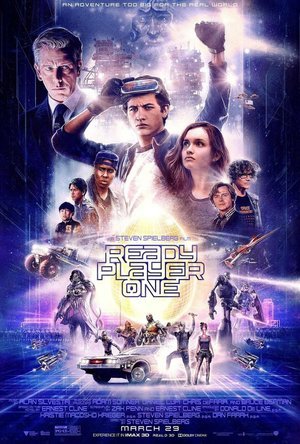
I saw this movie in the cinema back when it came out in March earlier this year and I honestly didn't feel ready to review it after a single viewing because of all of the references etc that there was to take in. After watching the movie a couple more times and watching a bunch of Easter Egg videos on Youtube, I feel more equipped to discuss the film.
Up top, I never read the book that this film is based on. It has been recommended to me quite a few times, but I have never gotten around to reading it, so I was going into this with no pre-conceived ideas of what it was going to be other than what I had seen in the various trailers for the movie.
Let's start with the good stuff. Although I have some issues with the overabundance of CGI onscreen, as a 3d animator myself I was extremely impressed at the sheer quality of the animation in the movie. I know that this thing had a pretty high budget behind it, but still the level of quality in the animation is really high throughout the film. The references are also pretty cool, at least for the first third of the movie but the novelty of seeing some of your favourite pop culture characters does wear off after a while and ends up feeling like a cheap gimmick before too long. Finally, if all you are looking for is a big dumb fun blockbuster, then this movie provides that in spades.
Ok, onto the stuff that bothered me. As I said above, although the quality of the CGI is pretty incredible, the vast amount of it gets tiresome after a while. I also don't like the character designs at all, Parzival looks like a rejected piece of Final Fantasy artwork, Art3mis looks like a stereotypical version of a what a middle aged man thinks a cool hacker looks like with a weird resemblance to a feline, Aech just looked chunky and awkward, like something from a last-gen Gears Of War game, I-R0k's weird, edgy, fantasy-based design didn't fit his voice or the tone of the scenes he appeared in and Sorrento's avatar just looked distractingly like a dastardly Clark Kent for some reason. Also, these original character designs seemed oddly out of place being surrounded by other characters from franchises that we already know like DC and Mortal Kombat, none of it meshed well.
From this point on I am going to delve into some mid-movie spoilers, so here's your warning.
It really annoyed me how they kept touching on the idea that someone in the Oasis might not necessarily look the same as they do in real life and if you ever met them in real life you would be sorely disappointed, only for the reason for all of this to be a birthmark on Olivia Cooke's character's face. The way that they make her out to some sort of beast-like monster because of a slight skin-irregularity is ridiculous and also kinda offensive. Also, we are told during the movie's opening sequence that the Oasis is a worldwide thing, where people from anywhere on the planet can meet up online and fight together or kill each other for coins, then halfway through the movie, all of the characters meet up in a small ice cream truck in the real world and it turns out that they all live within a few miles of each other. It just made the whole thing feel really small scale. Another issue is that the movie is only 6 months old at this point and it already feels slightly dated. I don't see this movie ageing very well at all and this is both due to the CGI and the references that they choose to include.
Lastly, as I said earlier, if what you want out of this movie is mindless fun, then you'll walk away satisfied, the problem with that is that the movie seems to want to be more than that. The way that the movie treats itself and the way it was marketed along with the fact that it's got Spielberg in the director's chair, signifies that the filmmakers were intending for this to be this generation's Back To The Future or Star Wars and on that front it totally fails. In these other movies that this film is aspiring to be, you care about what happens to the characters and want to see where they go, whereas here the audience cares way more about seeing the next popular franchise references than anything that happens to the main characters at the heart of this story and once you've seen the film, you are going to leave talking about the characters that appeared from outside franchises rather than the ones created for this story. The characters are also instantly forgettable, for example I have seen this film three times now and still couldn't tell you the real world names of any of the characters other than Wade Watts and Sorrento and that's only because he has the same name in the real world as he does in the Oasis. I also don't care if I ever see any of these characters again if I'm being honest. I'm sure there is probably a sequel to this already being planned seeing as it made a bunch of money at the box office and there is apparently a sequel book in the works, but frankly I wouldn't care if I never saw any of these characters again and I don't care where the story is going either.
In conclusion, Ready Player One doesn't achieve the goal that it sets for itself of being a modern sci-fi classic, but there is a lot of fun to be had here along with some impressive animation to boot. The movie has a fairly shallow, hollow feel to it throughout, as if we are scratching the surface of something potentially engaging and worth investing in, but the filmmakers constantly keep distracting us with flashy visuals and obscure pop culture references. If the movie committed to telling a more original story rather than being obsessed with the 80's classics it is exploiting, then it may be more worthwhile. Also, it's definitely not Spielberg's best, this may be a bit harsh but it's probably closer to Kingdom Of The Crystal Skull than Raiders Of The Lost Ark. I wish that Smashbomb had a half star rating system, because although I feel that the movie was better than a 6, I don't like it enough to give it a 7, so a 6.5 would sum up how I felt about the film more accurately.
Up top, I never read the book that this film is based on. It has been recommended to me quite a few times, but I have never gotten around to reading it, so I was going into this with no pre-conceived ideas of what it was going to be other than what I had seen in the various trailers for the movie.
Let's start with the good stuff. Although I have some issues with the overabundance of CGI onscreen, as a 3d animator myself I was extremely impressed at the sheer quality of the animation in the movie. I know that this thing had a pretty high budget behind it, but still the level of quality in the animation is really high throughout the film. The references are also pretty cool, at least for the first third of the movie but the novelty of seeing some of your favourite pop culture characters does wear off after a while and ends up feeling like a cheap gimmick before too long. Finally, if all you are looking for is a big dumb fun blockbuster, then this movie provides that in spades.
Ok, onto the stuff that bothered me. As I said above, although the quality of the CGI is pretty incredible, the vast amount of it gets tiresome after a while. I also don't like the character designs at all, Parzival looks like a rejected piece of Final Fantasy artwork, Art3mis looks like a stereotypical version of a what a middle aged man thinks a cool hacker looks like with a weird resemblance to a feline, Aech just looked chunky and awkward, like something from a last-gen Gears Of War game, I-R0k's weird, edgy, fantasy-based design didn't fit his voice or the tone of the scenes he appeared in and Sorrento's avatar just looked distractingly like a dastardly Clark Kent for some reason. Also, these original character designs seemed oddly out of place being surrounded by other characters from franchises that we already know like DC and Mortal Kombat, none of it meshed well.
From this point on I am going to delve into some mid-movie spoilers, so here's your warning.
It really annoyed me how they kept touching on the idea that someone in the Oasis might not necessarily look the same as they do in real life and if you ever met them in real life you would be sorely disappointed, only for the reason for all of this to be a birthmark on Olivia Cooke's character's face. The way that they make her out to some sort of beast-like monster because of a slight skin-irregularity is ridiculous and also kinda offensive. Also, we are told during the movie's opening sequence that the Oasis is a worldwide thing, where people from anywhere on the planet can meet up online and fight together or kill each other for coins, then halfway through the movie, all of the characters meet up in a small ice cream truck in the real world and it turns out that they all live within a few miles of each other. It just made the whole thing feel really small scale. Another issue is that the movie is only 6 months old at this point and it already feels slightly dated. I don't see this movie ageing very well at all and this is both due to the CGI and the references that they choose to include.
Lastly, as I said earlier, if what you want out of this movie is mindless fun, then you'll walk away satisfied, the problem with that is that the movie seems to want to be more than that. The way that the movie treats itself and the way it was marketed along with the fact that it's got Spielberg in the director's chair, signifies that the filmmakers were intending for this to be this generation's Back To The Future or Star Wars and on that front it totally fails. In these other movies that this film is aspiring to be, you care about what happens to the characters and want to see where they go, whereas here the audience cares way more about seeing the next popular franchise references than anything that happens to the main characters at the heart of this story and once you've seen the film, you are going to leave talking about the characters that appeared from outside franchises rather than the ones created for this story. The characters are also instantly forgettable, for example I have seen this film three times now and still couldn't tell you the real world names of any of the characters other than Wade Watts and Sorrento and that's only because he has the same name in the real world as he does in the Oasis. I also don't care if I ever see any of these characters again if I'm being honest. I'm sure there is probably a sequel to this already being planned seeing as it made a bunch of money at the box office and there is apparently a sequel book in the works, but frankly I wouldn't care if I never saw any of these characters again and I don't care where the story is going either.
In conclusion, Ready Player One doesn't achieve the goal that it sets for itself of being a modern sci-fi classic, but there is a lot of fun to be had here along with some impressive animation to boot. The movie has a fairly shallow, hollow feel to it throughout, as if we are scratching the surface of something potentially engaging and worth investing in, but the filmmakers constantly keep distracting us with flashy visuals and obscure pop culture references. If the movie committed to telling a more original story rather than being obsessed with the 80's classics it is exploiting, then it may be more worthwhile. Also, it's definitely not Spielberg's best, this may be a bit harsh but it's probably closer to Kingdom Of The Crystal Skull than Raiders Of The Lost Ark. I wish that Smashbomb had a half star rating system, because although I feel that the movie was better than a 6, I don't like it enough to give it a 7, so a 6.5 would sum up how I felt about the film more accurately.
Purple Phoenix Games (2266 KP) rated You're Pulling My Leg! in Tabletop Games
Aug 3, 2020
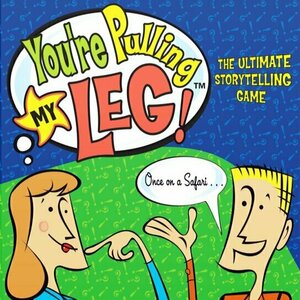
At the time I am writing this preview, the world is in the midst of a pandemic. That being said, the need for social distancing and quarantining has really affected the board gaming world. Without being able to have normal game nights, gamers must be creative in figuring out how to continue to play together, while still maintaining safe and healthy distances from one another. And one game that offers a solution is You’re Pulling My Leg!
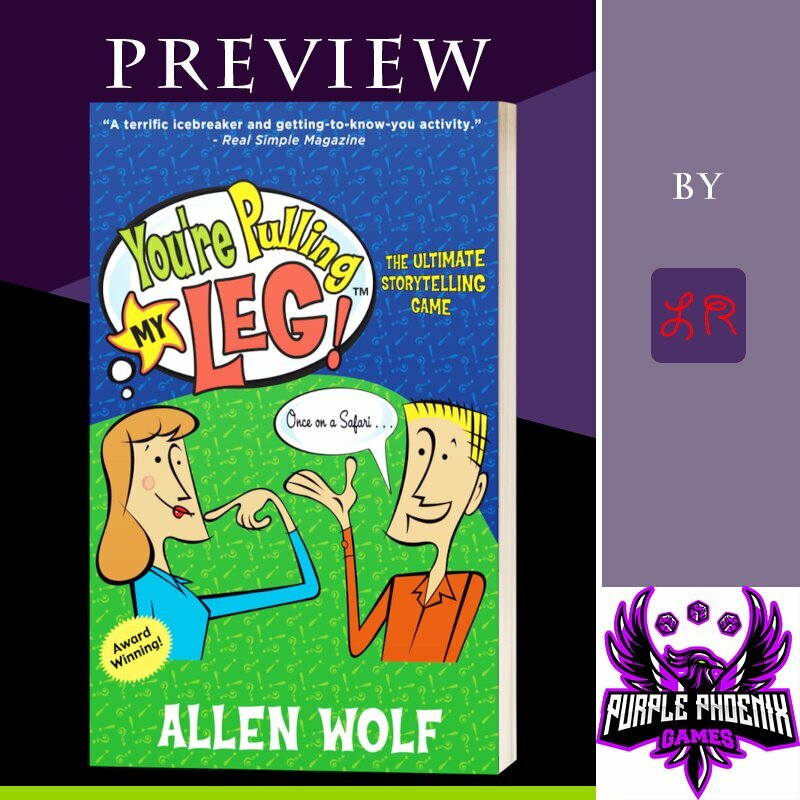
Disclaimer: We were provided a copy of this book for the purposes of this preview. The pictures below show the final production copy you can expect to receive when ordering this game. Check out the publisher’s website to get your hands on this unique party game! -L
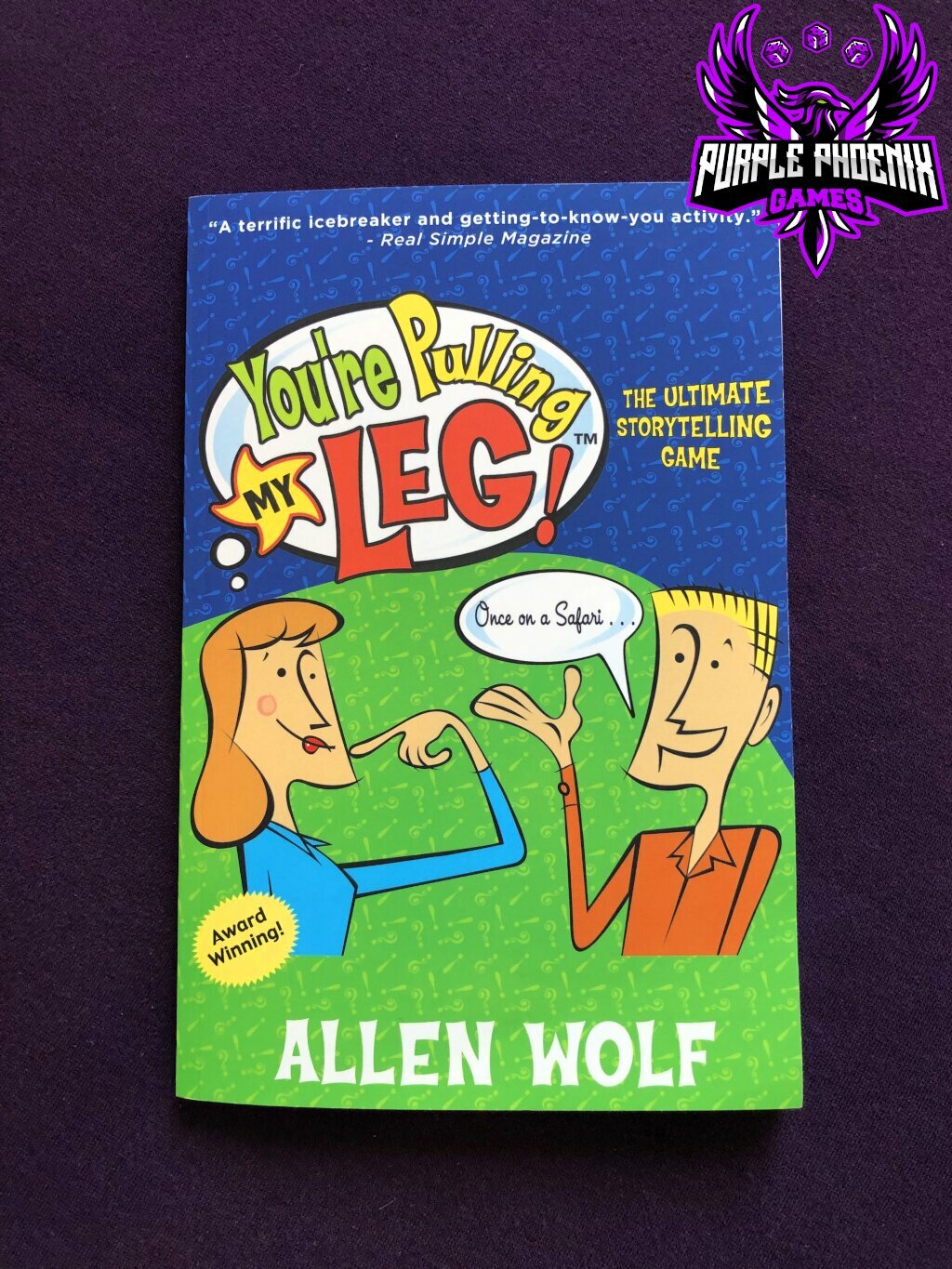
You’re Pulling My Leg! is a party game of bluffing and storytelling in which players are trying to be the first to earn 21 points. The rules are simple, the gameplay is straightforward, and it can even be played remotely!
To setup the game, every player needs a coin and a way to keep track of their score (paper/pencil, notes on a phone, etc.). Every player begins the game with 7 points. To start the game, choose a player to be the first Storyteller. The Storyteller selects a card from the book, reads the three questions on their chosen card, and chooses 1 to answer. The Storyteller then flips their coin – if HEADS, the answer must be a true story, but if TAILS, the answer must be false and untrue in essence. Only the Storyteller knows the result of the coin flip. The Storyteller proceeds to answer the question, telling a story dictated by their coin flip result.
After the Storyteller has told their response to the chosen question, the remaining players will vote (with points) on whether they believe the story was true or false. Players can vote with up to 3 points, and votes are revealed simultaneously. If you believe the story is TRUE, you vote with 1, 2, or 3 fingers pointing UP, and if you believe the story is FALSE, you vote with 1, 2, or 3 fingers pointing DOWN. After everyone has voted, the Storyteller reveals whether the story was true or false, and points are added/deducted accordingly. If a player voted correctly, they add the number of points with which they voted to their score. If they voted incorrectly, subtract the voted points from their score. The Storyteller can earn 1 point for each other player they have fooled, up to a maximum of 3 points per story. After tallying points, choose a new Storyteller and begin again – each player should have a chance to be the Storyteller once before repeating Storytellers. Play continues in this fashion until one player has scored 21 points, and is declared the winner!
At this point in my life, the thing I love about You’re Pulling My Leg! the most is that it can be played remotely. Everybody does not need to have an individual copy of the book to play via video chat or conference call. As long as one person has the book, your group can play! Instead of having each player read their own cards then, the owner of the book reads the cards aloud and the Storyteller chooses their question that way. The only supplies needed, apart from 1 copy of the book, are a coin and a way to track your score. Easy as pie. Another aspect of this game that I really enjoy is that it is pretty light-hearted in nature. Yes, there is an element of deception and bluffing, but it is all done in a light and quirky way. I especially enjoy this because I am a notoriously bad liar, and most bluffing games stress me out. But the ability to choose my question, and then weave a (hopefully) convincing story for my opponents takes some of that pressure off and allows me to really be creative and have fun.
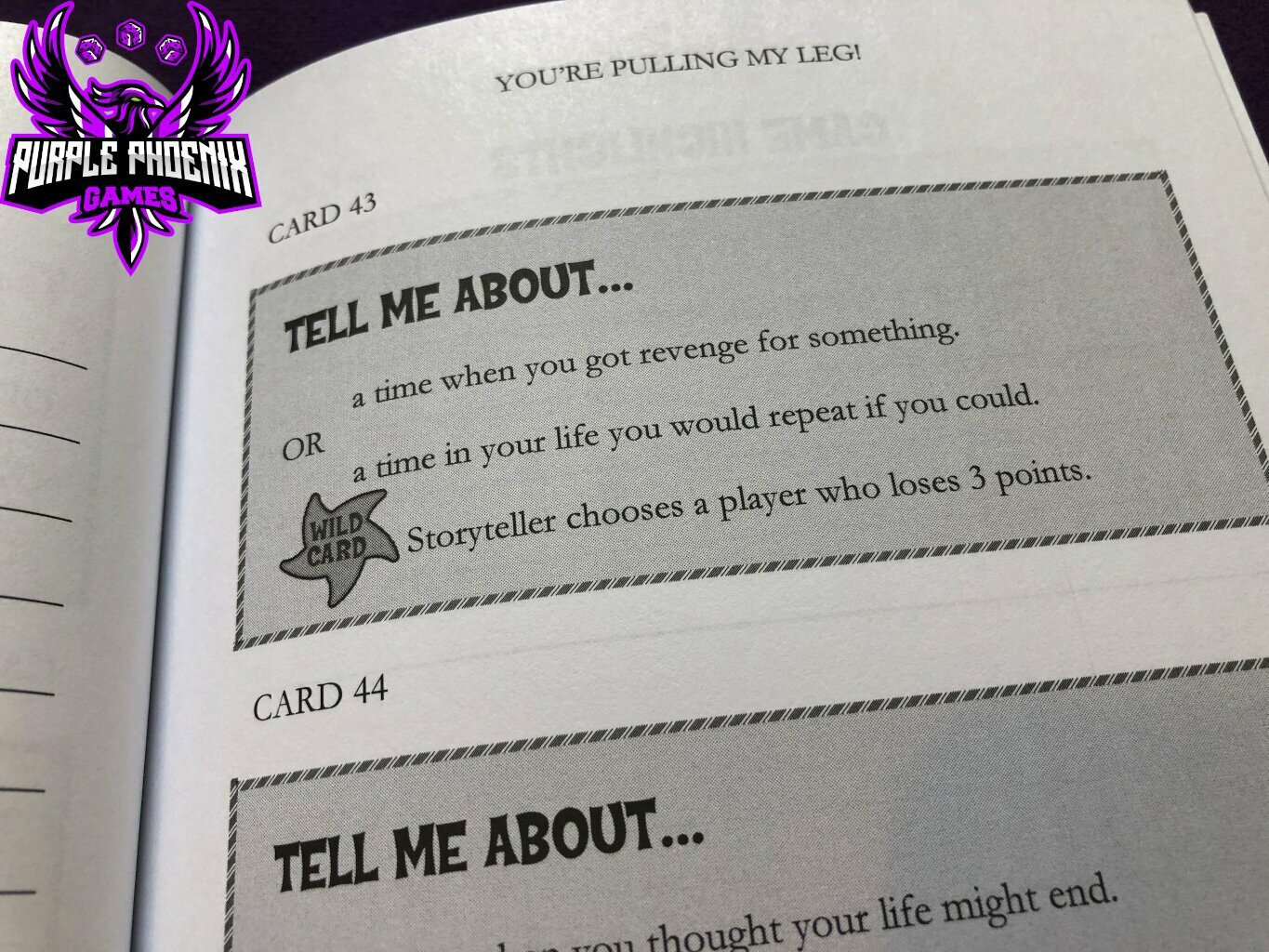
That being said, one tricky thing about this game is that when coming up with a false story, if must be false in essence. You cannot tell a mostly true story with a few trivial details changed. People who have trouble with storytelling or improv-type scenarios might have some difficulty in coming up with an appropriate story for the different questions. Just something to be aware of – you have to be able to come up with a story on the fly, with no hints or help whatsoever. Another tricky, yet usually fun, aspect of this game is that some cards have a Wild feature which can immediately affect someone’s score. For example, one Wild feature might say “Player with the longest hair gains 3 points.” That goes into effect immediately once the card is selected, and can put a fun twist and some good-natured take-that into this storytelling game. The process of voting with points adds an element of strategy as well. How confident are you that someone’s story is TRUE? Are you willing to bet 3 points on it? It’s a balance of risk and reward, and that adds excitement to the game table.
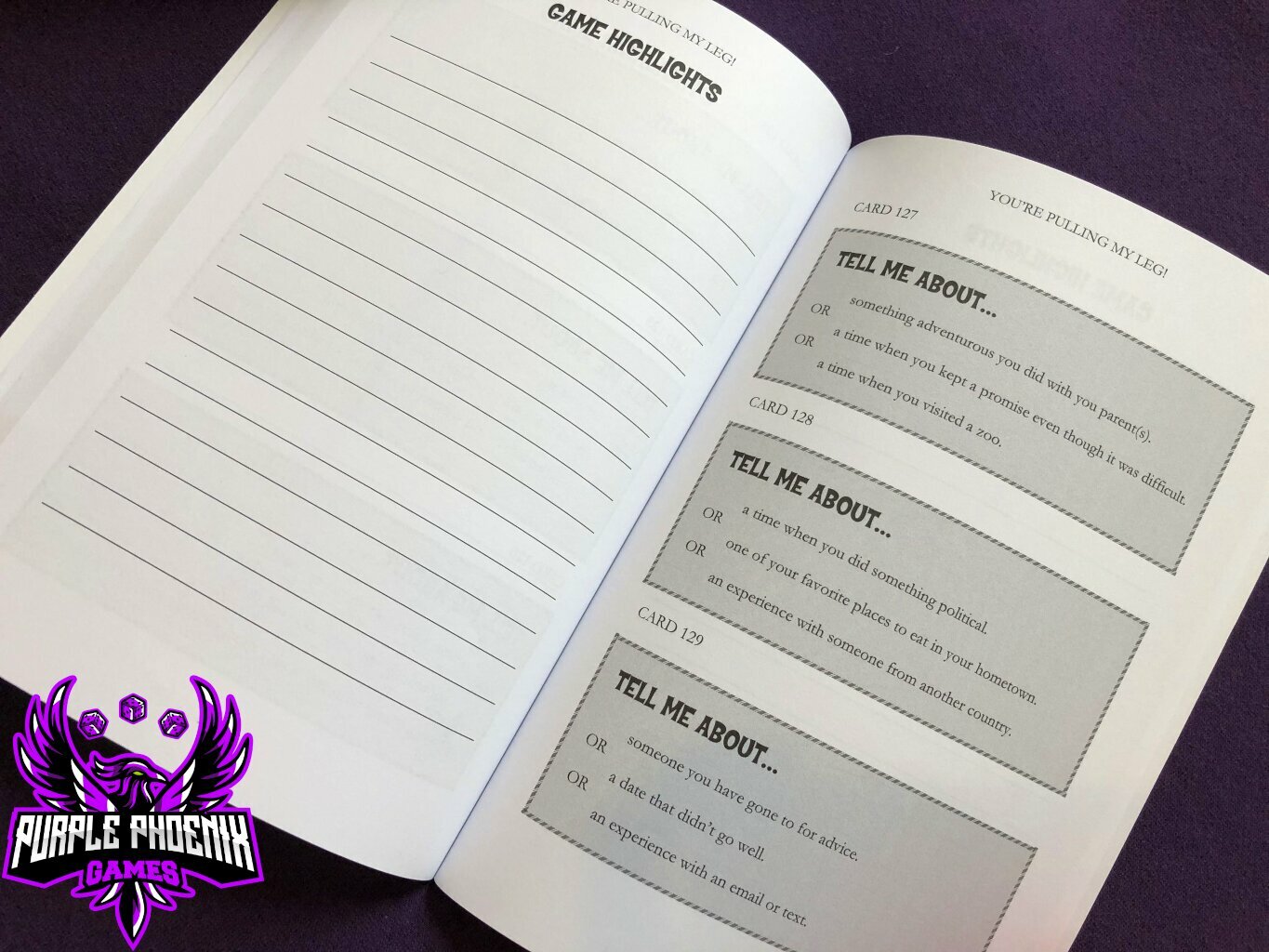
Let me touch on components for a minute. This game is a book, where each page contains 3 cards. You can start at card #1 or select a random page and pick a card there, but there are 225 cards from which to choose! On every other page there is also a blank page titled “Game Highlights,” and this space is for you to write down any particularly hilarious or creative responses someone may have come up with in response to a card. It’s not a game requirement, but just an element of fun for future reminiscence. The quality of the book is pretty good, and I know it is sturdy enough to withstand lots of travel and play.
So all-in-all, I think that You’re Pulling My Leg is a great and light little game to get your creative juices flowing. If you need an ice-breaker for a game night, this would definitely be a great one to get to know your gaming comrades. Is it a game I will pull out at every game night? No. But it is a fun and light-hearted game that I can see myself pulling out with different gaming groups on several occasions. Whether a family reunion, office party, or friend Zoom call, this game is one that will entertain all involved. If you’re looking for something unique, fun, and relatively simple overall, give You’re Pulling My Leg! a shot. It might just open the door to storytelling based games for you!
Disclaimer: We were provided a copy of this book for the purposes of this preview. The pictures below show the final production copy you can expect to receive when ordering this game. Check out the publisher’s website to get your hands on this unique party game! -L
You’re Pulling My Leg! is a party game of bluffing and storytelling in which players are trying to be the first to earn 21 points. The rules are simple, the gameplay is straightforward, and it can even be played remotely!
To setup the game, every player needs a coin and a way to keep track of their score (paper/pencil, notes on a phone, etc.). Every player begins the game with 7 points. To start the game, choose a player to be the first Storyteller. The Storyteller selects a card from the book, reads the three questions on their chosen card, and chooses 1 to answer. The Storyteller then flips their coin – if HEADS, the answer must be a true story, but if TAILS, the answer must be false and untrue in essence. Only the Storyteller knows the result of the coin flip. The Storyteller proceeds to answer the question, telling a story dictated by their coin flip result.
After the Storyteller has told their response to the chosen question, the remaining players will vote (with points) on whether they believe the story was true or false. Players can vote with up to 3 points, and votes are revealed simultaneously. If you believe the story is TRUE, you vote with 1, 2, or 3 fingers pointing UP, and if you believe the story is FALSE, you vote with 1, 2, or 3 fingers pointing DOWN. After everyone has voted, the Storyteller reveals whether the story was true or false, and points are added/deducted accordingly. If a player voted correctly, they add the number of points with which they voted to their score. If they voted incorrectly, subtract the voted points from their score. The Storyteller can earn 1 point for each other player they have fooled, up to a maximum of 3 points per story. After tallying points, choose a new Storyteller and begin again – each player should have a chance to be the Storyteller once before repeating Storytellers. Play continues in this fashion until one player has scored 21 points, and is declared the winner!
At this point in my life, the thing I love about You’re Pulling My Leg! the most is that it can be played remotely. Everybody does not need to have an individual copy of the book to play via video chat or conference call. As long as one person has the book, your group can play! Instead of having each player read their own cards then, the owner of the book reads the cards aloud and the Storyteller chooses their question that way. The only supplies needed, apart from 1 copy of the book, are a coin and a way to track your score. Easy as pie. Another aspect of this game that I really enjoy is that it is pretty light-hearted in nature. Yes, there is an element of deception and bluffing, but it is all done in a light and quirky way. I especially enjoy this because I am a notoriously bad liar, and most bluffing games stress me out. But the ability to choose my question, and then weave a (hopefully) convincing story for my opponents takes some of that pressure off and allows me to really be creative and have fun.
That being said, one tricky thing about this game is that when coming up with a false story, if must be false in essence. You cannot tell a mostly true story with a few trivial details changed. People who have trouble with storytelling or improv-type scenarios might have some difficulty in coming up with an appropriate story for the different questions. Just something to be aware of – you have to be able to come up with a story on the fly, with no hints or help whatsoever. Another tricky, yet usually fun, aspect of this game is that some cards have a Wild feature which can immediately affect someone’s score. For example, one Wild feature might say “Player with the longest hair gains 3 points.” That goes into effect immediately once the card is selected, and can put a fun twist and some good-natured take-that into this storytelling game. The process of voting with points adds an element of strategy as well. How confident are you that someone’s story is TRUE? Are you willing to bet 3 points on it? It’s a balance of risk and reward, and that adds excitement to the game table.
Let me touch on components for a minute. This game is a book, where each page contains 3 cards. You can start at card #1 or select a random page and pick a card there, but there are 225 cards from which to choose! On every other page there is also a blank page titled “Game Highlights,” and this space is for you to write down any particularly hilarious or creative responses someone may have come up with in response to a card. It’s not a game requirement, but just an element of fun for future reminiscence. The quality of the book is pretty good, and I know it is sturdy enough to withstand lots of travel and play.
So all-in-all, I think that You’re Pulling My Leg is a great and light little game to get your creative juices flowing. If you need an ice-breaker for a game night, this would definitely be a great one to get to know your gaming comrades. Is it a game I will pull out at every game night? No. But it is a fun and light-hearted game that I can see myself pulling out with different gaming groups on several occasions. Whether a family reunion, office party, or friend Zoom call, this game is one that will entertain all involved. If you’re looking for something unique, fun, and relatively simple overall, give You’re Pulling My Leg! a shot. It might just open the door to storytelling based games for you!

Bob Mann (459 KP) rated Wonder Woman (2017) in Movies
Sep 29, 2021
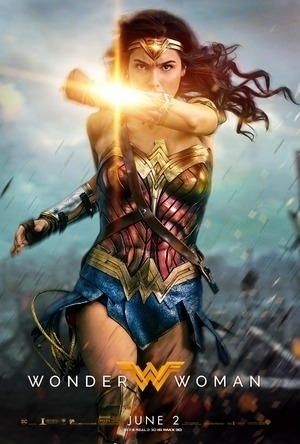
“What first attracted you Dr Mann to the movie with the scantily-clad Amazonians?”
Amazonians deliver! And how. The much anticipated new Wonder Woman movie is with us, and for once the film lives up to the wall-to-wall marketing hype.
With a heavy dose of mythology, Diana is growing up as the cossetted daughter of Hippolyta (Connie Nielsen, “Gladiator”), the Queen of the Amazons, on the hidden paradise island of Themyscira. Trained up as a warrior by Hippolyta’s sister, General Antiope (Robin Wright of “House of Cards”), Diana is clearly something special. Her ego is reinforced by the knowledge that she was made of clay with life breathed into her by the God Zeus. It’s enough to turn a girl’s head!
It’s 1917 and the man-free paradise is shaken up when an American spy by the name of Steve Trevor (Chris Pine, “Star Trek: Beyond“) crash-lands in the waters off Themyscira. (And yes… you didn’t mishear me… this film genuinely features a hero with both the names “Steve” and ‘Trevor”). Prince Eric – no, sorry, wrong film – is saved and awakened on the beach by Diana as the others arrive. “Thank God!”, say the Amazonians. “At last, someone to process the 200 year backlog of washing and ironing”!
But Steve (an “above average specimen”, LOL) is not long for paradise as he needs to return to the war with the results of his spy-work: a chemistry book stolen from the gorgeously deformed Dr Maru (Elena Anaya), gas-developer for the evil General Ludendorff (Danny Huston). Seeing Ludendorff to be her God-like nemesis Ares, Diana returns with Steve to the WW1 battlefields with the intent of killing the God of War and so ending the ‘war to end all wars’.
Much ‘fish out of water’ fun is had with Diana meeting civilised London society, although perhaps this section of the film doesn’t quite live up to its full potential: having ice cream for the first time, without any sign of surprise, all she can come up with is an amusing but rather lame “You must be very proud”.
But where the film really accelerates into awesomeness is when Diana reaches ‘The Front’. She emerges from the trenches like some shimmering vision of hotness, to set male and lesbian hearts a flutter. Its the most memorable trench-exit since the finale of “Black Adder 4”, and the subsequent scenes of Diana single-handedly facing the German guns is for me one of the most compelling and enjoyable scenes in any recent DC or Marvel movie.
Holding all this together is the ex-Israeli army-trainer Gal Gadot in the title role. And man oh man, what a Gal! Statuesque, athletic but also sweet, charming and emotionally fragile she completely owns this role from beginning to end. Gadot made a memorable entry in the otherwise poor “Batman v Superman: Dawn of Justice” (#marthagate #neverforget #neverforgive) but nothing prepares you for just how great she is in this outing. In fact, I’ll go as far as saying that this film, although having a UK 12 certificate, is a film of immense danger to heterosexual teenagers of any age (#humor):
All boys will be cast into a lifetime of misery, never able to find a woman that can possibly live up to the impossibly perfect vision of Diana Prince, tearing up the German army with fists and whip!;
All girls WILL BECOME LESBIANS AFTER WATCHING THIS FILM!
Parents: you have been warned! 🙂
Chris Pine – the thinking women’s Chris Pratt – once again proves himself as a talented actor who manages to successfully morph to inhabit the role he plays. Much as he did in the excellent “Hell or High Water“, not once did I equate him to be James Tiberius Kirk after the first 5 minutes.
Effective in supporting roles are David Thewlis (“Harry Potter”) as a ‘helpful’ army bod and an almost unrecognisable Lucy Davis (“The Office”) as Etta, Steve’s comedic secretary. Steve’s rather unlikely sidekicks of Sameer (Said Taghmaoui, “American Hustle“), Charlie (Ewen Bremner, “Trainspotting”) and ‘The Chief’ (Eugene Brave Rock “The Revenant“) all rather fade into the woodwork by comparison.
I saw the film in 3D (“careful now… you could take an eye out with those things”) and very good it was too. Aside from some rather unnecessary Amazonian arrows, its never feels overdone, and elements of it were extremely effective.
Another star of the show is the superb Wonder Woman theme by Hans Zimmer, here rolled out by the film’s composer Rupert Gregson-Williams (“Hacksaw Ridge“). Unfortunately, the rest of the soundtrack is not particularly memorable.
The film shifts into more traditional yawn-worthy ‘superhero finale’ mode in the last twenty minutes, which is a bit of a shame. It’s also really curious that for such a sexually charged film there is an almost complete absence of ‘lurrve’ on show. The one love scene coquettishly fades to a view of the outside window. Was this to protect the film’s family friendly rating (probably) or that the director didn’t want to show her heroine in a remotely submissive position (possibly)? More frustratingly, the morning after there is no mention of it at all! (“Move along, nothing to see here”). I at least wanted some sort of recognition that a human/God liaison had taken place: Steve grimacing a bit when he sits down; or Diana on the blower to Themyscira saying “Yes, you were right Mum. 5 minutes in, and it just snapped clean off!”
I know my friend David Moody (of markanddave vblog fame, and a big DC/Marvel fan) was generally disappointed with the film. Conversely, Amy Andrews from the ever-excellent Oh That Film Blog loved it. I’m with Amy on this one, and greatly enjoyed it as a well-constructed action rollercoaster. The nearly two and a half hours sped by. By the way (and I took one for the team here) there is no “monkey” at the end of the film’s credit to hang on for.
Patty Jenkins (“Monster”) directs and knows the audience she is aiming to please. One can only imagine the empowering impact this film will have on young girls, crossing their wrists to ‘THAT’ music and, in their imagination, casting terrorists into the hell that they should be consigned to. In this week of yet more Isis atrocity in London, Wonder Woman is a role-model we could all stand and salute: “I believe in love” too.
With a heavy dose of mythology, Diana is growing up as the cossetted daughter of Hippolyta (Connie Nielsen, “Gladiator”), the Queen of the Amazons, on the hidden paradise island of Themyscira. Trained up as a warrior by Hippolyta’s sister, General Antiope (Robin Wright of “House of Cards”), Diana is clearly something special. Her ego is reinforced by the knowledge that she was made of clay with life breathed into her by the God Zeus. It’s enough to turn a girl’s head!
It’s 1917 and the man-free paradise is shaken up when an American spy by the name of Steve Trevor (Chris Pine, “Star Trek: Beyond“) crash-lands in the waters off Themyscira. (And yes… you didn’t mishear me… this film genuinely features a hero with both the names “Steve” and ‘Trevor”). Prince Eric – no, sorry, wrong film – is saved and awakened on the beach by Diana as the others arrive. “Thank God!”, say the Amazonians. “At last, someone to process the 200 year backlog of washing and ironing”!
But Steve (an “above average specimen”, LOL) is not long for paradise as he needs to return to the war with the results of his spy-work: a chemistry book stolen from the gorgeously deformed Dr Maru (Elena Anaya), gas-developer for the evil General Ludendorff (Danny Huston). Seeing Ludendorff to be her God-like nemesis Ares, Diana returns with Steve to the WW1 battlefields with the intent of killing the God of War and so ending the ‘war to end all wars’.
Much ‘fish out of water’ fun is had with Diana meeting civilised London society, although perhaps this section of the film doesn’t quite live up to its full potential: having ice cream for the first time, without any sign of surprise, all she can come up with is an amusing but rather lame “You must be very proud”.
But where the film really accelerates into awesomeness is when Diana reaches ‘The Front’. She emerges from the trenches like some shimmering vision of hotness, to set male and lesbian hearts a flutter. Its the most memorable trench-exit since the finale of “Black Adder 4”, and the subsequent scenes of Diana single-handedly facing the German guns is for me one of the most compelling and enjoyable scenes in any recent DC or Marvel movie.
Holding all this together is the ex-Israeli army-trainer Gal Gadot in the title role. And man oh man, what a Gal! Statuesque, athletic but also sweet, charming and emotionally fragile she completely owns this role from beginning to end. Gadot made a memorable entry in the otherwise poor “Batman v Superman: Dawn of Justice” (#marthagate #neverforget #neverforgive) but nothing prepares you for just how great she is in this outing. In fact, I’ll go as far as saying that this film, although having a UK 12 certificate, is a film of immense danger to heterosexual teenagers of any age (#humor):
All boys will be cast into a lifetime of misery, never able to find a woman that can possibly live up to the impossibly perfect vision of Diana Prince, tearing up the German army with fists and whip!;
All girls WILL BECOME LESBIANS AFTER WATCHING THIS FILM!
Parents: you have been warned! 🙂
Chris Pine – the thinking women’s Chris Pratt – once again proves himself as a talented actor who manages to successfully morph to inhabit the role he plays. Much as he did in the excellent “Hell or High Water“, not once did I equate him to be James Tiberius Kirk after the first 5 minutes.
Effective in supporting roles are David Thewlis (“Harry Potter”) as a ‘helpful’ army bod and an almost unrecognisable Lucy Davis (“The Office”) as Etta, Steve’s comedic secretary. Steve’s rather unlikely sidekicks of Sameer (Said Taghmaoui, “American Hustle“), Charlie (Ewen Bremner, “Trainspotting”) and ‘The Chief’ (Eugene Brave Rock “The Revenant“) all rather fade into the woodwork by comparison.
I saw the film in 3D (“careful now… you could take an eye out with those things”) and very good it was too. Aside from some rather unnecessary Amazonian arrows, its never feels overdone, and elements of it were extremely effective.
Another star of the show is the superb Wonder Woman theme by Hans Zimmer, here rolled out by the film’s composer Rupert Gregson-Williams (“Hacksaw Ridge“). Unfortunately, the rest of the soundtrack is not particularly memorable.
The film shifts into more traditional yawn-worthy ‘superhero finale’ mode in the last twenty minutes, which is a bit of a shame. It’s also really curious that for such a sexually charged film there is an almost complete absence of ‘lurrve’ on show. The one love scene coquettishly fades to a view of the outside window. Was this to protect the film’s family friendly rating (probably) or that the director didn’t want to show her heroine in a remotely submissive position (possibly)? More frustratingly, the morning after there is no mention of it at all! (“Move along, nothing to see here”). I at least wanted some sort of recognition that a human/God liaison had taken place: Steve grimacing a bit when he sits down; or Diana on the blower to Themyscira saying “Yes, you were right Mum. 5 minutes in, and it just snapped clean off!”
I know my friend David Moody (of markanddave vblog fame, and a big DC/Marvel fan) was generally disappointed with the film. Conversely, Amy Andrews from the ever-excellent Oh That Film Blog loved it. I’m with Amy on this one, and greatly enjoyed it as a well-constructed action rollercoaster. The nearly two and a half hours sped by. By the way (and I took one for the team here) there is no “monkey” at the end of the film’s credit to hang on for.
Patty Jenkins (“Monster”) directs and knows the audience she is aiming to please. One can only imagine the empowering impact this film will have on young girls, crossing their wrists to ‘THAT’ music and, in their imagination, casting terrorists into the hell that they should be consigned to. In this week of yet more Isis atrocity in London, Wonder Woman is a role-model we could all stand and salute: “I believe in love” too.
Daniel Boyd (1066 KP) rated Fantastic Beasts and Where to Find Them (2016) in Movies
Jul 19, 2017

Some of the lighting is well implemented (1 more)
Colin Farrell
Bad CGI (2 more)
The movies 3 leads are extremely annoying
Johnny 'oooh' Depp
Fantastic Beasts and Where To Find Them - Or JK Rowling and the Never Ending Quest for More Money
Contains spoilers, click to show
First off, full disclosure, I have never been a fan of the Harry Potter franchise. I’ve read a few of the books and seen a few of the movies and it just isn’t my thing. Honestly, I’m not even a fan of fantasy in general, I think Lord Of The Rings is nonsense and Game Of Thrones is vastly overrated and the last Harry Potter movie I saw was the fourth one. However, I was willing to go into this movie with a clean slate and hopefully have it win me over and unfortunately it didn’t. Also this review will contain spoilers if you care about that sort of thing.
This film is a prequel to the other Harry Potter movies, this time set in America rather than Britain and telling the story of the events that led to the great wizarding war between Dumbledore and Grindlewald. The film did have potential, to see what would have essentially been WWII fought with magic could be really cool but unfortunately all we get here is setup and that actual event we want to see will probably take place 4 or 5 movies down the line. The film opens with Eddie Redmayne’s character, Newt Scamander going to New York from London to set free one of the beasts that he keeps inside his Tardis-like brief case. Then he ends up in a bank and meets a ‘Nomaj,’ which is this film’s lazy version of a ‘muggle,’ who we learn is a simple lonely guy that just wants to open his own bakery and that’s another character cliché ticked off the list. We now have the double act of the nerdy, sniveling protagonist and the overweight sympathetic sidekick. Also, for the rest of this review I will be referring to the baker character as fat bloke and this isn’t to be derogatory, but is purely because the script relies on the, ‘fat, jolly, sympathetic, pathetic loner’ stereotype and passes it off as a character arc. If the script isn’t treating the character with any respect, then why should I? So fat bloke it is then.
So the two of them of course have the exact same briefcase and after some cartoony looking CGI animals escape from Redmayne’s case in the bank the suitcases predictably get mixed up and then the fat bloke gets his bakery loan declined and returns home with Redmayne’s suitcase, then more bad CGI animals open the case and attack the fat bloke. Redmayne’s character then gets arrested by some wizarding inspector for letting the, ‘Nomaj,’ (urgh) get away after seeing the animals in the case and is taken to the New York Wizards base, I guess? Then it’s revealed that the wizarding inspector that arrested Redmayne is a bit of a shit inspector and she is trying to redeem herself in the eyes of her superiors, so in front of this high wizard council, she confiscates the case from Redmayne and opens it only to reveal a bunch of cakes inside. Yes, really… Who writes this shit? Rowling is doing to Harry Potter what Lucas did to Star Wars during the prequels at this point.
So Redmayne gets set free and he goes to fat bloke’s house to find him lying on the floor, then some more bad CGI later the inspector turns up and they take him back to her house to meet her sister? Friend? Does it matter? She ends up becoming the love interest for fat bloke. Then for no apparent reason Redmayne and fat bloke enter the case and he shows fat bloke all this crazy shit that apparently humans aren’t supposed to see and then Redmayne does some more sniveling and decides they have to sneak out of the girls’ apartment and recapture the animals that escaped in the bank and from fat bloke’s apartment. They get a couple of the beasts back then they go to central park to find Redmayne’s horny rhino and they dress fat bloke up in a leather rhino costume and use him as rape bait then they ice skate for a bit and capture the rhino. Again, really… I am not making this shit up for satirical reasons.
Then we see a real life prick Ezra Miller playing some sort of weird emo child who is beat by his mother and we see he is working with Colin Farrell to find a big bad dark spirit that is killing people around New York. Colin Farrell is definitely the best thing about the film at this point. After this a bunch of other stupid shit happens, like Ron Perlman and John Voight coming into the movie, showing a ray of potential then being totally wasted. The movie drags in the middle, but eventually after some more fat jokes, bad CGI and sniveling, all of the creatures are captured and Ezra Miller turns into a black death cloud or some such nonsense. Then he is boosting around New York, fucking up shit as he goes and so Redmayne and Farrell follow him down to the subway to stop him. Redmayne seems to be talking him down and then Farrell shows up and essentially tells him to join the dark side. Then there is a CGI wand battle and the council from earlier show up out of nowhere and kill the black cloud of death. Then Colin Farrell gets pissed off and in the best scene in the movie murders half of the council members before he gets arrested by Eddie Redmayne with some magic handcuffs.
Then the worst part in the movie takes place. It is revealed that Colin Farrell is actually Johnny Depp in disguise. I mean he is Grindlewald in disguise but the important part for me is the replacement of Colin Farrell with Johnny Depp. Now I’m not the world’s biggest Colin Farrell fan, he is great in, ‘In Bruges,’ but other than that he is pretty meh, but he was definitely the best thing that this movie had going for it and they fucking swapped him out! With fucking Johnny-‘ooh’-Depp. As if this movie wasn’t shit enough they swapped out the best thing about it for Johnny Depp, the biggest joke in Hollywood. I’m done, fuck this movie, fuck Johnny Depp, fuck JK Rowling, fuck Harry Potter, I’m out.
Okay, let’s briefly talk about the technical side of the film before I score this thing. The whole cast of this movie is phoning it in, so the acting is fine but nothing to write home about, Farrell is the best thing in this movie, but I feel that in the sequels it will just be an ‘ooh,’ off between Depp and Redmayne. The direction is okay as the movie plods along sufficiently, but the writing is wildly inconsistent and the plot as stated above is all over the place. The lighting and cinematography in one scene are fantastic, when Farrell and Miller are conversing in a dark alleyway but other than that they are pretty mundane too. The score is suitably Harry Potter like and the CGI is also to a similar standard of the Harry Potter films. The problem with that is that the CGI was ropey and of a fairly poor standard in the Harry Potter movies 10 years ago and it doesn’t seem like it has improved much since then. This movie isn’t for me, but even from an objective standpoint, based solely from a moviemaking perspective this movie is poor.
This film is a prequel to the other Harry Potter movies, this time set in America rather than Britain and telling the story of the events that led to the great wizarding war between Dumbledore and Grindlewald. The film did have potential, to see what would have essentially been WWII fought with magic could be really cool but unfortunately all we get here is setup and that actual event we want to see will probably take place 4 or 5 movies down the line. The film opens with Eddie Redmayne’s character, Newt Scamander going to New York from London to set free one of the beasts that he keeps inside his Tardis-like brief case. Then he ends up in a bank and meets a ‘Nomaj,’ which is this film’s lazy version of a ‘muggle,’ who we learn is a simple lonely guy that just wants to open his own bakery and that’s another character cliché ticked off the list. We now have the double act of the nerdy, sniveling protagonist and the overweight sympathetic sidekick. Also, for the rest of this review I will be referring to the baker character as fat bloke and this isn’t to be derogatory, but is purely because the script relies on the, ‘fat, jolly, sympathetic, pathetic loner’ stereotype and passes it off as a character arc. If the script isn’t treating the character with any respect, then why should I? So fat bloke it is then.
So the two of them of course have the exact same briefcase and after some cartoony looking CGI animals escape from Redmayne’s case in the bank the suitcases predictably get mixed up and then the fat bloke gets his bakery loan declined and returns home with Redmayne’s suitcase, then more bad CGI animals open the case and attack the fat bloke. Redmayne’s character then gets arrested by some wizarding inspector for letting the, ‘Nomaj,’ (urgh) get away after seeing the animals in the case and is taken to the New York Wizards base, I guess? Then it’s revealed that the wizarding inspector that arrested Redmayne is a bit of a shit inspector and she is trying to redeem herself in the eyes of her superiors, so in front of this high wizard council, she confiscates the case from Redmayne and opens it only to reveal a bunch of cakes inside. Yes, really… Who writes this shit? Rowling is doing to Harry Potter what Lucas did to Star Wars during the prequels at this point.
So Redmayne gets set free and he goes to fat bloke’s house to find him lying on the floor, then some more bad CGI later the inspector turns up and they take him back to her house to meet her sister? Friend? Does it matter? She ends up becoming the love interest for fat bloke. Then for no apparent reason Redmayne and fat bloke enter the case and he shows fat bloke all this crazy shit that apparently humans aren’t supposed to see and then Redmayne does some more sniveling and decides they have to sneak out of the girls’ apartment and recapture the animals that escaped in the bank and from fat bloke’s apartment. They get a couple of the beasts back then they go to central park to find Redmayne’s horny rhino and they dress fat bloke up in a leather rhino costume and use him as rape bait then they ice skate for a bit and capture the rhino. Again, really… I am not making this shit up for satirical reasons.
Then we see a real life prick Ezra Miller playing some sort of weird emo child who is beat by his mother and we see he is working with Colin Farrell to find a big bad dark spirit that is killing people around New York. Colin Farrell is definitely the best thing about the film at this point. After this a bunch of other stupid shit happens, like Ron Perlman and John Voight coming into the movie, showing a ray of potential then being totally wasted. The movie drags in the middle, but eventually after some more fat jokes, bad CGI and sniveling, all of the creatures are captured and Ezra Miller turns into a black death cloud or some such nonsense. Then he is boosting around New York, fucking up shit as he goes and so Redmayne and Farrell follow him down to the subway to stop him. Redmayne seems to be talking him down and then Farrell shows up and essentially tells him to join the dark side. Then there is a CGI wand battle and the council from earlier show up out of nowhere and kill the black cloud of death. Then Colin Farrell gets pissed off and in the best scene in the movie murders half of the council members before he gets arrested by Eddie Redmayne with some magic handcuffs.
Then the worst part in the movie takes place. It is revealed that Colin Farrell is actually Johnny Depp in disguise. I mean he is Grindlewald in disguise but the important part for me is the replacement of Colin Farrell with Johnny Depp. Now I’m not the world’s biggest Colin Farrell fan, he is great in, ‘In Bruges,’ but other than that he is pretty meh, but he was definitely the best thing that this movie had going for it and they fucking swapped him out! With fucking Johnny-‘ooh’-Depp. As if this movie wasn’t shit enough they swapped out the best thing about it for Johnny Depp, the biggest joke in Hollywood. I’m done, fuck this movie, fuck Johnny Depp, fuck JK Rowling, fuck Harry Potter, I’m out.
Okay, let’s briefly talk about the technical side of the film before I score this thing. The whole cast of this movie is phoning it in, so the acting is fine but nothing to write home about, Farrell is the best thing in this movie, but I feel that in the sequels it will just be an ‘ooh,’ off between Depp and Redmayne. The direction is okay as the movie plods along sufficiently, but the writing is wildly inconsistent and the plot as stated above is all over the place. The lighting and cinematography in one scene are fantastic, when Farrell and Miller are conversing in a dark alleyway but other than that they are pretty mundane too. The score is suitably Harry Potter like and the CGI is also to a similar standard of the Harry Potter films. The problem with that is that the CGI was ropey and of a fairly poor standard in the Harry Potter movies 10 years ago and it doesn’t seem like it has improved much since then. This movie isn’t for me, but even from an objective standpoint, based solely from a moviemaking perspective this movie is poor.
Mandy and G.D. Burkhead (26 KP) rated The Book of Kings in Books
May 20, 2018
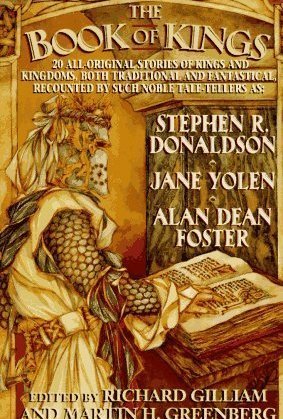
Shelf Life – The Book of Kings Has a Few Gems and a Few Warts
Contains spoilers, click to show
Unlike other short story anthologies I could mention, this one wasn’t mostly horrible. Instead, the stories inside run the gamut from stupid to brilliant and from annoying to nothing special to fun and memorable. A little something for everyone, then.
So since I can’t review it with one blanket sentiment, let’s instead take a quick look at a handful of the 20 all-original stories inside. The following are the tales that most stood out to me during my reading, for better or worse.
“The Kiss” by Alan Dean Foster – A woman walking through a snowy city finds a frog who says he’s a prince, so she kisses him. He turns into a guy and stabs her to death.
Oh boy, we’re not off to a great start here. This story could have been told in a page or so and been an interesting twist on the old tale, but instead the author drew it out over three pages by choosing the absolute most pretentious choice of words for every damn sentence. The guy doesn’t stab the woman, his “knife describes a Gothic arc.” She doesn’t shout or whisper or ask what’s going on, she “expels a querrelous trauma.” It’s not snowing on her face, “trifles of ice as beautiful as they were capricious tickled her exposed cheeks, only to be turned into simulacra of tears as they were instantly metamorphosed by the bundled furnace of her body.”
Yes, really.
The sheer purpleness of this prose might be excused for a deliberately lofty and overwrought tale, but it absolutely does not fit a story about a girl getting shanked by a frog on the street. If the contrast between what’s happening and how it’s presented is supposed to seem absolutely ridiculous, then it’s a success. This reads more like a writing exercise for seeing how unbearably melodramatic you can tell a simple story that the author went ahead and published anyway. I only read it last night as of the time of this particular bit of review, but I still have a headache.
“Divine Right” by Nancy Holder – A king grieving for his recently passed daughter and only heir tries to figure out how to keep his legacy from dying out and eventually decides on a way to choose a successor, sealing his decision by making a pact with God.
I really liked this one, partly for the great characterization of the king via his priorities. He’s not a bastion of righteousness or a tyrannical despot. He might be a pretty decent ruler, or he might not, depending on your priorities and the angle from which you view him. Mostly he’s written to be believable for his position and time period, pride and failings and all.
But what really sealed this story for me was the ironic bent of the plot that I can’t really discuss in any more depth without spoiling it except to say that it definitely fit with the tone and left an appropriate message. So let’s just give it a thumbs up and leave it at that.
“In the Name of the King” by Judith Tarr – If you know the story of Hatshepsut, an Egyptian queen who ruled as Pharaoh, then this is an extra interesting story. It follows both Hatshepsut and her lover in the afterlife and the legacy they’re leaving behind after their deaths, in which they take a surprisingly active interest for dead people.
If you know your history, though, you know where this is going, and it’s very touching as it gets there. It’s also character-centric in a way that makes its dead cast members seem very much alive. This one’s a good contender for my favorite story in the whole anthology.
“Please to See the King” by Debra Doyle and James D. Macdonald – A small glimpse of about one evening each into the lives of two seemingly unrelated, seemingly unimportant men against the backdrop of the battles being fought over a vague and distant rebellion against a vague and distant crown.
To say more would be to spoil the story, which is short, sweet, and interesting. It gives you just enough details, and no more, that you can piece together a much deeper story with room left for speculation about who certain characters really were and what exactly just happened. I’ve spent more time thinking about how the ending may be interpreted than it took me to read it, which is a good sign of nuance done right.
“The Name of a King” by Diana L. Paxson – This’n c’n rightf’ly b’ put in w’ th’ other st’ries I woul’n’t oth’rwise b’ther t’ mention ‘cept fer th’ o’erwrought dialectic style o’ nearly all o’ th’ dialogue, whut c’n git on yer nerves right quick-like whene’er any’ne op’ns their mouths. An’ while I’m ‘ere, th’ settin’ w’s rife wi’ plen’y o’ hints at deeper d’tails whut was ne’er sufficien’ly delved into or whut impact’d th’ actu’l plot much. Felt like part o’ a fant’sy series whut I was ‘spected t’ b’ f’miliar wit’ but wasn’t, an’ whut di’n’t give me ’nuff t’ git f’miliar wit’ just fr’m this st’ry.
Oth’rwise, t’w’sn’t t’ b’d, I s’pose. Bit borin’.
“Coda: Working Stiff” by Mike Resnick and Nicholas A. DiChario – This one was just fun. Again trying not to give away any twists or revelations, this one follows a journalist interviewing a bus driver who used to be a big, famous king back in his heyday but is now content (or so he says) with his obscure life of working a simple job in the day and drinking in his spartan home at night.
Who this ex-king really is probably isn’t who you think it’s gonna be at first, but the story does still technically, and cheekily, fit in with the premise of the book overall. It reminds me very much of something Neil Gaiman might have written, or maybe Terry Pratchett if he’d decided to tackle the kingly premise from a more modern and realistic approach.
There are still 14 stories left in here, many of which are also good reads, or at least decent. In fact, looking back through it again, the only real dud that stands out to me is “The Kiss.” The weakest of what’s left are either adaptations of stories that didn’t really do it for me (“The Tale of Lady Ashburn” by John Gregory Betancourt) or weird original works that weren’t really memorable in what they set out to do (“A Parker House Roll” by Dean Wesley Smith).
Overall, The Book of Kings is a fun and interesting romp through a number of royal worlds, themes, and tones. As such, anyone who gives it a look will probably have the same general sentiment I did at the end, with a few things to like and a few to point to as examples of what doesn’t work for them. Me, I got a bit of the inspiration I was looking for and a few memorable tales out of it, so I’ll forgive the warts.
So since I can’t review it with one blanket sentiment, let’s instead take a quick look at a handful of the 20 all-original stories inside. The following are the tales that most stood out to me during my reading, for better or worse.
“The Kiss” by Alan Dean Foster – A woman walking through a snowy city finds a frog who says he’s a prince, so she kisses him. He turns into a guy and stabs her to death.
Oh boy, we’re not off to a great start here. This story could have been told in a page or so and been an interesting twist on the old tale, but instead the author drew it out over three pages by choosing the absolute most pretentious choice of words for every damn sentence. The guy doesn’t stab the woman, his “knife describes a Gothic arc.” She doesn’t shout or whisper or ask what’s going on, she “expels a querrelous trauma.” It’s not snowing on her face, “trifles of ice as beautiful as they were capricious tickled her exposed cheeks, only to be turned into simulacra of tears as they were instantly metamorphosed by the bundled furnace of her body.”
Yes, really.
The sheer purpleness of this prose might be excused for a deliberately lofty and overwrought tale, but it absolutely does not fit a story about a girl getting shanked by a frog on the street. If the contrast between what’s happening and how it’s presented is supposed to seem absolutely ridiculous, then it’s a success. This reads more like a writing exercise for seeing how unbearably melodramatic you can tell a simple story that the author went ahead and published anyway. I only read it last night as of the time of this particular bit of review, but I still have a headache.
“Divine Right” by Nancy Holder – A king grieving for his recently passed daughter and only heir tries to figure out how to keep his legacy from dying out and eventually decides on a way to choose a successor, sealing his decision by making a pact with God.
I really liked this one, partly for the great characterization of the king via his priorities. He’s not a bastion of righteousness or a tyrannical despot. He might be a pretty decent ruler, or he might not, depending on your priorities and the angle from which you view him. Mostly he’s written to be believable for his position and time period, pride and failings and all.
But what really sealed this story for me was the ironic bent of the plot that I can’t really discuss in any more depth without spoiling it except to say that it definitely fit with the tone and left an appropriate message. So let’s just give it a thumbs up and leave it at that.
“In the Name of the King” by Judith Tarr – If you know the story of Hatshepsut, an Egyptian queen who ruled as Pharaoh, then this is an extra interesting story. It follows both Hatshepsut and her lover in the afterlife and the legacy they’re leaving behind after their deaths, in which they take a surprisingly active interest for dead people.
If you know your history, though, you know where this is going, and it’s very touching as it gets there. It’s also character-centric in a way that makes its dead cast members seem very much alive. This one’s a good contender for my favorite story in the whole anthology.
“Please to See the King” by Debra Doyle and James D. Macdonald – A small glimpse of about one evening each into the lives of two seemingly unrelated, seemingly unimportant men against the backdrop of the battles being fought over a vague and distant rebellion against a vague and distant crown.
To say more would be to spoil the story, which is short, sweet, and interesting. It gives you just enough details, and no more, that you can piece together a much deeper story with room left for speculation about who certain characters really were and what exactly just happened. I’ve spent more time thinking about how the ending may be interpreted than it took me to read it, which is a good sign of nuance done right.
“The Name of a King” by Diana L. Paxson – This’n c’n rightf’ly b’ put in w’ th’ other st’ries I woul’n’t oth’rwise b’ther t’ mention ‘cept fer th’ o’erwrought dialectic style o’ nearly all o’ th’ dialogue, whut c’n git on yer nerves right quick-like whene’er any’ne op’ns their mouths. An’ while I’m ‘ere, th’ settin’ w’s rife wi’ plen’y o’ hints at deeper d’tails whut was ne’er sufficien’ly delved into or whut impact’d th’ actu’l plot much. Felt like part o’ a fant’sy series whut I was ‘spected t’ b’ f’miliar wit’ but wasn’t, an’ whut di’n’t give me ’nuff t’ git f’miliar wit’ just fr’m this st’ry.
Oth’rwise, t’w’sn’t t’ b’d, I s’pose. Bit borin’.
“Coda: Working Stiff” by Mike Resnick and Nicholas A. DiChario – This one was just fun. Again trying not to give away any twists or revelations, this one follows a journalist interviewing a bus driver who used to be a big, famous king back in his heyday but is now content (or so he says) with his obscure life of working a simple job in the day and drinking in his spartan home at night.
Who this ex-king really is probably isn’t who you think it’s gonna be at first, but the story does still technically, and cheekily, fit in with the premise of the book overall. It reminds me very much of something Neil Gaiman might have written, or maybe Terry Pratchett if he’d decided to tackle the kingly premise from a more modern and realistic approach.
There are still 14 stories left in here, many of which are also good reads, or at least decent. In fact, looking back through it again, the only real dud that stands out to me is “The Kiss.” The weakest of what’s left are either adaptations of stories that didn’t really do it for me (“The Tale of Lady Ashburn” by John Gregory Betancourt) or weird original works that weren’t really memorable in what they set out to do (“A Parker House Roll” by Dean Wesley Smith).
Overall, The Book of Kings is a fun and interesting romp through a number of royal worlds, themes, and tones. As such, anyone who gives it a look will probably have the same general sentiment I did at the end, with a few things to like and a few to point to as examples of what doesn’t work for them. Me, I got a bit of the inspiration I was looking for and a few memorable tales out of it, so I’ll forgive the warts.

Mothergamer (1655 KP) rated The Last of Us in Video Games
Apr 3, 2019
I have been slowly but surely going through my backlog of games, so I chose The Last Of Us Remastered to play next because I have been curious about it and many of my friends have been telling me I needed to play this game. To them I say you were right. I did need to play this game because it wasn't just fun to play; it was phenomenal story telling. When a game's story has me getting choked up about something within the first few minutes, I know it's going to be a heck of a ride and be great.
I couldn't help, but like Joel. This is a character that has been through something that is so devastating to him and yet somehow he's kept going on and had to do things that are not necessarily good, but that he felt had to be done in order to keep surviving especially since the world as everyone knows it has ended and a post-apocalyptic world is the new normal.
Is Joel a good person? No, not really. He's not really a terrible person either. His partner Tess was interesting also and she's another character that's not really good or evil. The Last Of Us really showcases that this world isn't really that black and white; there are varying shades of grey and not everyone is completely good or bad and that many of the people are just trying to survive any way they can.
It wasn't long before the story progressed to meeting Ellie. I loved Ellie. She was this mouthy 14 year old kid, but you come to realize that a lot of why she's like that is because she's scared of losing those she cares about and having to parent herself. In spite of that, Ellie always managed to dig down deep and find the courage to do what needed to be done and I admired and respected that level of strength in her. The interaction between Ellie and Joel at first was rather terse, but I understood that was normal especially for Joel because he just wanted to finish the mission and not get attached.
I really got into it because the game was that good for me. The combat controls are great; not clunky at all. Sometimes I would get nailed by an infected and have to start over from that point (I really HATE the Clickers and Bloaters, they're terrifying), but I didn't really mind because I was enjoying the story and wanted to know what happened next. There are human factions as well such as military, the Fireflies, and Hunters. This is definitely a game for adults because of how dark the story can be at certain points and because of the harsh violence.
Infected are scary!
The environments in the game are beautifully done. I found myself stopping and just looking at everything often. From riding a horse in the woods to an abandoned college campus with a herd of giraffes, all of it looks great and really stands out. The music in the game is perfectly done as well with some hauntingly beautiful melodies that add to the emotions of moments in the story.
Horse riding in the woods
Even an abandoned campus can be pretty
There were points in the story where I got pretty emotional because I came to care about the characters. I had to remind myself it was just a game, but it was difficult especially when it came to the characters of Henry and Sam. I actually had to walk away for a few minutes because I was so saddened by what happened to them especially with Sam because he and Ellie were close to the same age and they had bonded and became friends.
The big thing that stood out for me is the relationship between Joel and Ellie. I loved how it slowly progressed from Joel being reluctant about getting to know Ellie to during some slower moments like navigating an area to look for supplies there would be a bit of talking between them back and forth about different things such as what a type of video game was like or that an ice cream truck was a real thing. I also found myself chuckling at some of the awful puns that Ellie would read from her book of puns.
As I got further in the game I recognized that Joel is a very angry and desperate man, but when it came to Ellie he could have these moments of kindness and really seemed to look out for her. The story isn't in your face about it and it becomes this gradual evolution of Joel treating her like a daughter and her coming to trust him while they both support each other in a situation that is pretty dangerous and exhausting on many levels. It's poignant and the emotions from both characters is so incredible that it draws you into the story fully which shows how fantastic the voice acting was in this.
Joel and Ellie watching some giraffes.
When I got to the ending of the game, it made me think about a lot. It made me ask questions like could I do what Joel had done? Was the leader of the Fireflies right about sacrificing a few for the many? It brought up a lot of ideas about the choices that people have to make in this world and not all of them are easy; much of it involves hard choices. I liked the ending, but it definitely wasn't a sunshine happy ending because that's not the kind of game The Last of Us is.
I played the Left Behind DLC also and I thought it was interesting to get a chance to see what Ellie was like before she met Joel. It also shows you some moments that are pivotal in the main story line that focus on Ellie which are also great. I liked the interaction between her and Riley because it brings some lightheartedness to the game with them just being kids and having fun, forgetting about the dark things going on in their world for a moment. It also shows some great emotional moments between Ellie and Riley that don't feel forced and seem to happen quite naturally. Of course the cheerful stuff only lasts for so long and then it's back to some very sad things happening. The final conversation between Ellie and Riley just before Left Behind ends had me choking back some tears because it was this heartfelt moment between two characters that truly cared for and loved each other.
Ellie and Riley having fun in a photo booth.
This is exactly why I loved The Last Of Us. It is hands down one of the best games I've ever played because of how intelligent the writing for this was creating a game that is perfectly story driven with some very memorable characters; characters that you find yourself caring about a great deal. The exploration of the various relationships are wonderfully executed making for a fantastic gaming and story experience. The game play is excellent and it shows that a lot of thought was put into getting things just right. The Last Of Us is a game title that I am thrilled to have in my gaming collection and it's absolutely worth playing.
I couldn't help, but like Joel. This is a character that has been through something that is so devastating to him and yet somehow he's kept going on and had to do things that are not necessarily good, but that he felt had to be done in order to keep surviving especially since the world as everyone knows it has ended and a post-apocalyptic world is the new normal.
Is Joel a good person? No, not really. He's not really a terrible person either. His partner Tess was interesting also and she's another character that's not really good or evil. The Last Of Us really showcases that this world isn't really that black and white; there are varying shades of grey and not everyone is completely good or bad and that many of the people are just trying to survive any way they can.
It wasn't long before the story progressed to meeting Ellie. I loved Ellie. She was this mouthy 14 year old kid, but you come to realize that a lot of why she's like that is because she's scared of losing those she cares about and having to parent herself. In spite of that, Ellie always managed to dig down deep and find the courage to do what needed to be done and I admired and respected that level of strength in her. The interaction between Ellie and Joel at first was rather terse, but I understood that was normal especially for Joel because he just wanted to finish the mission and not get attached.
I really got into it because the game was that good for me. The combat controls are great; not clunky at all. Sometimes I would get nailed by an infected and have to start over from that point (I really HATE the Clickers and Bloaters, they're terrifying), but I didn't really mind because I was enjoying the story and wanted to know what happened next. There are human factions as well such as military, the Fireflies, and Hunters. This is definitely a game for adults because of how dark the story can be at certain points and because of the harsh violence.
Infected are scary!
The environments in the game are beautifully done. I found myself stopping and just looking at everything often. From riding a horse in the woods to an abandoned college campus with a herd of giraffes, all of it looks great and really stands out. The music in the game is perfectly done as well with some hauntingly beautiful melodies that add to the emotions of moments in the story.
Horse riding in the woods
Even an abandoned campus can be pretty
There were points in the story where I got pretty emotional because I came to care about the characters. I had to remind myself it was just a game, but it was difficult especially when it came to the characters of Henry and Sam. I actually had to walk away for a few minutes because I was so saddened by what happened to them especially with Sam because he and Ellie were close to the same age and they had bonded and became friends.
The big thing that stood out for me is the relationship between Joel and Ellie. I loved how it slowly progressed from Joel being reluctant about getting to know Ellie to during some slower moments like navigating an area to look for supplies there would be a bit of talking between them back and forth about different things such as what a type of video game was like or that an ice cream truck was a real thing. I also found myself chuckling at some of the awful puns that Ellie would read from her book of puns.
As I got further in the game I recognized that Joel is a very angry and desperate man, but when it came to Ellie he could have these moments of kindness and really seemed to look out for her. The story isn't in your face about it and it becomes this gradual evolution of Joel treating her like a daughter and her coming to trust him while they both support each other in a situation that is pretty dangerous and exhausting on many levels. It's poignant and the emotions from both characters is so incredible that it draws you into the story fully which shows how fantastic the voice acting was in this.
Joel and Ellie watching some giraffes.
When I got to the ending of the game, it made me think about a lot. It made me ask questions like could I do what Joel had done? Was the leader of the Fireflies right about sacrificing a few for the many? It brought up a lot of ideas about the choices that people have to make in this world and not all of them are easy; much of it involves hard choices. I liked the ending, but it definitely wasn't a sunshine happy ending because that's not the kind of game The Last of Us is.
I played the Left Behind DLC also and I thought it was interesting to get a chance to see what Ellie was like before she met Joel. It also shows you some moments that are pivotal in the main story line that focus on Ellie which are also great. I liked the interaction between her and Riley because it brings some lightheartedness to the game with them just being kids and having fun, forgetting about the dark things going on in their world for a moment. It also shows some great emotional moments between Ellie and Riley that don't feel forced and seem to happen quite naturally. Of course the cheerful stuff only lasts for so long and then it's back to some very sad things happening. The final conversation between Ellie and Riley just before Left Behind ends had me choking back some tears because it was this heartfelt moment between two characters that truly cared for and loved each other.
Ellie and Riley having fun in a photo booth.
This is exactly why I loved The Last Of Us. It is hands down one of the best games I've ever played because of how intelligent the writing for this was creating a game that is perfectly story driven with some very memorable characters; characters that you find yourself caring about a great deal. The exploration of the various relationships are wonderfully executed making for a fantastic gaming and story experience. The game play is excellent and it shows that a lot of thought was put into getting things just right. The Last Of Us is a game title that I am thrilled to have in my gaming collection and it's absolutely worth playing.