
Search
Search results

Lee Ronaldo recommended Anthem of the Sun by Grateful Dead in Music (curated)



Hadley (567 KP) rated The Devil in the White City: Murder, Magic, and Madness in Books
Jan 18, 2021

History (1 more)
Well-written
H.H. Holmes had many aliases and lives.
He's been a doctor and a licensed pharmacist, who then conned an old couple into selling their drug store to him where he preyed on young girls and ignorant customers that would buy whatever Holmes would tell them to buy, whether it were real or fake tonics.
He was a building owner who had a murder hotel secretly built with " a wooden chute that would descend from a secret location on the second floor all the way to the basement... ", "a room next to his office fitted with a large walk-in vault, with airtight seams and asbestos-coated iron walls. A gas jet embedded in one wall would be controlled from his closet...", "a large basement with hidden chambers and a sub-basement for the permanent storage of sensitive material. "
He owned and ran an alcohol-treatment company known as the Silver Ash Institute that claimed to have the cure for alcoholism.
He was a traveling business man, who had two wives and two children. He established the Campbell-Yates Manufacturing Company, which made nothing and sold nothing.
He was also labeled as America's first serial killer. His body count is unknown even today; his victims were frequently young women, which included stenographers and house wives. He was best known for convincing people who trusted him to sign him as the beneficiary of their life insurance policies, only to kill them and make it seem an accident so he could collect the money.
Holmes grew up in a small farming village in New Hampshire, where he briefly spoke about an early fear of a human skeleton that hung in a doctor's office: " 'I had daily to pass the office of one village doctor, the door of which was seldom if ever barred,' he wrote in a later memoir. 'Partly from its being associated in my mind as the source of all the nauseous mixtures that had been my childish terror (for this was before the day of children's medicines), and partly because of vague rumors I had heard regarding its contents, this place was one of peculiar abhorrence to me.' "... "Two children discovered Mudgett's [Holmes' real last name] fear and one day captured him and dragged him 'struggling and shrieking' into the doctor's office. 'Nor did they desist,' Mudgett wrote, 'until I had been brought face to face with one of its grinning skeletons, which, with arms outstretched, seemed ready in its turn to seize me. It was a wicked and dangerous thing to do to a child of tender years and health,' he wrote, ' but it proved an heroic method of treatment, destined ultimately to cure me of my fears, and to inculcate in me, first, a strong feeling of curiosity, and, later, a desire to learn, which resulted years afterwards in my adopting medicine as a profession.' "
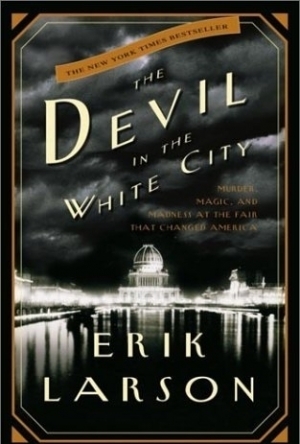
Erik Larson's fourth book, the Devil in the White City, is only partly about Holmes and his dark trail of murder and lies. The story told is mostly centered around the planning and building of the 1893 World's Fair. The prologue opens with one of the architects aboard a ship long after the fair has ended - - - 1912 to be exact- - - where he begins to write of the fair in his diary. The next chapter continues on with Chicago competing against other major cities to win the rights to host the World's Fair. Chicago was not the ideal place for the fair because it was known for it's crime and slaughter houses - - - this was exactly why the politicians wanted it so badly there, so it would help to lighten the image of Chicago for the rest of the world. Even the local Whitechapel Club that had sprouted up after the infamous murders by Jack the Ripper, were excited to win the rights to host the fair in their city, and celebrated in a macabre way:
"Upon learning that Chicago had won the fair, the men of the Whitechapel Club composed a telegram to Chauncey Depew, who more than any other man symbolized New York and its campaign to win the fair. Previously Depew had promised the members of the Whitechapel Club that if Chicago prevailed he would present himself at the club's next meeting, to be hacked apart by the Ripper himself - - - metaphorically, he presumed, although at the Whitechapel Club could one ever be certain? The club's coffin, for example, had once been used to transport the body of a member who had committed suicide. After claiming his body, the club hauled it to the Indiana Dunes on Lake Michigan, where members erected an immense pyre. They placed the body on top, then set it alight. Carrying torches and wearing black hooded robes, they circled the fire singing hymns to the dead between sips of whiskey. The club also had a custom of sending robed members to kidnap visiting celebrities and steal them away in a black coach with covered windows, all without saying a word.
The club's telegram reached Depew in Washington twenty minutes after the final ballot, just as Chicago's congressional delegation began celebrating at the Willard Hotel near the White House. The telegram asked, 'When may we see you at our dissecting table?' "
There are chapters in-between, technically reading like a side story, that tell us about Holmes and his misdeeds in Chicago, but there just wasn't enough about Holmes that I could consider this a True Crime book, nor an informative book about Holmes. Unfortunately, when the reader begins to really dwell into the story of Holmes, it's quickly ended by having two or more chapters about the building of the World's Fair. One interesting point about the story is that the reader does get to see how many inventions were brought to light because of the Fair, such as the invention of the Ferris Wheel. Larson's writing is very coherent and the descriptions are so well done that the reader is practically transported back to the late 1800s, yet, before I finished the book, I felt misled by the title... then coming across everything that happened to not only the Fair, but the people who were involved with it, it's hard not to wonder if the whole thing was cursed, thus the Devil being in the White City.
One of the side stories I did really enjoy was the slow unfolding of a man named Prendergast. A delusional young man who ran one of the groups of paperboys in Chicago, who was also obsessed with politics, became a determined supporter of Mayor Harrison; after Harrison was voted into office again, Prendergast believed it was because of him and the letters he sent out to numerous politicians and potential voters. Prendergast also believed he deserved a chair on the council for Harrison's re-election, for which he even showed up at City Hall to take over. This incident was the straw that broke the camel's back for Prendergast - - - he was humiliated when the people there laughed in his face. Prendergast then decided to take matters into his own hands, and bought a revolver. The day before the Fair would end, Prendergast showed up at Harrison's home and shot him. Harrison died minutes later. Prendergast turned himself in for the murder as soon as he left Harrison's residence. When asked why he had done it, Prendergast responded: " ' Because he betrayed my confidence. I supported him through his campaign and he promised to appoint me corporation counsel. He didn't live up to his word.' "
This book has been voted as a top True Crime must-read novel. I don't agree with this. As I said before: Holmes' chapters are few; eighty percent of this book is about the building of the World's Fair. As a True Crime junkie, I didn't enjoy this one, but also as a history junkie, I enjoyed learning about the Fair and everything that happened. I can't recommend this book to TC fans or horror fans. It's mostly history and architecture.
He's been a doctor and a licensed pharmacist, who then conned an old couple into selling their drug store to him where he preyed on young girls and ignorant customers that would buy whatever Holmes would tell them to buy, whether it were real or fake tonics.
He was a building owner who had a murder hotel secretly built with " a wooden chute that would descend from a secret location on the second floor all the way to the basement... ", "a room next to his office fitted with a large walk-in vault, with airtight seams and asbestos-coated iron walls. A gas jet embedded in one wall would be controlled from his closet...", "a large basement with hidden chambers and a sub-basement for the permanent storage of sensitive material. "
He owned and ran an alcohol-treatment company known as the Silver Ash Institute that claimed to have the cure for alcoholism.
He was a traveling business man, who had two wives and two children. He established the Campbell-Yates Manufacturing Company, which made nothing and sold nothing.
He was also labeled as America's first serial killer. His body count is unknown even today; his victims were frequently young women, which included stenographers and house wives. He was best known for convincing people who trusted him to sign him as the beneficiary of their life insurance policies, only to kill them and make it seem an accident so he could collect the money.
Holmes grew up in a small farming village in New Hampshire, where he briefly spoke about an early fear of a human skeleton that hung in a doctor's office: " 'I had daily to pass the office of one village doctor, the door of which was seldom if ever barred,' he wrote in a later memoir. 'Partly from its being associated in my mind as the source of all the nauseous mixtures that had been my childish terror (for this was before the day of children's medicines), and partly because of vague rumors I had heard regarding its contents, this place was one of peculiar abhorrence to me.' "... "Two children discovered Mudgett's [Holmes' real last name] fear and one day captured him and dragged him 'struggling and shrieking' into the doctor's office. 'Nor did they desist,' Mudgett wrote, 'until I had been brought face to face with one of its grinning skeletons, which, with arms outstretched, seemed ready in its turn to seize me. It was a wicked and dangerous thing to do to a child of tender years and health,' he wrote, ' but it proved an heroic method of treatment, destined ultimately to cure me of my fears, and to inculcate in me, first, a strong feeling of curiosity, and, later, a desire to learn, which resulted years afterwards in my adopting medicine as a profession.' "
Erik Larson's fourth book, the Devil in the White City, is only partly about Holmes and his dark trail of murder and lies. The story told is mostly centered around the planning and building of the 1893 World's Fair. The prologue opens with one of the architects aboard a ship long after the fair has ended - - - 1912 to be exact- - - where he begins to write of the fair in his diary. The next chapter continues on with Chicago competing against other major cities to win the rights to host the World's Fair. Chicago was not the ideal place for the fair because it was known for it's crime and slaughter houses - - - this was exactly why the politicians wanted it so badly there, so it would help to lighten the image of Chicago for the rest of the world. Even the local Whitechapel Club that had sprouted up after the infamous murders by Jack the Ripper, were excited to win the rights to host the fair in their city, and celebrated in a macabre way:
"Upon learning that Chicago had won the fair, the men of the Whitechapel Club composed a telegram to Chauncey Depew, who more than any other man symbolized New York and its campaign to win the fair. Previously Depew had promised the members of the Whitechapel Club that if Chicago prevailed he would present himself at the club's next meeting, to be hacked apart by the Ripper himself - - - metaphorically, he presumed, although at the Whitechapel Club could one ever be certain? The club's coffin, for example, had once been used to transport the body of a member who had committed suicide. After claiming his body, the club hauled it to the Indiana Dunes on Lake Michigan, where members erected an immense pyre. They placed the body on top, then set it alight. Carrying torches and wearing black hooded robes, they circled the fire singing hymns to the dead between sips of whiskey. The club also had a custom of sending robed members to kidnap visiting celebrities and steal them away in a black coach with covered windows, all without saying a word.
The club's telegram reached Depew in Washington twenty minutes after the final ballot, just as Chicago's congressional delegation began celebrating at the Willard Hotel near the White House. The telegram asked, 'When may we see you at our dissecting table?' "
There are chapters in-between, technically reading like a side story, that tell us about Holmes and his misdeeds in Chicago, but there just wasn't enough about Holmes that I could consider this a True Crime book, nor an informative book about Holmes. Unfortunately, when the reader begins to really dwell into the story of Holmes, it's quickly ended by having two or more chapters about the building of the World's Fair. One interesting point about the story is that the reader does get to see how many inventions were brought to light because of the Fair, such as the invention of the Ferris Wheel. Larson's writing is very coherent and the descriptions are so well done that the reader is practically transported back to the late 1800s, yet, before I finished the book, I felt misled by the title... then coming across everything that happened to not only the Fair, but the people who were involved with it, it's hard not to wonder if the whole thing was cursed, thus the Devil being in the White City.
One of the side stories I did really enjoy was the slow unfolding of a man named Prendergast. A delusional young man who ran one of the groups of paperboys in Chicago, who was also obsessed with politics, became a determined supporter of Mayor Harrison; after Harrison was voted into office again, Prendergast believed it was because of him and the letters he sent out to numerous politicians and potential voters. Prendergast also believed he deserved a chair on the council for Harrison's re-election, for which he even showed up at City Hall to take over. This incident was the straw that broke the camel's back for Prendergast - - - he was humiliated when the people there laughed in his face. Prendergast then decided to take matters into his own hands, and bought a revolver. The day before the Fair would end, Prendergast showed up at Harrison's home and shot him. Harrison died minutes later. Prendergast turned himself in for the murder as soon as he left Harrison's residence. When asked why he had done it, Prendergast responded: " ' Because he betrayed my confidence. I supported him through his campaign and he promised to appoint me corporation counsel. He didn't live up to his word.' "
This book has been voted as a top True Crime must-read novel. I don't agree with this. As I said before: Holmes' chapters are few; eighty percent of this book is about the building of the World's Fair. As a True Crime junkie, I didn't enjoy this one, but also as a history junkie, I enjoyed learning about the Fair and everything that happened. I can't recommend this book to TC fans or horror fans. It's mostly history and architecture.

Acanthea Grimscythe (300 KP) rated The Motion of Puppets in Books
May 16, 2018


In Keith Donohue's modern retelling of Orpheus and Eurydice, The Motion of Puppets, we're introduced to a range of characters from a besotted husband and his missing wife, to an emotionally unstable puppet girl as the husband embarks on a journey to save his wife from eternity as a doll. For fans of mythology, this sounds like a great read and it is, without a doubt, beautifully written; however, when it comes to execution, the story fell flat.
Theo and Kay Harper are newlyweds with a ten year age difference between them. A teacher at a local college, Theo takes an summer vacation away from New York with his wife, Kay, as she performs with a cirque in Quebec City. While she works, he translates a book from French to English, and everything appears to be fine. That is, until Kay suddenly disappears one night after going out with her fellow actors for dinner and drinks. Woven with necromancy, animated puppets, and many references to the madness of Alice in Wonderland, Donohue's story could be considered riveting, and perhaps I would gladly label it so if I had not been so profoundly bored while reading it.
The book's plot is, in and of itself, highly intriguing. As a fan of horror and having proclaimed a love for anything necromantic in nature, the idea of people becoming puppets, or even dying and being reanimated in any fashion really, is something apt to catch my attention, and for that reason and my love of ancient mythology, I requested an advanced reader's copy of The Motion of Puppets. My frustration with it came mostly in the fact that I felt like the book progressed too slowly and there seemed to be a lot of extra "fluff" added in. For instance, the snippets regarding Theo's translation of Eadweard Muybridge's biography really felt a bit unnecessary. There was no real correlation between Muybridge and the book itself, save to provide Theo with something on which to focus. That, also, didn't feel necessary, as Theo seems to be a rather detached character, despite his very clear obsession with his wife. Even Kay's point of view seems to be a bit overly deluded, considering her time as a puppet is significantly shorter than that of the other puppets around her and yet she seems almost as aloof as they are by the conclusion of the book.
In addition to moving at a bit of a slow pace, The Motion of Puppets also seems to rely a bit more on Alice in Wonderland-like elements than it does mythos or current happenings. Everything seems weird and ridiculous, and little, if anything, makes any sense. If you try to make sense of it, chances are you'll find yourself lost, which I found myself giving up on halfway through the book. Magic is clearly alluded to as being the cause for the current state of the majority of the cast's existence; however, it is hardly mentioned and never really explained. Clearly there's enough oddness going on that the nearly-faceless bad guys worry about being found out, but even that isn't enough of a reason to delve into the why or how: it simply is.
There is no doubt in my mind that Keith Donohue is an excellent writer; he has a beautiful command of language that quite literally takes my breath away. Though The Motion of Puppets failed to satisfy me as a reader, I will likely read more of his work when I have the time. As for the genre of this book, horror probably isn't the right one. It'd be better suited in fantasy. There's nothing scary here.
Thank you to Macmillan-Picador, NetGalley, and the author for providing me with an advanced reader's copy of this book in exchange for an honest review.
Theo and Kay Harper are newlyweds with a ten year age difference between them. A teacher at a local college, Theo takes an summer vacation away from New York with his wife, Kay, as she performs with a cirque in Quebec City. While she works, he translates a book from French to English, and everything appears to be fine. That is, until Kay suddenly disappears one night after going out with her fellow actors for dinner and drinks. Woven with necromancy, animated puppets, and many references to the madness of Alice in Wonderland, Donohue's story could be considered riveting, and perhaps I would gladly label it so if I had not been so profoundly bored while reading it.
The book's plot is, in and of itself, highly intriguing. As a fan of horror and having proclaimed a love for anything necromantic in nature, the idea of people becoming puppets, or even dying and being reanimated in any fashion really, is something apt to catch my attention, and for that reason and my love of ancient mythology, I requested an advanced reader's copy of The Motion of Puppets. My frustration with it came mostly in the fact that I felt like the book progressed too slowly and there seemed to be a lot of extra "fluff" added in. For instance, the snippets regarding Theo's translation of Eadweard Muybridge's biography really felt a bit unnecessary. There was no real correlation between Muybridge and the book itself, save to provide Theo with something on which to focus. That, also, didn't feel necessary, as Theo seems to be a rather detached character, despite his very clear obsession with his wife. Even Kay's point of view seems to be a bit overly deluded, considering her time as a puppet is significantly shorter than that of the other puppets around her and yet she seems almost as aloof as they are by the conclusion of the book.
In addition to moving at a bit of a slow pace, The Motion of Puppets also seems to rely a bit more on Alice in Wonderland-like elements than it does mythos or current happenings. Everything seems weird and ridiculous, and little, if anything, makes any sense. If you try to make sense of it, chances are you'll find yourself lost, which I found myself giving up on halfway through the book. Magic is clearly alluded to as being the cause for the current state of the majority of the cast's existence; however, it is hardly mentioned and never really explained. Clearly there's enough oddness going on that the nearly-faceless bad guys worry about being found out, but even that isn't enough of a reason to delve into the why or how: it simply is.
There is no doubt in my mind that Keith Donohue is an excellent writer; he has a beautiful command of language that quite literally takes my breath away. Though The Motion of Puppets failed to satisfy me as a reader, I will likely read more of his work when I have the time. As for the genre of this book, horror probably isn't the right one. It'd be better suited in fantasy. There's nothing scary here.
Thank you to Macmillan-Picador, NetGalley, and the author for providing me with an advanced reader's copy of this book in exchange for an honest review.

Gareth von Kallenbach (980 KP) rated House of Wax (2005) in Movies
Aug 14, 2019

As sure as the winter season brings snow and rain, summer is sure to bring sequels and remakes to theaters across the land. With many classic horror films such as “The Amityville Horror:”, “The Texas Chainsaw Massacre” already released and with “The Fog”, pending, Hollywood is trying to find gold from the past.
The latest remake to make the screen is The House of Wax which shares precious little with the 1953 Vincent Price classic aside from the title house and an abundance of wax figures. The story follows Carly Jones, (Elisa Cuthbert), a young college graduate who is planning to move from her small town to take an internship in New York. Her boyfriend Wade (Jared Padalecki) is unsure if he will follow her to the big city which is a source of tension between the otherwise happy couple.
Carly and Wade decide to take a road trip to a big sporting event, and have their friends Paige (Paris Hilton), Blake (Robert Ri’chard), Dalton (John Abrahams), and Carly’s brother Nick (Chad Michael Murray), along for the ride. In a true horror film cliche, the road trip becomes and overnight campout in a remote backwoods area where drinking, sex, and other youthful merriment abounds.
Of course the merriment is interrupted when a strange encounter with a mysterious truck and an unexpectedly broken car fan belt in the morning forces Carly and wade to stay behind to locate the needed part in a nearby town while their friends continue on to the game.
The local town is mostly empty, and looks like something out of the 60’s aside from numerous signs that tout the local wax museum. While exploring the empty town, Carly and Wade stumble upon a church where a service is in session, and meet Bo, (Brian Van Holt), who is the local mechanic who tells them he can get the needed part as soon as the service has ended. With time on their hands, Carly and Wade visit the local wax museum which is equally deserted, but filled with life like figures.
When Carly suddenly sees a bizarre figure lurking in the shadows the events soon unfold leaving Carly and Wade trapped in a nightmare that is out of control. As if that was not bad enough, their friends have become stuck in traffic and decide to forgo the big game and return to pick up Carly and Wade not knowing bizarre nightmare they are about to encounter.
Despite some flaws, House generally works and as horror films go, is entertaining. Sure the characters and plot are paper thin and characters seem to have a severe lack of common sense, yet despite the flaws, there are some good moments. The film goes almost 50 minutes before the mayhem starts, but when it does, the killings are some of the most brutal in horror film history. On more than one occasion during my press screener did I see a member of the audience hiding their face in the shoulder of a significant other during some of the films more intense moments.
The film also has a good villain that while not well defined, is nevertheless chilling and projects menace very well. The cast works well with one another given the limitations of the genre, and the pacing of the film by first time director Jaume Serra is effective in adding a bit of tension yet keeping the adrenalin moving during key parts.
My biggest issue with the film would be the ending that I thought took the Hollywood way out, with a big effects spectacle instead of staying focused on the characters and their plight, That being said, as mindless Summer thrills The House of Wax is a decent if albeit at times lacking film.
The latest remake to make the screen is The House of Wax which shares precious little with the 1953 Vincent Price classic aside from the title house and an abundance of wax figures. The story follows Carly Jones, (Elisa Cuthbert), a young college graduate who is planning to move from her small town to take an internship in New York. Her boyfriend Wade (Jared Padalecki) is unsure if he will follow her to the big city which is a source of tension between the otherwise happy couple.
Carly and Wade decide to take a road trip to a big sporting event, and have their friends Paige (Paris Hilton), Blake (Robert Ri’chard), Dalton (John Abrahams), and Carly’s brother Nick (Chad Michael Murray), along for the ride. In a true horror film cliche, the road trip becomes and overnight campout in a remote backwoods area where drinking, sex, and other youthful merriment abounds.
Of course the merriment is interrupted when a strange encounter with a mysterious truck and an unexpectedly broken car fan belt in the morning forces Carly and wade to stay behind to locate the needed part in a nearby town while their friends continue on to the game.
The local town is mostly empty, and looks like something out of the 60’s aside from numerous signs that tout the local wax museum. While exploring the empty town, Carly and Wade stumble upon a church where a service is in session, and meet Bo, (Brian Van Holt), who is the local mechanic who tells them he can get the needed part as soon as the service has ended. With time on their hands, Carly and Wade visit the local wax museum which is equally deserted, but filled with life like figures.
When Carly suddenly sees a bizarre figure lurking in the shadows the events soon unfold leaving Carly and Wade trapped in a nightmare that is out of control. As if that was not bad enough, their friends have become stuck in traffic and decide to forgo the big game and return to pick up Carly and Wade not knowing bizarre nightmare they are about to encounter.
Despite some flaws, House generally works and as horror films go, is entertaining. Sure the characters and plot are paper thin and characters seem to have a severe lack of common sense, yet despite the flaws, there are some good moments. The film goes almost 50 minutes before the mayhem starts, but when it does, the killings are some of the most brutal in horror film history. On more than one occasion during my press screener did I see a member of the audience hiding their face in the shoulder of a significant other during some of the films more intense moments.
The film also has a good villain that while not well defined, is nevertheless chilling and projects menace very well. The cast works well with one another given the limitations of the genre, and the pacing of the film by first time director Jaume Serra is effective in adding a bit of tension yet keeping the adrenalin moving during key parts.
My biggest issue with the film would be the ending that I thought took the Hollywood way out, with a big effects spectacle instead of staying focused on the characters and their plight, That being said, as mindless Summer thrills The House of Wax is a decent if albeit at times lacking film.

Stop Smoking Forever - Hypnosis by Glenn Harrold
Lifestyle and Education
App
Stop smoking forever with this superb high quality hypnosis App by Glenn Harrold. Glenn is one of...

Deep Sleep by Glenn Harrold, a Self-Hypnosis Meditation for Relaxation
Health & Fitness and Lifestyle
App
Download Deep Sleep Now and Sleep Well Tonight! Glenn Harrold's powerful deep sleep hypnotherapy...

Kim Kardashian: Hollywood
Games and Entertainment
App
Join KIM KARDASHIAN on a red carpet adventure in Kim Kardashian: Hollywood! Create your own aspiring...
Gareth von Kallenbach (980 KP) rated Teenage Mutant Ninja Turtles (2014) in Movies
Aug 6, 2019


I’m kind of like everyone else out there. I grew up with the Ninja Turtles. I loved the cartoons, the comics and most of all the toys. I remember the pizza shooter. Boy, did I get into some trouble with that. When the movie came out in 1990, I begged and begged by father to take me to it until he finally did. I loved that movie! And while it may not for most, it still hold up for me today.
I wish that I could speak with as much enthusiasm about 2014’s Teenage Mutant Ninja Turtles. The truth is, as I sat there and watched I found myself shaking my head “no” more often than not over the course of the hour and a half. My worst fears for the movie came true, and I am ashamed of what this may do to the franchise. And be warned, there are most definitely spoilers ahead.
TMNT is about a “gang” called the Foot Clan, who are robbing chemical shipments, banks and all sorts of places in New York City. April O’Neil, a local news reporter, is looking to make a big break and thinks she may have found it as she happens upon a robbery in progress by the Foot Clan. But before she could any good pictures or footage, mysterious vigilantes show up and save the day. This leads her to investigate and find out that none other than our favorite heroes in the half shell are said vigilantes. We find out that the partner of Shredder, the head of the Foot Clan, was running experiments using a chemical compound not of this world. They were injecting, you guessed it, four turtles and a rat. Now the turtles must stop the Foot Clan from carrying out there ultimate plan, which leads us to a final showdown between our heroes and Shredder.
First off, bad move changing the origin story like that. A mutagen made from an alien compound? It totally lacks credibility especially as it is only slight referenced in one scene, and then never spoken of again. Plus, losing “the ooze” origin totally closes doors (though maybe not all the way) on other characters in the TMNT universe (i.e. BeBop and Rocksteady). It’s just really lame to see them veer away from what was tried and true.
The turtles themselves, their new look actually grew on me. I think that some of the accessories may have been a little overboard, but the basics were there. I especially liked that the bandanas weren’t identical. However, the look is where it ended for me. I do not think that they cast the voices right. It just didn’t sound like they are supposed to sound. We’ve had the iconic voices from animated series to the old series of movies that just stand out. I didn’t get that here.
Also, I just don’t get the deal with Megan Fox. I get that some guys find her attractive, but that doesn’t mean she can act. She was the absolute worst choice for April O’Neil. She just didn’t look the part. Maybe Michael Bay was trying to prove a point about the rumors going around for why she wasn’t in Transformers 3. Will Arnett, however, did an excellent job as Vern Fenwick, O’Neil’s camera man. He had some great comedic timing and relief from the action sequences.
If you ask me, they showed Shredder’s face way too early in the movie. And then they way overdid him, right off the get go. Shredder was a formidable foe because of his cunningness and martial arts expertise. But ladies and gentleman, they introduce Super Shredder almost immediately off the bat. Or, as I like to call him in this film, Swiss Army Shredder. He looked like a freaking Transformer, in the worst way. I swear I even heard the Transformer sound when he jumped and landed one time. They way, way over did it. I know, I’ve already said this. But it seems to be a theme of the night.
I walked out of the film wishing I had never agreed to do this. Unfortunately, though, someone’s got to take one for the team. And if it means that I can warn others, than I am glad to have done it. The movie was entirely bad; there were a couple of funny moments. It just saddens me to think that this will be some people’s first exposure to what was always such an awesome universe. I will most definitely not be picking this up on Blu-ray. I will, however, be watching 1990’ Teenage Mutant Ninja Turtles.
Now, I understand that some of you may see me as being a fan boy obsessing over nostalgia. But if you have read any of my reviews, you know that I always am kinder and look for the entertainment value of movies. This movie just made me sad. But if you don’t believe me, or doubt my opinion… go check it out. You’ll wish you hadn’t.
I wish that I could speak with as much enthusiasm about 2014’s Teenage Mutant Ninja Turtles. The truth is, as I sat there and watched I found myself shaking my head “no” more often than not over the course of the hour and a half. My worst fears for the movie came true, and I am ashamed of what this may do to the franchise. And be warned, there are most definitely spoilers ahead.
TMNT is about a “gang” called the Foot Clan, who are robbing chemical shipments, banks and all sorts of places in New York City. April O’Neil, a local news reporter, is looking to make a big break and thinks she may have found it as she happens upon a robbery in progress by the Foot Clan. But before she could any good pictures or footage, mysterious vigilantes show up and save the day. This leads her to investigate and find out that none other than our favorite heroes in the half shell are said vigilantes. We find out that the partner of Shredder, the head of the Foot Clan, was running experiments using a chemical compound not of this world. They were injecting, you guessed it, four turtles and a rat. Now the turtles must stop the Foot Clan from carrying out there ultimate plan, which leads us to a final showdown between our heroes and Shredder.
First off, bad move changing the origin story like that. A mutagen made from an alien compound? It totally lacks credibility especially as it is only slight referenced in one scene, and then never spoken of again. Plus, losing “the ooze” origin totally closes doors (though maybe not all the way) on other characters in the TMNT universe (i.e. BeBop and Rocksteady). It’s just really lame to see them veer away from what was tried and true.
The turtles themselves, their new look actually grew on me. I think that some of the accessories may have been a little overboard, but the basics were there. I especially liked that the bandanas weren’t identical. However, the look is where it ended for me. I do not think that they cast the voices right. It just didn’t sound like they are supposed to sound. We’ve had the iconic voices from animated series to the old series of movies that just stand out. I didn’t get that here.
Also, I just don’t get the deal with Megan Fox. I get that some guys find her attractive, but that doesn’t mean she can act. She was the absolute worst choice for April O’Neil. She just didn’t look the part. Maybe Michael Bay was trying to prove a point about the rumors going around for why she wasn’t in Transformers 3. Will Arnett, however, did an excellent job as Vern Fenwick, O’Neil’s camera man. He had some great comedic timing and relief from the action sequences.
If you ask me, they showed Shredder’s face way too early in the movie. And then they way overdid him, right off the get go. Shredder was a formidable foe because of his cunningness and martial arts expertise. But ladies and gentleman, they introduce Super Shredder almost immediately off the bat. Or, as I like to call him in this film, Swiss Army Shredder. He looked like a freaking Transformer, in the worst way. I swear I even heard the Transformer sound when he jumped and landed one time. They way, way over did it. I know, I’ve already said this. But it seems to be a theme of the night.
I walked out of the film wishing I had never agreed to do this. Unfortunately, though, someone’s got to take one for the team. And if it means that I can warn others, than I am glad to have done it. The movie was entirely bad; there were a couple of funny moments. It just saddens me to think that this will be some people’s first exposure to what was always such an awesome universe. I will most definitely not be picking this up on Blu-ray. I will, however, be watching 1990’ Teenage Mutant Ninja Turtles.
Now, I understand that some of you may see me as being a fan boy obsessing over nostalgia. But if you have read any of my reviews, you know that I always am kinder and look for the entertainment value of movies. This movie just made me sad. But if you don’t believe me, or doubt my opinion… go check it out. You’ll wish you hadn’t.
Gareth von Kallenbach (980 KP) rated Veronica Mars (2014) in Movies
Aug 6, 2019


The incomparable Rob Thomas has delivered a masterpiece of dramatic film that all Veronica Mars fans will thoroughly enjoy.
(Note: I am a rabid fan of the Veronica Mars TV series. Much of the review will be clearly colored by this.)
10 years after the debut of an exceptional TV show, and eight years after it was unceremoniously pulled from the airwaves, Rob Thomas put up a Kickstarter campaign to fund a movie. It had a goal of $2 million, which would get the movie made — but it wouldn’t get us much.
As it turned out, 91,585 people liked his plan to create a film that would wrap up storylines from the series. They liked it enough that rather than pledging just $2 million, the backers generated over $5.7 million.
In the process of doing so, they achieved a number of amazing Kickstarter awards:
Fastest project to reach $1 million.
Fastest project to reach $2 million.
All-time highest-funded project in the FILM category.
Third-highest-funded project in Kickstarter history.
Most project backers of any project in Kickstarter history.
On to the movie itself.
The movies share its title with the TV show: Veronica Mars. It opens with a quick recap of the show’s two-season run before launching forward to a time 10 years after the series ended (intelligently appropriate, Rob).
Veronica (Kristen Bell) is primed to take the bar exam and become a lawyer. For a reason I can’t explain, she is interviewing with a very prestigious law firm in New York City. It’s a firm which, I have to imagine, doesn’t hire people fresh out of school, especially those who haven’t even passed the bar yet.
In the midst of her interviews, she gets a call from an old high school love interest, Logan Echolls (Jason Dohring). He has been accused of murder (again).
Naturally, Veronica decides to pack up, say goodbye to her boyfriend, Stosh “piz” Piznarski (Chris Lowell), and head back to her sunny home town of Neptune, California.
Logan, an Air Force pilot, is relieved to see his friend. He starts bringing her up to speed, and shortly thereafter, the rest of the familiar faces join in: Gia Goodman (Krysten Ritter), Mac (Cindy Majorino), Dick Casablancas (Ryan Hansen), Weevil (Francis Copa), Keith Mars (Enrico Colantoni), Wallace Fennel (Percy Daggs III), and many more that will delight returning viewers.
As you might imagine, a complex series of issues comes to light, creating a symphony of drama, and, in typical Rob-Thomas fashion, some true laugh-out-loud moments.
While this is a great standalone film, it is peppered with many humorous references and nods to the movie’s predecessor. If you are a fan of the series, you won’t be disappointed. There are many giggle-worthy moments: from the guy on the street singing, “we used to be friends,” to Dax Shepard’s appearance, to the mention of Veronica supposedly going to work for the FBI (referring to a potential third season).
My only real note of contention is, admittedly, somewhat petty. Kristen Bell was just recovering from having her child with husband Dax Shepard. The unfortunate (and expected) weight gain from that wonderful life event left her looking very unlike the character we all fell in love with, and distracted from the film. I’m curious to know why they couldn’t have waited a few more months to start filming, to allow Bell to get back into shape for the movie.
Aside from that one tiny note, the film was fantastic. The script was masterfully written, the acting superb, the humor gut-heaving, and the drama well done.
Cinematography for the film was indistinguishable from other high-quality films, and it’s easy to see that a lot of time, effort, and care went into it. Its creators ensured that the $5.7 million of pledges went into a work of art that does not disappoint.
As one of the 91,000+ backers, I am proud to be a part of this community effort. As a huge fan of Thomas, the series, and the mythos, I am ecstatic to report that this is an excellent film.
(Note: I am a rabid fan of the Veronica Mars TV series. Much of the review will be clearly colored by this.)
10 years after the debut of an exceptional TV show, and eight years after it was unceremoniously pulled from the airwaves, Rob Thomas put up a Kickstarter campaign to fund a movie. It had a goal of $2 million, which would get the movie made — but it wouldn’t get us much.
As it turned out, 91,585 people liked his plan to create a film that would wrap up storylines from the series. They liked it enough that rather than pledging just $2 million, the backers generated over $5.7 million.
In the process of doing so, they achieved a number of amazing Kickstarter awards:
Fastest project to reach $1 million.
Fastest project to reach $2 million.
All-time highest-funded project in the FILM category.
Third-highest-funded project in Kickstarter history.
Most project backers of any project in Kickstarter history.
On to the movie itself.
The movies share its title with the TV show: Veronica Mars. It opens with a quick recap of the show’s two-season run before launching forward to a time 10 years after the series ended (intelligently appropriate, Rob).
Veronica (Kristen Bell) is primed to take the bar exam and become a lawyer. For a reason I can’t explain, she is interviewing with a very prestigious law firm in New York City. It’s a firm which, I have to imagine, doesn’t hire people fresh out of school, especially those who haven’t even passed the bar yet.
In the midst of her interviews, she gets a call from an old high school love interest, Logan Echolls (Jason Dohring). He has been accused of murder (again).
Naturally, Veronica decides to pack up, say goodbye to her boyfriend, Stosh “piz” Piznarski (Chris Lowell), and head back to her sunny home town of Neptune, California.
Logan, an Air Force pilot, is relieved to see his friend. He starts bringing her up to speed, and shortly thereafter, the rest of the familiar faces join in: Gia Goodman (Krysten Ritter), Mac (Cindy Majorino), Dick Casablancas (Ryan Hansen), Weevil (Francis Copa), Keith Mars (Enrico Colantoni), Wallace Fennel (Percy Daggs III), and many more that will delight returning viewers.
As you might imagine, a complex series of issues comes to light, creating a symphony of drama, and, in typical Rob-Thomas fashion, some true laugh-out-loud moments.
While this is a great standalone film, it is peppered with many humorous references and nods to the movie’s predecessor. If you are a fan of the series, you won’t be disappointed. There are many giggle-worthy moments: from the guy on the street singing, “we used to be friends,” to Dax Shepard’s appearance, to the mention of Veronica supposedly going to work for the FBI (referring to a potential third season).
My only real note of contention is, admittedly, somewhat petty. Kristen Bell was just recovering from having her child with husband Dax Shepard. The unfortunate (and expected) weight gain from that wonderful life event left her looking very unlike the character we all fell in love with, and distracted from the film. I’m curious to know why they couldn’t have waited a few more months to start filming, to allow Bell to get back into shape for the movie.
Aside from that one tiny note, the film was fantastic. The script was masterfully written, the acting superb, the humor gut-heaving, and the drama well done.
Cinematography for the film was indistinguishable from other high-quality films, and it’s easy to see that a lot of time, effort, and care went into it. Its creators ensured that the $5.7 million of pledges went into a work of art that does not disappoint.
As one of the 91,000+ backers, I am proud to be a part of this community effort. As a huge fan of Thomas, the series, and the mythos, I am ecstatic to report that this is an excellent film.
Gareth von Kallenbach (980 KP) rated King Kong (2005) in Movies
Aug 14, 2019
Following up the box office and Oscar success of the Lord of the Rings Trilogy is an undertaking that is sure to have its dangers. Expectations of the fans notwithstanding, the ability to recapture the magic of the trilogy could be akin to capturing lightning in a bottle. When it was announced that Peter Jackson would follow his Oscar success by doing yet another adaptation of King Kong, there were plenty of questions amidst the excitement.
When an earlier remake was a critical and commercial bomb, “Would Jackson be able to do justice to one of the all time classics?” was one of the biggest questions. When it was announced that comedian Jack Black would be in the film, people began to wonder what Jackson had brewing. Black, as well as Academy Award winner Adrian Brody were seen as offbeat choices. As the release date for the film neared, so did speculation over the look of the film, the running time, and its decision to follow the screenplay of the original rather than adapt to a modern setting.
The film follows a filmmaker named Carl Denham (Jack Black), who in an act of desperation flees New York for a mysterious and uncharted island in an attempt to finish his latest movie before the studio can shut him down. Amidst the backdrop of the Great Depression, it is clear that Denham knows that failure now could be the end of his livelihood and his long term future. As he embarks on his fly by night production, Denham encounters Ann Darrow (Naomi Watts), a recently unemployed Vaudeville performer who is enticed into the film in the hopes of meeting its writer Jack Driscoll (Adrian Brody). It seems that Ann has long coveted a part in Driscoll’s plays and hopes that by meeting him, she will obtain her long sought after audition.
With the cops and studio hot on their heels, the cast and crew board a tramp steamer named “The Venture” as they set off for the mysterious island that is known only to Denham via a mysterious map he obtained through methods unknown.
As the voyage unwinds, not only does Denham get the chance to film segments of the film, but Ann and a stranded Jack find themselves becoming an item. Jack is inspired by Ann, and he works like a man inspired turning out page after page of material for various projects which he hopes Ann will star.
Eventually the ship finds its way to the mysterious Skull Island surrounded in fog, and the crew venture ashore to take in the bizarre and exotic land that has previously been unexplored. Upon finding a fortified wall and settlement the crew has a run in with some dangerous natives which in turn leads to Ann being kidnapped and offered up sacrificial style to a gigantic creature the Islanders refer to as Kong. Undaunted, Jack and the crew set off to rescue Ann while Denham shoots footage along the way, as the island offers visuals the likes of which have never been seen by mankind.
Along the way, the crew encounters deadly creatures and obstacles at every turn, as does Ann who plays a dangerous game of cat and mouse with Kong as she comes to grips with her situation. Kong is taken with the lovely Ann and protects her against numerous dangers including a pack of Tyrannosauruses in one of the film’s best action sequences.
Of course few will be surprised at the final act of the film so I will leave it to say that the fish out of water nature of the previous versions remains intact as Kong finds himself dealing with an urban jungle which leads to a spectacular finale atop the Empire State Building.
In many ways Jackson’s film is three separate films. The first hour of the film is an interesting and, at times witty, character piece where the lead characters assemble. The look of the city is amazing, making it very clear that enormous amounts of effort went into crafting the look of Depression Era New York, and to remind the audience that Prohibition was also in effect. The interplay between the characters is decent.Black does standout work as the slick Denham, as does Watts as the wholesome and lovable Ann.
The second hour of the film is the special effects showcase where the mysteries of Skull Island and Kong are shown complete with all manner of CGI creatures and action sequences. While most of them are well staged, I could not help but note that on more than one occasion the CGI backdrops did not match up well with their live action counterparts. There is one scene of a stampede where it looked like the actors had been drawn in and that they were running in place as they clearly did not mesh with the spectacle behind them.
Throughout the film this occurrence happened more and more which really had me wondering if the effects house was overtaxed. A film with a budget reportedly over 100 million should not have these technical issues. Thankfully Kong himself is a wonder, with everything from his expressive eyes and facial features, captured in a remarkable way. It is just a shame that the other effects did not get the same treatment as the films namesake, as he truly is a site to behold. Andy Serkis who did the character mannerisms for the animators program did a phenomenal job. The movements of Kong progress with a strength and agility that bellies a simian rather than a skilled performer.
I do not want it to sound as if I did not enjoy the film, as much of the film worked very well, technical issues aside. What my biggest issue with the film was that at over 3 Hours, it was far too long for the material to support. We get numerous scenes of Ann and Kong flirting, bonding, fighting, running, and more. What is cute the first couple of times becomes dull the more it is repeated. It is obvious that they have a bond; we do not need to see it over and over ad nauseum to get the message. Also, the character development and interplay between the characters that was so effective in the first part of the film all but vanishes amidst the effects.
The finale of the film is a rousing success as the daring visuals and camera angles are very inventive and thrilling. This segment with its fury of motion and sound will have viewers on the edge of their seat as it certainly delivers the goods. The biggest issue again is having to sit through three hours to get to it. Anyone who has seen either version of Kong knows exactly where the film is heading, and after two hours of screen time I found myself wishing they would just hurry up and get to it.
Jackson has crafted a very entertaining and lavish film that packs its share of thrills. What the film needed is someone to reign in Jackson and his boundless enthusiasm for the project to remind him that sometimes less is more. Jackson has said that he had over 4 hours worth of material filmed but trimmed it down to its current running time. When the film is almost twice the running time of the original, I found myself thinking that minus 45 minutes the same story could have been told.
Despite the flaws and the hype, King Kong is a solid film that for me was more satisfying in many ways than any of the “Rings” films. While not quite a masterpiece, this Kong is worthy of the name and pedigree of the timeless original that inspired it.
When an earlier remake was a critical and commercial bomb, “Would Jackson be able to do justice to one of the all time classics?” was one of the biggest questions. When it was announced that comedian Jack Black would be in the film, people began to wonder what Jackson had brewing. Black, as well as Academy Award winner Adrian Brody were seen as offbeat choices. As the release date for the film neared, so did speculation over the look of the film, the running time, and its decision to follow the screenplay of the original rather than adapt to a modern setting.
The film follows a filmmaker named Carl Denham (Jack Black), who in an act of desperation flees New York for a mysterious and uncharted island in an attempt to finish his latest movie before the studio can shut him down. Amidst the backdrop of the Great Depression, it is clear that Denham knows that failure now could be the end of his livelihood and his long term future. As he embarks on his fly by night production, Denham encounters Ann Darrow (Naomi Watts), a recently unemployed Vaudeville performer who is enticed into the film in the hopes of meeting its writer Jack Driscoll (Adrian Brody). It seems that Ann has long coveted a part in Driscoll’s plays and hopes that by meeting him, she will obtain her long sought after audition.
With the cops and studio hot on their heels, the cast and crew board a tramp steamer named “The Venture” as they set off for the mysterious island that is known only to Denham via a mysterious map he obtained through methods unknown.
As the voyage unwinds, not only does Denham get the chance to film segments of the film, but Ann and a stranded Jack find themselves becoming an item. Jack is inspired by Ann, and he works like a man inspired turning out page after page of material for various projects which he hopes Ann will star.
Eventually the ship finds its way to the mysterious Skull Island surrounded in fog, and the crew venture ashore to take in the bizarre and exotic land that has previously been unexplored. Upon finding a fortified wall and settlement the crew has a run in with some dangerous natives which in turn leads to Ann being kidnapped and offered up sacrificial style to a gigantic creature the Islanders refer to as Kong. Undaunted, Jack and the crew set off to rescue Ann while Denham shoots footage along the way, as the island offers visuals the likes of which have never been seen by mankind.
Along the way, the crew encounters deadly creatures and obstacles at every turn, as does Ann who plays a dangerous game of cat and mouse with Kong as she comes to grips with her situation. Kong is taken with the lovely Ann and protects her against numerous dangers including a pack of Tyrannosauruses in one of the film’s best action sequences.
Of course few will be surprised at the final act of the film so I will leave it to say that the fish out of water nature of the previous versions remains intact as Kong finds himself dealing with an urban jungle which leads to a spectacular finale atop the Empire State Building.
In many ways Jackson’s film is three separate films. The first hour of the film is an interesting and, at times witty, character piece where the lead characters assemble. The look of the city is amazing, making it very clear that enormous amounts of effort went into crafting the look of Depression Era New York, and to remind the audience that Prohibition was also in effect. The interplay between the characters is decent.Black does standout work as the slick Denham, as does Watts as the wholesome and lovable Ann.
The second hour of the film is the special effects showcase where the mysteries of Skull Island and Kong are shown complete with all manner of CGI creatures and action sequences. While most of them are well staged, I could not help but note that on more than one occasion the CGI backdrops did not match up well with their live action counterparts. There is one scene of a stampede where it looked like the actors had been drawn in and that they were running in place as they clearly did not mesh with the spectacle behind them.
Throughout the film this occurrence happened more and more which really had me wondering if the effects house was overtaxed. A film with a budget reportedly over 100 million should not have these technical issues. Thankfully Kong himself is a wonder, with everything from his expressive eyes and facial features, captured in a remarkable way. It is just a shame that the other effects did not get the same treatment as the films namesake, as he truly is a site to behold. Andy Serkis who did the character mannerisms for the animators program did a phenomenal job. The movements of Kong progress with a strength and agility that bellies a simian rather than a skilled performer.
I do not want it to sound as if I did not enjoy the film, as much of the film worked very well, technical issues aside. What my biggest issue with the film was that at over 3 Hours, it was far too long for the material to support. We get numerous scenes of Ann and Kong flirting, bonding, fighting, running, and more. What is cute the first couple of times becomes dull the more it is repeated. It is obvious that they have a bond; we do not need to see it over and over ad nauseum to get the message. Also, the character development and interplay between the characters that was so effective in the first part of the film all but vanishes amidst the effects.
The finale of the film is a rousing success as the daring visuals and camera angles are very inventive and thrilling. This segment with its fury of motion and sound will have viewers on the edge of their seat as it certainly delivers the goods. The biggest issue again is having to sit through three hours to get to it. Anyone who has seen either version of Kong knows exactly where the film is heading, and after two hours of screen time I found myself wishing they would just hurry up and get to it.
Jackson has crafted a very entertaining and lavish film that packs its share of thrills. What the film needed is someone to reign in Jackson and his boundless enthusiasm for the project to remind him that sometimes less is more. Jackson has said that he had over 4 hours worth of material filmed but trimmed it down to its current running time. When the film is almost twice the running time of the original, I found myself thinking that minus 45 minutes the same story could have been told.
Despite the flaws and the hype, King Kong is a solid film that for me was more satisfying in many ways than any of the “Rings” films. While not quite a masterpiece, this Kong is worthy of the name and pedigree of the timeless original that inspired it.