

Purple Phoenix Games (2266 KP) rated Villages of Valeria in Tabletop Games
Jun 12, 2019
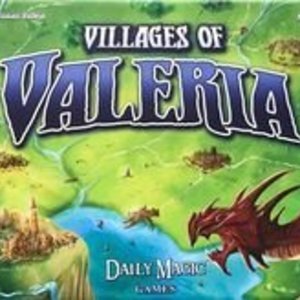

In VoV you are a Duke/Duchess being charged by the King to found a new Capital City to replace the previous one that has been ravaged by the wars played out in VCK. The King has assigned you a castle to use as your HQ and expects the most enterprising Duke/Duchess to win the day by building the most flourishing village. Will you be able to create the resources necessary to build the most attractive buildings that adventurers will want to frequent? Or will you spend your time taxing your constituents to death?
DISCLAIMER: This review focuses on vanilla Villages of Valeria. We have all the released expansions and may do a review of them in the future. If we do, we will edit this review or link to the new review here. -T
VoV uses a handful of really great game mechanics that will be familiar to some gamers, but not intimidating enough to scare off new gamers, that really work well together to create an excellent gaming experience. I will address most of them here, but please do not use this review as a replacement for the rulebook, as I will not be addressing every single rule.
VoV is played over several rounds where every player will be taking a turn as the active player until someone has built the requisite number of buildings prescribed in the rulebook to trigger the end of the game. Each player starts with a castle card that provides a wild resource of your choice when you need to pay resources to build buildings on future turns. You are also given gold and a starting hand of cards in accordance with setup rules. Setup the decks of cards and create the offer rows for each and you are ready to play!
When you are the active player you will take an action from a list of five available actions: Harvest, Develop, Build, Recruit, and Tax. If you choose to Harvest on your turn you will draw three cards from either the face-up green building cards on the offer or blindly from the deck of green building cards. To Develop you will play a building card from your hand to the back of your castle, tucked underneath and upside down, to be used as the resources printed at the bottom of the card (wood, magic, stone, food). These resources are now available to be used for the build action (think of the brown and gray cards in 7 Wonders, if you’re familiar). When you take the Build action, you will be playing a building card from your hand to be built in the tableau in front of you. Since number of buildings is the end game trigger condition, you will be trying to build buildings as much as possible. All building cards have a cost printed on the left side of the card, and those costs will need to be paid for by using the gold you possess. You can use one gold on your own castle card as it provides a wild resource to you, and you can use one gold per card you have Developed previously for their resource benefit. You may even spend your gold to use an opponent’s resources (not their castle! – also akin to 7 Wonders neighbor resource purchasing). The catch here is that you lose that gold piece to your opponent, but they will not be able to use that resource until the beginning of their turn as active player. Most buildings will have benefits printed on them that either take effect immediately or when triggered by another action. When you Recruit an Adventurer, you are using your village’s buildings to attract them to your cause. Each Adventurer’s cost to recruit is printed on the side of the card, and these costs are paid by having the matching symbols on building cards in your village. Once recruited, these Adventurers can also enact conditional abilities similar to building cards, but usually will be advantages to final VP scores. By taking the Tax action you will take one gold from the bank and draw a building card from the offer or the deck.
Now this all seems pretty easy and I have only really mentioned one form of tension by blocking opponents’ use of their own resources if you spend a gold to use it on your turn. Since you reclaim all gold on your castle and resource cards in your village at the beginning of your turn this should cause no problems, right? Well, VoV also uses the follow mechanic that has been employed by other games previously. When you are the active player you choose which action you want to take on your turn, complete that action, and then the same action is offered to your opponents for them to take at a disadvantage. Example: I choose Tax as my action, so I take my gold and my card and my turn is over. Then, going around the table, each player can decide to follow my action but are only able to take a building card as a follow action. No gold. Each action has a Lead and Follow benefit, so you are always paying attention during the game, even on others’ turns because you might still benefit from the chosen actions.
Play continues like this with active player Lead actions and possible others’ Follow actions until someone triggers the end game condition. Then everyone completes the turn and VPs from all cards in your tableau are added (including gold pieces you collected). Most VPs wins the game of Villages of Valeria!
Components. Okay, I have to admit that I have the Kickstarter Deluxe version of this game so I am only speaking from experience with that version. The cards are of really good quality. The gold tokens and active player castle token are great, but the action tracker we found a bit cumbersome to use so we just, like, didn’t. The building tracker and castleeples are great as well. The art is by The Mico, and I just love his art style, so that’s a big positive for me. Overall, the components are really really nice.
So why do I love this game? Well, it’s really a mashup of mechanics that work well for me. I love the Lead/Follow mechanic. I love 7 Wonders, so borrowing some of those mechanics and nuances is a great fit for me. I absolutely LOVE The Mico’s artwork on every Valeria game. No two games of VoV will be alike because the amount of cards that come inside the box (and growing with every expansion) gives such a diverse gaming experience that I love playing. If you like any of the Valeria games and you have yet to try Villages of Valeria you MUST find a copy. You will be drawn in by the familiar feel of Valeria and mechanics from classic games that will surely delight. We at Purple Phoenix Games give this gem a bustling 20 / 24. Long live Valeria!
https://purplephoenixgames.wordpress.com/2019/04/05/villages-of-valeria-review/
Purple Phoenix Games (2266 KP) rated Space Plague in Tabletop Games
Mar 9, 2021
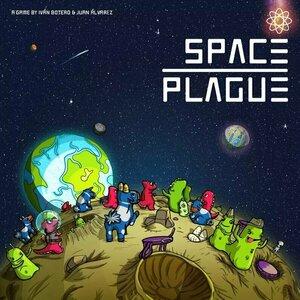
Space Plague is a new game from first time designers who hail from the country of Colombia. In it players assume the command of a race of aliens attempting to colonize a newfound planet before the other races assume majority. Each race is essentially the same, and have similar tactics, but may use these tactics differently from other races. The player who amasses the most plagues from their race by the time the game ends will be crowned champion, and settler of the new world.
DISCLAIMER: We were provided a prototype copy of this game for the purposes of this review. These are preview copy components, and I do not know for sure if the final components will be any different from these shown. Also, it is not my intention to detail every rule in the game, as there are just too many. You are invited to download the rulebook, back the game through the Kickstarter campaign, or through any retailers stocking it after fulfillment. -T
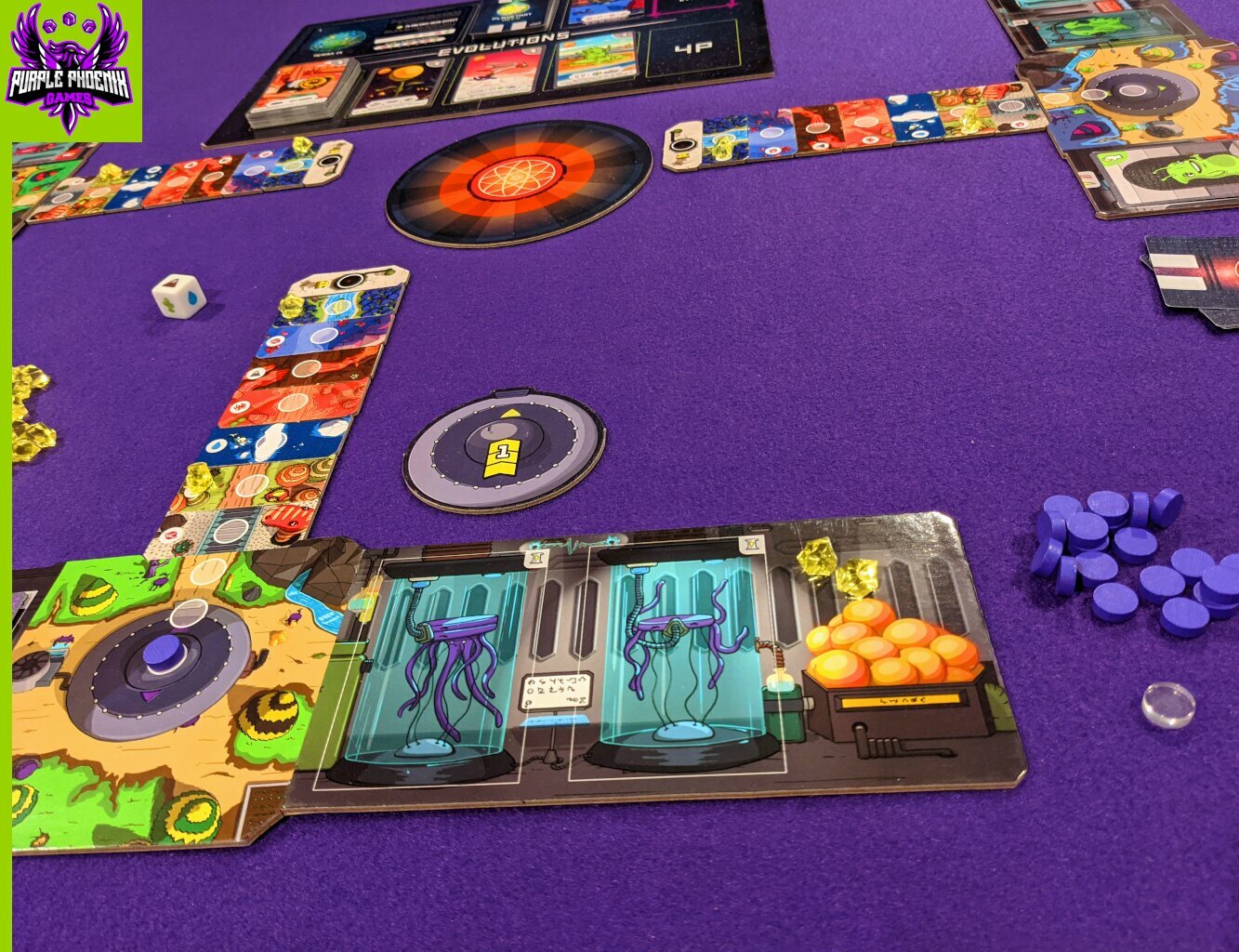
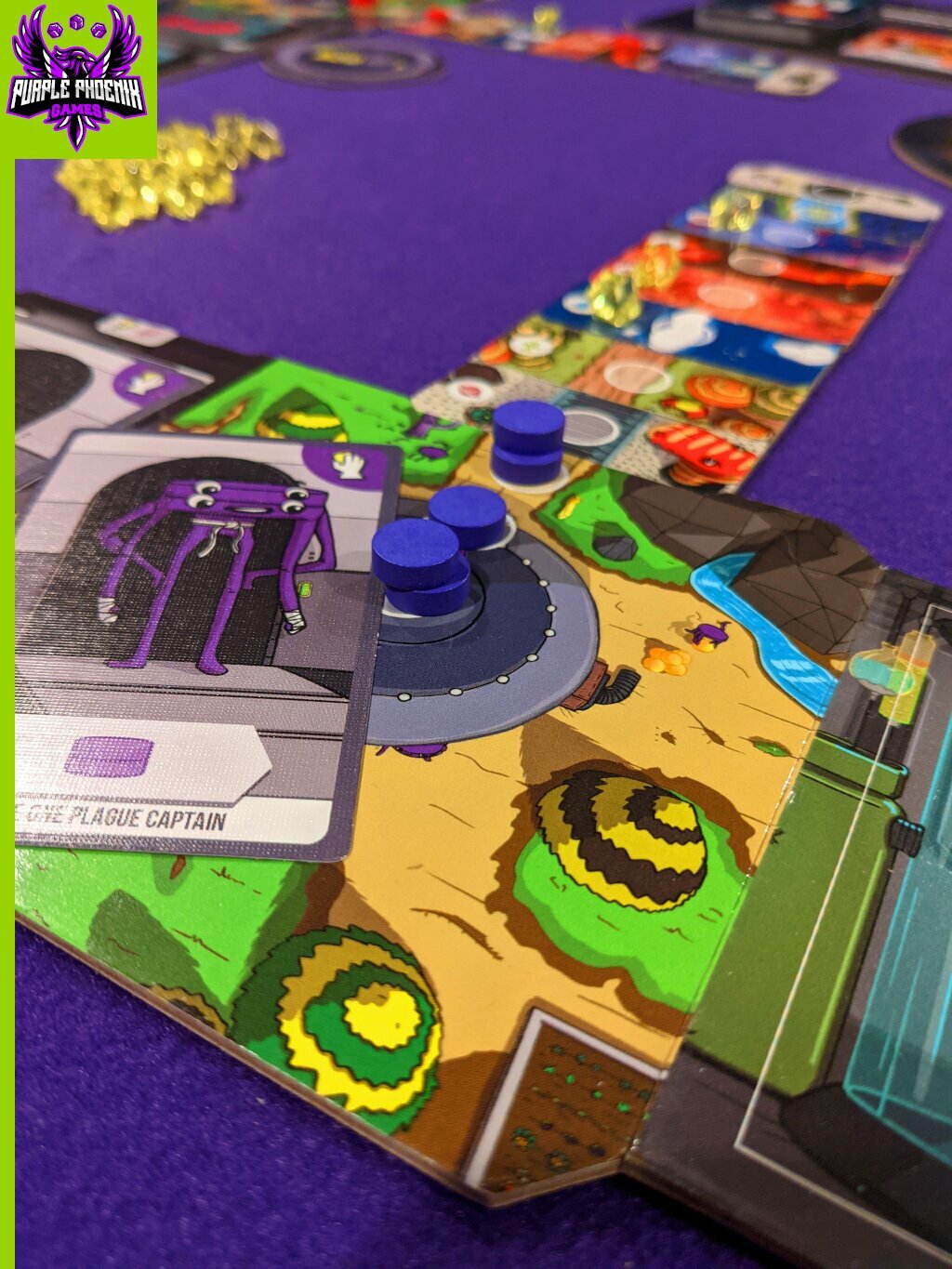
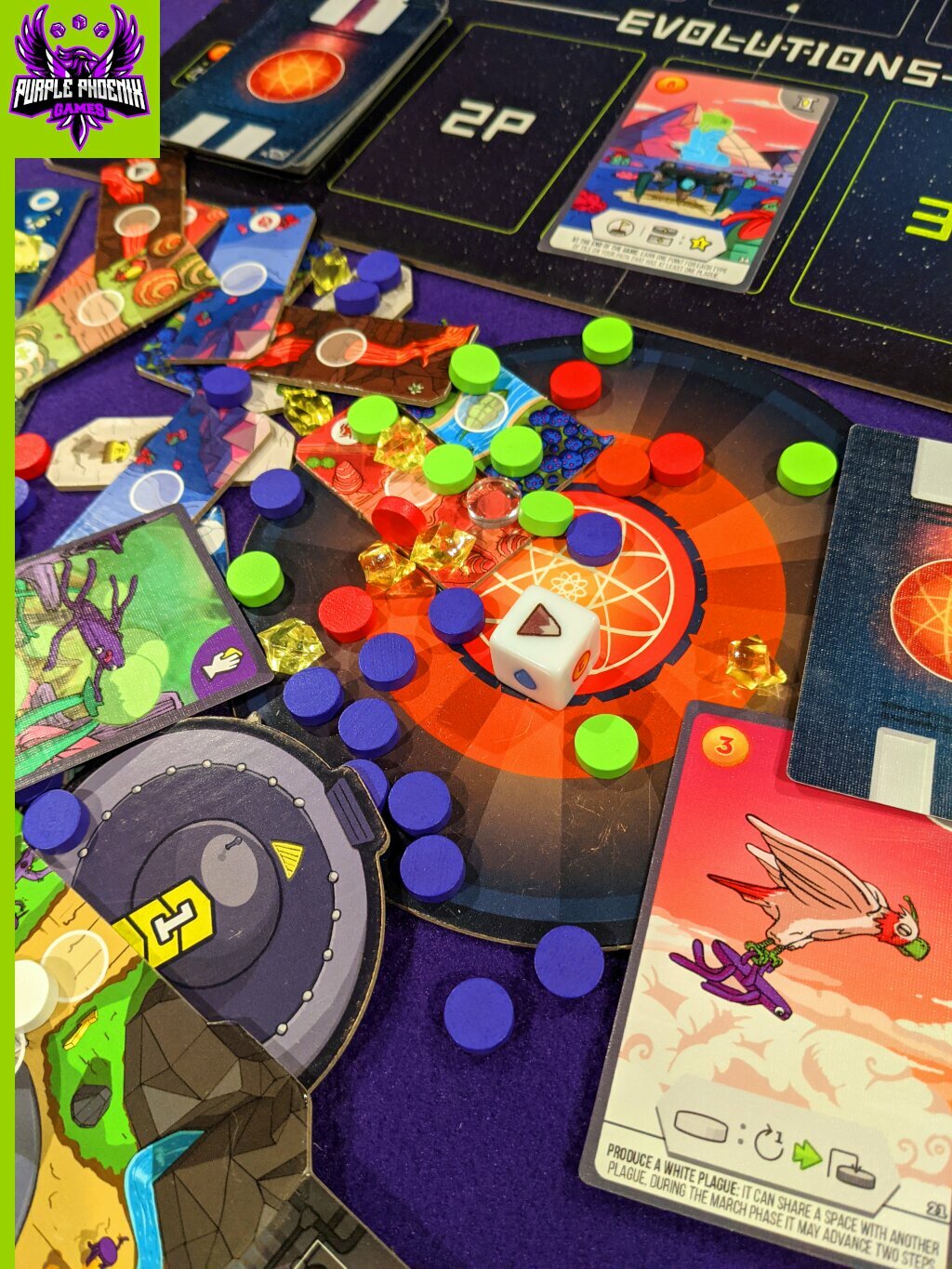
To setup, follow the instructions, as there are many steps for setup. Once complete, the game should look similar to the photo below. You will see in this photo the main board at the top, the circular world core board (in black and red), and individual board setups for three players. Of course, for this review I will be playing the purple faction: The Flat-Earthers (not that I agree with the actual group of Flat-Earthers). Each player receives the same components, just in their player color. This includes six action cards to serve as the opening hand.
Each round follows four phases: Planetary Deck, Play Action Cards, Planetary Event, and March. On the main board a Planetary Event Card is flipped at the start of each round. This will inform the players which terrain type will generate energy this turn, as well as give a glimpse into the future event that will occur once the card travels to the activation zone on the board. Once players have placed energy shards onto the requisite terrain tiles they must each choose one card to be played this turn from their hand. As each player has the same six beginning Action Cards turns may seem similar. These action cards include Producing Plague (placing a plague disc on the space furthest from the end of the terrain tile line, on top of the picture of the player’s spaceship), Producing a Captain (a stronger version of the normal plague disc), Fast Movement (allows plague discs to move twice toward the core or two discs to move one space each), Slow But Steady (allows one plague disc to move forward one space OR allows the player to place a shield disc on top of a plague to protect it from harm), and Evolving OR Getting Lucky (which allows the player to purchase an Evolution Card from the Market or to roll the energy die and place energy shards on the resulting terrain type). More action cards can be purchased at the Market and used on future turns in order to buff certain actions, abduct opponent plagues, or even create new types of plagues with special abilities.
Once all players have played and resolved their action card for the round the Planetary Event phase begins. If an event card has moved its way to the activation zone of the main board its event text is resolved now. These events signify death of plague discs if they reside on specific terrain types, allow for purchasing cards at the Market or else destroying the plague furthest toward the core, or other various and nefarious events.
When the event has been resolved the active player token is passed to the next player and the March phase ensues. Players will move each of their plague discs one space toward the core to make room for more incoming plagues and captains.
Once the final event card has made its way through each of the main board slots and past the activation zone the game will end. Players will count their plague discs that made it onto the core of the planet and the player with the most discs will win! The rules also include several tie-breakers, ending with a shared victory and a snarky, “tough toothpaste,” style of comment.
Components. Again, this is a prototype copy of the game, and components are not at all final. However, component quality aside, this game looks amazing on the table and hints at some really excellent plans for the final aesthetic. The character art and art on the cards is cartoony, but not in a bad way, and the other art in the graphic design is just stellar (checks around the room for the hook). The game feels “spacey” and “alieny” but also hip and lighthearted. I like it. I like it a lot. My hope for the final product is that the rulebook gets much more detailed, as I had to ask several questions to the designer that just were not clear or present in the rules. I am also hoping that the cards themselves will see quite a bit of beefiness added to them, as this prototype copy shipped with mega-thin cards that are delicate to handle. For a prototype, the components are good and show me what could be upon a successful Kickstarter campaign.
The gameplay is definitely something I want to discuss. I was blown away by how much fun I had playing this game! I cannot count how many times I vocalized how impressed I was with the design and how much fun I was having. I love the mechanic of giving all players the same components but allowing them to choose how to use them best for their strategies. Sometimes I felt that I need to flood my track with plagues and get them moving, while other times I wanted to just upgrade my race by using the evolution cards from the market. Those evolution cards are so interesting to use because they can change the course of the game, especially if specific cards come out near the beginning of the game.
Players can choose which world they wish to conquer at the start of each game (five were included with this copy), and each world possesses different strategies of play. That said, Space Plague definitely scores points for replayability from us.
While it was difficult to get into at first (remember all the rules questions I had), once I was able to truly learn the game it became so enjoyable, and everyone I have played with has thoroughly enjoyed it. If this is the style of game we can expect to come out of Colombia and Bamboo Studios in particular, I am very excited for the future and for the board game community as a whole. This one is a gem and I cannot recommend it highly enough. If you are looking for something a little kooky but with great art and super fun play, then it’s a no-brainer. Space Plague is a must-play at the very least.

GTI EDITION 35
Games
9.0 Rate It
App
With GOLF GTI EDITION 35 Volkswagen celebrates the 35th anniversary of the Golf GTI Edition and...

My Masked Shadow (Beautiful Stalkers #3)
10.0 Rate It
Book
I'm in her firewall. She's under my skin. I don’t need to creep down dark alleys to stalk her. ...
Dark Contemporary Stalker Romance Erotica

Grumpy Goblin (123 KP) rated Mechs vs. Minions in Tabletop Games
Mar 27, 2018

The first thing that caught my attention when it arrived was how big the box was... it is massive! This didn't bother me too much, but those who may not have much storage or use Kallax to store their games might find this a bit of a pain..
On opening the box, I was a little deterred by the amount of items that were in there.. it was very daunting, but I persevered and started reading the rules and first scenario that come with it and soon realised there was nothing to worry about.
The rules are really well written (compared to this review) and the tutorial scenario teaches you (and party members) in a quick, fun and easy way. One thing I don't like about a lot of games is the learning curve and sometimes lack of explanation or badly written rules, there is none of that with MvM, they have really thought about teaching this to the player in the easiest way possible.
After finishing the tutorial scenario, I was excited to carry on and work my way through the rest of the game.. at this point i'd like to point out I was doing this solo and was playing for both player 1 and player 2 , the experience was still very enjoyable. I carried on through the game for the next couple of days and enjoyed every minute of it.. I am looking forward to breaking it out with my friends when they're next over.
Definitely a well worth game in my opinion, especially if you are just wanting to play something that isn't too intense and a bit of fun!

Livres Audio HQ
Book and Education
App
***** Over 77 5-star ratings 1,353 free audiobooks in French. Ėcouter des livres en français! If...

Strategy and Choice
Book
From the coalition's desert showdown with Saddam Hussein to the dieter's duel with himself in the...

Cate Le Bon recommended Barrett by Syd Barrett in Music (curated)
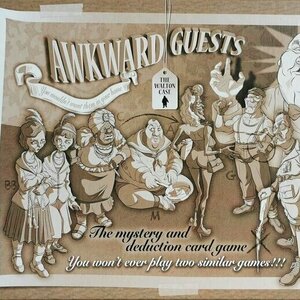
Awkward Guests
7.0 Rate It
Tabletop Game
Awkward Guests / Incómodos Invitados is a one of a kind deduction game with infinite...