
Search
Search results
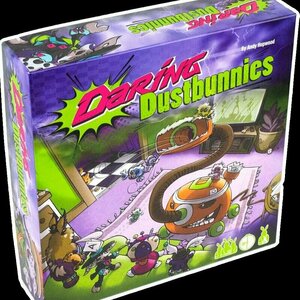
Daring Dustbunnies
9.0 Rate It
Tabletop Game
Description from the publisher: You are one of the magical Dustbunnies living under the sofa....

Debbiereadsbook (1839 KP) rated Mathos (The Hawks #3) in Books
Nov 21, 2021

loving this series so hard!
I was gifted my copy of this book, that I write a review was not required.
This is book 3 in The Hawks series, and you really MUST read books one, Tristan, and book 2, Val before this one. There is an on-going story arc across the series, that is not fully recapped. And you, cos I said so! I loved those books, and I loved this one too.
Mathos is a player, calls everyone darlin' and never spends more than one night with a woman. He's happy with his lot. So why then, does Lucilla push all his buttons and make him want things he never knew he wanted? She's a spoilt princess, and he just has to get her to the palace. Lucy, however, does not want to go. Her brother will kill her, and she's suffered enough. Finding out though, that Ballinor is dead and a far darker mind wishes to possess her, mean she has to trust Mathos, and his band of the Hawks.
I loved Mathos in the other books, and here he really does shine. Lucy (as Mathos begins to call her) shines also, but in an entirely different way.
Lucilla has been kept behind closed doors for so long, so she can't remember life before. Suffering at the hands of her brother and his cronies has been her life. She doesn't want to be controlled or coralled anywhere, but Mathos makes a good point. Getting to the palace will secure her future and mean she can make all the choices she wants. But Mathos creeps into her heart, and when he does what he does, you can feel how much Mathos means to her.
Mathos though, feels he does not deserve anyone, let alone a queen. No one can love him, if his own mother can't, surely? Walking away from Lucy and from his brothers was probably the hardest thing he ever did, but also the most stoopidest thing, EVER! But it's WHO that makes him see clearly for the first time in weeks that surprised me! Given as said someone has been missing since the first book, you'll understand why and I really pray that he gets some peace.
He's not next though! Tor is next and given whats said here, I'm intrigued as to what has happened between him and Keeley!
I'm loving this series, I really am! Please keep them coming, I still cannot see the bigger picture and what's going to happen!
5 full and shiny stars
*same worded review will appear elsewhere
This is book 3 in The Hawks series, and you really MUST read books one, Tristan, and book 2, Val before this one. There is an on-going story arc across the series, that is not fully recapped. And you, cos I said so! I loved those books, and I loved this one too.
Mathos is a player, calls everyone darlin' and never spends more than one night with a woman. He's happy with his lot. So why then, does Lucilla push all his buttons and make him want things he never knew he wanted? She's a spoilt princess, and he just has to get her to the palace. Lucy, however, does not want to go. Her brother will kill her, and she's suffered enough. Finding out though, that Ballinor is dead and a far darker mind wishes to possess her, mean she has to trust Mathos, and his band of the Hawks.
I loved Mathos in the other books, and here he really does shine. Lucy (as Mathos begins to call her) shines also, but in an entirely different way.
Lucilla has been kept behind closed doors for so long, so she can't remember life before. Suffering at the hands of her brother and his cronies has been her life. She doesn't want to be controlled or coralled anywhere, but Mathos makes a good point. Getting to the palace will secure her future and mean she can make all the choices she wants. But Mathos creeps into her heart, and when he does what he does, you can feel how much Mathos means to her.
Mathos though, feels he does not deserve anyone, let alone a queen. No one can love him, if his own mother can't, surely? Walking away from Lucy and from his brothers was probably the hardest thing he ever did, but also the most stoopidest thing, EVER! But it's WHO that makes him see clearly for the first time in weeks that surprised me! Given as said someone has been missing since the first book, you'll understand why and I really pray that he gets some peace.
He's not next though! Tor is next and given whats said here, I'm intrigued as to what has happened between him and Keeley!
I'm loving this series, I really am! Please keep them coming, I still cannot see the bigger picture and what's going to happen!
5 full and shiny stars
*same worded review will appear elsewhere

Purple Phoenix Games (2266 KP) rated Of Knights & Ninjas in Tabletop Games
Jan 23, 2020


Little-known factoid about me: I am a Knight. Not from England, and not due to my daring heroics in war, but a Knight Templar of the Grand Commandery in the York Rite of Freemasonry. Politics and conspiracy theories aside, becoming a Knight was a highlight of my life, and something I will forever treasure. And speaking of treasure and Knights Templar (read your history, kids), we all know that one of the biggest foes of the Knights in olden times were the nefarious Ninjas. Or maybe it’s just fun to think about and play a game where these factions are represented.
Of Knights & Ninjas is a card game about claiming enough treasure to ascend to kinghood and rule all the lands. You can accomplish this by sending forces to your opponents’ realms and stealing their glorious gems. The first lord to amass 10 gems will have sufficient wealth to assume the kinghood and rule all realms!
DISCLAIMER: We were provided a prototype copy of this game for the purposes of this review. These are preview copy components, and the final components may be different from these shown. Also, it is not my intention to detail every rule in the game, but to give our readers an idea of how the game plays. If you would like to read the rulebook in full, you may visit the publisher’s website, purchase the game through the publisher, back the game through the Kickstarter campaign, or through any retailers stocking it after fulfillment. -T
To setup, each player will take five gems of their preferred color in front of them. Shuffle the large deck of cards, and deal each player four cards (this rule was updated after our play-throughs). You are now ready to play!
On your turn, you will draw two cards from the deck (unless it’s the first draw of the game – that player will draw just one). You must now play a card to the table or discard a card from your hand. Cards that you can play from your hand will each have different abilities, and thankfully the designer will be providing a reference sheet for these, as there are many cards with wildly different abilities. This is also why I will not be explaining the entire rulebook.
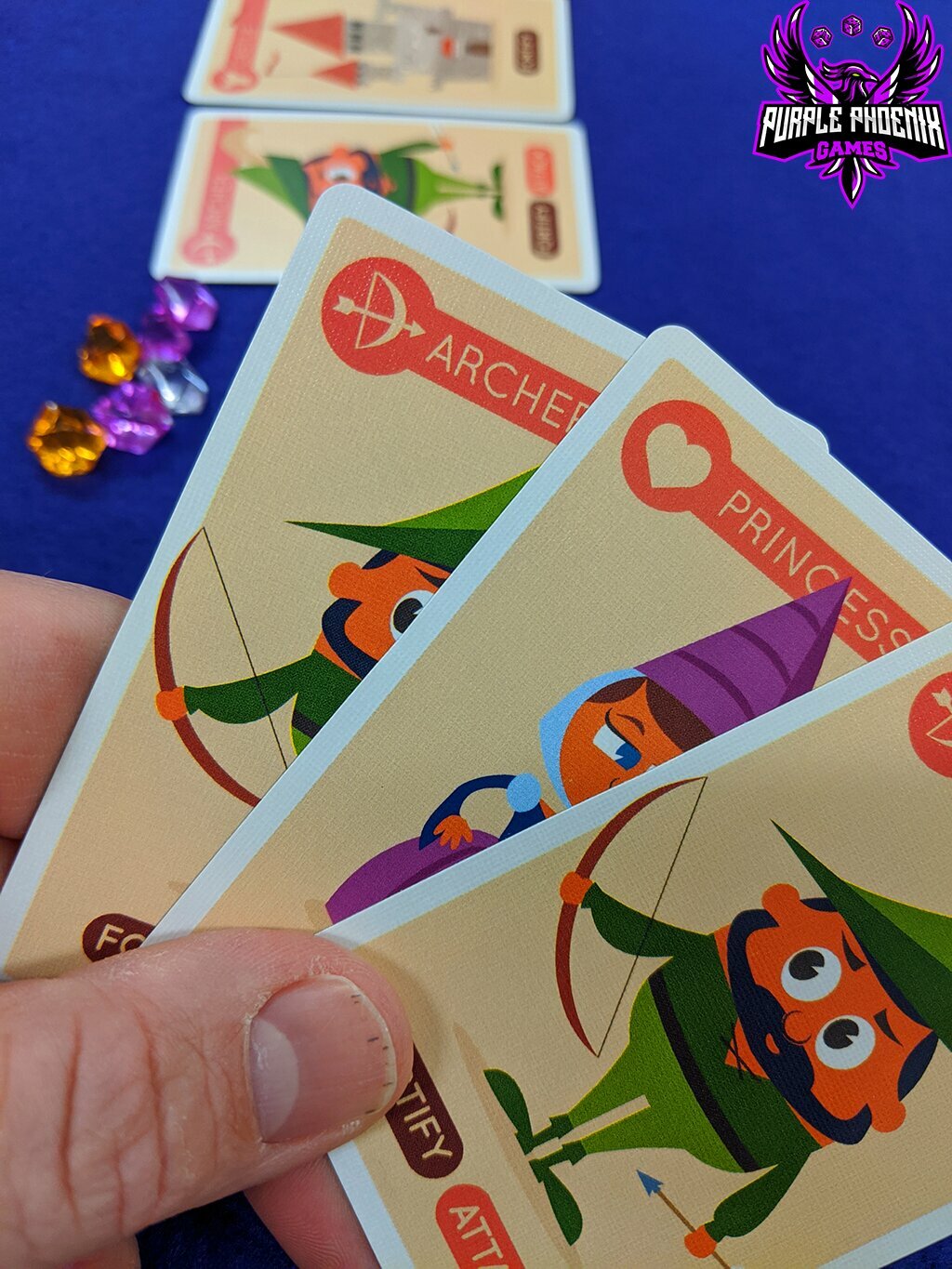
Typically you will be able to play Fortify cards (castles, archers), Attack cards (knights, ninjas, etc), Respond cards, and Special cards (minstrels, jesters, etc). Fortify cards protect your gems from certain Attack cards, like an Archer only being able to attack another Archer, or a Dragon being able to attack a Castle – but not if an Archer is stationed there (logic). Although, a Ninja can scale a Castle wall, and a Catapult can destroy a Castle altogether (but not that pesky Archer that happens to be sitting on top)…
Attack cards are just that: they Attack. Each Attack card will show a number in a starburst icon in the upper right hand corner that signifies how many gems they are able to steal. Once an opponent is declared and an Attack card played, let’s say a 1-power Peasant, the defender may then play a card with the Respond keyword (which will also have a starburst number) to offset the number of stolen gems. If the attacker chooses, they may continue playing Attack cards against the same opponent in order to draw out all the Respond cards and come away with some sweet, sweet gems.
But maybe once all is said and done, and gems are about to change hands, another opponent plays a Special card – a Highwayman, for example. These characters will steal all the gems that are about to change hands (as if he was robbing the gem carriage en route to the new owner). But then again, perhaps yet ANOTHER opponent plays a Highwayman as well, and steals those gems a second time! You just never know when these Special cards will come out and how they may affect the best laid plans.
Play continues in this fashion until one player has amassed the 10 gems they require to win the game!
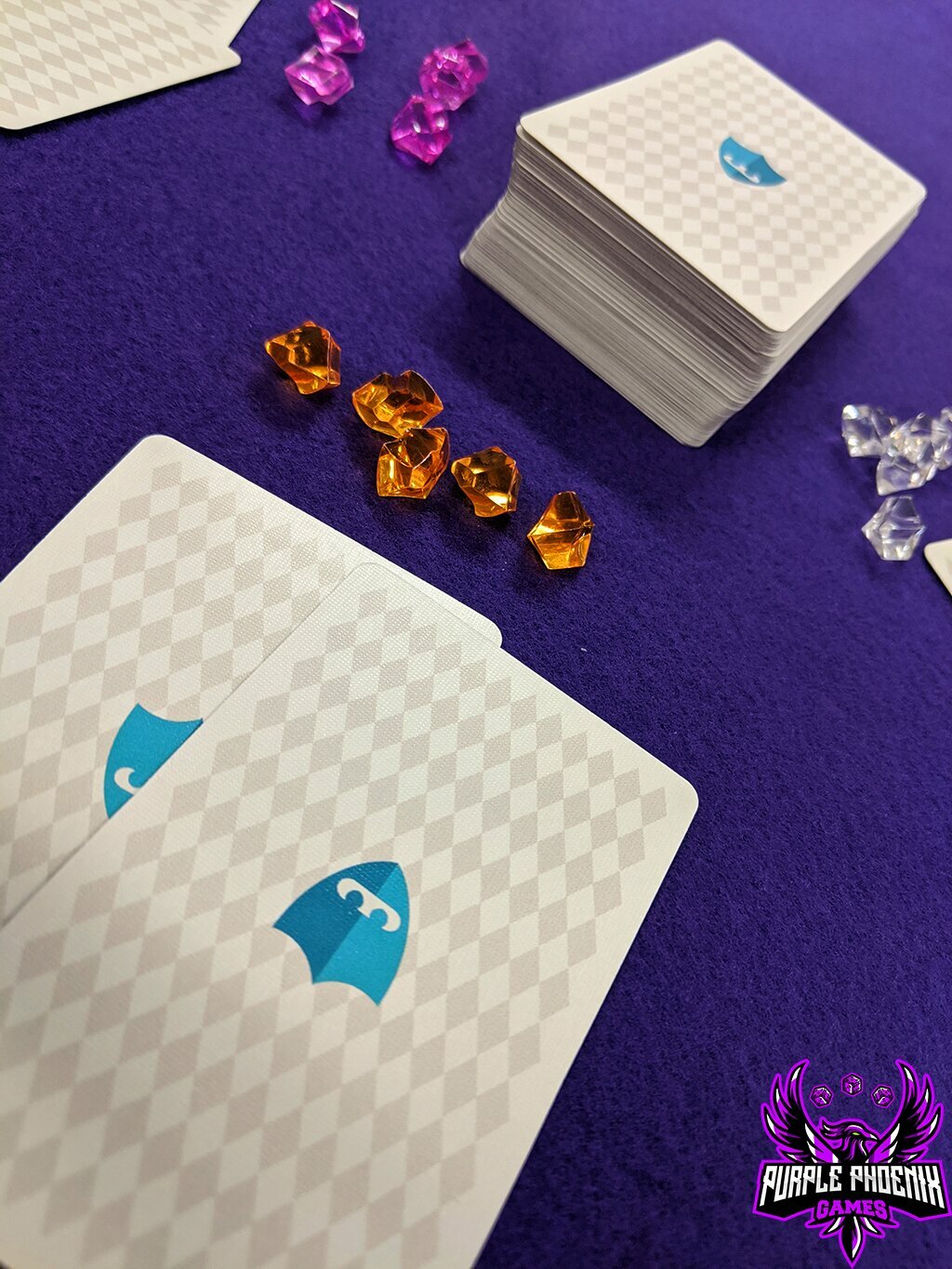
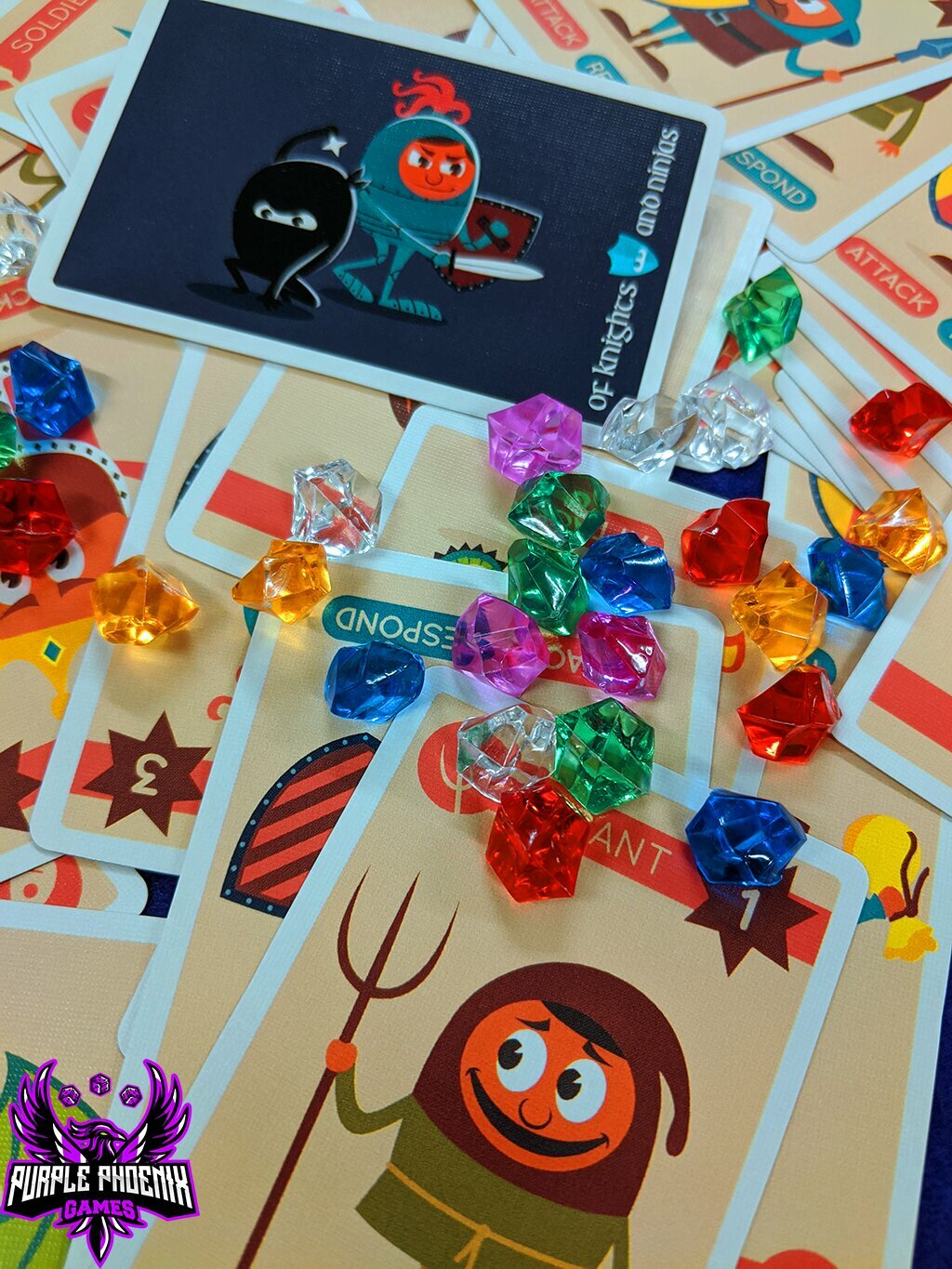
Components. Again, we were provided a prototype copy of this game, and we understand that components can change during the course of a successful Kickstarter campaign. That said, this game is a ton of cards and some plastic gem pieces. The art is stellar – cartoony, but whimsical and fun. The card layouts make sense and are very easy to read and understand. The gems are colorful and fun to play with. I only have one concern/suggestion/wish for the components here. I wish the individual card’s abilities were somehow printed on the cards themselves. That would alleviate the need for a reference sheet, but it would then detract from the cute art on the cards. So, maybe that wouldn’t be so great after all. I’m torn on that.
All in all, this game is super fun to play. It will be chaotic one moment, and strategically tense the next. Being able to whittle an opponent’s hand down to nothing and then slapping them with a King card to steal a huge chunk of gems is just so sneakily satisfying. Or sending your Ninja to infiltrate their unArchered (I know it’s not a word) Castle and slither away with the goods. Don’t get too attached to your gems, because you may find yourself without for several rounds. You can always rebuild, but make haste as your opponents will keep you down if you let them.
If you are a fan of games that are cute, fun, and relatively quick with a quirky, but light-hearted theme, then definitely check this one out.
Of Knights & Ninjas is a card game about claiming enough treasure to ascend to kinghood and rule all the lands. You can accomplish this by sending forces to your opponents’ realms and stealing their glorious gems. The first lord to amass 10 gems will have sufficient wealth to assume the kinghood and rule all realms!
DISCLAIMER: We were provided a prototype copy of this game for the purposes of this review. These are preview copy components, and the final components may be different from these shown. Also, it is not my intention to detail every rule in the game, but to give our readers an idea of how the game plays. If you would like to read the rulebook in full, you may visit the publisher’s website, purchase the game through the publisher, back the game through the Kickstarter campaign, or through any retailers stocking it after fulfillment. -T
To setup, each player will take five gems of their preferred color in front of them. Shuffle the large deck of cards, and deal each player four cards (this rule was updated after our play-throughs). You are now ready to play!
On your turn, you will draw two cards from the deck (unless it’s the first draw of the game – that player will draw just one). You must now play a card to the table or discard a card from your hand. Cards that you can play from your hand will each have different abilities, and thankfully the designer will be providing a reference sheet for these, as there are many cards with wildly different abilities. This is also why I will not be explaining the entire rulebook.
Typically you will be able to play Fortify cards (castles, archers), Attack cards (knights, ninjas, etc), Respond cards, and Special cards (minstrels, jesters, etc). Fortify cards protect your gems from certain Attack cards, like an Archer only being able to attack another Archer, or a Dragon being able to attack a Castle – but not if an Archer is stationed there (logic). Although, a Ninja can scale a Castle wall, and a Catapult can destroy a Castle altogether (but not that pesky Archer that happens to be sitting on top)…
Attack cards are just that: they Attack. Each Attack card will show a number in a starburst icon in the upper right hand corner that signifies how many gems they are able to steal. Once an opponent is declared and an Attack card played, let’s say a 1-power Peasant, the defender may then play a card with the Respond keyword (which will also have a starburst number) to offset the number of stolen gems. If the attacker chooses, they may continue playing Attack cards against the same opponent in order to draw out all the Respond cards and come away with some sweet, sweet gems.
But maybe once all is said and done, and gems are about to change hands, another opponent plays a Special card – a Highwayman, for example. These characters will steal all the gems that are about to change hands (as if he was robbing the gem carriage en route to the new owner). But then again, perhaps yet ANOTHER opponent plays a Highwayman as well, and steals those gems a second time! You just never know when these Special cards will come out and how they may affect the best laid plans.
Play continues in this fashion until one player has amassed the 10 gems they require to win the game!
Components. Again, we were provided a prototype copy of this game, and we understand that components can change during the course of a successful Kickstarter campaign. That said, this game is a ton of cards and some plastic gem pieces. The art is stellar – cartoony, but whimsical and fun. The card layouts make sense and are very easy to read and understand. The gems are colorful and fun to play with. I only have one concern/suggestion/wish for the components here. I wish the individual card’s abilities were somehow printed on the cards themselves. That would alleviate the need for a reference sheet, but it would then detract from the cute art on the cards. So, maybe that wouldn’t be so great after all. I’m torn on that.
All in all, this game is super fun to play. It will be chaotic one moment, and strategically tense the next. Being able to whittle an opponent’s hand down to nothing and then slapping them with a King card to steal a huge chunk of gems is just so sneakily satisfying. Or sending your Ninja to infiltrate their unArchered (I know it’s not a word) Castle and slither away with the goods. Don’t get too attached to your gems, because you may find yourself without for several rounds. You can always rebuild, but make haste as your opponents will keep you down if you let them.
If you are a fan of games that are cute, fun, and relatively quick with a quirky, but light-hearted theme, then definitely check this one out.

Purple Phoenix Games (2266 KP) rated Fantastiqa in Tabletop Games
Jul 30, 2021

Ahh yes, Fantastiqa. Another to add to the list of, “I once owned, then I got rid of it, then missed it so much I had to reacquire it.” My wife loves when I do that… In any case, Fantastiqa gives players a very strange slant on deck building adventure games. Some would say the theme and its implementation will make or break it for players. Upon which side of the line do we fall?
Fantastiqa is a fantasy rock-paper-scissors style deck building adventure game. Now each of those mechanics individually can make for a wonderful children’s game. Looking upon the art in Fantastiqa will also nudge players towards that of a children’s game. Alas, Fantastiqa is not a children’s game and players will be scratching their heads for multiple reasons whilst playing it.
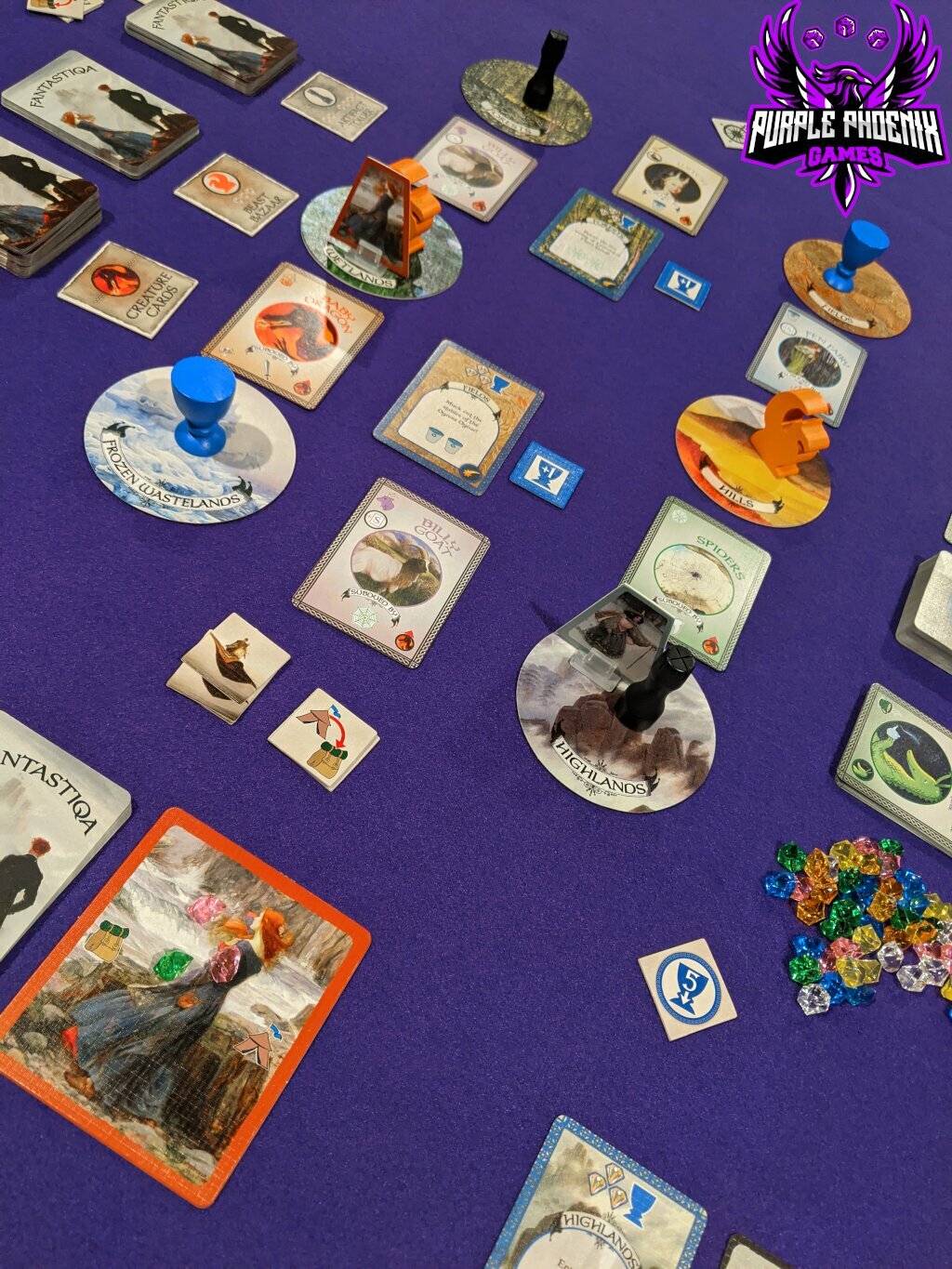
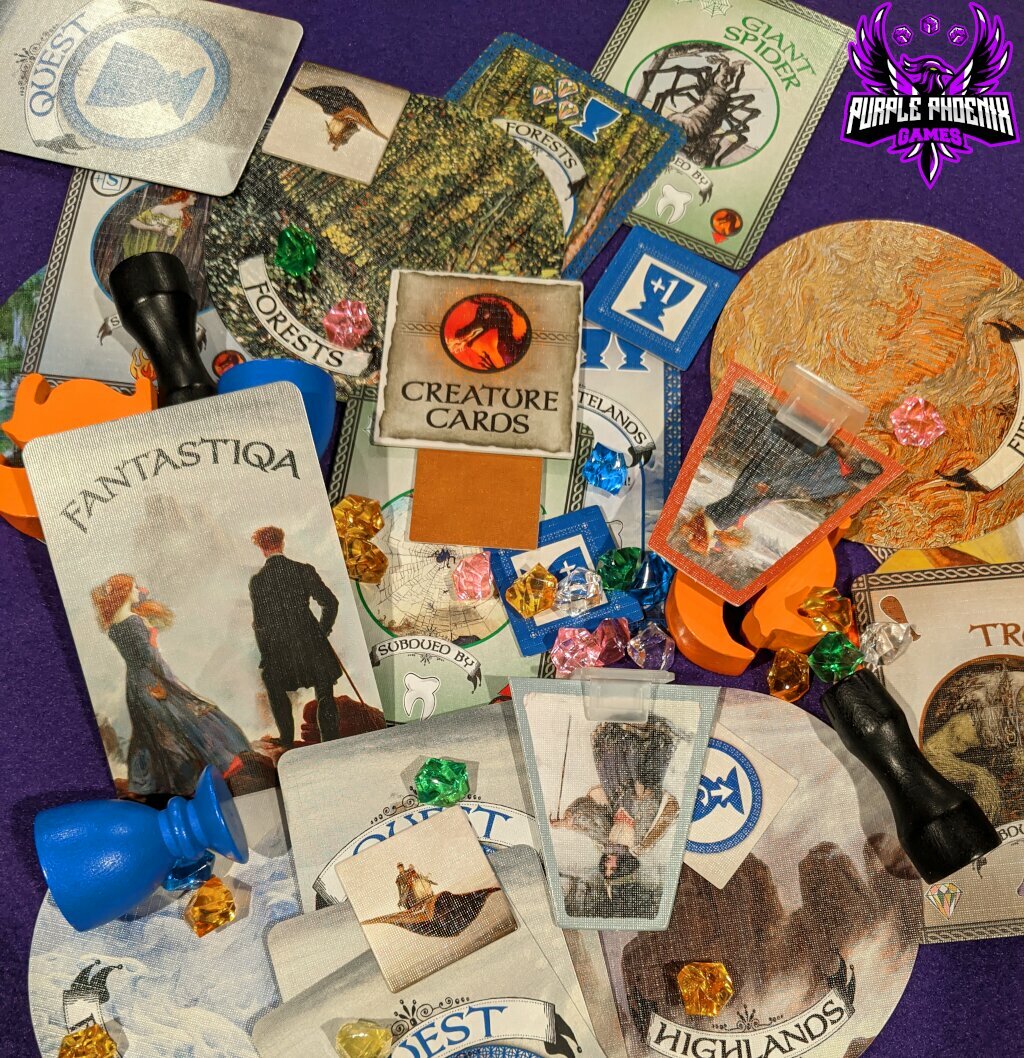
To setup, follow the instructions of the rulebook. There are just too many to list and explain here. Once setup, the game should look something like the photo above. Each player will have their draw decks identical to those of their opponents, and the play area is essentially a map of six locations with a statue at each location and decks of cards from which players will be drawing on their turns.
A typical turn will allow players to complete one of three different actions: Go Adventuring (where players will be using cards from their decks to subdue and recruit creatures between locations), Visit a Statue (where players can draw cards from the different decks for Beast, Artifact, and Quest cards to add to their discard piles, or pay gems to exile cards from their hands out of the game, or even pay gems to teleport to the matching statue on the other side of the board), or Complete a Quest (by discarding their appropriate cards that fulfill the quest requirements).
Turns can be very quick, or long and drawn out as players carefully choose which tactics to apply to the board on the table, while weighing the need for more powerful cards in their decks, and keeping up with the Joneses as they compete for VP on Quest cards. This is a deck builder, after all, so improving one’s deck is always the first consideration, but should a player oust those dang tea-drinking lazy dragon cards, or attempt to commit cards to a quest? The choices are quite numerous as play continues, and players realize that, again, this is no child’s game. Play continues in this fashion of players taking turns completing actions and quests until one player gains enough VP through completed quests to win the game.
Components. Every component in Fantastiqa is Fantastiq! I feel like the entire game is linen-finished, save for the little plastic gems and large statueeples. This game feels quite deluxe, and that will always be a big stamp of approval from me. One thing that can jar some players is the choice of art used between the player placards, card art, token art, and other components. They certainly don’t match at all, but I believe this tracks with the quirky nature of the theme and game overall, so I quite enjoy it. I can indeed understand why some would be opposed, but that is not how I feel at all.
I kinda bled into my final thoughts there, but I do love Fantastiqa. The theme is super weird: players answer a Help Wanted ad and long story short they meet a crazy old man who gives them a rucksack full of ordinary items: toothbrush, helmet, bat, and a dog. The dog runs away across the street and players find themselves in another world where these ordinary items are now transformed into magic wands, rams (the animals), clubs, and a dog, among other items. Players I have played with cannot accept that a spatula is a sword in the game and that just breaks immersion for them. I quite like it and the game’s wacky theme.
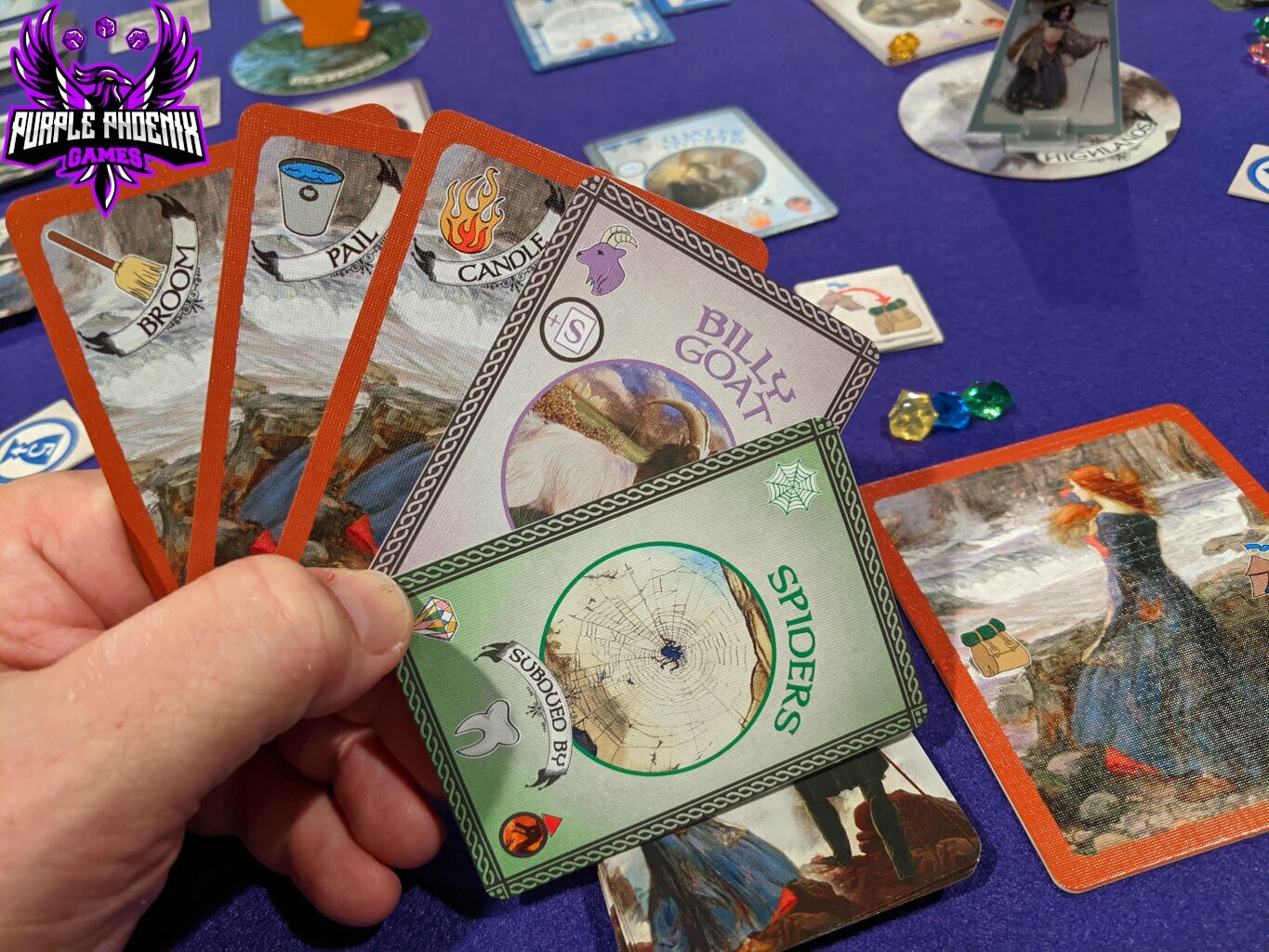
But the gameplay itself is also quite engaging. Traveling all over this new world subduing (and subsequently recruiting to your cause) Knights with spatulae and Giant Spiders with cat’s teeth is interesting and a fresh way to incorporate a theme into a deck builder as opposed to simply generating purchasing power and buying the cards that are wanted. The statue interactions are great ways to build up your deck as well, and keeping an eye on what quests others are gunning for as well as their personal hidden quests adds a bit of race-game feeling that some other deck builders lack. I can’t say enough great things about Fantastiqa, but completely understand how the theme may break the game for others’ enjoyment. That said, Purple Phoenix Games give this one a well-traveled 10 / 12. It’s weird, I’ll give you that, but it’s a good kind of weird. Check it out.
Fantastiqa is a fantasy rock-paper-scissors style deck building adventure game. Now each of those mechanics individually can make for a wonderful children’s game. Looking upon the art in Fantastiqa will also nudge players towards that of a children’s game. Alas, Fantastiqa is not a children’s game and players will be scratching their heads for multiple reasons whilst playing it.
To setup, follow the instructions of the rulebook. There are just too many to list and explain here. Once setup, the game should look something like the photo above. Each player will have their draw decks identical to those of their opponents, and the play area is essentially a map of six locations with a statue at each location and decks of cards from which players will be drawing on their turns.
A typical turn will allow players to complete one of three different actions: Go Adventuring (where players will be using cards from their decks to subdue and recruit creatures between locations), Visit a Statue (where players can draw cards from the different decks for Beast, Artifact, and Quest cards to add to their discard piles, or pay gems to exile cards from their hands out of the game, or even pay gems to teleport to the matching statue on the other side of the board), or Complete a Quest (by discarding their appropriate cards that fulfill the quest requirements).
Turns can be very quick, or long and drawn out as players carefully choose which tactics to apply to the board on the table, while weighing the need for more powerful cards in their decks, and keeping up with the Joneses as they compete for VP on Quest cards. This is a deck builder, after all, so improving one’s deck is always the first consideration, but should a player oust those dang tea-drinking lazy dragon cards, or attempt to commit cards to a quest? The choices are quite numerous as play continues, and players realize that, again, this is no child’s game. Play continues in this fashion of players taking turns completing actions and quests until one player gains enough VP through completed quests to win the game.
Components. Every component in Fantastiqa is Fantastiq! I feel like the entire game is linen-finished, save for the little plastic gems and large statueeples. This game feels quite deluxe, and that will always be a big stamp of approval from me. One thing that can jar some players is the choice of art used between the player placards, card art, token art, and other components. They certainly don’t match at all, but I believe this tracks with the quirky nature of the theme and game overall, so I quite enjoy it. I can indeed understand why some would be opposed, but that is not how I feel at all.
I kinda bled into my final thoughts there, but I do love Fantastiqa. The theme is super weird: players answer a Help Wanted ad and long story short they meet a crazy old man who gives them a rucksack full of ordinary items: toothbrush, helmet, bat, and a dog. The dog runs away across the street and players find themselves in another world where these ordinary items are now transformed into magic wands, rams (the animals), clubs, and a dog, among other items. Players I have played with cannot accept that a spatula is a sword in the game and that just breaks immersion for them. I quite like it and the game’s wacky theme.
But the gameplay itself is also quite engaging. Traveling all over this new world subduing (and subsequently recruiting to your cause) Knights with spatulae and Giant Spiders with cat’s teeth is interesting and a fresh way to incorporate a theme into a deck builder as opposed to simply generating purchasing power and buying the cards that are wanted. The statue interactions are great ways to build up your deck as well, and keeping an eye on what quests others are gunning for as well as their personal hidden quests adds a bit of race-game feeling that some other deck builders lack. I can’t say enough great things about Fantastiqa, but completely understand how the theme may break the game for others’ enjoyment. That said, Purple Phoenix Games give this one a well-traveled 10 / 12. It’s weird, I’ll give you that, but it’s a good kind of weird. Check it out.
Purple Phoenix Games (2266 KP) rated Cryptid in Tabletop Games
Jul 1, 2020
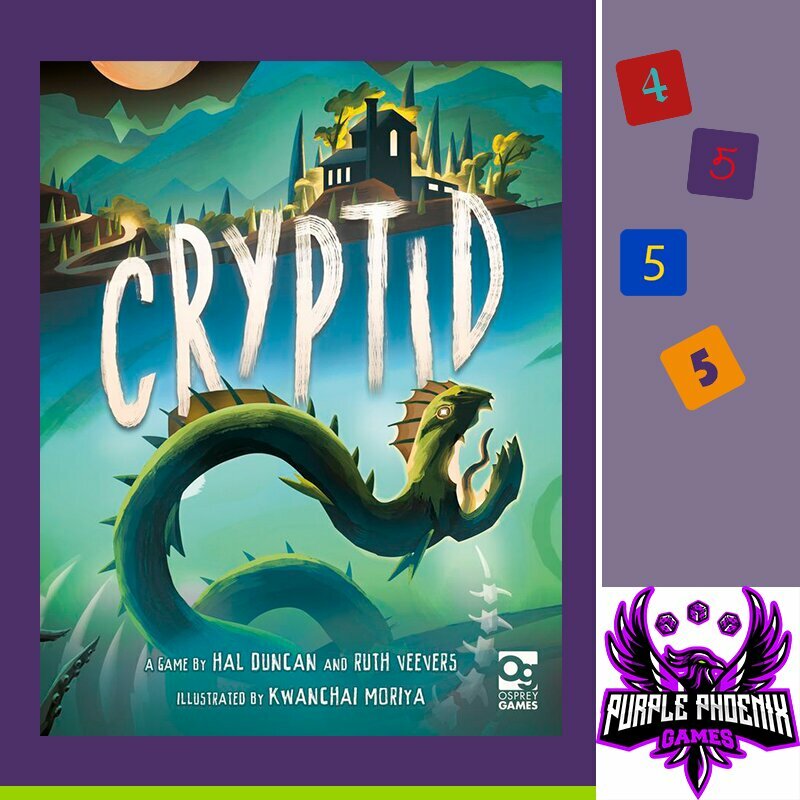
If you are a fan of the lore behind the likes of the Cthulhu, Sasquatch, Loch Ness, and El Cucuy, then you will love the theme behind this next game. Cryptid is a board game that basks in these old tales of years long past and puts you on the hunt for the infamous “Cryptid” snake/dragon-like monster. You are in a race against the other players to determine who can catch the infamous Cryptid first. This snake-like dragon is slippery and likes to hide just out of reach of the players though. It will take a bit of strategy, some social deduction with other players, and well, a bit of luck to find it! Good luck adventurers!
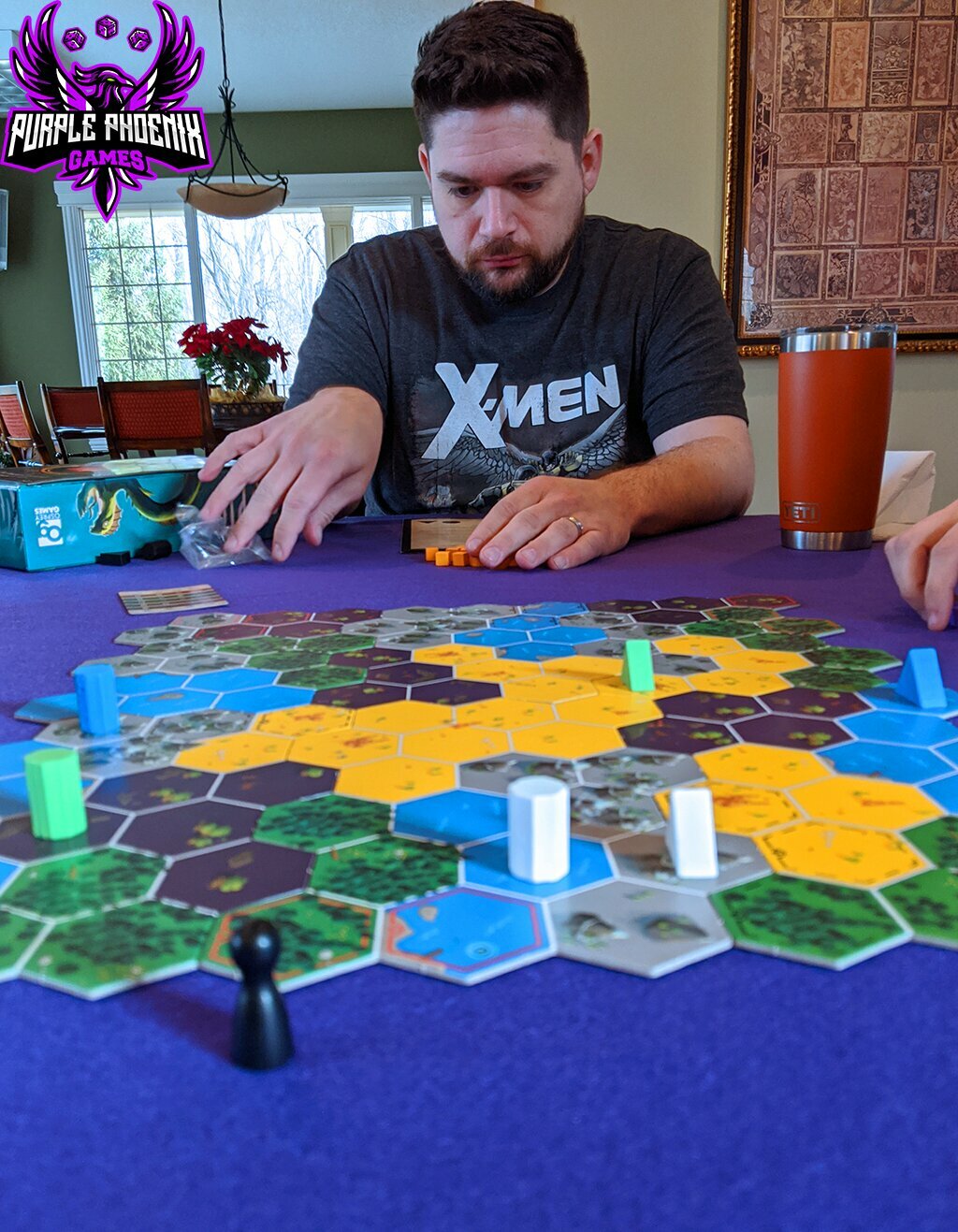
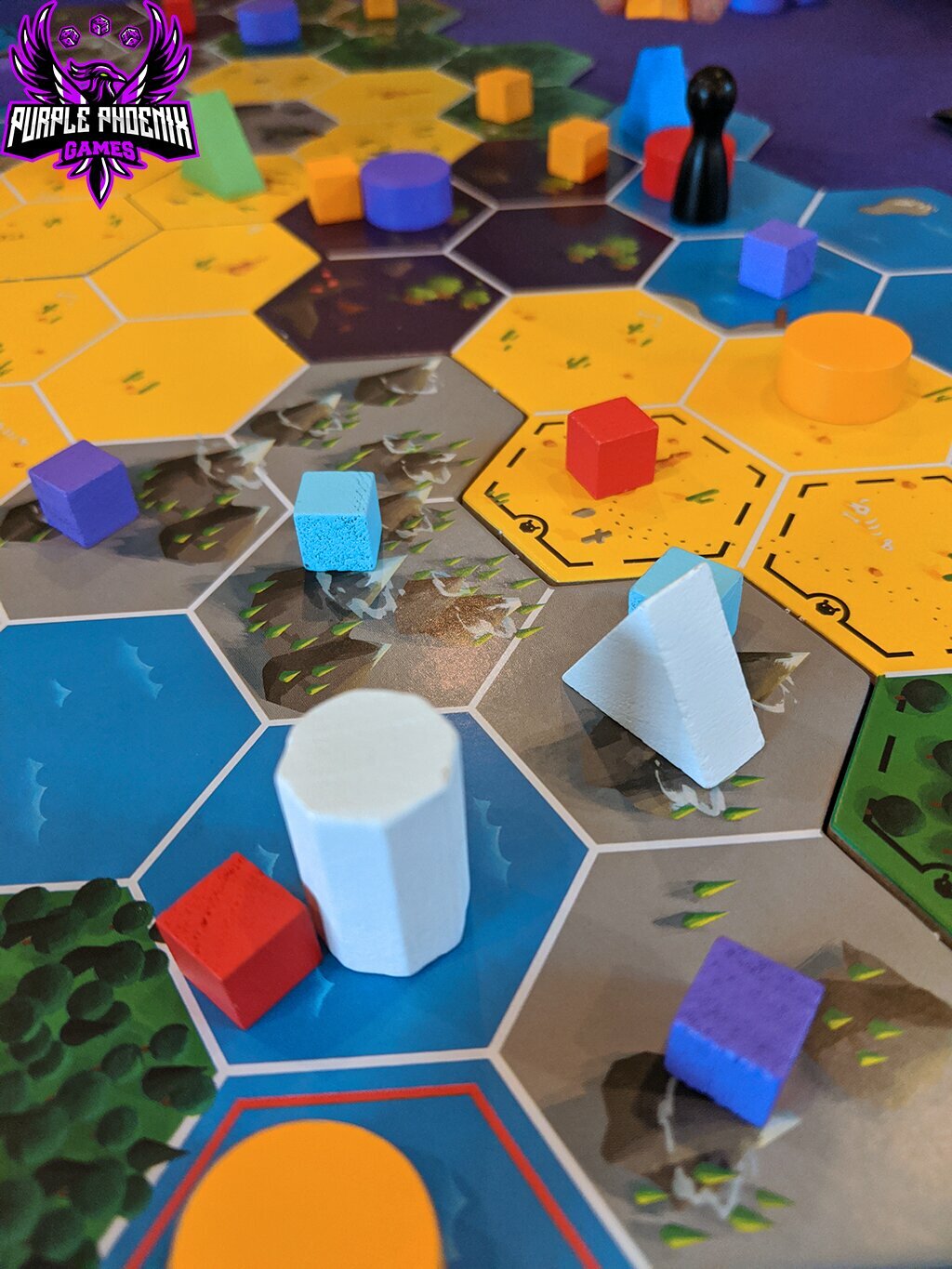
Upon setup, each player, up to a max of 4, will take a hints booklet and tokens of any of the 4 colors. The booklets provide each player with one, and only one, hint as to where the “Cryptid” could be hiding on the game board. The game board has 4 different terrain types, and a few landmark spots such as bear dens, towers, and cougar hideouts, where the monster could be hiding. Once each player has read their clue, they will go around the table a total of 2 times placing small cubes in places where the “Cryptid” is not. This serves two purposes, to assist the game from taking more than the time necessary to have fun, and to allow the players a little early game strategy to throw other players off the scent.
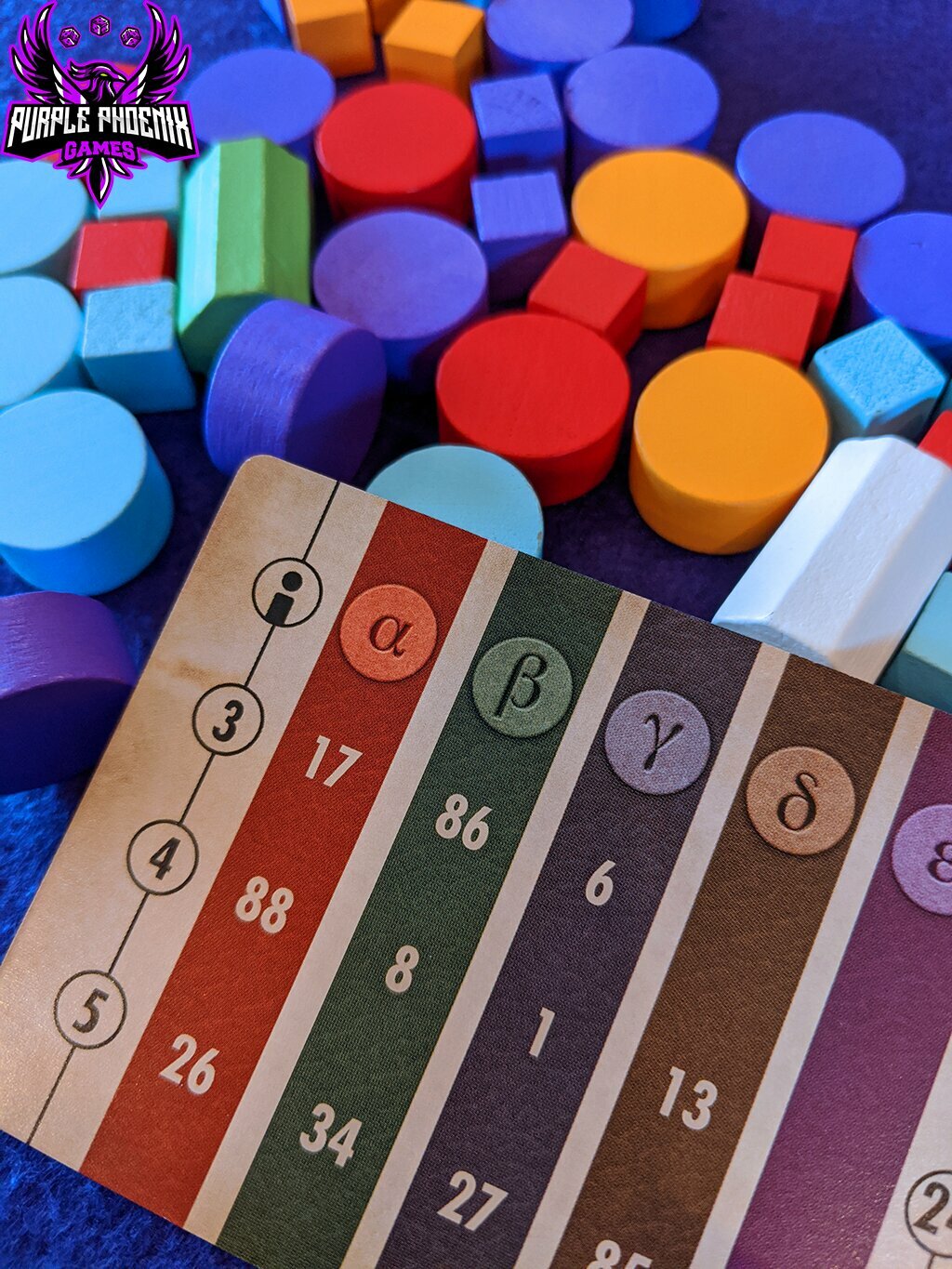
From this point forward, it is up to the players to start deducing what clues they think the other players have. A list of all possible clue types can be found in each booklet to give the players an idea of what to be considering. This also assists the game experience from taking too long. Players will now have 2 options on their turn. They can ask for information from any other player, or they can take a guess as to where they think the “Cryptid” might be. There is NO penalty for guessing the correct answer, but in doing so, if you are incorrect, you are identifying a space to the other players of where your clue may indicate where the “Cryptid” could be located. So guess carefully! As you venture forth to ask clues of other players, they will place either a cube on the space you inquired about, indicating the “Cryptid” could not be in that spot based on their clue, or they will place a disk, indicating that the space could be the space as to where the monster could be hiding. As the board begins to fill with cubes and disks, you will begin to triangulate (just a fun word I LOVE using) where you think the monster may be hiding. When you feel like you’ve got it, then take a guess. If all other players place a disk on the spot you have guessed, then you have located the “Cryptid”!
What I love about this game is its simplicity, but immersion. The game does a great job of creating that on-the-edge-of-your-seat feeling that you are about to get another clue. As I mentioned above, the designers have included some very non-intrusive, but key elements, into the game that prevent it from becoming a waiting game while other players who may be stuck trying to over-analyze the clues and accidentally hijack the time. From the simplistic clues, to the initial cube setting, the game board will fill with clues fairly quick, giving you the opportunity to make some key guesses early on.
It’s this fast paced organization of “Cryptid” that allows for multiple plays, and hopefully multiple winners. Or, if you are my 12 year old son….the winner EVERY time. Don’t ask me how he does it! My wife and I think he has special powers. We may be on to something here! Anyhow, “Cryptid” is a wonderfully whimsical game that will take you on about a 30-45 minute adventure with your friends and family. You will furiously be on the edge of your chair trying to figure out the next clue. The gameplay feels satisfying and smooth, and will leave you wanting to trek across the island again someday to find the ever illusive “Cryptid”! For these reasons, and many more, Purple Phoenix Games gives this one an illusive 19 / 24.
Upon setup, each player, up to a max of 4, will take a hints booklet and tokens of any of the 4 colors. The booklets provide each player with one, and only one, hint as to where the “Cryptid” could be hiding on the game board. The game board has 4 different terrain types, and a few landmark spots such as bear dens, towers, and cougar hideouts, where the monster could be hiding. Once each player has read their clue, they will go around the table a total of 2 times placing small cubes in places where the “Cryptid” is not. This serves two purposes, to assist the game from taking more than the time necessary to have fun, and to allow the players a little early game strategy to throw other players off the scent.
From this point forward, it is up to the players to start deducing what clues they think the other players have. A list of all possible clue types can be found in each booklet to give the players an idea of what to be considering. This also assists the game experience from taking too long. Players will now have 2 options on their turn. They can ask for information from any other player, or they can take a guess as to where they think the “Cryptid” might be. There is NO penalty for guessing the correct answer, but in doing so, if you are incorrect, you are identifying a space to the other players of where your clue may indicate where the “Cryptid” could be located. So guess carefully! As you venture forth to ask clues of other players, they will place either a cube on the space you inquired about, indicating the “Cryptid” could not be in that spot based on their clue, or they will place a disk, indicating that the space could be the space as to where the monster could be hiding. As the board begins to fill with cubes and disks, you will begin to triangulate (just a fun word I LOVE using) where you think the monster may be hiding. When you feel like you’ve got it, then take a guess. If all other players place a disk on the spot you have guessed, then you have located the “Cryptid”!
What I love about this game is its simplicity, but immersion. The game does a great job of creating that on-the-edge-of-your-seat feeling that you are about to get another clue. As I mentioned above, the designers have included some very non-intrusive, but key elements, into the game that prevent it from becoming a waiting game while other players who may be stuck trying to over-analyze the clues and accidentally hijack the time. From the simplistic clues, to the initial cube setting, the game board will fill with clues fairly quick, giving you the opportunity to make some key guesses early on.
It’s this fast paced organization of “Cryptid” that allows for multiple plays, and hopefully multiple winners. Or, if you are my 12 year old son….the winner EVERY time. Don’t ask me how he does it! My wife and I think he has special powers. We may be on to something here! Anyhow, “Cryptid” is a wonderfully whimsical game that will take you on about a 30-45 minute adventure with your friends and family. You will furiously be on the edge of your chair trying to figure out the next clue. The gameplay feels satisfying and smooth, and will leave you wanting to trek across the island again someday to find the ever illusive “Cryptid”! For these reasons, and many more, Purple Phoenix Games gives this one an illusive 19 / 24.
Purple Phoenix Games (2266 KP) rated Deep Blue in Tabletop Games
Mar 17, 2022

A couple of months ago, Travis was in town, so he and I went over to Josh’s place to get a day of gaming in. It was an awesome time to play together, and to get to experience some new games for each of us. While we were there, we got to talking about some of the games in Josh’s collection, and he pulled out Deep Blue. He’d had it for a while, but had since gotten another game that he felt did the same things but better. So he asked if either of us wanted to take it off his hands. I said sure, as I’d never played the game before. Now that it’s a part of my collection, is it going to stay there? Or will my feelings mirror Josh’s with regards to the gameplay?
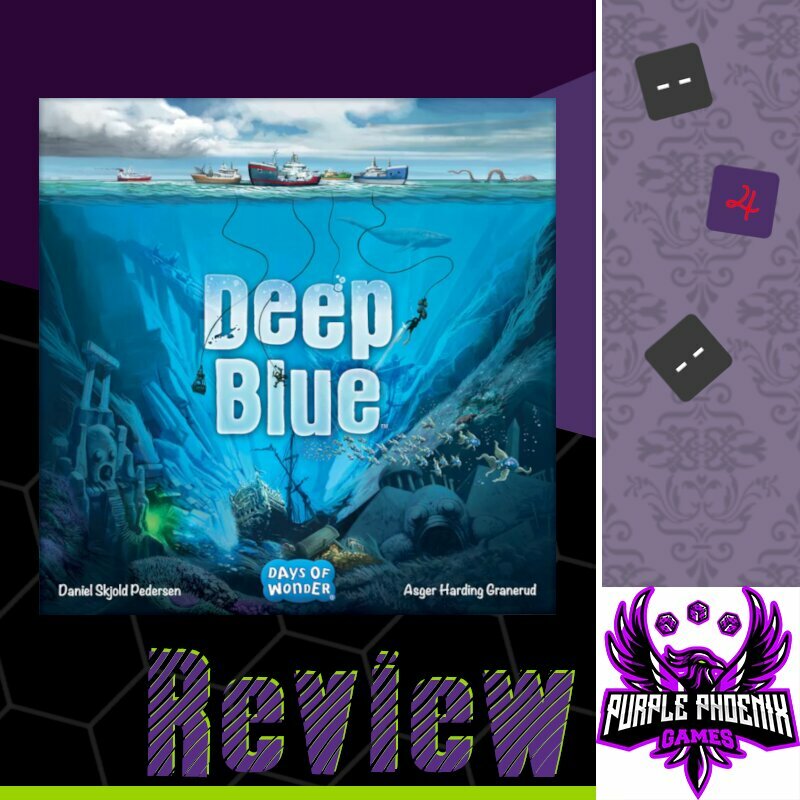
Deep Blue is a nautical game for 2-5 players of deck building, hand management, and a bit of push your luck. In it, players take on the roles ship Captains who are racing to collect treasures from undersea wrecks. Players will be hiring Crew members, sailing across the sea, and sending divers down to wrecks to salvage any valuables. The race is on, though, because you are not the only Captain on this treasure hunt… Throughout the game, players will stumble across 4 Wrecks that make up a Sunken City. Once all 4 areas of the Sunken City have been discovered and searched, the game ends. The player who earns the most VP from their collected treasures by the end of the game is declared the winner!
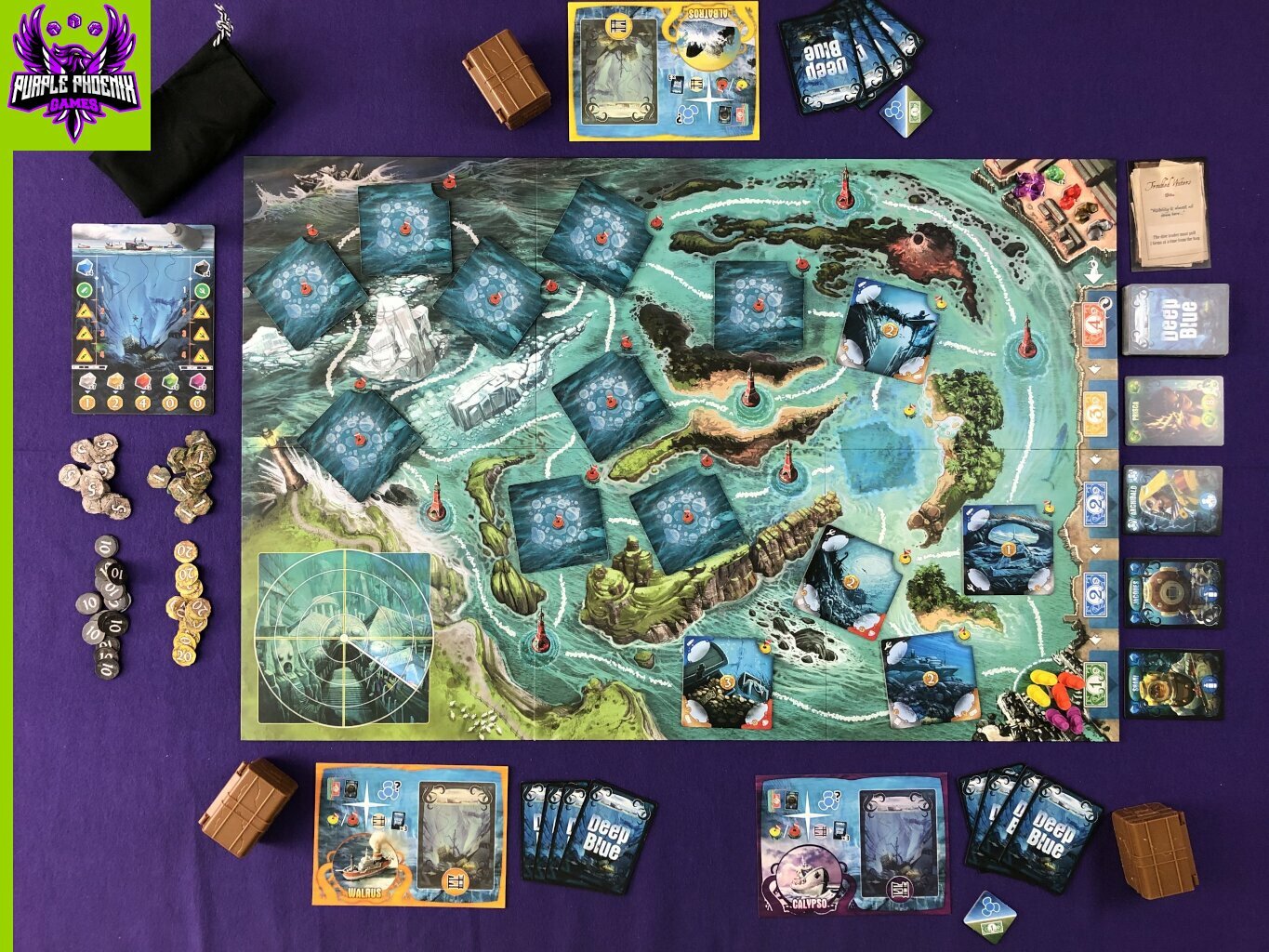
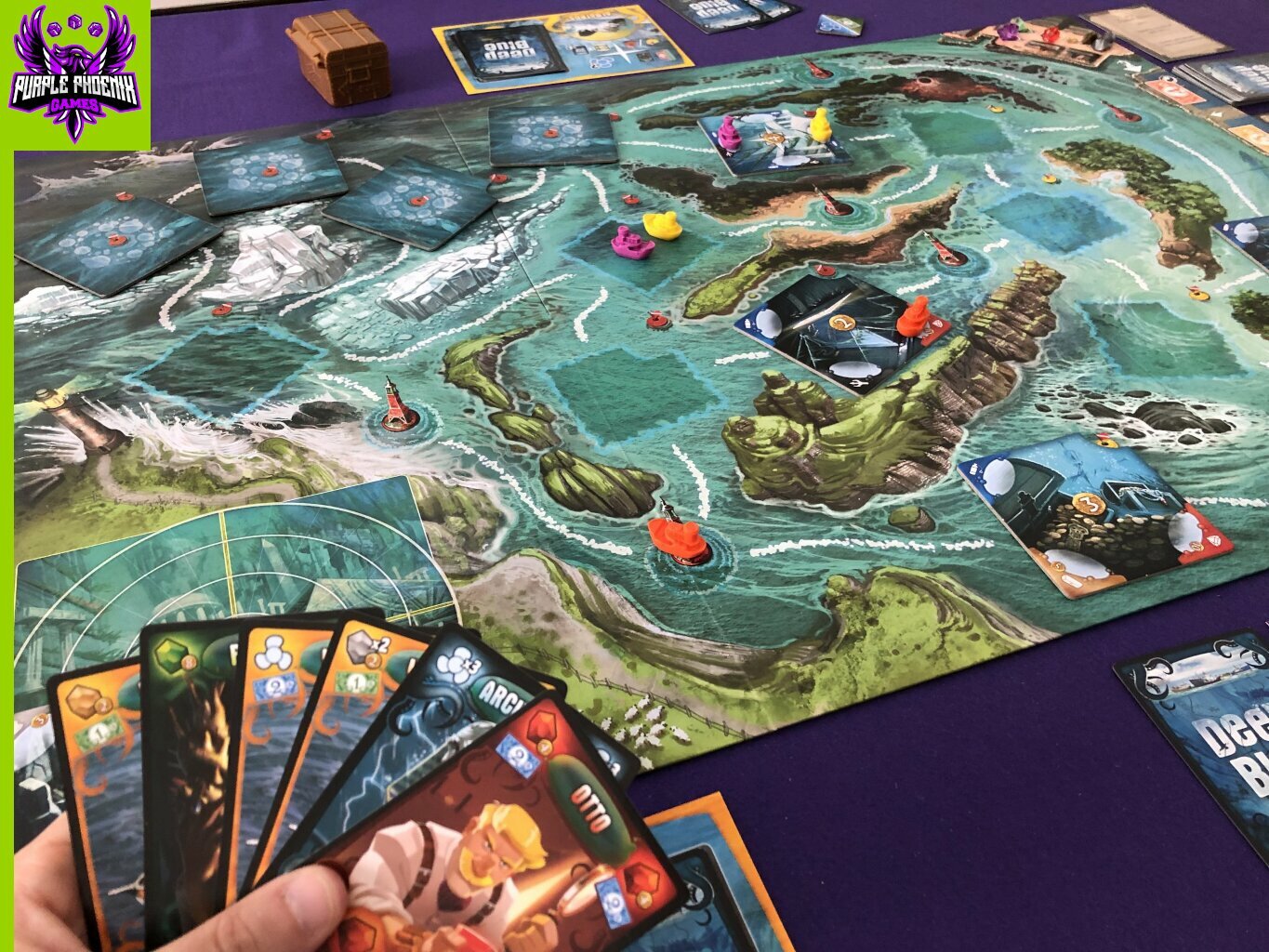
To setup for a game, follow the instructions in the rulebook – there are simply too many to detail here. The basic gist of setup is to create a market of Crew cards, shuffle and randomly distribute Wreck tiles across the board, and create a Gem pool. Each player will receive a player mat and starting cards in their chosen color, as well as 2 ships to be placed on the starting space of the board. Players will also get a treasure chest, in which they will keep their VP throughout the game. Set the Dive Site board, Gem bag, and VP tokens off to the side. Select a starting player, deal out starting tokens accordingly, and the game is ready to begin! Pictured below is the setup for a 3-player game.
On your turn, you will take one of four possible actions: Recruit a Crew Member, Sail, Rest, or Dive. Throughout the game you will be building your personal deck by Recruiting Crew Members. These new Crew offer unique abilities and scoring powers to be used during Dives. In order to recruit a Crew Member, you must pay the corresponding cost listed by its location in the market. To do so, you will play cards from your hand with $ symbols that equal the required cost. Once you play a card from your hand, it goes facedown onto the Rest area of your player mat. Take the Crew Member you just hired directly into your hand, and move the Market cards down to fill in the empty space, drawing a new card for the final slot. If you choose to Sail, you will play a number of cards from your hand with the Propeller icon. The number of icons dictates how many spaces you may sail. You can use all of your movement on one of your ships, or you can break movement across both ships. If you end a move on a face-up Wreck tile, you will ‘anchor’ your boat to one of the open scouting spots. These scouting spots offer special scoring benefits during the Dive on this tile. If you end movement on a face-down Wreck tile, first you will flip it face-up, and then anchor your boat. When landing on a buoy or an empty dive site, nothing happens.
On any turn, you may instead choose to Rest. To perform this action, you will shuffle all cards that reside on the Rest area of your player mat, and then draw only the 3 topmost cards into your hand. This is the action that allows you to refresh your hand, as you play more cards and your hand starts to dwindle. The final action choice is to Dive. This action is the crux of the game. When you have a boat on a Wreck tile, you may choose to start a Dive. The first step is to declare your Dive – decide which Wreck to Dive if your boats are on different Wreck tiles. Before the Dive begins, any opponents who have boats on adjacent Wreck tiles may move their boats to your Wreck in hopes of also profiting from the Dive. When all eligible boats have been moved to the Wreck, you will then officially begin the Dive. Take the Gem bag and Dive Site board. You will then draw Gems out of the bag, one-by-one, resolving them as necessary. Red, Gold, Silver, Green, and Purple gems are treasures, and can earn you VP. Blue and Black gems are Hazards that must be defended against in order to continue the Dive.
After a Gem is drawn and placed on the Dive Site board, players may choose to play a Crew Member to increase their VP earned. For example, one card allows you to earn 8 VP for a Green gem, instead of 0. To defend against hazards, players may play Crew from their hands who have the ability to negate the hazard, or may use the special ability of their scouting spot on the Wreck tile. If you are unable to defend against a hazard, you are forced to resurface and leave the Dive. The Dive continues in this fashion, until either the active player decides to end the Dive, or when they no longer have the ability to defend against hazards. Any players who still have boats at the Dive Site will collect VP from Crew cards they played, as well as a base amount of VP for the different Gems that were drawn. Once a Dive has been performed at a Wreck, that tile is removed from the game, leaving an empty dive site behind. If players have performed a Dive at one of the 4 Sunken City tiles, it is removed from the board, but placed on its corresponding space in the corner of the board. After all 4 Sunken City tiles have been moved to the corner of the board, the game immediately ends. Players will count up all the VP collected throughout the game, and the player with the highest score is declared the winner!
So how do I feel about Deep Blue overall? I would have to say that it’s fine. Just fine. There are some elements that I really enjoy, but others that kind of frustrate me. What I enjoy – the bits of strategy involved, and the awesome components. What I don’t enjoy – the pacing of the game and the imbalance of actions. To touch on the pros first, this game does require some strategy. You have to decide where to Sail, which Crew to recruit, which Crew to play and when to play them, etc. VP are earned by participating in Dives, so you want to make sure you can be at as many Dives as possible. That means keeping ships close to opponents to profit from any dives they may choose to initiate. Another interesting strategic element is the Rest action. You shuffle your discard pile, but then only draw the 3 topmost cards into your hand. You might not always draw what you were wanting, but you are always allowed to take a Rest action, regardless of how many cards are in your discard. There is no hand limit in this game, so do you rest every other turn to ensure you have almost all cards in your hand? Or do you dwindle your hand down in order to perform other actions instead? It’s all about your strategy, and you never quite know what your opponents are trying to do.
Now for the cons. The pacing of the gameplay feels really slow to me. You are only allowed to perform 1 action per turn, so it seems like the game takes a while to really get going. At first, everyone is going to be wanting to Sail, as all players start in the same starting area of the board. You want to get your ships out there ASAP. But then you run out of cards, so you have to take a turn to Rest and get those cards back. You’re taking a bunch of little turns to accomplish any one bigger thing, and that bogs down the gameplay for me. If you were able to perform 2 actions per turn, that would probably alleviate some of this frustration, as it would allow you to progress more quickly than by taking only a single action. Another aspect I mentioned is the imbalance of actions. The Recruit, Sail, and Rest actions all feel to me like they are on the same level, but the Dive action is different. Which in and of itself isn’t necessarily a bad thing. But the process of the Dive action is vastly different than any of the other actions, to the point that it kind of feels like a different game to me. For half of the game, you’re playing this game of strategy, deck building, and optimizing placement across the board. But for the other half, it turns into a push-your-luck frenzy that seems disjointed from the rest of the game to me. No matter how strategic and careful you are with your actions, it ultimately comes down to the luck of the draw.
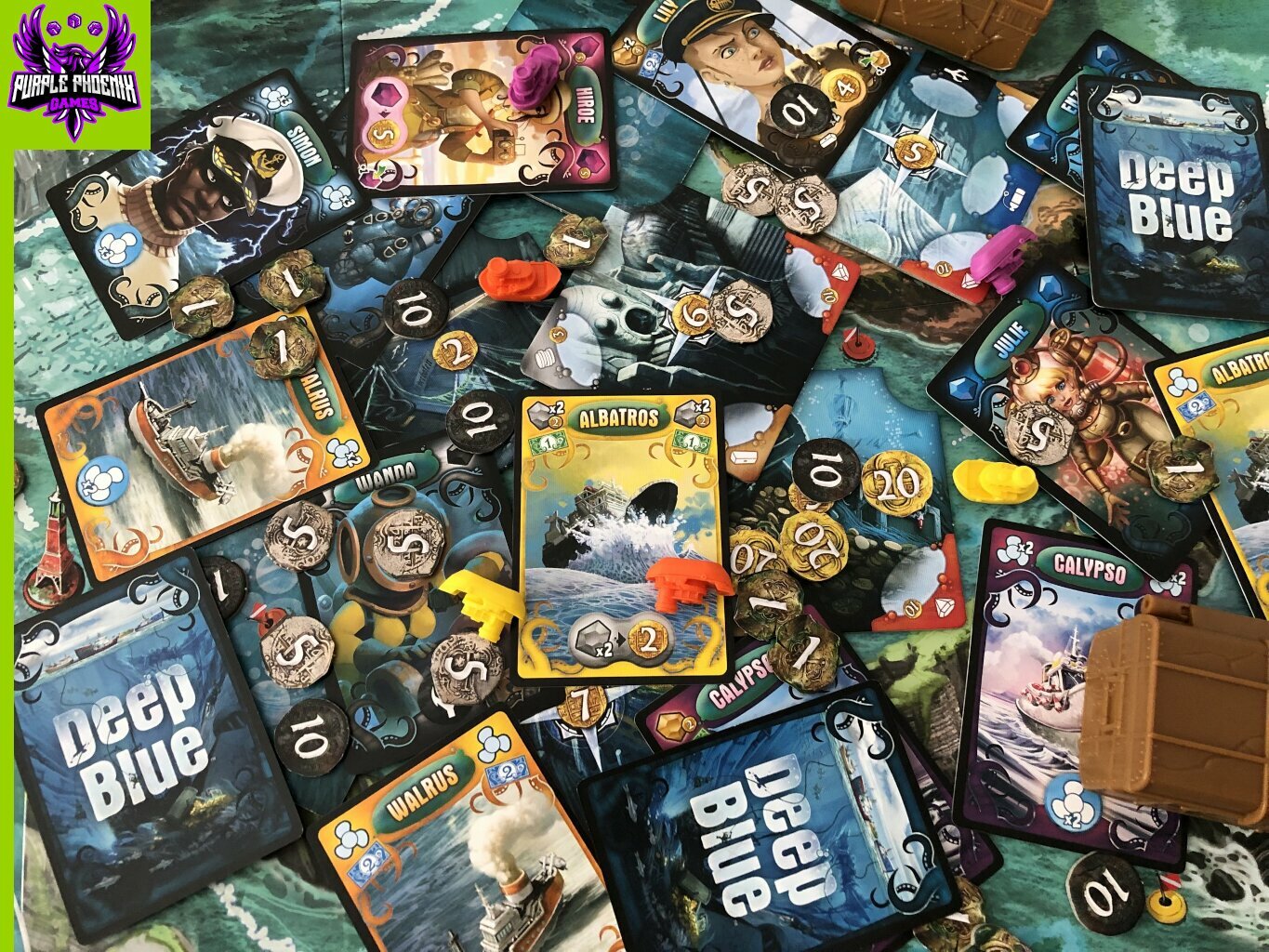
To touch on components for a minute – the production quality of this game is awesome. The board, Dive Site board, and VP tokens are nice chunky cardboard. The cards are colorful, have cool artwork, and are sturdy. And the treasure chests are awesome little plastic chests that definitely are holding up well. The Wreck tiles are big and thick, the Gems are cute, and the ships are fun to play with. So overall, this game is made very well.
You can probably tell by now that I have mixed feelings about Deep Blue. There are aspects that I like, but other aspects that negate some of those positive attributes. I was psyched for a cool nautical deck builder where I could really flex my strategy, but got more push-your-luck than I was anticipating. Deep Blue will probably stick around in my collection for the time being. But, like Josh, I will probably find something that gives me the same vibes but done better. It’s a game that I’ll pull out from time to time, but definitely not one that’s going to break into my Top 10. With that said, Purple Phoenix Games gives it a sunken 4 / 6.
Deep Blue is a nautical game for 2-5 players of deck building, hand management, and a bit of push your luck. In it, players take on the roles ship Captains who are racing to collect treasures from undersea wrecks. Players will be hiring Crew members, sailing across the sea, and sending divers down to wrecks to salvage any valuables. The race is on, though, because you are not the only Captain on this treasure hunt… Throughout the game, players will stumble across 4 Wrecks that make up a Sunken City. Once all 4 areas of the Sunken City have been discovered and searched, the game ends. The player who earns the most VP from their collected treasures by the end of the game is declared the winner!
To setup for a game, follow the instructions in the rulebook – there are simply too many to detail here. The basic gist of setup is to create a market of Crew cards, shuffle and randomly distribute Wreck tiles across the board, and create a Gem pool. Each player will receive a player mat and starting cards in their chosen color, as well as 2 ships to be placed on the starting space of the board. Players will also get a treasure chest, in which they will keep their VP throughout the game. Set the Dive Site board, Gem bag, and VP tokens off to the side. Select a starting player, deal out starting tokens accordingly, and the game is ready to begin! Pictured below is the setup for a 3-player game.
On your turn, you will take one of four possible actions: Recruit a Crew Member, Sail, Rest, or Dive. Throughout the game you will be building your personal deck by Recruiting Crew Members. These new Crew offer unique abilities and scoring powers to be used during Dives. In order to recruit a Crew Member, you must pay the corresponding cost listed by its location in the market. To do so, you will play cards from your hand with $ symbols that equal the required cost. Once you play a card from your hand, it goes facedown onto the Rest area of your player mat. Take the Crew Member you just hired directly into your hand, and move the Market cards down to fill in the empty space, drawing a new card for the final slot. If you choose to Sail, you will play a number of cards from your hand with the Propeller icon. The number of icons dictates how many spaces you may sail. You can use all of your movement on one of your ships, or you can break movement across both ships. If you end a move on a face-up Wreck tile, you will ‘anchor’ your boat to one of the open scouting spots. These scouting spots offer special scoring benefits during the Dive on this tile. If you end movement on a face-down Wreck tile, first you will flip it face-up, and then anchor your boat. When landing on a buoy or an empty dive site, nothing happens.
On any turn, you may instead choose to Rest. To perform this action, you will shuffle all cards that reside on the Rest area of your player mat, and then draw only the 3 topmost cards into your hand. This is the action that allows you to refresh your hand, as you play more cards and your hand starts to dwindle. The final action choice is to Dive. This action is the crux of the game. When you have a boat on a Wreck tile, you may choose to start a Dive. The first step is to declare your Dive – decide which Wreck to Dive if your boats are on different Wreck tiles. Before the Dive begins, any opponents who have boats on adjacent Wreck tiles may move their boats to your Wreck in hopes of also profiting from the Dive. When all eligible boats have been moved to the Wreck, you will then officially begin the Dive. Take the Gem bag and Dive Site board. You will then draw Gems out of the bag, one-by-one, resolving them as necessary. Red, Gold, Silver, Green, and Purple gems are treasures, and can earn you VP. Blue and Black gems are Hazards that must be defended against in order to continue the Dive.
After a Gem is drawn and placed on the Dive Site board, players may choose to play a Crew Member to increase their VP earned. For example, one card allows you to earn 8 VP for a Green gem, instead of 0. To defend against hazards, players may play Crew from their hands who have the ability to negate the hazard, or may use the special ability of their scouting spot on the Wreck tile. If you are unable to defend against a hazard, you are forced to resurface and leave the Dive. The Dive continues in this fashion, until either the active player decides to end the Dive, or when they no longer have the ability to defend against hazards. Any players who still have boats at the Dive Site will collect VP from Crew cards they played, as well as a base amount of VP for the different Gems that were drawn. Once a Dive has been performed at a Wreck, that tile is removed from the game, leaving an empty dive site behind. If players have performed a Dive at one of the 4 Sunken City tiles, it is removed from the board, but placed on its corresponding space in the corner of the board. After all 4 Sunken City tiles have been moved to the corner of the board, the game immediately ends. Players will count up all the VP collected throughout the game, and the player with the highest score is declared the winner!
So how do I feel about Deep Blue overall? I would have to say that it’s fine. Just fine. There are some elements that I really enjoy, but others that kind of frustrate me. What I enjoy – the bits of strategy involved, and the awesome components. What I don’t enjoy – the pacing of the game and the imbalance of actions. To touch on the pros first, this game does require some strategy. You have to decide where to Sail, which Crew to recruit, which Crew to play and when to play them, etc. VP are earned by participating in Dives, so you want to make sure you can be at as many Dives as possible. That means keeping ships close to opponents to profit from any dives they may choose to initiate. Another interesting strategic element is the Rest action. You shuffle your discard pile, but then only draw the 3 topmost cards into your hand. You might not always draw what you were wanting, but you are always allowed to take a Rest action, regardless of how many cards are in your discard. There is no hand limit in this game, so do you rest every other turn to ensure you have almost all cards in your hand? Or do you dwindle your hand down in order to perform other actions instead? It’s all about your strategy, and you never quite know what your opponents are trying to do.
Now for the cons. The pacing of the gameplay feels really slow to me. You are only allowed to perform 1 action per turn, so it seems like the game takes a while to really get going. At first, everyone is going to be wanting to Sail, as all players start in the same starting area of the board. You want to get your ships out there ASAP. But then you run out of cards, so you have to take a turn to Rest and get those cards back. You’re taking a bunch of little turns to accomplish any one bigger thing, and that bogs down the gameplay for me. If you were able to perform 2 actions per turn, that would probably alleviate some of this frustration, as it would allow you to progress more quickly than by taking only a single action. Another aspect I mentioned is the imbalance of actions. The Recruit, Sail, and Rest actions all feel to me like they are on the same level, but the Dive action is different. Which in and of itself isn’t necessarily a bad thing. But the process of the Dive action is vastly different than any of the other actions, to the point that it kind of feels like a different game to me. For half of the game, you’re playing this game of strategy, deck building, and optimizing placement across the board. But for the other half, it turns into a push-your-luck frenzy that seems disjointed from the rest of the game to me. No matter how strategic and careful you are with your actions, it ultimately comes down to the luck of the draw.
To touch on components for a minute – the production quality of this game is awesome. The board, Dive Site board, and VP tokens are nice chunky cardboard. The cards are colorful, have cool artwork, and are sturdy. And the treasure chests are awesome little plastic chests that definitely are holding up well. The Wreck tiles are big and thick, the Gems are cute, and the ships are fun to play with. So overall, this game is made very well.
You can probably tell by now that I have mixed feelings about Deep Blue. There are aspects that I like, but other aspects that negate some of those positive attributes. I was psyched for a cool nautical deck builder where I could really flex my strategy, but got more push-your-luck than I was anticipating. Deep Blue will probably stick around in my collection for the time being. But, like Josh, I will probably find something that gives me the same vibes but done better. It’s a game that I’ll pull out from time to time, but definitely not one that’s going to break into my Top 10. With that said, Purple Phoenix Games gives it a sunken 4 / 6.
Purple Phoenix Games (2266 KP) rated Tiny Epic Galaxies in Tabletop Games
Jul 16, 2019

When it comes to game themes, I’ve got them all – modern mystery, fantasy, superhero, abstract puzzle, pirates, zombies, and more. But the one theme I never had was space. Which, thinking back on it now, is kind of weird because there are so many space-themed games out there. In my exploration of the Tiny Epic series, I eventually came to the third installment, Tiny Epic Galaxies. And thus, the space-game void I didn’t even know I had was filled. Since then, I’ve played a handful of other space-themed games, but Tiny Epic Galaxies is by far my favorite.
In Tiny Epic Galaxies, you are the leader of a galactic empire looking to expand its borders and influence across space. Unfortunately, you are not the only one vying for power – competing galactic leaders are also gathering resources and sending out scouts to planets in hopes of bringing them into the folds of their own empires. Can you outwit your opponents and stake your claim on these new planets before your rivals do? Or are you doomed to live under someone else’s rule forever?
DISCLAIMER: There are several expansions to this game, but we are not reviewing them at this time. Should we review them in the future we will either update this review or post a link to the new material here. -T
Tiny Epic Galaxies is a game of dice rolling and area control/influence in which players take turns rolling dice and activating powers in order to gather resources and increase their influence on newly-discovered planets. On your turn, you will roll a specified number of dice, and activate them in any order you choose to perform any of the available actions: move a ship, advance your colonization of a planet, acquire resources, or utilize the special power of a planet you control. Gaining control of a planet earns victory points, and the game ends once a player has reached 21 VPs. Sounds simple enough, right? But here’s a twist – when you activate a die on your turn, any other player can spend a resource to follow your action and perform the same action you just did. Make sure you keep an eye on your opponents’ ships and resources – a beneficial action for you could also earn your opponents a planet!
My absolute favorite part of all the Tiny Epic games is that they have so much more to offer than meets the eye, and Tiny Epic Galaxies is no exception. The premise of the game is simple and easy to learn, yet mastering the strategy is what keeps me coming back for more. There is no single strategy for guaranteed success, and the necessity to adapt strategy based upon your dice rolls keeps the game engaging and exciting. You may have a plan in mind, but unless the dice cooperate, you’ll have to adjust that plan on the fly. And you’ve also got to pay attention to your resources and your opponents’ turns, because you might be able to capitalize on their dice if you can afford the cost. It could potentially always be your turn, even if it’s not your official turn, since you have the ability to follow an opponent’s action. You’re coming up with your own strategy, while also trying to decipher your opponents’ strategies so you can outwit them and earn the most VPs the fastest.
Another great part of this game is that there is a good amount of player interaction, but not in a way that feels confrontational. In some situations it may feel like a bit of ‘take that,’ but remember – you’re the one who gave them the opportunity to take that action! Without you taking the action in the first place, your opponent would not have had the chance to follow you! Your strategy must transcend your individual galaxy and also take into account every other galaxy in play. In Tiny Epic Galaxies, you’re constantly interacting – some interactions are just more subtle than others.
Tiny Epic Galaxies is perhaps my favorite Tiny Epic game to date. It’s quick, simple, and yet deceptively strategic. Plus the little spaceships are so cute! If I had to pick one Tiny Epic game to use to introduce someone to the series, I would pick this one. Purple Phoenix Games gives Tiny Epic Galaxies an out-of-this-world 17 / 18.
In Tiny Epic Galaxies, you are the leader of a galactic empire looking to expand its borders and influence across space. Unfortunately, you are not the only one vying for power – competing galactic leaders are also gathering resources and sending out scouts to planets in hopes of bringing them into the folds of their own empires. Can you outwit your opponents and stake your claim on these new planets before your rivals do? Or are you doomed to live under someone else’s rule forever?
DISCLAIMER: There are several expansions to this game, but we are not reviewing them at this time. Should we review them in the future we will either update this review or post a link to the new material here. -T
Tiny Epic Galaxies is a game of dice rolling and area control/influence in which players take turns rolling dice and activating powers in order to gather resources and increase their influence on newly-discovered planets. On your turn, you will roll a specified number of dice, and activate them in any order you choose to perform any of the available actions: move a ship, advance your colonization of a planet, acquire resources, or utilize the special power of a planet you control. Gaining control of a planet earns victory points, and the game ends once a player has reached 21 VPs. Sounds simple enough, right? But here’s a twist – when you activate a die on your turn, any other player can spend a resource to follow your action and perform the same action you just did. Make sure you keep an eye on your opponents’ ships and resources – a beneficial action for you could also earn your opponents a planet!
My absolute favorite part of all the Tiny Epic games is that they have so much more to offer than meets the eye, and Tiny Epic Galaxies is no exception. The premise of the game is simple and easy to learn, yet mastering the strategy is what keeps me coming back for more. There is no single strategy for guaranteed success, and the necessity to adapt strategy based upon your dice rolls keeps the game engaging and exciting. You may have a plan in mind, but unless the dice cooperate, you’ll have to adjust that plan on the fly. And you’ve also got to pay attention to your resources and your opponents’ turns, because you might be able to capitalize on their dice if you can afford the cost. It could potentially always be your turn, even if it’s not your official turn, since you have the ability to follow an opponent’s action. You’re coming up with your own strategy, while also trying to decipher your opponents’ strategies so you can outwit them and earn the most VPs the fastest.
Another great part of this game is that there is a good amount of player interaction, but not in a way that feels confrontational. In some situations it may feel like a bit of ‘take that,’ but remember – you’re the one who gave them the opportunity to take that action! Without you taking the action in the first place, your opponent would not have had the chance to follow you! Your strategy must transcend your individual galaxy and also take into account every other galaxy in play. In Tiny Epic Galaxies, you’re constantly interacting – some interactions are just more subtle than others.
Tiny Epic Galaxies is perhaps my favorite Tiny Epic game to date. It’s quick, simple, and yet deceptively strategic. Plus the little spaceships are so cute! If I had to pick one Tiny Epic game to use to introduce someone to the series, I would pick this one. Purple Phoenix Games gives Tiny Epic Galaxies an out-of-this-world 17 / 18.
Purple Phoenix Games (2266 KP) rated Jaipur in Tabletop Games
Jun 12, 2019

Finding a time when the entire group can get together to game can be rare – there always seems to be at least one person who cannot come. But fear not! Low attendance at any given game night does not automatically make it a dud! There are many excellent games for only two players, and that brings us to Jaipur!
Congratulations! You have become one of the most powerful traders in the Indian city of Jaipur – nobody can strike a deal quite like you! Only the best merchant will have the privilege of trading directly with the Maharajah (the city leader), and that is definitely you! Or at least, it was until a new competitor showed up and started swiping your customers… Will you give up your position willingly? Of course not! Through cunning strategy, you can prove that you are still the best trader the city has to offer – so let the competition begin!
In Jaipur, you and your opponent take turns buying, trading, and selling goods and camels for money. Out-sell your opponent in two out of three rounds to become the greatest tradesperson! Collect sets of the same goods to maximize your earnings, and use your camels wisely in trades as you try to anticipate the market trends. On your turn, you can take one of four actions: 1. Take a single good from the market, 2. Take all of the camels from the market, 3. Exchange goods/camels from your hand for multiple goods in the market, or 4. Sell goods. What will your strategy be? Monopolize the market in a specific good, or dabble in all goods? Try to anticipate your opponent’s strategy and throw a wrench in their plans, or mind your own business? No matter what you choose, strategy is the key to success in Jaipur, so make it count!
Jaipur is probably my favorite two-player game to date. The rules are simple enough, the mechanics (card drafting and set collection) are straight-forward, and it requires enough strategy to make it a fun challenge! Since it is a specifically two-player game, everything you do directly impacts your opponent. On your turn, not only are you trying to think of the best move for you to make, but you must also be thinking of what your opponent is trying to accomplish. If a couple of rounds pass and I see my opponent picking up silver goods, I can probably guess they’re hoping to make bank by selling a complete set. So do I pick up the next silver I see on my turn? Or do I cash in the set of diamonds that I’ve been secretly picking up each round? My strategy is constantly changing based on what cards appear in the market at any given time, and that is what elevates this technically simple game for me!
The only grievance for me with Jaipur has to do with the market distribution. The market cards are re-shuffled at the end of each round, and sometimes the shuffling is not balanced. I have lost many rounds because I am forced to take low-scoring goods or camels from a saturated market, only to reveal high-scoring goods for my opponent to take on their turn. Ultimately, that is not an issue with the game, but an issue with my poor card-shuffling ability. If anything, I try to see it as a strategic challenge – how can I best use these lowly goods to balance out the better cards my opponent has picked up? Nothing is a given in this game, and the market can completely change in a single turn!
If you want a quick but engaging game, look no further than Jaipur. It’s a solid two-player game that deserves more love! Purple Phoenix Games gives it a 16 / 18 (Bryan hasn’t played it yet).
https://purplephoenixgames.wordpress.com/2018/12/28/jaipur-review/
Congratulations! You have become one of the most powerful traders in the Indian city of Jaipur – nobody can strike a deal quite like you! Only the best merchant will have the privilege of trading directly with the Maharajah (the city leader), and that is definitely you! Or at least, it was until a new competitor showed up and started swiping your customers… Will you give up your position willingly? Of course not! Through cunning strategy, you can prove that you are still the best trader the city has to offer – so let the competition begin!
In Jaipur, you and your opponent take turns buying, trading, and selling goods and camels for money. Out-sell your opponent in two out of three rounds to become the greatest tradesperson! Collect sets of the same goods to maximize your earnings, and use your camels wisely in trades as you try to anticipate the market trends. On your turn, you can take one of four actions: 1. Take a single good from the market, 2. Take all of the camels from the market, 3. Exchange goods/camels from your hand for multiple goods in the market, or 4. Sell goods. What will your strategy be? Monopolize the market in a specific good, or dabble in all goods? Try to anticipate your opponent’s strategy and throw a wrench in their plans, or mind your own business? No matter what you choose, strategy is the key to success in Jaipur, so make it count!
Jaipur is probably my favorite two-player game to date. The rules are simple enough, the mechanics (card drafting and set collection) are straight-forward, and it requires enough strategy to make it a fun challenge! Since it is a specifically two-player game, everything you do directly impacts your opponent. On your turn, not only are you trying to think of the best move for you to make, but you must also be thinking of what your opponent is trying to accomplish. If a couple of rounds pass and I see my opponent picking up silver goods, I can probably guess they’re hoping to make bank by selling a complete set. So do I pick up the next silver I see on my turn? Or do I cash in the set of diamonds that I’ve been secretly picking up each round? My strategy is constantly changing based on what cards appear in the market at any given time, and that is what elevates this technically simple game for me!
The only grievance for me with Jaipur has to do with the market distribution. The market cards are re-shuffled at the end of each round, and sometimes the shuffling is not balanced. I have lost many rounds because I am forced to take low-scoring goods or camels from a saturated market, only to reveal high-scoring goods for my opponent to take on their turn. Ultimately, that is not an issue with the game, but an issue with my poor card-shuffling ability. If anything, I try to see it as a strategic challenge – how can I best use these lowly goods to balance out the better cards my opponent has picked up? Nothing is a given in this game, and the market can completely change in a single turn!
If you want a quick but engaging game, look no further than Jaipur. It’s a solid two-player game that deserves more love! Purple Phoenix Games gives it a 16 / 18 (Bryan hasn’t played it yet).
https://purplephoenixgames.wordpress.com/2018/12/28/jaipur-review/
Purple Phoenix Games (2266 KP) rated Dungeon Roll in Tabletop Games
Jun 12, 2019
One of the best parts of the board gaming experience is finding a fun group of people with whom to play! Sometimes, though, coordinating a game night is easier said than done. We all must occasionally forego the group experience and face the world as the Lonely Only. But fear not! The world of solo-play is a vast and exciting realm! What follows is a chronicle of my journey into the solo-playing world – notes on gameplay, mechanics, rules, difficulty, and overall experience with solo variations of commonly multiplayer games! I hope this will provide some insight as you continue to grow your collection, or explore your already owned games!
Dungeon Roll is a quick and fun dice-rolling game where Heroes delve into a dungeon to fight monsters (potentially including a dragon!), find treasure, and gain experience points based on how deep into the dungeon they go. If you are playing in a group or solo, the rules of the game are the same – the only difference is how you win! In group play, the winner is the player with the most experience points after 3 rounds of play. In solo play, you are working to get as many experience points as possible – competing against previous plays trying to best yourself!
After a few runs of Dungeon Roll, it has quickly become one of my favorite games to play solo for two main reasons. First, I like and appreciate the simplicity of the rules. It is quick and easy to learn, and the solo variation has no extra rules or stipulations. Simply put, I don’t have to worry about forgetting solo rules because there aren’t any! Don’t have any other players? Great! Just play like you normally would! Yeah, I may have to roll my own Dungeon Dice, but I don’t have to worry about controlling any ghost players or remembering whether or not I need to start the game with a solo handicap. The simplicity and uniformity of the rules, regardless of player count, means that I don’t have to spend time re-reading the rulebook to refresh my memory on solo play, and can just get down to playing instead!
The next reason why I love to play Dungeon Roll solo is due to the variability and unpredictability of the game. The base game comes with 8 Hero cards, each with unique abilities, and the expansion packs provide even more Hero choices. Different heroes/abilities lend themselves to different strategies for success – there is not one right way to play. Even if you pick to play as the same Hero every game, though, the dice rolling mechanism makes sure that no two games are ever alike. Dice rolling can be a fickle friend, and oftentimes the success (or failure) of a round depends solely on the luck of the roll. I, unfortunately, am a notoriously bad dice-roller…. BUT that helps make this game more interesting for me because it forces me to really strategize how I am going to use my Hero abilities, treasure tokens, and dice to my benefit. Sometimes it works out well and I come out with a respectable score! But then again, sometimes it’s the exact opposite and I come out wondering whether or not I should even log the play with as feeble a score as I got… Either way, dice rolling is unpredictable and that (along with different Hero abilities and treasure tokens) makes for a unique game every time.
Dungeon Roll is a fun and competitive game for both groups and the solo player. This game is deceptively simple and wildly entertaining, and I highly recommend adding it to your solo arsenal!
https://purplephoenixgames.wordpress.com/2018/12/21/solo-chronicles-dungeon-roll/
Dungeon Roll is a quick and fun dice-rolling game where Heroes delve into a dungeon to fight monsters (potentially including a dragon!), find treasure, and gain experience points based on how deep into the dungeon they go. If you are playing in a group or solo, the rules of the game are the same – the only difference is how you win! In group play, the winner is the player with the most experience points after 3 rounds of play. In solo play, you are working to get as many experience points as possible – competing against previous plays trying to best yourself!
After a few runs of Dungeon Roll, it has quickly become one of my favorite games to play solo for two main reasons. First, I like and appreciate the simplicity of the rules. It is quick and easy to learn, and the solo variation has no extra rules or stipulations. Simply put, I don’t have to worry about forgetting solo rules because there aren’t any! Don’t have any other players? Great! Just play like you normally would! Yeah, I may have to roll my own Dungeon Dice, but I don’t have to worry about controlling any ghost players or remembering whether or not I need to start the game with a solo handicap. The simplicity and uniformity of the rules, regardless of player count, means that I don’t have to spend time re-reading the rulebook to refresh my memory on solo play, and can just get down to playing instead!
The next reason why I love to play Dungeon Roll solo is due to the variability and unpredictability of the game. The base game comes with 8 Hero cards, each with unique abilities, and the expansion packs provide even more Hero choices. Different heroes/abilities lend themselves to different strategies for success – there is not one right way to play. Even if you pick to play as the same Hero every game, though, the dice rolling mechanism makes sure that no two games are ever alike. Dice rolling can be a fickle friend, and oftentimes the success (or failure) of a round depends solely on the luck of the roll. I, unfortunately, am a notoriously bad dice-roller…. BUT that helps make this game more interesting for me because it forces me to really strategize how I am going to use my Hero abilities, treasure tokens, and dice to my benefit. Sometimes it works out well and I come out with a respectable score! But then again, sometimes it’s the exact opposite and I come out wondering whether or not I should even log the play with as feeble a score as I got… Either way, dice rolling is unpredictable and that (along with different Hero abilities and treasure tokens) makes for a unique game every time.
Dungeon Roll is a fun and competitive game for both groups and the solo player. This game is deceptively simple and wildly entertaining, and I highly recommend adding it to your solo arsenal!
https://purplephoenixgames.wordpress.com/2018/12/21/solo-chronicles-dungeon-roll/
March of Empires
Games and Social Networking
4.0 Rate It
App
Brace yourself for an age of massive medieval war, where you will march over your rivals’ burning...