

Purple Phoenix Games (2266 KP) rated Gekitai in Tabletop Games
Feb 20, 2020
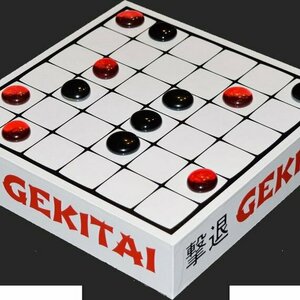
Gekitai is an abstract strategy game with very minimal rules. The phrase, “easy to learn, but hard to master” is very overdone, but it certainly applies here. For those that are wondering, the term, “Gekitai” is Japanese for “Repel.” You will see why this nomenclature is perfect for this game soon.
DISCLAIMER: We were provided a prototype copy of this game for the purposes of this review. Though I know the designer personally, I will be reviewing this game as an impartial judge. -T
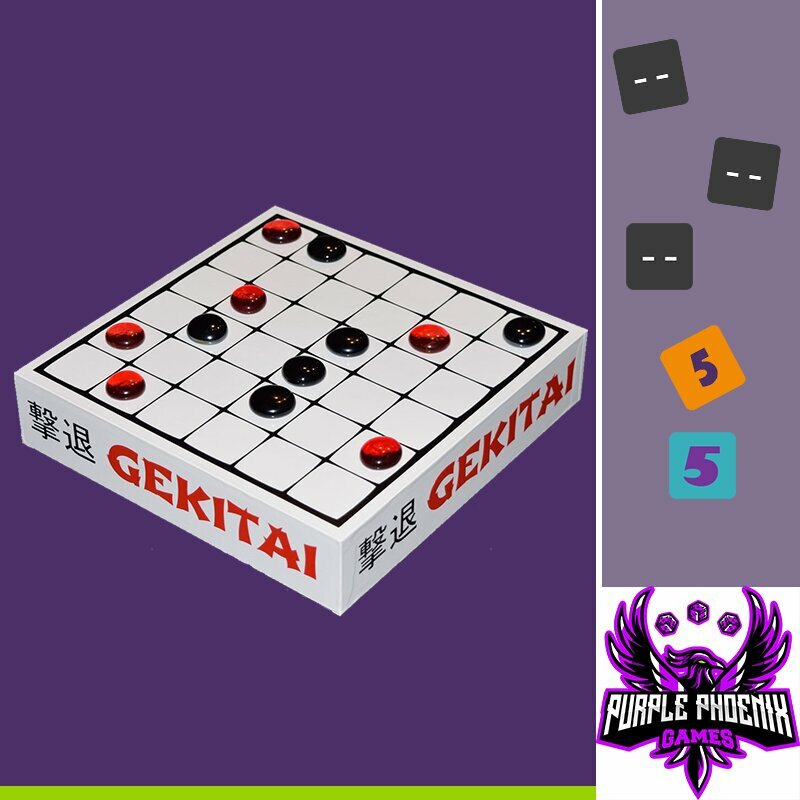
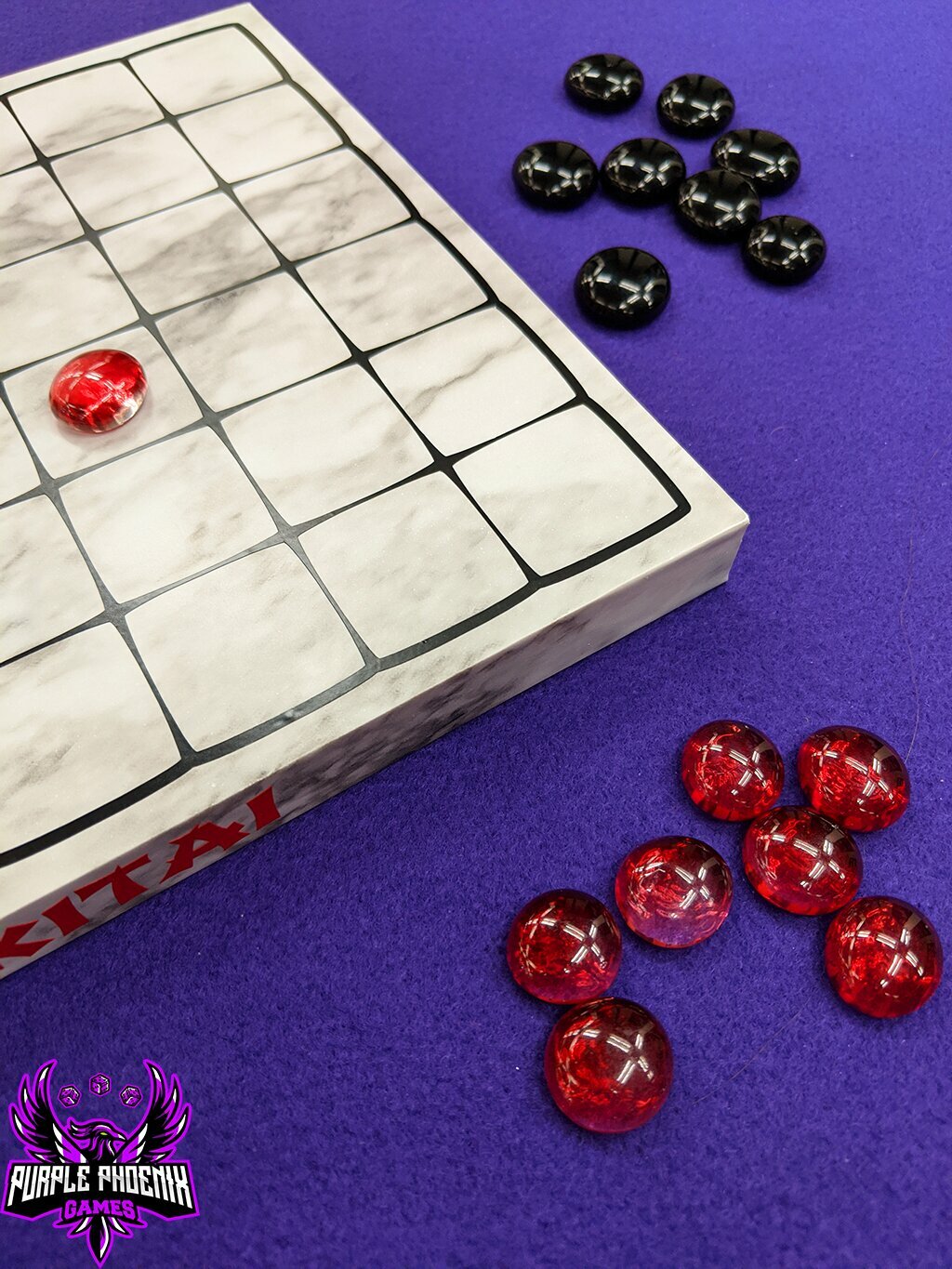
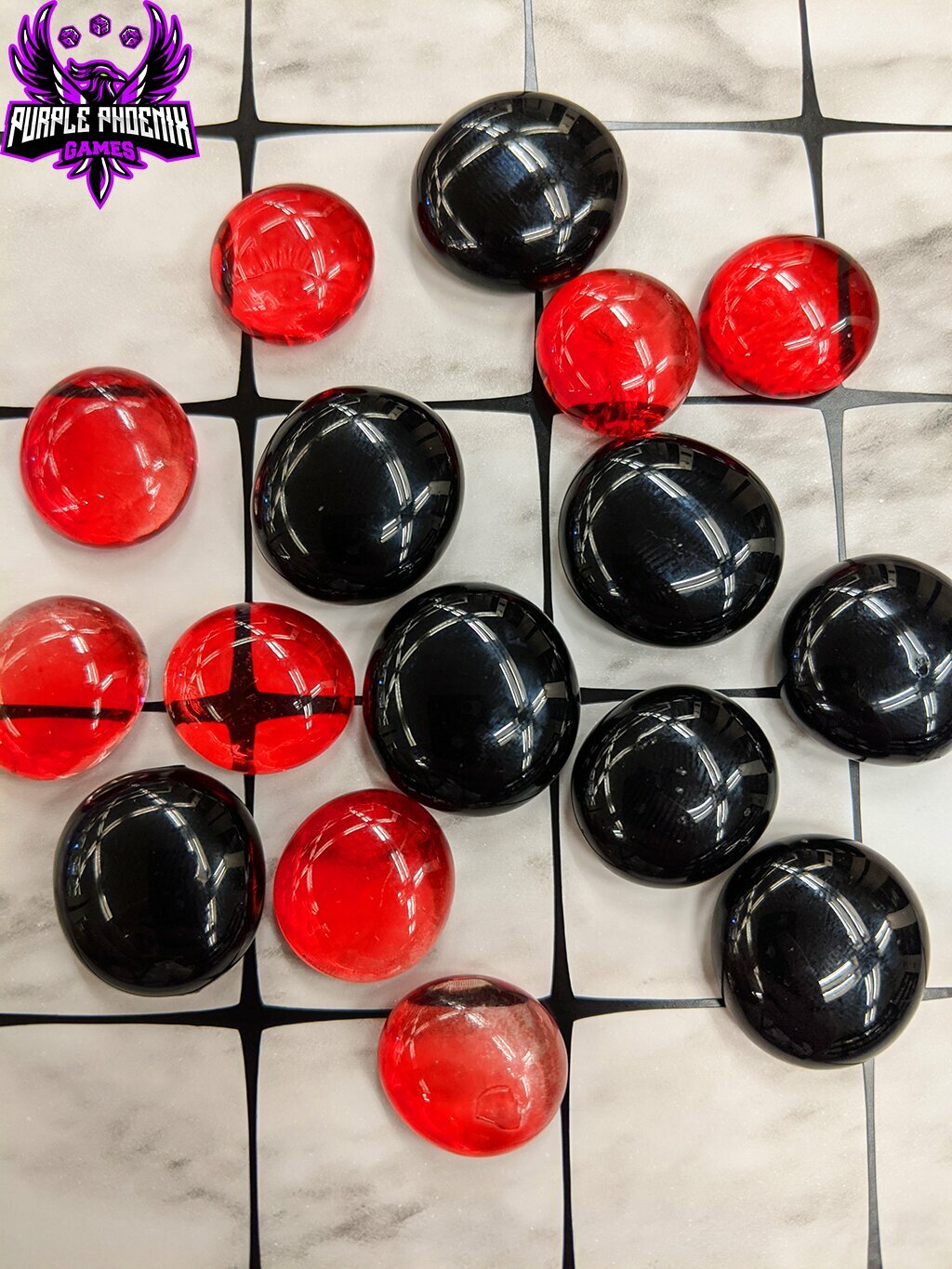
Normally I like to include setup instructions here in this paragraph for my reviews, so I shall do that now. To setup, place the board between the two players and give each player their eight matching pieces. In my game, they are red and black glass beads. For convenience I will refer to the red ones as apples and the black ones as 8-balls. That’s it. You’re setup to play.
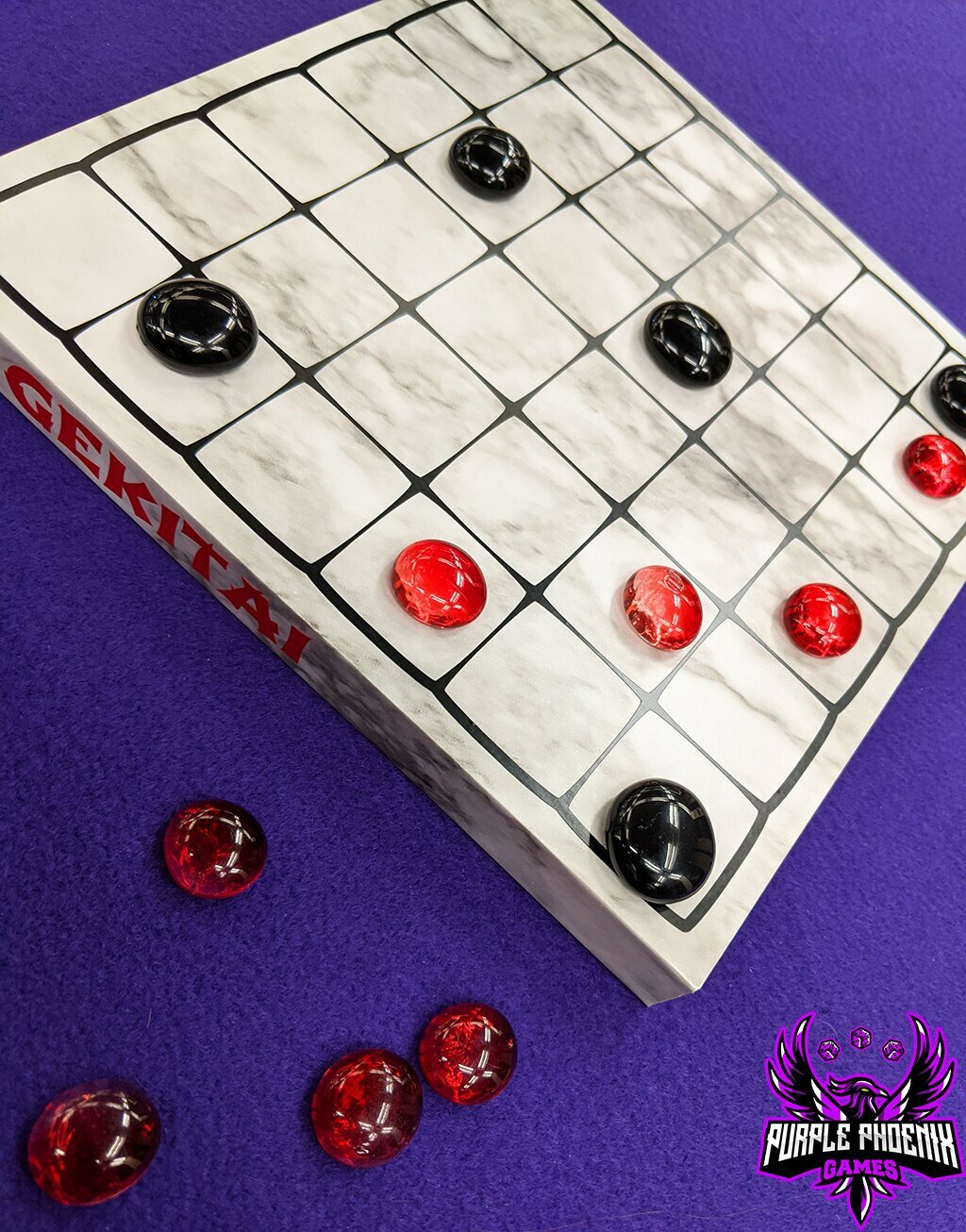
The object of Gekitai is to fulfill one of two victory conditions: play until one player has three of their pieces in a row (diagonally OR orthogonally) or finish their turn with all eight of their pieces on the board. Easy, right? It most certainly is! Oh, you want the catch? Ok then, here’s the catch: while players can place any piece on any empty square, once placed the pieces will repel all other adjacent pieces away from itself. This includes their own pieces.
So let’s say you start the game and place your first 8-ball in a corner closest to you. Great opening noob. I mean move. You see, I would just place one of my apples adjacent to your 8-ball and repel it right off the board. That doesn’t mean that I have captured your 8-ball or anything like that. You would be able to use it again next turn if you like, but this is the danger of outside spaces. When repelled, a piece (your 8-ball) continues one space in the direction away from the most recently-placed piece (my apple). So diagonally if diagonal from the just-placed apple, or orthogonally otherwise. Again, this would affect all pieces that are adjacent, not just your opponent’s. Think of placing a piece as someone doing a cannonball in an infinity pool. Everyone already in the pool will get pushed away from the point of impact and may even fall out of the pool, but be able to hop back in soon.
One note about pushing other pieces. One piece can only push one other piece. Here’s what I mean. When my apple is placed near another 8-ball or apple, it repels it, right? Well, a piece may only be repelled if there is an empty space for it to go. If another apple is blocking the pathway of an affected apple or 8-ball, no movement happens. The pieces has been blocked. In this way strategy plays in integral part in Gekitai – you must always be thinking about 10 turns in the future. Play continues in this fashion until a player has achieved three-in-a-row or placed all of their pieces on the board.
Components. Again, we are playing with a PNP prototype game package. Granted, this PNP is assembled by the designer and looks WAAAY better than if I had tried to assemble it myself, so we do take that into consideration. Components aside (because unless you order a copy from the designer via Etsy in the future, you will probably download the files and play on a sheet of paper with coins or other stand-ins), this is a typical, classic abstract strategy-style game. The board can look any way you like in a 6×6 board and you can you use any bits for your game. Heck, you could even play with real apples and 8-balls. But what we were provided is excellent and looks great on the table.
But gameplay. Like I mentioned earlier, I know the designer and his family and they are wonderful people. Luckily that makes no difference here because the game itself is absolutely wonderful! My wife typically kicks my booty in all abstracts. Ok fine, usually in all games. BUT! After playing Gekitai lots with her, she has only beaten me once! When we do play it she asks for rematches several times over and I just love being able to have a go-to game for when we have a few minutes between running around with the kids. I love it. She loves it. We at Purple Phoenix Games, with an enthusiastic guest score from my wife, give Gekitai a cannonball-esque 11 / 12. We suggest you go to the BGG page where the PNP files can be printed. You will want this in your collection.
Purple Phoenix Games (2266 KP) rated Blokus in Tabletop Games
Jan 30, 2020

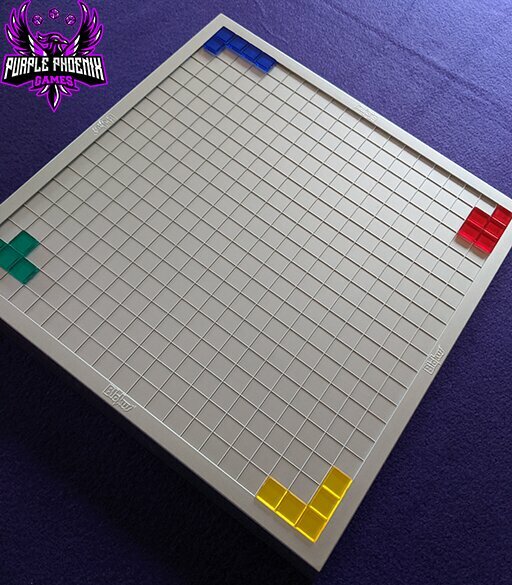
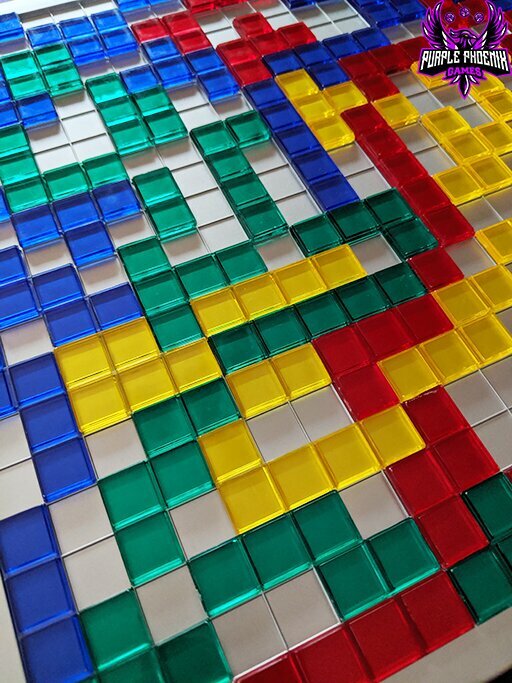
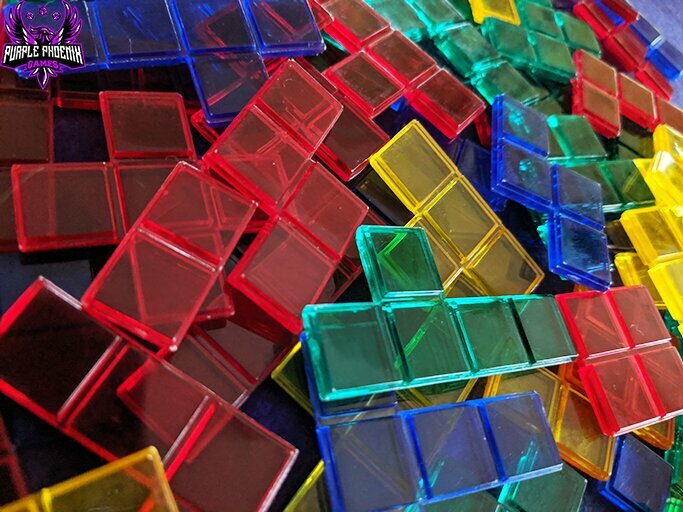
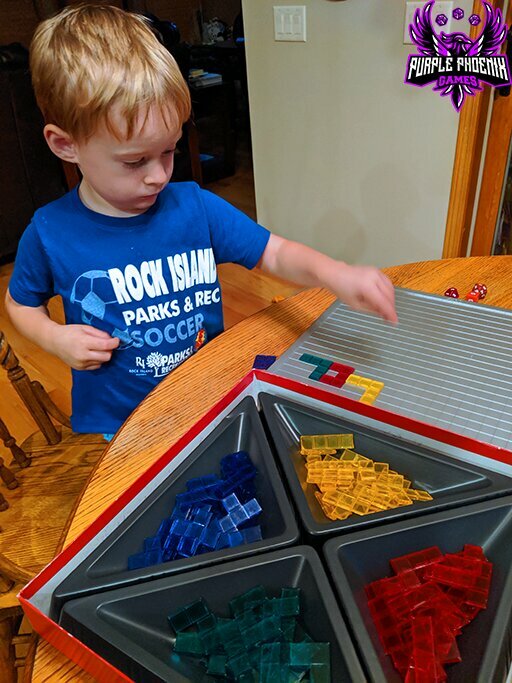
Blokus is a Tetris-like game of abstract strategy, hand management and tile placement. Players receive a set of colored tiles in various shapes, and take turns playing them to the board. Simple, right? The catch is that when you play a tile, it cannot be placed adjacent to your other pieces, but it must touch corners with at least one of your other pieces in play. Your tiles can be adjacent to those of your opponents, just not your own! (See picture below for reference) Play continues until no player can legally place anymore tiles. At the game’s end, if you successfully placed all of your tiles, you receive 15 points. For any tiles you were unable to place, count up the number of squares on each tile, and each square counts as a negative point. The player with the highest score is the winner!
I really like Blokus. For such a simple game, it actually requires a decent amount of strategy. As the game progresses, the available board space gets smaller – you’ve really got to be strategizing the best ways to place your own tiles while also trying to anticipate where your opponents might place theirs. There might even be a little “Take That” going on in your game if you can find ways to block your competitors while getting yourself ahead! I really like that there’s no single strategy for success – you’re always adapting to the board at any given time, so no two games will ever be the same.
Another thing I like about Blokus is that it is simple to learn, teach, and play. It can be played with pretty much all ages, which makes it a good pick for a fun family game. Blokus is a light game in terms of complexity, but that doesn’t negate the strategic implications. I think it’s a great balance of simplicity and strategy, and that makes it an enjoyable game to play every time.
If you’re looking for a family game, or even a nice little filler game, consider Blokus. It’s pretty simple, but in no way does that make it boring, in my opinion. It’s a game I’m always down to play, and one that I use to introduce people to the hobby. Purple Phoenix Games gives Blokus a poor-play-photo 17 / 24.
Terror in Meeple City
6.7 Rate It
Tabletop Game
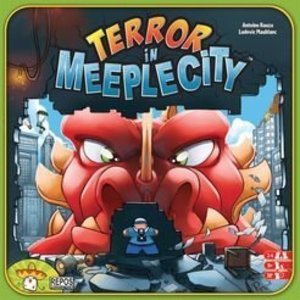
In Terror in Meeple City (formerly known as Rampage), you arrive in Meeple City as a gigantic,...
Purple Phoenix Games (2266 KP) rated Castle: The Detective Card Game in Tabletop Games
Jul 17, 2021
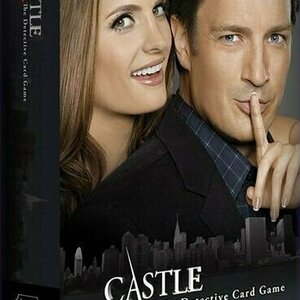

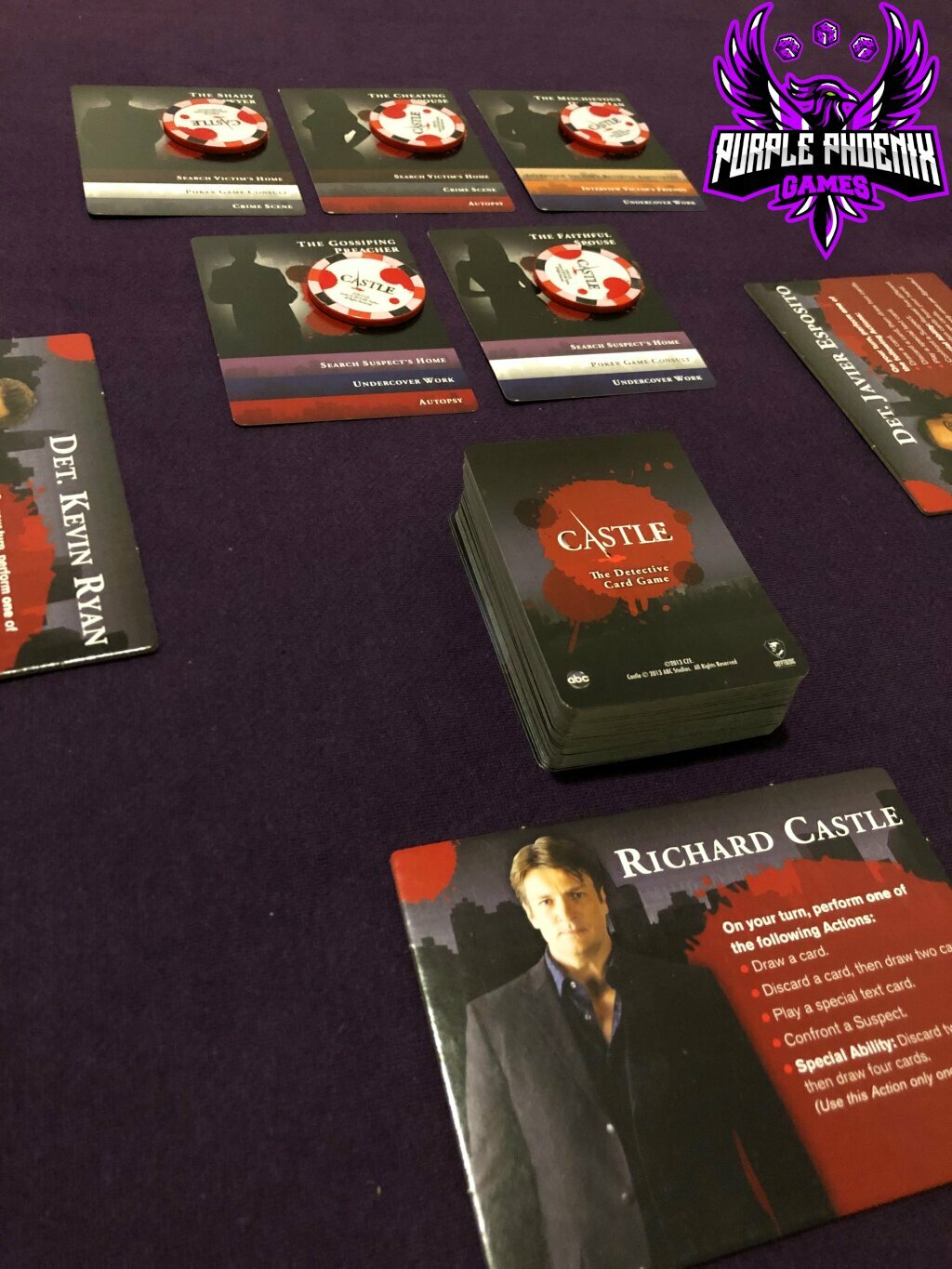
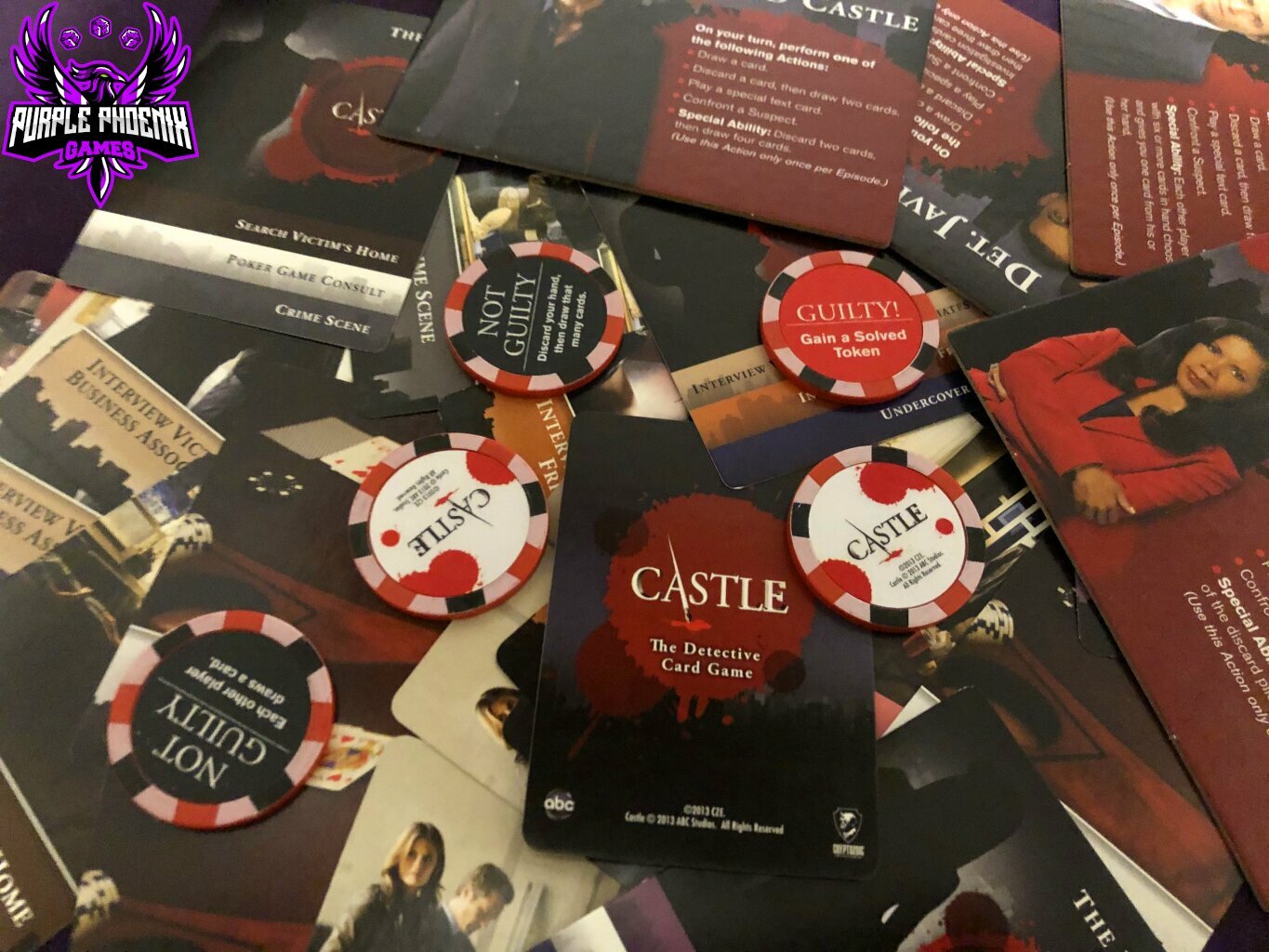
In Castle: The Detective Card Game (referred to as just Castle for the rest of this review) is a murder-mystery card game in which players assume the role of a character from the show, and work to gather evidence and conduct investigations in order to solve the murder at hand! To set up a game, give every player a Character card that represents one of the main characters from the show. Each Character card has a unique Special Ability to be used during play. Shuffle the Suspect cards, and randomly draw five to be placed face-up in the middle of the table. Select one Guilty token and four Not Guilty tokens – shuffle them together face-down and then place one token on each of the Suspect cards. Shuffle the deck of Investigation cards, deal 3 to each player, place the remaining cards into a Draw deck, and the game is ready to begin!
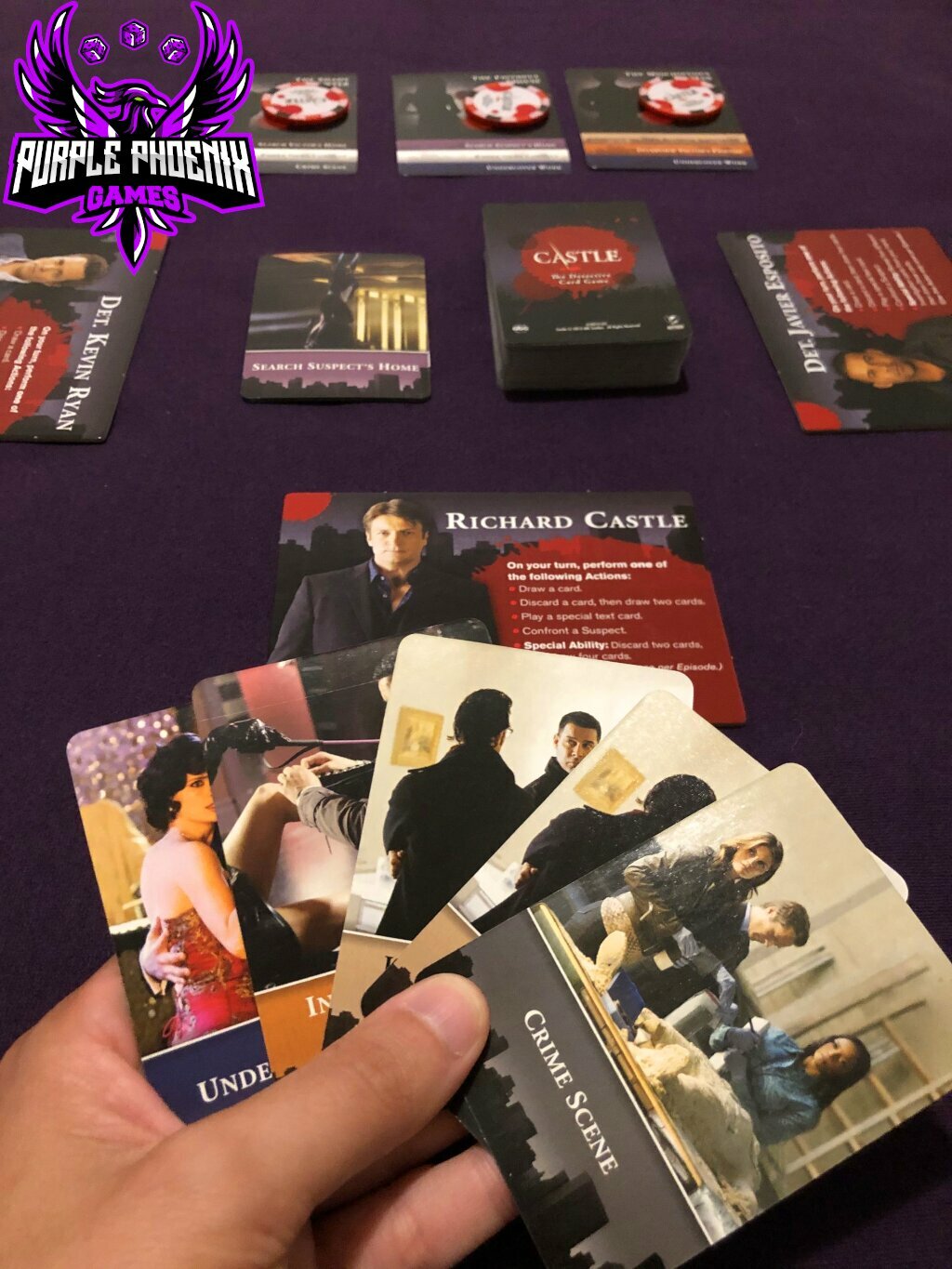
Moving in clockwise order, players will take turns performing one of the following actions: Draw a card, Discard one card to draw two cards, Play a Special Text card, Use your Special Ability, or Confront a Suspect. The first two actions regarding drawing cards are pretty self-explanatory. Throughout the game, you might draw into your hand an Investigation card with Special Text. You may play a Special Text card, and perform the specified action on your turn. Each Character has a Special Ability that can be used once per game, so plan wisely and use it appropriately! The last action, Confront a Suspect, is what the entire game is leading to. In order to Confront a Suspect, you must have the three Investigation cards listed on the bottom of the Suspect card in hand. When performing this action, you will reveal the three requisite Investigation cards, and then you flip the token on that Suspect card. If the token reads Guilty, then you have won the game! If the token reads Not Guilty, perform the action listed on the token, remove that Suspect and token from the game, discard your used Investigation cards, and play continue with a narrowed Suspect pool! The goal is to be the first player to find the Guilty party before the Draw deck runs out of cards.
Pretty straight-forward, right? I think so, and that’s one of the things I really like about this game. The gameplay is fast and simple, and makes for a quick little set collection game. Another neat element of this game is that although it is based around the Castle TV show, you do not need to have watched any of the show to play. Anyone can play and not feel like they are missing any vital information if they haven’t seen the show, and that makes it accessible to all players, not just fans of the show.
Even though I love the show, I have to admit that the gameplay, although fast and simple, is heavily dependent on the luck of the draw. Throughout the game, you are working to collect sets of the necessary Investigation cards for individual suspects, but the only way in which cards are distributed is through drawing them from the deck. There isn’t an offering that you ‘pay’ certain resources for coveted cards, there’s no real way to know in advance what card you are going to draw, etc. It really depends on how the deck was shuffled whether you will be successful or not. There are no real opportunities to strategize, and that keeps the overall gameplay kind of stagnant. Yes, there are Special Text cards and each Character has a unique ability, but deciding when to use them is kind of a shot in the dark due to the dependence on luck.
Let’s talk components for a minute. All of the Investigation and Character cards use photos or stills from the actual TV show. Again, you need not have watched it to play, but the use of the stills makes the game more immersive and nostalgic for those that have seen it. I love looking at the cards and trying to remember from which episode each still is, and if I remember who the killer was in that specific scenario. It’s just a fun little thing. The cards are all of good sturdy quality and will hold up decently in the long run. The Guilty/Not Guilty tokens in this game are some thick and heavy poker chips and they are AWESOME. They are so high quality, I just love to manipulate them, and they add some cool ‘bling’ to the game.
All in all, is Castle a great card game? No, not necessarily. It is a fun little murder mystery game, but not one that requires and real strategy or brain power to successfully play. Do I like it though? Absolutely, because it is based on my favorite show! If you’re looking for a nice filler game, or a game that doesn’t require too much focus, give Castle: The Detective Card Game a shot. That being said, I feel like only fans of the show will be trying this game, but I guess you can prove me wrong! Purple Phoenix Games give this a mischievous 6 / 12.

Purple Phoenix Games (2266 KP) rated Indigo in Tabletop Games
Jun 12, 2019

Indigo is a strategy game of tile placement and route building in which players are attempting to get various gems from the center of the board through their “gateways” on the edges of the board to score points. Players are each building their own pathways, in a maze-like sort of way, to maneuver the gems around the board, through their own gateways, and away from those of their opponents. Each player receives one tile, and on their turn, plays it to the board. Tiles can be placed anywhere on the board, they don’t necessarily need to be placed adjacent to other tiles. If you play a tile to extend an existing route with a gem on it, move the gem as far along that route as possible. After playing a tile, you draw a new tile to be played on your next turn. The game continues until all gems have been claimed, and then points are added! Gems are worth points depending on their color, and the player with the highest score wins!
I think Indigo is such a neat game. It is so simple, yet strategic, and that makes it so much fun for me to play. The board itself becomes a visual maze as tiles are added, and you must be diligent about watching which pathways are open and available to you, while also trying to make sure you keep pathways blocked off towards your opponents. The possibilities are endless with this game in terms of tile placement and strategy, and that keeps me engaged the entire game. I also love the fact that all players only have 1 tile to play at any given time – you’ve got to make your tile work, you don’t have a hand of tiles from which to choose your best option. That ups the strategy factor even more because one misplaced tile could be the difference between gaining a gem or accidentally giving one away!
Another thing I like about Indigo is just that it’s a pretty game to look at! I think it is so cool to see the board fill up as the game progresses, and you get to watch the maze come to life with each turn. What starts as a mostly blank board soon becomes filled with ribbon-like paths that can lead to anywhere! It’s a neat visual effect for me, and that’s something that drew me into this game in the first place.
Is Indigo the best strategy game I’ve ever played? No. But it is a fun one that keeps me on my toes. With so many possibilities for routes, and the board changing with every tile placed, players are constantly engaged and active in the game. Purple Phoenix Games gives Indigo a swirly 13 / 18.
https://purplephoenixgames.wordpress.com/2019/04/09/indigo-review/

Stellaris: Infinite Legacy
Tabletop Game
The Galaxy is vast and full of wonder Academy Games introduces the 4X board game based on the hit...
Purple Phoenix Games (2266 KP) rated BANG! in Tabletop Games
Jun 12, 2019

Okay, so at its Wild West heart, BANG! The Dice Game is just that: a dice game. Have you played Yahtzee! before? Or anything with the Yahtzee! mechanic? You know, you throw some dice, save one or more for scoring, and can re-roll up to twice more to try to get the desired result? Well now you know how to play BANG! The Dice Game – mostly.
What makes this different and more exciting than Yahtzee! is that everyone will have a special identity which affords them a special player power. It could be re-rolling a specific die face again, or minimizing damage from an attack. Add to that the fact that everyone is also dealt a role card to determine their team affiliation – Sheriff and Deputy, Outlaws, or the Renegade. The Sheriff wins if the bad guys are eliminated, the Deputy wins if the Sheriff survives, the Outlaws win if the Sheriff is eliminated, and the Renegade wins if they are the last one standing.
Now, I didn’t mention that there are “Indians” who could possibly shoot arrows at the players because it’s not politically correct, but this is set in the Old West, and that’s unfortunately what they called Native Americans, and that’s the terminology that is used in the game.
This game boasts a play experience that is fast, engaging on every turn (even the other players’), easy to learn, and just plain hilarious fun. Yes, you could be eliminated in a game, but games typically last like 15-20 minutes, so you don’t have to wait long to get back in the fight.
With easy, fast, and fun gameplay, an interesting theme to role play, and great components, Purple Phoenix Games gives this one a rootin’ tootin’ 13 / 18 (Josh hasn’t played it yet).
https://purplephoenixgames.wordpress.com/2019/01/02/bang-the-dice-game-review/

Felicia (44 KP) rated Ready Player One (2018) in Movies
Sep 20, 2018

Ready Player One is a entertaining ride that follows the main character Wade through the virtual world of the Oasis. The creator of this virtual world is dead but he left a puzzle when he died that if the players figured out it would lead them to a series of keys that would grant them ownership of the world.
But of course nothing can just be simple, so while the players are trying to figure out the puzzle in the Oasis there are people who are trying to take them out of the real world.
The movie goes through many different phases cutting between live action and cgi to demonstrate the difference between the Oasis and the real world. So if you're a fan of CGI this probably won't annoy you too much.
One of my major complaints about the movie is that visually there is too much going on, it is a huge distraction with so much going on in the background to really pay attention to what is going on in the foreground. This could be because they were trying to give the illusion of it being a real world but in a movie setting it was just too much.
The movie is also too long, some of the challenges and scenes just take too much time and drag down the pace of the movie. But one of the Challenges, where the players go into a recreating of The Shining is actually the best part of the whole movie, it is fun, familiar, and entertaining. Moments like that really help to save the movie from the slower moments that seem to drag.
Overall the movie isn't bad but it also isn't good. I doubt it will become a classic like the novel had when it was released. But I can totally see people putting it on when hanging out with a group of friends and want some background noise. It was a really interesting and good concept but they tried to do too much with it and it really hurt the movie in the long run.

Gareth von Kallenbach (980 KP) rated Fluster Cluck in Video Games
Jun 19, 2019

When things like Playstion Plus are factored in in which subscribers are given free access to a series of games each month, and when you look at the price of such games being far lower than a studio release, there has been a rush of developers eager to get out there to the public.
One of the more interesting and humor laden games in this genre has arrived in the form of Fluster Cluck. The game offers a frantic and comedy based adventure where players can play against the system or in a 2vs 2 mode to gather resources for the Chikkinizer.
In a battle of corporate politics, players fly around maps in flying saucers to use their capture beams on cows, camels, and other objects, to transport them to the Chikkinizer for processing. The player with the biggest haul wins the round and then moves onto the next level where it all starts again.
Of course the other players will not go down without a fight and they fire their lasers at you as well as all manner of tricks at their disposal to take you out, distract you, your objectives, and so on.
It can take a few moments to get used to the controls as the left stick moves you and the right stick directs and fires your weapons but in no time flat you will be spinning around. I did have a bit of frustration with the requirement to win the round in order to move on as repeating rounds is never ideal when your getting a sense for the game. We also had some issues with the game not pairing with the Dualshock 4 one evening but that has not happened since and we have been able to play without issues.
The casual graphics and gameplay style are fun but do reflect the independent nature of the game but the developer Loot, knows the audience and infuses the game with as much fun as it can.
http://sknr.net/2014/10/21/fluster-cluck/

Mortal Kombat X
8.6 Rate It
Video Game
Mortal Kombat X is a fighting video game developed by NetherRealm Studios and published by Warner...
Mortal Kombat X