Search
Search results

Stack the Countries®
Education and Games
App
- Featured on the TODAY show! - Editor's Choice Award! - Children's Technology Review - "Stack the...

Kirk Bage (1775 KP) rated Alita: Battle Angel (2019) in Movies
Jan 22, 2021


Robert Rodriguez is not a good director. He isn’t an especially good writer or producer either. This is the guy responsible for four Spy Kids films, that start below average and downgrade exponentially into excruciatingly awful. What he is pretty good at is ideas, and seeing the potential of something visually arresting and exciting. That is what led to the success of Sin City, arguably his best effort to date, because he saw how the comic book creations of Frank Miller could become live action and he made it happen.
Alita: Battle Angel is a similar deal. This time Yukito Kishiro’s early 90s manga creation is the inspiration. With James Cameron as producer, and the considerable talents of Christoph Waltz, Jennifer Connelly and Mahershala Ali onboard, it would have been pretty hard for even Rodriguez to mess this up entirely. Although at times he does seem to try, mostly by doing too much and making certain sections too busy and too confusingly cross-genre, like he is frantically trying to colour within the lines whilst using every felt-tip in the pack. A habit that means every now and again something great happens, but you may have missed it in all the background noise.
Compare this film, that just falls short of qualifying for my Bad Movie Triple Bill list, to Spielberg’s superior yet similarly busy Ready Player One. Both involve high concept future realities that are very tech and AI driven. Both make extensive use of CGI and vivid colour palettes. Both are frenetic and demand an audience pays attention in order to fully appreciate the storyline. The difference is that one zig-zags back and forth in tone and momentum, and one is razor sharp in moving us from one idea to the next on a perfect learning curve towards a satisfying climax and conclusion. Guess which one is which? This is why Spielberg is Spielberg and Rodriguez is… a hack.
That said, Alita as a character and concept is charming, and you do therefore find yourself at least wanting to discover her story. The action scenes are also quite electric, and the visuals are often breath-taking. But the whole is less than the sum of the parts here, and we are left with something that can only really exist in the same box as dozens of admirable sci-fi B-movies aimed at teenagers, such as The Maze Runner, Mortal Engines and The City of Ember. It also continues to prove the point alongside Ghost in the Shell and Speed Racer that Anime / Manga into live action is a very tricky business.
There is definitely an audience out there for this movie, and I dare say at some point I will be tempted to give it another watch. What is definitely worth watching however, is how James Cameron uses this as a stepping stone to perfecting virtual humans on the big screen. I am sure everyone involved learned a lot in that respect, so all is far from lost.
Alita: Battle Angel is a similar deal. This time Yukito Kishiro’s early 90s manga creation is the inspiration. With James Cameron as producer, and the considerable talents of Christoph Waltz, Jennifer Connelly and Mahershala Ali onboard, it would have been pretty hard for even Rodriguez to mess this up entirely. Although at times he does seem to try, mostly by doing too much and making certain sections too busy and too confusingly cross-genre, like he is frantically trying to colour within the lines whilst using every felt-tip in the pack. A habit that means every now and again something great happens, but you may have missed it in all the background noise.
Compare this film, that just falls short of qualifying for my Bad Movie Triple Bill list, to Spielberg’s superior yet similarly busy Ready Player One. Both involve high concept future realities that are very tech and AI driven. Both make extensive use of CGI and vivid colour palettes. Both are frenetic and demand an audience pays attention in order to fully appreciate the storyline. The difference is that one zig-zags back and forth in tone and momentum, and one is razor sharp in moving us from one idea to the next on a perfect learning curve towards a satisfying climax and conclusion. Guess which one is which? This is why Spielberg is Spielberg and Rodriguez is… a hack.
That said, Alita as a character and concept is charming, and you do therefore find yourself at least wanting to discover her story. The action scenes are also quite electric, and the visuals are often breath-taking. But the whole is less than the sum of the parts here, and we are left with something that can only really exist in the same box as dozens of admirable sci-fi B-movies aimed at teenagers, such as The Maze Runner, Mortal Engines and The City of Ember. It also continues to prove the point alongside Ghost in the Shell and Speed Racer that Anime / Manga into live action is a very tricky business.
There is definitely an audience out there for this movie, and I dare say at some point I will be tempted to give it another watch. What is definitely worth watching however, is how James Cameron uses this as a stepping stone to perfecting virtual humans on the big screen. I am sure everyone involved learned a lot in that respect, so all is far from lost.

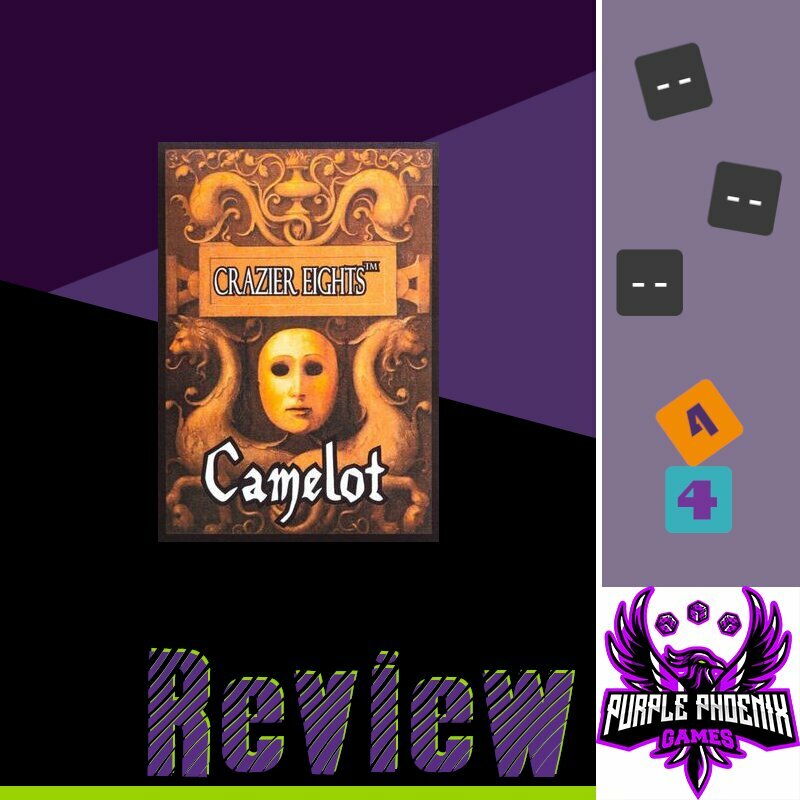
Purple Phoenix Games (2266 KP) rated Crazier Eights: Camelot in Tabletop Games
Dec 23, 2020


DISCLAIMER: We have previously reviewed Crazier Eights: Olympus and Crazier Eights: Pantheon, and this preview has much of the same verbiage as the family of games share most things. Near the end of the preview are my thoughts about the differences in Camelot vs Olympus and Pantheon.
War. Old Maid. Go Fish. Crazy Eights. These are classic card games we probably all grew up playing. There have been many re-themes and new difficulty layers spread upon them to make them even more interesting. While UNO certainly has cornered the market on the Crazy Eights base, we have a new contender: Crazier Eights. Recoculous has published several versions of this card game with different themes: Avalon, One Thousand & One Nights, Olympus, and Shahrzad. Today we are taking a preview of Crazier Eights: Camelot.
You HAVE played Crazy Eights right? The card game where you attempt to be the first to exhaust your hand of cards, but you can only play down if you can match the suit or number on top of the discard pile? And if you can’t, you throw down an 8 as a wild and call the color to be played next? Well there you have the easy rules. Crazier Eights: Camelot (which I will from here call C8C) holds basically the same rule-set with a few new mechanics and a theme. The win condition is still the same: be the first to exhaust your hand of cards, but to win you will need to play your hand strategically against your opponents.
DISCLAIMER: We were provided a copy of this game for the purposes of this review. This is a retail copy of the game, so what you see in these photos is exactly what would be received in your box. I do not intend to cover every single rule included in the rulebook, but will describe the overall game flow and major rule set so that our readers may get a sense of how the game plays. For more in depth rules, you may purchase a copy online or from your FLGS. -T
To setup, shuffle the large deck of cards and place the deck in the middle of the table. Flip the top card to begin the discard pile and dictate the first card play. Deal each player seven cards and you are ready to begin!
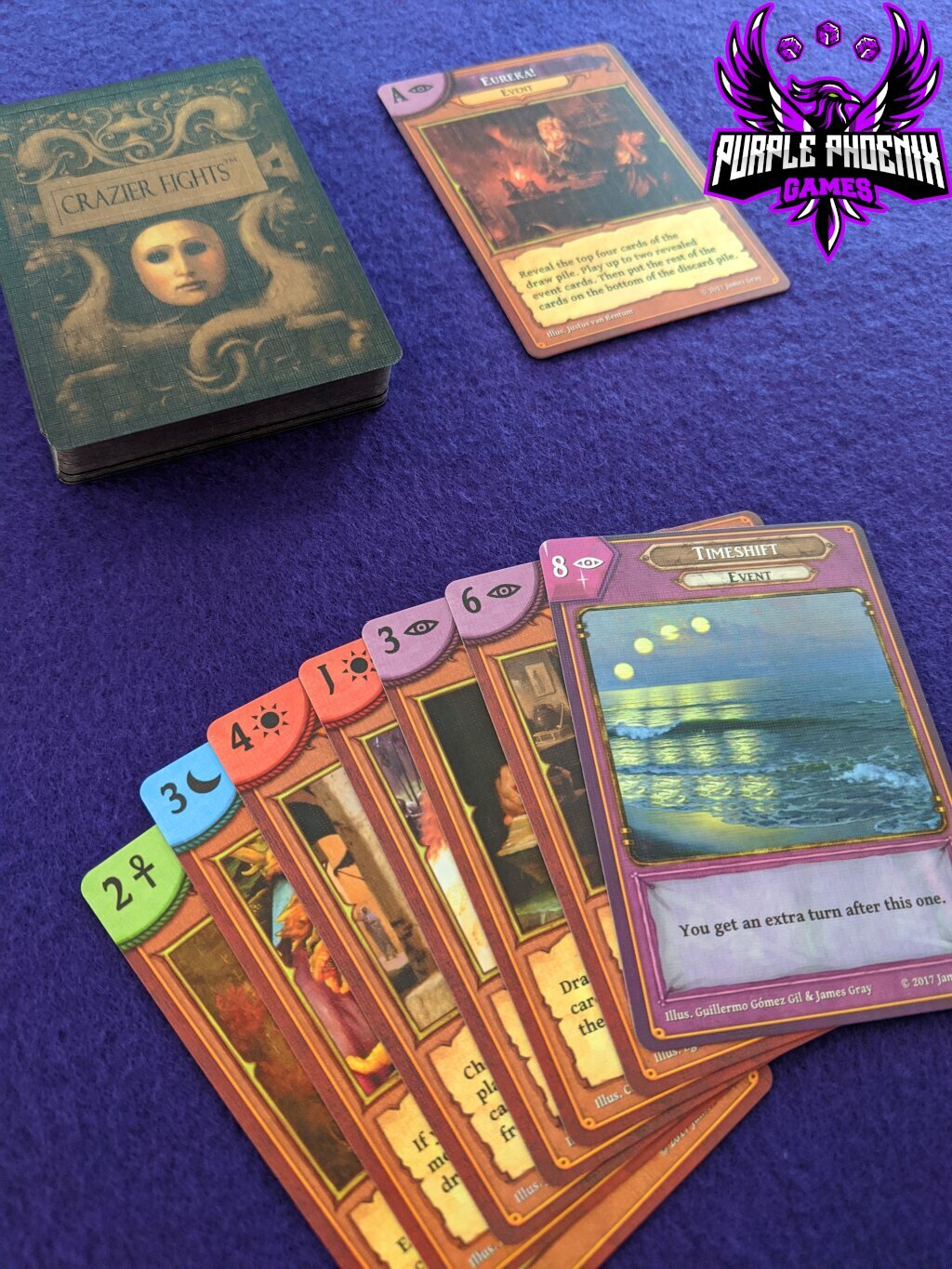
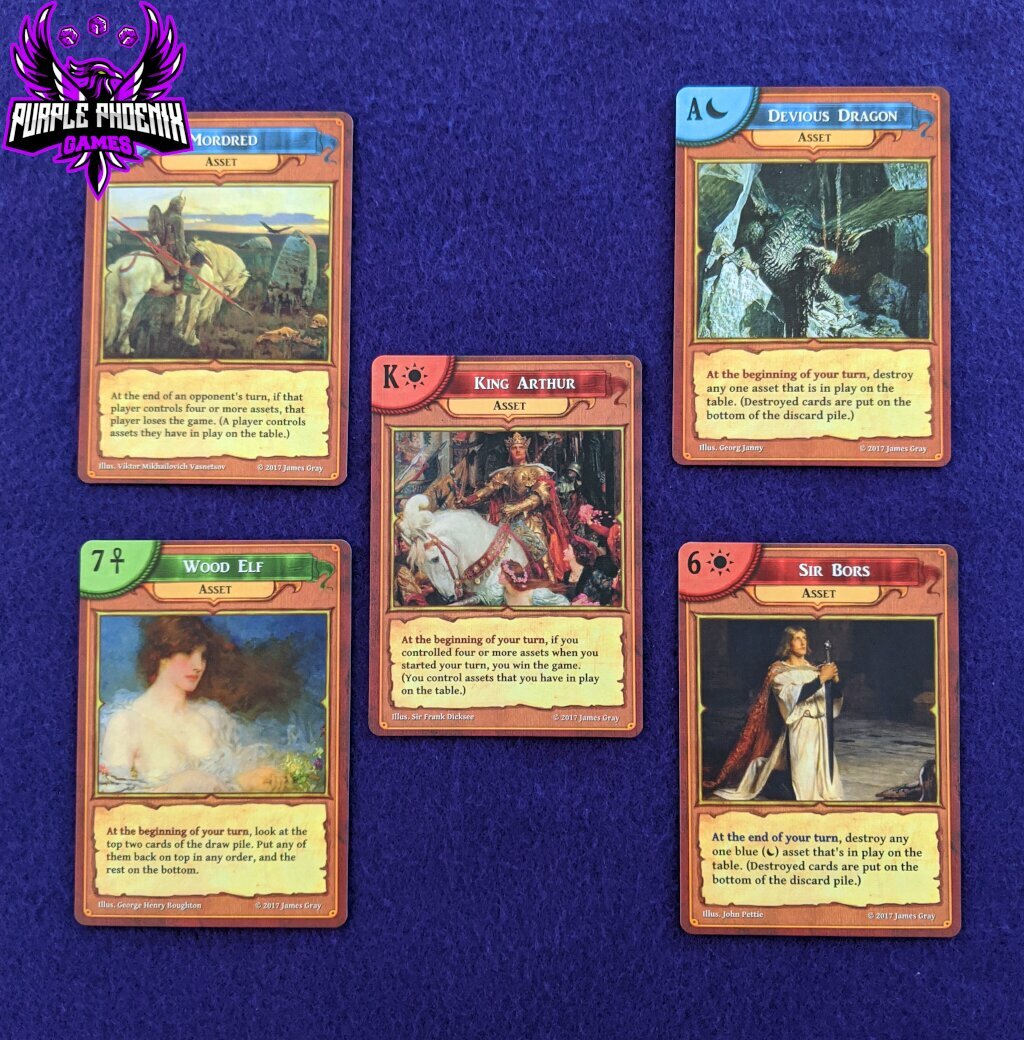
The turn structure is familiar: check for any “start of turn” effects and apply them, draw a card, play and/or discard a card, then resolve any “end of turn” effects. The deck is comprised of Events and Assets in different colors (suits) and numbers like in a typical deck of playing cards. After checking and resolving start of turn effects on Asset cards in your personal tableau, you must draw a card from the deck. This is where C8C strays from OG Crazy Eights a bit. You may play a card from your hand (Assets and Events) and discard a card to the discard pile (matching the suit/number/or an Eight), or simply play a card from your hand without discarding. Cards played from your hand can be Event cards that are played, resolved, and then discarded to the bottom of the discard pile, or an Asset card that is played to your tableau that cause chain reactions or other abilities on future turns. Next, resolve any end of turn effects from Assets in your tableau before the next player begins their turn.
Play continues in this fashion until one player has rid themselves of their hand and is crowned the Master of the Camelot! Or at least, the winner of the game.
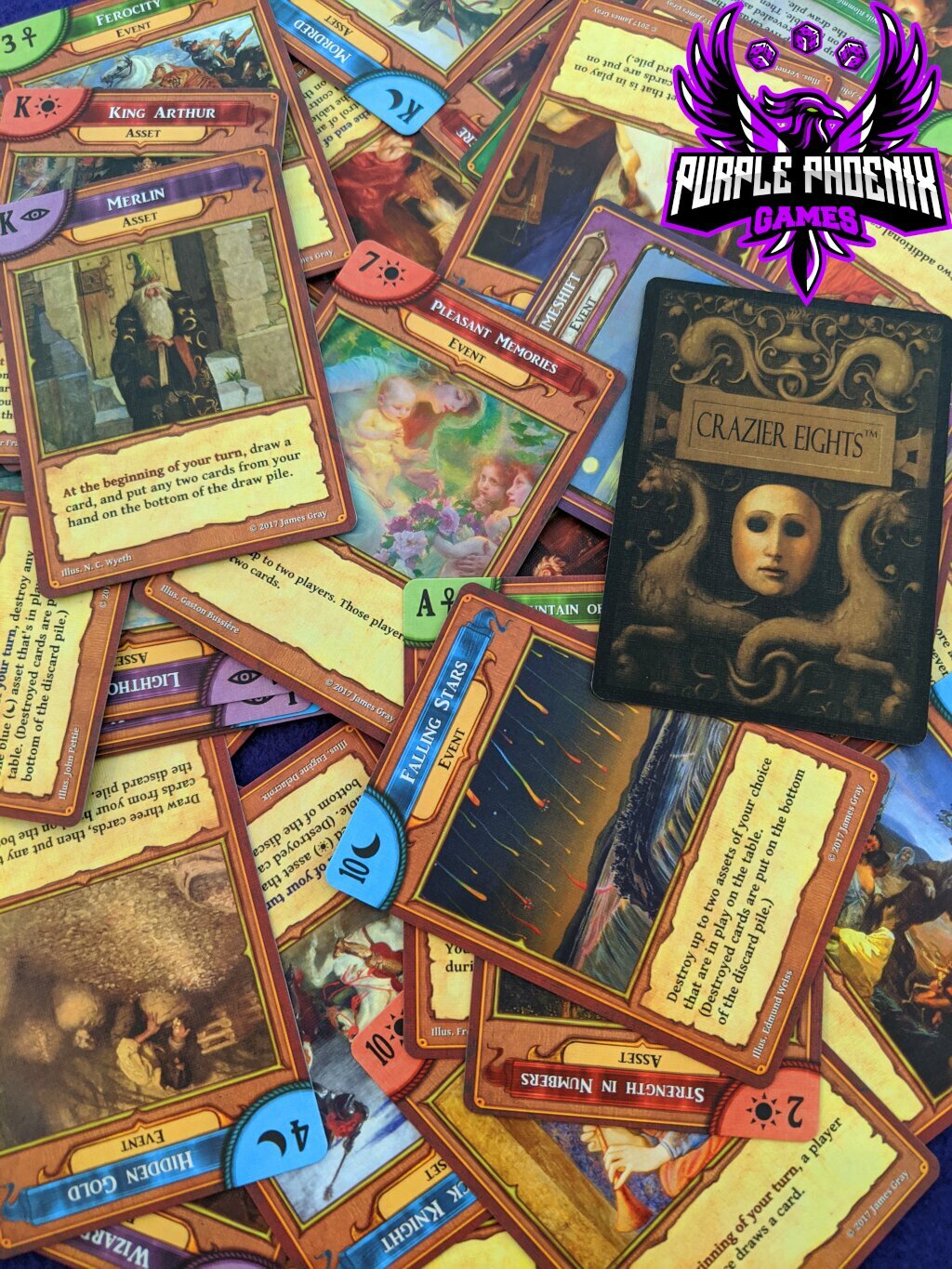
Components. This game is a box full of cards. The cards are good. The layout makes sense, and the art on the faces of the cards remind me of very classic art depicting ancient Arthurian scenes. I am no art historian, so I do not know if they are existing art pieces or new ones crafted for this game, but either way, they are a joy to behold… if you can spend the time appreciating the art instead of tracking what cards you need to play and what effects you can chain together (that was me). Extra points to the Recoculous team for associating symbols with the different suit colors for our colorblind friends. This is something that unfortunately goes unaddressed far too often.
This implementation is the third Crazier Eights we have had the chance to try, and I can say that we really enjoyed our plays of it (we played Olympus first and recently also reviewed Pantheon). The game comes with many interesting and varied effects to craft an ingenious strategy, and the art is stellar. Beware of playing with AP-prone gamers, as there is a lot going on and it is more than just a skinned Crazy Eights.
This Camelot set is slightly different than our previous experiences with both Olympus and Pantheon in a few ways. Firstly, it is more of a base game deck like Olympus instead of a standalone/expansion like Pantheon. Secondly, this set seems to use more cards that affect the assets of other players, specifically in destroying them. Additionally, I have noticed a few cards in the deck that specifically say if certain criteria are met one player automatically wins or loses the game. That’s it. Done-zo. Maybe I missed these cards in the other sets, but I do not remember them ever surfacing. Having each set focus on different aspects of the game and the manipulation of the rules ever so slightly to affect a player’s strategy from one set to the next is quite enchanting to me. Could you put all the sets together to make a massive meta-deck a la Munchkin with all the sets and expansions? Probably, but like Munchkin, I probably would rather keep them separate.
Now having played this family of games several times, I can say that it is my favorite Crazy Eights derivative and certainly worthy of a look. If your game collection is sorely lacking in Arthurian-themed card games, or if you want a hybrid game of old school rules with interesting twists, then do consider purchasing this or one of its predecessors.
PS – Don’t worry if, while you are playing, you have all your Assets stolen or destroyed. I have won the game with zero Assets in front of me while opponents have had eight, ironically. Assets are great, but you still need to shed your hand.
War. Old Maid. Go Fish. Crazy Eights. These are classic card games we probably all grew up playing. There have been many re-themes and new difficulty layers spread upon them to make them even more interesting. While UNO certainly has cornered the market on the Crazy Eights base, we have a new contender: Crazier Eights. Recoculous has published several versions of this card game with different themes: Avalon, One Thousand & One Nights, Olympus, and Shahrzad. Today we are taking a preview of Crazier Eights: Camelot.
You HAVE played Crazy Eights right? The card game where you attempt to be the first to exhaust your hand of cards, but you can only play down if you can match the suit or number on top of the discard pile? And if you can’t, you throw down an 8 as a wild and call the color to be played next? Well there you have the easy rules. Crazier Eights: Camelot (which I will from here call C8C) holds basically the same rule-set with a few new mechanics and a theme. The win condition is still the same: be the first to exhaust your hand of cards, but to win you will need to play your hand strategically against your opponents.
DISCLAIMER: We were provided a copy of this game for the purposes of this review. This is a retail copy of the game, so what you see in these photos is exactly what would be received in your box. I do not intend to cover every single rule included in the rulebook, but will describe the overall game flow and major rule set so that our readers may get a sense of how the game plays. For more in depth rules, you may purchase a copy online or from your FLGS. -T
To setup, shuffle the large deck of cards and place the deck in the middle of the table. Flip the top card to begin the discard pile and dictate the first card play. Deal each player seven cards and you are ready to begin!
The turn structure is familiar: check for any “start of turn” effects and apply them, draw a card, play and/or discard a card, then resolve any “end of turn” effects. The deck is comprised of Events and Assets in different colors (suits) and numbers like in a typical deck of playing cards. After checking and resolving start of turn effects on Asset cards in your personal tableau, you must draw a card from the deck. This is where C8C strays from OG Crazy Eights a bit. You may play a card from your hand (Assets and Events) and discard a card to the discard pile (matching the suit/number/or an Eight), or simply play a card from your hand without discarding. Cards played from your hand can be Event cards that are played, resolved, and then discarded to the bottom of the discard pile, or an Asset card that is played to your tableau that cause chain reactions or other abilities on future turns. Next, resolve any end of turn effects from Assets in your tableau before the next player begins their turn.
Play continues in this fashion until one player has rid themselves of their hand and is crowned the Master of the Camelot! Or at least, the winner of the game.
Components. This game is a box full of cards. The cards are good. The layout makes sense, and the art on the faces of the cards remind me of very classic art depicting ancient Arthurian scenes. I am no art historian, so I do not know if they are existing art pieces or new ones crafted for this game, but either way, they are a joy to behold… if you can spend the time appreciating the art instead of tracking what cards you need to play and what effects you can chain together (that was me). Extra points to the Recoculous team for associating symbols with the different suit colors for our colorblind friends. This is something that unfortunately goes unaddressed far too often.
This implementation is the third Crazier Eights we have had the chance to try, and I can say that we really enjoyed our plays of it (we played Olympus first and recently also reviewed Pantheon). The game comes with many interesting and varied effects to craft an ingenious strategy, and the art is stellar. Beware of playing with AP-prone gamers, as there is a lot going on and it is more than just a skinned Crazy Eights.
This Camelot set is slightly different than our previous experiences with both Olympus and Pantheon in a few ways. Firstly, it is more of a base game deck like Olympus instead of a standalone/expansion like Pantheon. Secondly, this set seems to use more cards that affect the assets of other players, specifically in destroying them. Additionally, I have noticed a few cards in the deck that specifically say if certain criteria are met one player automatically wins or loses the game. That’s it. Done-zo. Maybe I missed these cards in the other sets, but I do not remember them ever surfacing. Having each set focus on different aspects of the game and the manipulation of the rules ever so slightly to affect a player’s strategy from one set to the next is quite enchanting to me. Could you put all the sets together to make a massive meta-deck a la Munchkin with all the sets and expansions? Probably, but like Munchkin, I probably would rather keep them separate.
Now having played this family of games several times, I can say that it is my favorite Crazy Eights derivative and certainly worthy of a look. If your game collection is sorely lacking in Arthurian-themed card games, or if you want a hybrid game of old school rules with interesting twists, then do consider purchasing this or one of its predecessors.
PS – Don’t worry if, while you are playing, you have all your Assets stolen or destroyed. I have won the game with zero Assets in front of me while opponents have had eight, ironically. Assets are great, but you still need to shed your hand.
Purple Phoenix Games (2266 KP) rated Sheriff of Nottingham in Tabletop Games
Nov 16, 2021
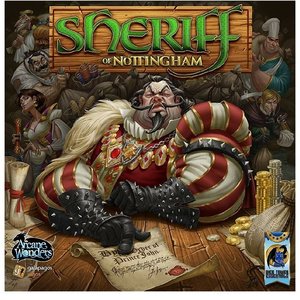
One neat thing about the board gaming hobby is how many new games are designed/created daily. So much innovation, creativity, and hype surrounds new releases and helps keep us gamers hooked! That being said, what happens to older games as time goes on? Can they still hold their own over the years? Do they still feel new and novel to first-time players who are getting to them late? The latter describes me with Sheriff of Nottingham. I only received it for Christmas two years ago, and it has sadly been sitting on my Shelf of Shame until recently. So now that I’ve finally gotten it to the table, how does it hold up? Keep reading to find out!
Disclaimer: I have the first edition of this game, so the pictures below do not reflect the art/component changes brought in the recently released second edition. -L
Sheriff of Nottingham is a party game of bluffing, negotiation, and set collection in which players are trying to earn the most money by bringing their goods (Legal or Contraband!) to market. However, before those goods can get to your merchant stand, they must be cleared to pass by the Sheriff of Nottingham. Are you honest in your declarations, or are you trying to sneak something past the town authority? Bluff, bribe, or negotiate your way to victory and collect the most gold!
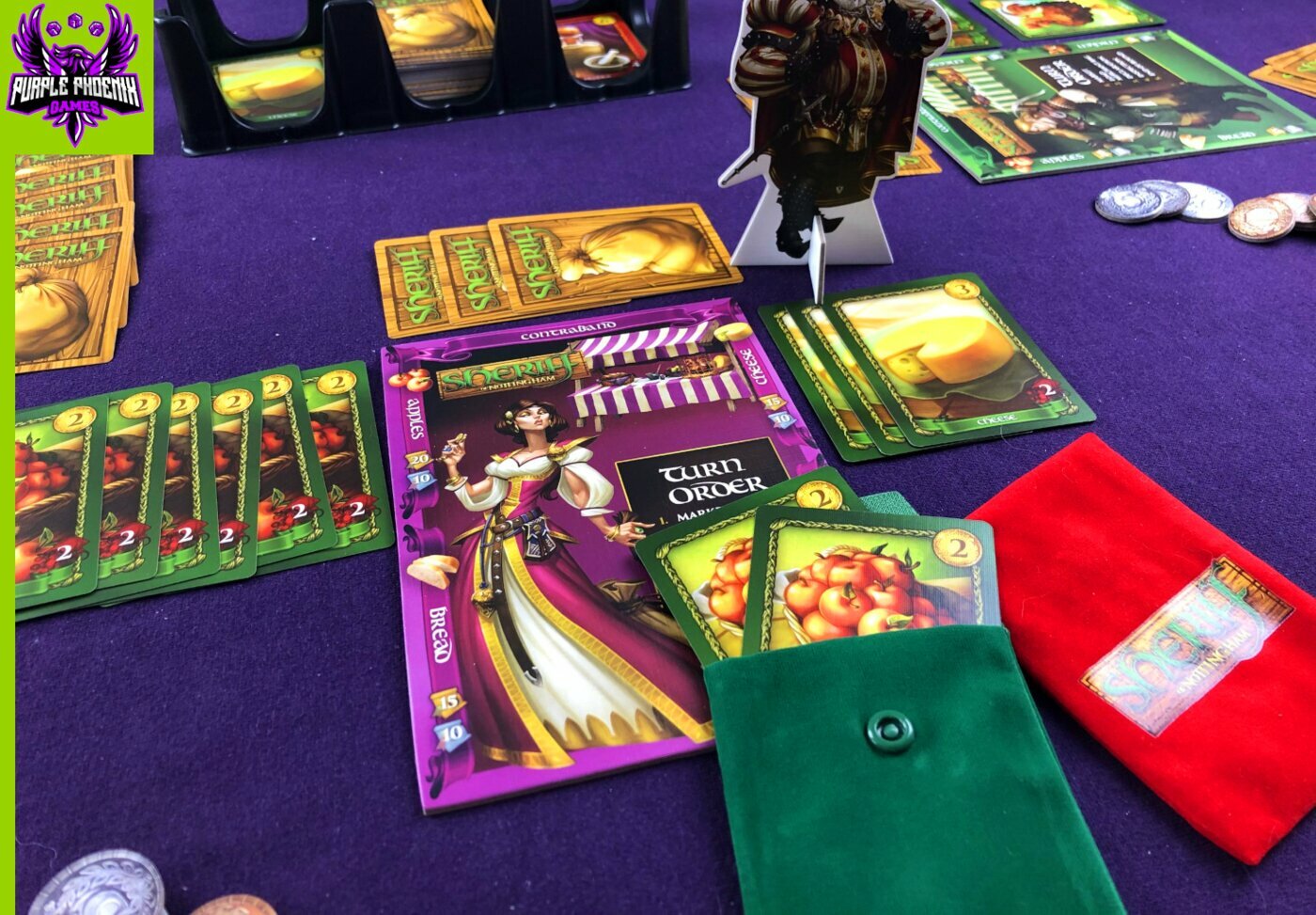
To setup for a game of Sheriff of Nottingham, each player receives a merchant stand board and bag in their chosen color, 20 starting gold, and 6 Goods cards. The remaining Goods cards are placed in a draw pile, with 2 adjacent discard piles. Turn over 5 cards to each discard pile, select a starting Sheriff, and the game is ready to begin! Sheriff of Nottingham is played over a series of rounds, and each round is broken down into 5 phases: Market, Load Merchant Bag, Declaration, Inspection, and End of Round. Important note – the player acting as Sheriff for the round will only act in the Inspection phase of a round. During the Market phase, players have the opportunity to discard unwanted Goods from their hand in order to draw cards from the draw pile or either discard pile. New cards are drawn one at a time, and you will draw as many cards as you have chosen to discard. The cards you discard will be placed in either discard pile, in whatever order you choose.
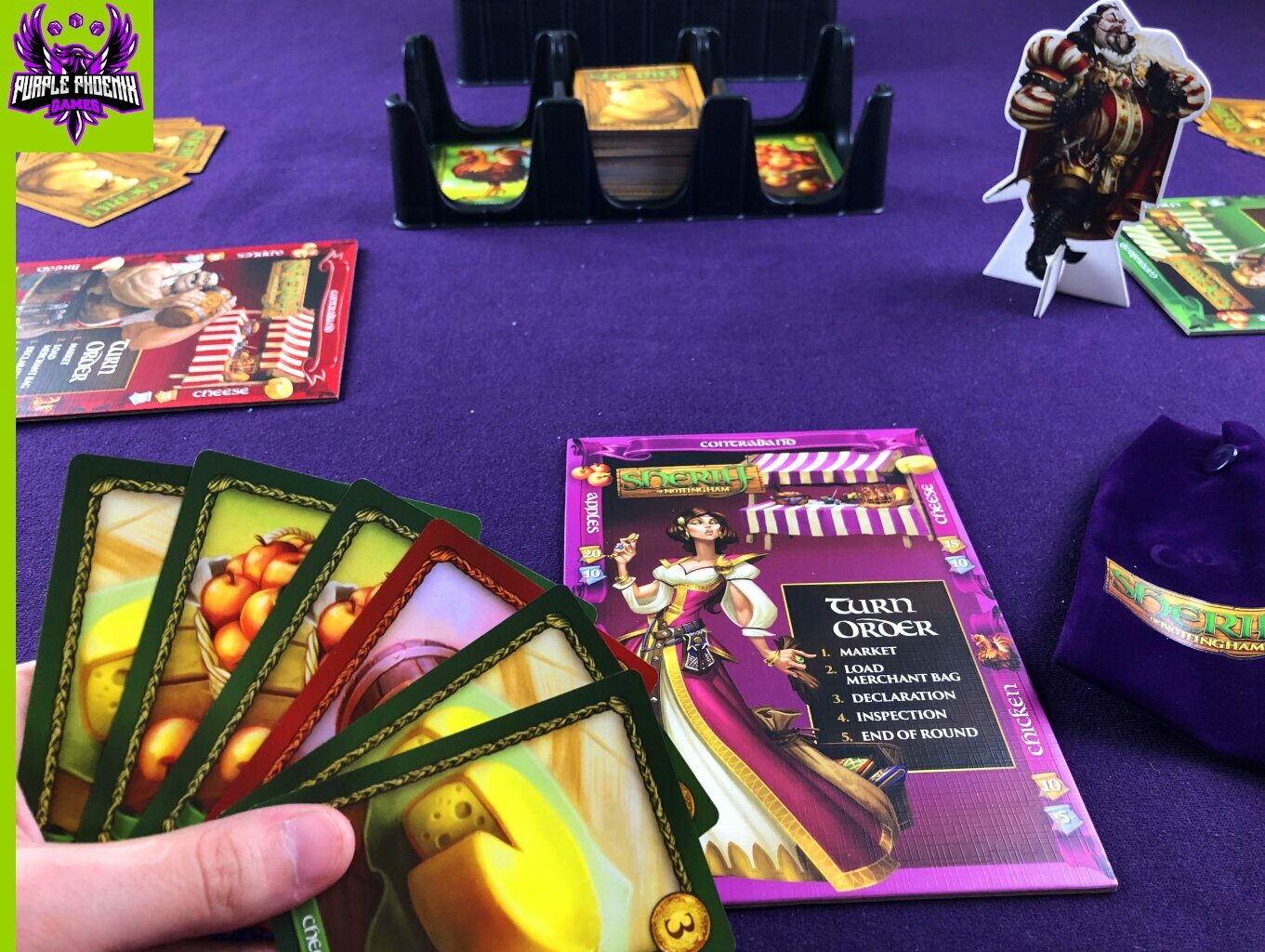
The next phase, Load Merchant Bag, is pretty self-explanatory. All merchant players will select up to 5 cards from their hand to place in their merchant bag. Snap it closed, and place it in front of you for the next phase, Declaration. In this phase, players will take turns declaring what good they are bringing to market. You must say exactly how many cards you are bringing, and you may only declare 1 type of Legal good! Even if your bag has multiple types of goods, you must declare only 1 type. Here is where your bluffing skills come into play! Once all players have made their declarations, the game moves to the Inspection phase, and it is now time for the Sheriff to act! In this phase, the Sheriff will get to decide if they wish to inspect any of the merchant bags, and merchants will have the opportunity to negotiate or bribe the Sheriff to not inspect their bag, or to inspect an opponent’s bag instead. If you make a deal with the Sheriff, you must hold up your end of the agreement!
Once the Sheriff has made their decision, they will either inspect bags or allow them to pass. If you are allowed to pass, you will take back your bag, open it, and add all goods to your merchant stand in their corresponding locations. Legal goods are known to all players, but Contraband goods are kept face-down. If the Sheriff chose to inspect your bag, they will open it and reveal the cards inside. If you were in fact telling the truth, and the cards inside are exactly what you declared, you add them to your merchant stand and the Sheriff will pay you a penalty for each Good card in your bag. If you were lying, a few things happen. First, any goods that were truthfully declared will go to your merchant stand as normal. Any goods that you lied about are confiscated by the Sheriff, and placed onto either discard pile. You then will pay the Sheriff a penalty fee for each confiscated good! The final phase, End of Round, has all players draw back up to 6 cards in hand, and the Sheriff title passes to the next player. The game continues in this fashion until all players have been the Sheriff twice (or three times in a 3-player game). Points are counted up – from your goods in your merchant stand, any gold coins you possess, and any bonus points for majority of Legal goods compared to opponents. Once all points have been tallied, the player with the highest score wins!
I know that I have said before that I generally don’t like bluffing games, but I think that Sheriff of Nottingham might be an exception. Yes, in some cases you will have to bluff about the contents of your merchant bag, but the ability to bribe/negotiate with the Sheriff takes some focus off the actual bluffing part. Can you convince the Sheriff to inspect another player’s bag just because you are trying to hinder that player? Or do you try to get the Sheriff to inspect your own bag, because then they will have to pay you a penalty fee for your honesty (this round, at least). It feels like there is more strategic gameplay here than simple bluffing, and I like the opportunity to strategize instead of relying solely on my (admittedly horrendous) poker-face.
Another thing that I really like about Sheriff of Nottingham is that it can technically be categorized as a party game, but it doesn’t feel like a typical party game to me. It takes strategy to play, and doesn’t just rely on crude/adult humor for laughs. This game really engages all players at all times, as you’re constantly watching your opponents, keeping track of what goods they seem to be collecting, and trying to catch them in a lie. The gameplay itself is pretty streamlined and straightforward, and that just helps to make it flow naturally and logically. The playing time is listed as 60 minutes, but it doesn’t feel like a long game to me at all. It’s just a light, fun, and entertaining game for really any type of game night.
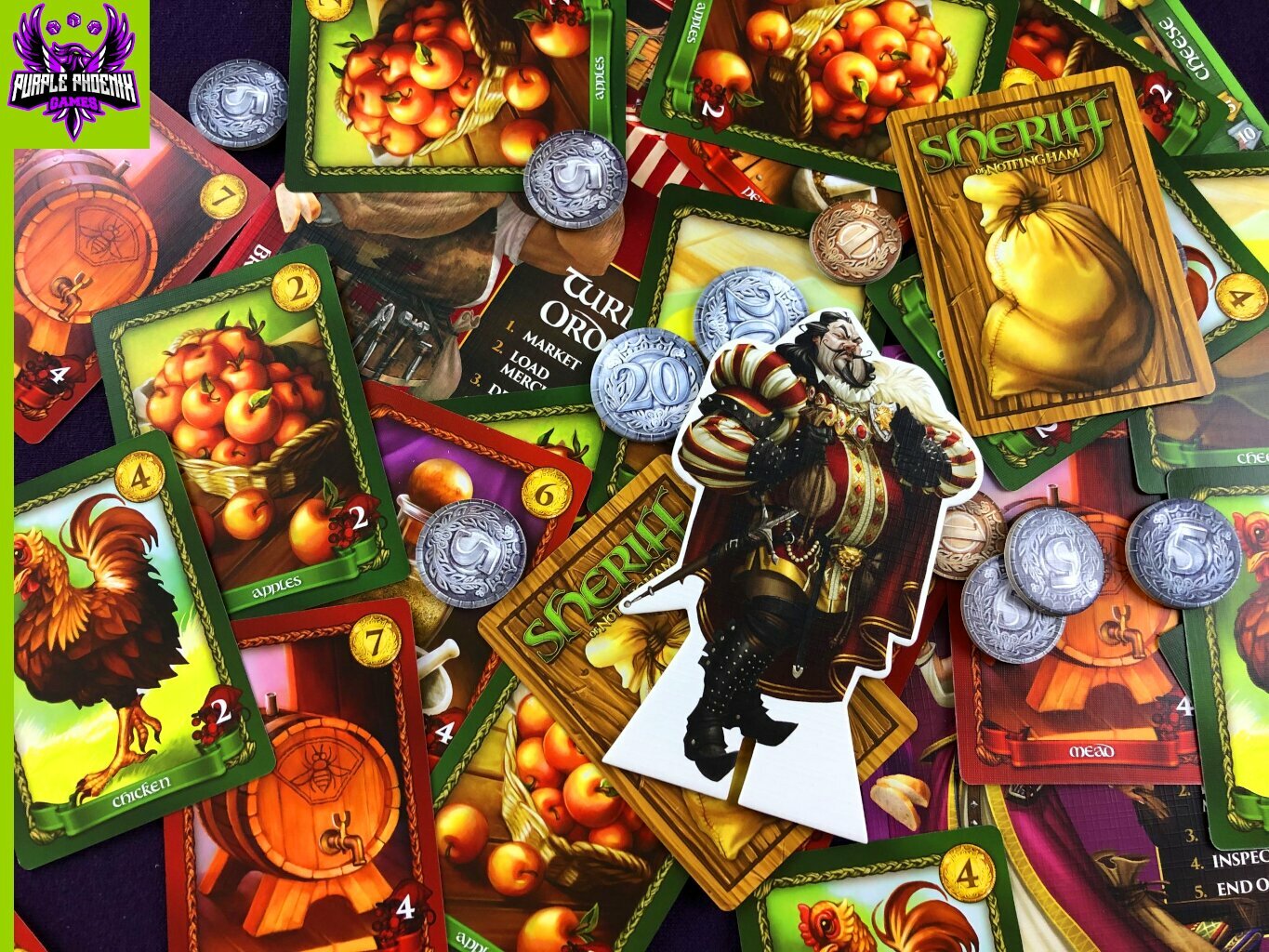
Let’s talk components for a minute. Again, I have the first edition of the game, so I cannot speak as to any component changes in the second edition. But overall, the quality of the first edition is pretty nice! The merchant stand boards are nice, thick cardboard, and are colorful and clear. Perhaps my favorite part of the boards is they each have a turn order reference on them. Not that the gameplay is that complicated, but it’s nice to just have that quick guide. The Goods cards are good quality and feel nice in hand. The artwork is mostly pretty simple, but I like that, since the crux of the gameplay is in the player interactions. The cardboard coins are chunky, and the insert doubles as a draw/discard pile organizer – which to me is a lifesaver! Nothing bothers me more than unruly stacks of cards. The merchant bags are nice and mostly functional. My biggest issue with them is that sometimes the snaps are a little hard to open, and it feels like you might tear the bag if you pull on them too hard. To alleviate that, I just don’t have players actually close the snap, instead just folding over the flap, and that works just as well! Great production quality in my opinion.
So if I seem to like this game, why did I only give it a 4 out of 6? The simple answer to that is that I do like the game, but I don’t love it. It’s fun and serves its purpose well, but it’s not a game that I am dying to pull out every game night. It’s one that will stay in my collection for sure, because there are some occasions that are just perfect for it. But it’s not one that will ever make its way to my Top 10. All in all, it holds up well for being an ‘older’ game, but it doesn’t exactly have me jumping up and down to play. That’s why Purple Phoenix Games gives this one an 11 / 18.
Disclaimer: I have the first edition of this game, so the pictures below do not reflect the art/component changes brought in the recently released second edition. -L
Sheriff of Nottingham is a party game of bluffing, negotiation, and set collection in which players are trying to earn the most money by bringing their goods (Legal or Contraband!) to market. However, before those goods can get to your merchant stand, they must be cleared to pass by the Sheriff of Nottingham. Are you honest in your declarations, or are you trying to sneak something past the town authority? Bluff, bribe, or negotiate your way to victory and collect the most gold!
To setup for a game of Sheriff of Nottingham, each player receives a merchant stand board and bag in their chosen color, 20 starting gold, and 6 Goods cards. The remaining Goods cards are placed in a draw pile, with 2 adjacent discard piles. Turn over 5 cards to each discard pile, select a starting Sheriff, and the game is ready to begin! Sheriff of Nottingham is played over a series of rounds, and each round is broken down into 5 phases: Market, Load Merchant Bag, Declaration, Inspection, and End of Round. Important note – the player acting as Sheriff for the round will only act in the Inspection phase of a round. During the Market phase, players have the opportunity to discard unwanted Goods from their hand in order to draw cards from the draw pile or either discard pile. New cards are drawn one at a time, and you will draw as many cards as you have chosen to discard. The cards you discard will be placed in either discard pile, in whatever order you choose.
The next phase, Load Merchant Bag, is pretty self-explanatory. All merchant players will select up to 5 cards from their hand to place in their merchant bag. Snap it closed, and place it in front of you for the next phase, Declaration. In this phase, players will take turns declaring what good they are bringing to market. You must say exactly how many cards you are bringing, and you may only declare 1 type of Legal good! Even if your bag has multiple types of goods, you must declare only 1 type. Here is where your bluffing skills come into play! Once all players have made their declarations, the game moves to the Inspection phase, and it is now time for the Sheriff to act! In this phase, the Sheriff will get to decide if they wish to inspect any of the merchant bags, and merchants will have the opportunity to negotiate or bribe the Sheriff to not inspect their bag, or to inspect an opponent’s bag instead. If you make a deal with the Sheriff, you must hold up your end of the agreement!
Once the Sheriff has made their decision, they will either inspect bags or allow them to pass. If you are allowed to pass, you will take back your bag, open it, and add all goods to your merchant stand in their corresponding locations. Legal goods are known to all players, but Contraband goods are kept face-down. If the Sheriff chose to inspect your bag, they will open it and reveal the cards inside. If you were in fact telling the truth, and the cards inside are exactly what you declared, you add them to your merchant stand and the Sheriff will pay you a penalty for each Good card in your bag. If you were lying, a few things happen. First, any goods that were truthfully declared will go to your merchant stand as normal. Any goods that you lied about are confiscated by the Sheriff, and placed onto either discard pile. You then will pay the Sheriff a penalty fee for each confiscated good! The final phase, End of Round, has all players draw back up to 6 cards in hand, and the Sheriff title passes to the next player. The game continues in this fashion until all players have been the Sheriff twice (or three times in a 3-player game). Points are counted up – from your goods in your merchant stand, any gold coins you possess, and any bonus points for majority of Legal goods compared to opponents. Once all points have been tallied, the player with the highest score wins!
I know that I have said before that I generally don’t like bluffing games, but I think that Sheriff of Nottingham might be an exception. Yes, in some cases you will have to bluff about the contents of your merchant bag, but the ability to bribe/negotiate with the Sheriff takes some focus off the actual bluffing part. Can you convince the Sheriff to inspect another player’s bag just because you are trying to hinder that player? Or do you try to get the Sheriff to inspect your own bag, because then they will have to pay you a penalty fee for your honesty (this round, at least). It feels like there is more strategic gameplay here than simple bluffing, and I like the opportunity to strategize instead of relying solely on my (admittedly horrendous) poker-face.
Another thing that I really like about Sheriff of Nottingham is that it can technically be categorized as a party game, but it doesn’t feel like a typical party game to me. It takes strategy to play, and doesn’t just rely on crude/adult humor for laughs. This game really engages all players at all times, as you’re constantly watching your opponents, keeping track of what goods they seem to be collecting, and trying to catch them in a lie. The gameplay itself is pretty streamlined and straightforward, and that just helps to make it flow naturally and logically. The playing time is listed as 60 minutes, but it doesn’t feel like a long game to me at all. It’s just a light, fun, and entertaining game for really any type of game night.
Let’s talk components for a minute. Again, I have the first edition of the game, so I cannot speak as to any component changes in the second edition. But overall, the quality of the first edition is pretty nice! The merchant stand boards are nice, thick cardboard, and are colorful and clear. Perhaps my favorite part of the boards is they each have a turn order reference on them. Not that the gameplay is that complicated, but it’s nice to just have that quick guide. The Goods cards are good quality and feel nice in hand. The artwork is mostly pretty simple, but I like that, since the crux of the gameplay is in the player interactions. The cardboard coins are chunky, and the insert doubles as a draw/discard pile organizer – which to me is a lifesaver! Nothing bothers me more than unruly stacks of cards. The merchant bags are nice and mostly functional. My biggest issue with them is that sometimes the snaps are a little hard to open, and it feels like you might tear the bag if you pull on them too hard. To alleviate that, I just don’t have players actually close the snap, instead just folding over the flap, and that works just as well! Great production quality in my opinion.
So if I seem to like this game, why did I only give it a 4 out of 6? The simple answer to that is that I do like the game, but I don’t love it. It’s fun and serves its purpose well, but it’s not a game that I am dying to pull out every game night. It’s one that will stay in my collection for sure, because there are some occasions that are just perfect for it. But it’s not one that will ever make its way to my Top 10. All in all, it holds up well for being an ‘older’ game, but it doesn’t exactly have me jumping up and down to play. That’s why Purple Phoenix Games gives this one an 11 / 18.


Gareth von Kallenbach (980 KP) rated Maneater in Video Games
Jul 26, 2019

Talking Maneater With Bill Munk – Game Director at Tripwire Interactive
Recently I spoke with Bill Munk – Game Director at Tripwire Interactive about their pending game Maneater. I saw the game at E3 and it looks like a promising game indeed.
What is the background and setting for the game?
Maneater is a single-player, open world, action RPG set in a fictionalized version of the US Gulf Coast. Players take on the role of a baby bull shark torn from its mother’s belly. Your only tools are your wits, your jaws, and an uncanny ability to evolve as you feed. Anything and everything is on the menu… provided you kill it before it kills you.
How did the idea to play as a Shark come about?
The concept for Maneater originally came from Alex Quick, the creator of Depth and director for the original Killing Floor. Tripwire Interactive loved the over-the-top and new approach to the action RPG and open world genres so much, they decided to bring the project in-house, increasing the development staff and budget to bring the team’s concept to life.
How many levels and areas are planned for the game at release?
Players should expect a vast variety of environments to explore, including, swamps, beach resorts, sunken ship wrecks, all the way out to the deep blue sea.
What are some of the customizations that will be available and how will players be able to upgrade their character?
As players continue to eat and explore, they’ll acquire key nutrients, which can be used to help them evolve. This is where the “RPG” progression systems in Maneater really come into play. Players can choose from a variety of evolutions, that may help with increased biting power, more maneuverability, armor, and more.
What are some of the moves players will be able to do and will new moves unlock later in the game?
We really want to make sure the act of swimming and feeding feels satisfying and meaty. During our E3 demo, you saw players knifing along the surface of the water, breaching onto land, barrel rolling and charging shark bounty hunters, and diving deep into the water to gain momentum for large leaps.
What can you tell us about the enemies that players will face in the game?
Each region in the game has an Apex Predator. As you battle smaller predators and consume food in each region, the apex will do whatever it takes to protect their food source. Maneater also features a bounty system. As you wreak havoc along the coast, your infamy level will rise. This causes local bounty hunters to search for you while trying to end your feeding frenzy. Depending on your infamy level, the bounty hunters will become more difficult ranging from hunters on small skiffs, all the way up to bringing out the coast guard.
The gameplay we saw at E3 looked like fun but I was curious about how the story will advance and how do you avoid the issue of repetition in the gameplay?
Maneater is a “dueling tales of revenge” story featuring Scaly Pete, who we revealed in our newest E3 trailer. Without revealing too much, Scaly Pete is responsible for tearing you from your mother’s belly, and you manage to escape into the open waters of the gulf. That’s where our story begins. Maneater is presented through the lens of a reality TV show called “Shark Hunters vs. Maneaters” that follows the adventures of Scaly Pete as he’s hunting you throughout our world. This also allows us to follow our player shark and give a voice to the actions of the player through the show’s narrator, who is voiced by Chris Parnell.
Will the game offer multiplayer or DLC?
Right now, we want to focus on making Maneater a fantastic single-player Action RPG experience.
What are some of your favorite moves in the game?
Breaching is one of the most satisfying shark moves we’ve been working on. Breaching out of shallow waters to feed on unsuspecting beach goers on land or even on a large shark bounty hunter boat captures the over-the-top fun and ridiculousness we’re aiming for with Maneater. We’re also working really hard on what we call the “whip-shot”, where you can tail whip anything that’s in your mouth, turning objects into weaponized projectiles.
What can you tell us about the music and sound effects in the game?
We’ve been working really hard on our dynamic music system, that is constantly adapting to what the player is doing throughout the game. It’s also been an interesting challenge creating sound effects for above the water with boats, explosions and civilians and then creating a whole new set of sound effects for the underwater world, including for the underwater wildlife, underwater sounds of the boats and swimmers and so much more.
Are you planning on being at PAX West with the game?
We can’t wait to tell you more about our plans for Maneater at future shows. In the meantime, we’d recommend your readers follow @maneatergame on Twitter for the latest.
Recently I spoke with Bill Munk – Game Director at Tripwire Interactive about their pending game Maneater. I saw the game at E3 and it looks like a promising game indeed.
What is the background and setting for the game?
Maneater is a single-player, open world, action RPG set in a fictionalized version of the US Gulf Coast. Players take on the role of a baby bull shark torn from its mother’s belly. Your only tools are your wits, your jaws, and an uncanny ability to evolve as you feed. Anything and everything is on the menu… provided you kill it before it kills you.
How did the idea to play as a Shark come about?
The concept for Maneater originally came from Alex Quick, the creator of Depth and director for the original Killing Floor. Tripwire Interactive loved the over-the-top and new approach to the action RPG and open world genres so much, they decided to bring the project in-house, increasing the development staff and budget to bring the team’s concept to life.
How many levels and areas are planned for the game at release?
Players should expect a vast variety of environments to explore, including, swamps, beach resorts, sunken ship wrecks, all the way out to the deep blue sea.
What are some of the customizations that will be available and how will players be able to upgrade their character?
As players continue to eat and explore, they’ll acquire key nutrients, which can be used to help them evolve. This is where the “RPG” progression systems in Maneater really come into play. Players can choose from a variety of evolutions, that may help with increased biting power, more maneuverability, armor, and more.
What are some of the moves players will be able to do and will new moves unlock later in the game?
We really want to make sure the act of swimming and feeding feels satisfying and meaty. During our E3 demo, you saw players knifing along the surface of the water, breaching onto land, barrel rolling and charging shark bounty hunters, and diving deep into the water to gain momentum for large leaps.
What can you tell us about the enemies that players will face in the game?
Each region in the game has an Apex Predator. As you battle smaller predators and consume food in each region, the apex will do whatever it takes to protect their food source. Maneater also features a bounty system. As you wreak havoc along the coast, your infamy level will rise. This causes local bounty hunters to search for you while trying to end your feeding frenzy. Depending on your infamy level, the bounty hunters will become more difficult ranging from hunters on small skiffs, all the way up to bringing out the coast guard.
The gameplay we saw at E3 looked like fun but I was curious about how the story will advance and how do you avoid the issue of repetition in the gameplay?
Maneater is a “dueling tales of revenge” story featuring Scaly Pete, who we revealed in our newest E3 trailer. Without revealing too much, Scaly Pete is responsible for tearing you from your mother’s belly, and you manage to escape into the open waters of the gulf. That’s where our story begins. Maneater is presented through the lens of a reality TV show called “Shark Hunters vs. Maneaters” that follows the adventures of Scaly Pete as he’s hunting you throughout our world. This also allows us to follow our player shark and give a voice to the actions of the player through the show’s narrator, who is voiced by Chris Parnell.
Will the game offer multiplayer or DLC?
Right now, we want to focus on making Maneater a fantastic single-player Action RPG experience.
What are some of your favorite moves in the game?
Breaching is one of the most satisfying shark moves we’ve been working on. Breaching out of shallow waters to feed on unsuspecting beach goers on land or even on a large shark bounty hunter boat captures the over-the-top fun and ridiculousness we’re aiming for with Maneater. We’re also working really hard on what we call the “whip-shot”, where you can tail whip anything that’s in your mouth, turning objects into weaponized projectiles.
What can you tell us about the music and sound effects in the game?
We’ve been working really hard on our dynamic music system, that is constantly adapting to what the player is doing throughout the game. It’s also been an interesting challenge creating sound effects for above the water with boats, explosions and civilians and then creating a whole new set of sound effects for the underwater world, including for the underwater wildlife, underwater sounds of the boats and swimmers and so much more.
Are you planning on being at PAX West with the game?
We can’t wait to tell you more about our plans for Maneater at future shows. In the meantime, we’d recommend your readers follow @maneatergame on Twitter for the latest.
Purple Phoenix Games (2266 KP) rated Cloud City in Tabletop Games
Oct 21, 2020


Uh oh, another city-building game. I am notoriously horrible with the theme and mechanics, but I do love playing them anyway. But maybe it’s just because most games involve sprawling out, and maybe my specialty is sprawling up. Maybe, just maybe, I can be a vertical architect and leave the land-grubbing to those “other” architects.
Cloud City is a tile and building placing game for two to four players that is super light and super quick to play. In it players are building architects attempting to plan the greatest use of resources to create the most breathtaking buildings and connections of walkways all above the clouds. The winner is the player who amasses the most City Council votes by creating walkways that span daring lengths and connect same-sized buildings in the sky.
DISCLAIMER: We were provided a copy of this game for the purposes of this review. This is a retail copy of the game, so what you see in these photos is exactly what would be received in your box. I do not intend to cover every single rule included in the rulebook, but will describe the overall game flow and major rule set so that our readers may get a sense of how the game plays. For more in depth rules, you may purchase a copy online or from your FLGS. -T
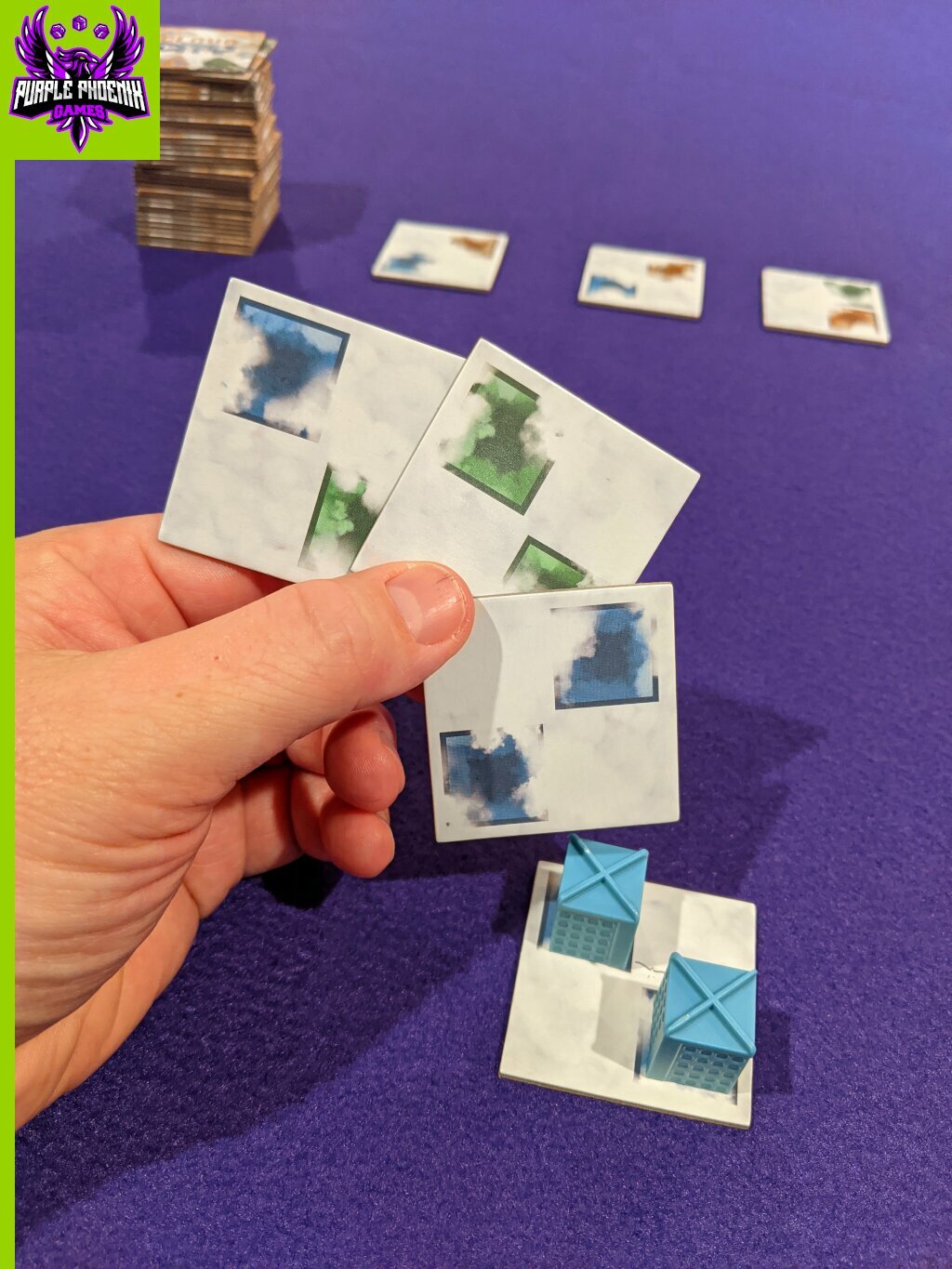
To setup set aside the starter Cloud tiles for use as player tiles (they have bird icons on them). Shuffle the remaining Cloud tiles and make a giant draw stack. Reveal three tiles for an offer row. Each player draws three Cloud tiles into their hand to be kept secret from the other players. They also will take the appropriate building pieces to place on their starting tiles. Keep the building pieces nearby as they will be used during the game. Players may now begin their bids for architect supreme!
On their turn each player will place a tile from their hand to add to their city, place the corresponding building pieces on the two areas of the tile, optionally build walkways to connect buildings, and then refill their hand of tiles.
When placing a tile, a few rules must be observed: tiles must be placed orthogonally adjacent to an existing tile in the city, may be rotated any direction, and must never be placed outside of a 3×3 tile grid (like the placement rules in Kingdomino).
Once tiles are placed, grab the matching-colored building pieces for the newly placed tile and plop them down on the icons. As the building in the city begin the spring up above the clouds they will need to be connected to buildings of the same height.
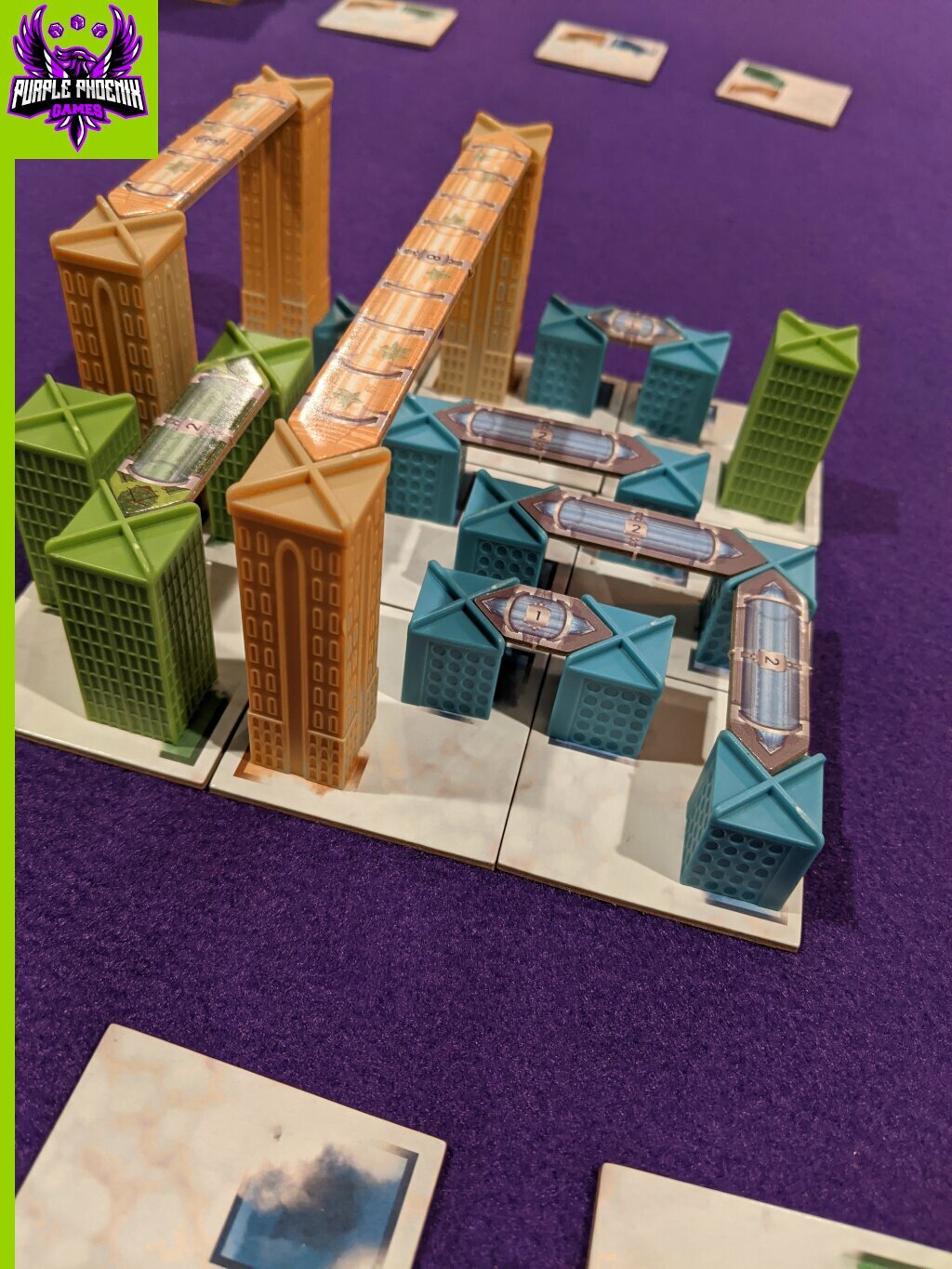
To connect these buildings players will take from the supply walkway tokens of different lengths and place them between building of matching height, as shown below. It is these walkways that score the players points as votes from the City Council.
As the player now has only two tiles in hand, a third tile will need to be drawn from either the offer row or blindly from the top of the draw pile. It is now the next player’s turn and the game ends once all players have built their 3×3 city!
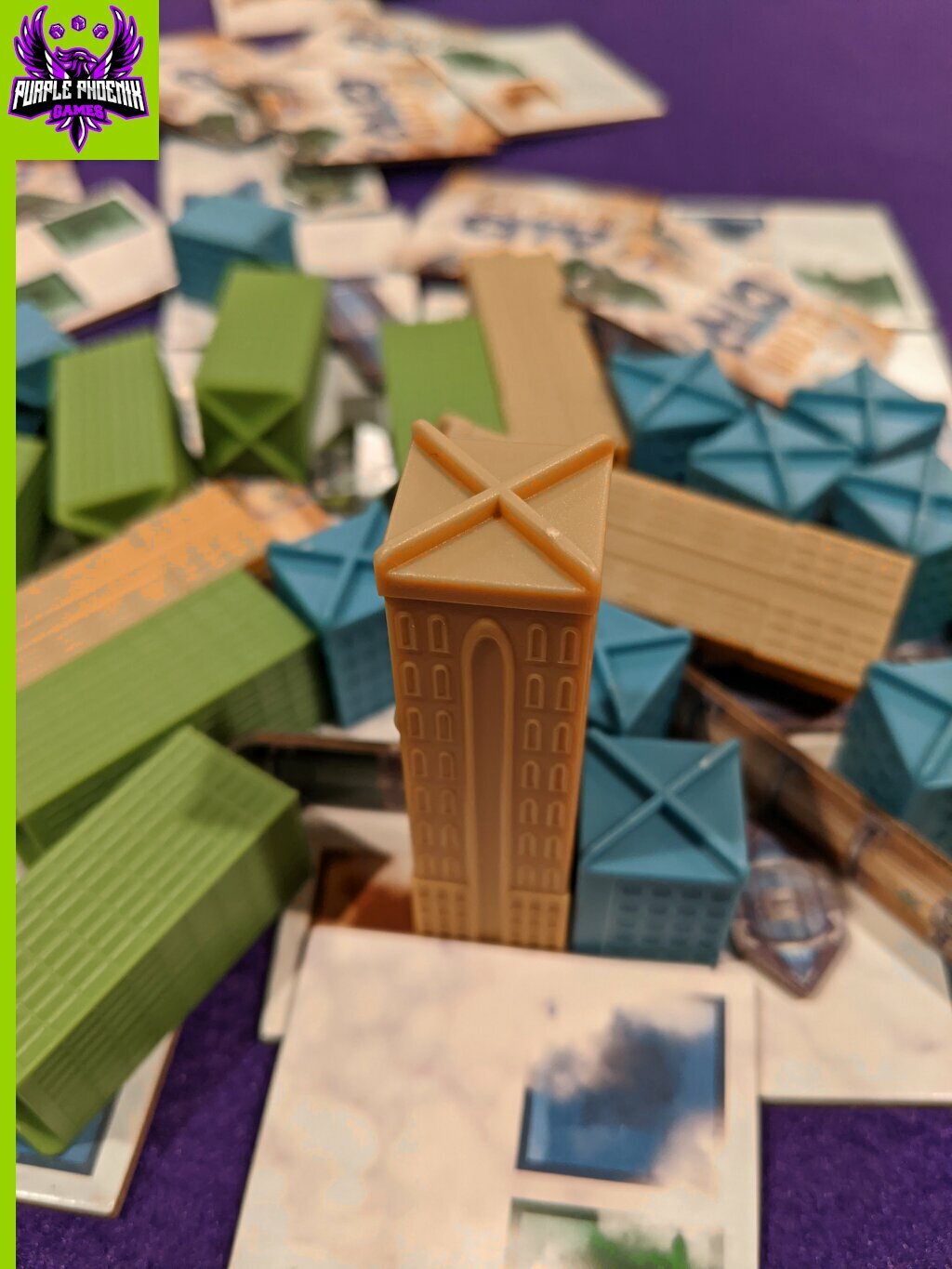
Components. This game consists of a bunch of thick cardboard Cloud tiles (48), a bunch more walkway tokens (93), and even more building pieces (96). The tiles are all thick cardboard with minimal but effective art, and are great quality. The walkways are similar thickness and quality and fit into the depressions on the building tops quite nicely. And finally, those building pieces. Oh man, these are great! Super durable plastic (or resin if there’s a difference? I was never very good at chemistry) in three colors and heights. Not needed but certainly appreciated is the detail on each piece with sculpted windows and doors. These are fun pieces to handle during game play and see being built in front of you. Excellent components in this box!
Gameplay is super simple and quick! There are only four real rules to remember (with some restrictions per rule, but they make sense) and as there are only three tiles in hand to build on a turn, AP-prone gamers will still be able to take acceptable-length turns. It’s quick, light, and boasts some great components.
Cloud City is a sure-fire hit and big time winner for me. In fact, I am planning on having my 4-year-old play it with me to truly test the box stating ages 10+. If I can get him to sit still for 30 minutes and concentrate on something other than the tablet or TV I think he will really enjoy it. If you are looking for a great gateway game that even could act as a filler with great components and gameplay that makes you consider the old, “Just one more” attitude, then give Cloud City a look. Blue Orange Games has really increased their production values and choices of games to release. They are remarkable! Just like Cloud City: remarkable!
Cloud City is a tile and building placing game for two to four players that is super light and super quick to play. In it players are building architects attempting to plan the greatest use of resources to create the most breathtaking buildings and connections of walkways all above the clouds. The winner is the player who amasses the most City Council votes by creating walkways that span daring lengths and connect same-sized buildings in the sky.
DISCLAIMER: We were provided a copy of this game for the purposes of this review. This is a retail copy of the game, so what you see in these photos is exactly what would be received in your box. I do not intend to cover every single rule included in the rulebook, but will describe the overall game flow and major rule set so that our readers may get a sense of how the game plays. For more in depth rules, you may purchase a copy online or from your FLGS. -T
To setup set aside the starter Cloud tiles for use as player tiles (they have bird icons on them). Shuffle the remaining Cloud tiles and make a giant draw stack. Reveal three tiles for an offer row. Each player draws three Cloud tiles into their hand to be kept secret from the other players. They also will take the appropriate building pieces to place on their starting tiles. Keep the building pieces nearby as they will be used during the game. Players may now begin their bids for architect supreme!
On their turn each player will place a tile from their hand to add to their city, place the corresponding building pieces on the two areas of the tile, optionally build walkways to connect buildings, and then refill their hand of tiles.
When placing a tile, a few rules must be observed: tiles must be placed orthogonally adjacent to an existing tile in the city, may be rotated any direction, and must never be placed outside of a 3×3 tile grid (like the placement rules in Kingdomino).
Once tiles are placed, grab the matching-colored building pieces for the newly placed tile and plop them down on the icons. As the building in the city begin the spring up above the clouds they will need to be connected to buildings of the same height.
To connect these buildings players will take from the supply walkway tokens of different lengths and place them between building of matching height, as shown below. It is these walkways that score the players points as votes from the City Council.
As the player now has only two tiles in hand, a third tile will need to be drawn from either the offer row or blindly from the top of the draw pile. It is now the next player’s turn and the game ends once all players have built their 3×3 city!
Components. This game consists of a bunch of thick cardboard Cloud tiles (48), a bunch more walkway tokens (93), and even more building pieces (96). The tiles are all thick cardboard with minimal but effective art, and are great quality. The walkways are similar thickness and quality and fit into the depressions on the building tops quite nicely. And finally, those building pieces. Oh man, these are great! Super durable plastic (or resin if there’s a difference? I was never very good at chemistry) in three colors and heights. Not needed but certainly appreciated is the detail on each piece with sculpted windows and doors. These are fun pieces to handle during game play and see being built in front of you. Excellent components in this box!
Gameplay is super simple and quick! There are only four real rules to remember (with some restrictions per rule, but they make sense) and as there are only three tiles in hand to build on a turn, AP-prone gamers will still be able to take acceptable-length turns. It’s quick, light, and boasts some great components.
Cloud City is a sure-fire hit and big time winner for me. In fact, I am planning on having my 4-year-old play it with me to truly test the box stating ages 10+. If I can get him to sit still for 30 minutes and concentrate on something other than the tablet or TV I think he will really enjoy it. If you are looking for a great gateway game that even could act as a filler with great components and gameplay that makes you consider the old, “Just one more” attitude, then give Cloud City a look. Blue Orange Games has really increased their production values and choices of games to release. They are remarkable! Just like Cloud City: remarkable!

Purple Phoenix Games (2266 KP) rated Azul: Stained Glass of Sintra in Tabletop Games
Oct 15, 2019
Sometimes, finding a game that the entire group loves can be extremely difficult. Such was not the case when Purple Phoenix Games played Azul. We immediately fell in love with it, as you can see by its well-earned Golden Feather Award. So when Azul: Stained Glass of Sintra was released, we knew we had to try it! A reimplementation of a game we all loved – we were so stoked to get it to the table. How does this ‘sequel’ hold up to the OG Azul? Keep reading to find out!
For many years you have worked as a tile layer, creating uniquely beautiful mosaics that adorn walls all around the world. Taking your expert skills, you’ve decided to hone your talent into a new form of mosaic decoration – stained glass windows. Select the most colorful glass combinations to create elaborate and beautiful designs, all while being careful not to waste or break any of your supplies in the process! Years of tile-laying have resulted in a steady hand, but glass is a different story. Does your talent and eye for design transcend materials, or are you better left to your familiar ceramic tiles?
Disclaimer: I do not intend to rehash the entire rulebook in this review. I will briefly go over the turn order, but will leave the specifics for you to discover in the rulebook! – L
Like Azul, Azul: Stained Glass of Sintra is a game of pattern building, set collection, and tile placement. To set up, each player receives a palace board, 8 double-sided pattern strips, and glazier (pawn) in their chosen color. All players need to select the same side, A or B, for their palace boards, but the pattern strips can be placed with either side face-up. Place your glazier above the left-most pattern strip, and you are ready to go! The designated score-keeper sets up the score board – placing each players’ scoring cube on the score track and broken glass track, as well as randomly placing 1 tile of each color on the round tracker. Much like OG Azul, a certain number of factories are in play, each populated with 4 pane tiles. Now the game can begin!
On your turn, you may do one of two things – Advance a pattern, or Move your glazier to the left-most pattern strip. If you choose to advance a pattern, you complete these three steps: Select pane pieces of one color from a factory or the middle of the table, place the pieces on one of your pattern strips, and check to see if the pattern is complete. Easy enough! There are a few placement restrictions to keep in mind, and they are detailed in the rulebook. Moving on, after placing your tiles, if the pattern strip is not yet full, your turn is over and play continues with the next player. If you have successfully filled the entire pattern strip, you get to immediately score that window, and then your turn ends. Specific steps for scoring are found in the rulebook. The other action available to you on your turn is to move your glazier back to the left-most pattern strip. Once you do this, your turn is over. Play continues over six rounds, and the player at the end of the game with the most points is the winner!
So how does Azul: Stained Glass of Sintra hold up? I think it’s a pretty great game. It’s very mechanically and thematically similar to the original Azul, but there is enough of a difference in gameplay that keeps it interesting. It doesn’t just feel like the exact same game to me, even if there are many similarities between the two. There definitely is a good amount of strategy involved, and I think the addition of the glazier (which can sorta restrict your placement options) adds a new level of complexity to the game. Do you dare ‘waste’ a turn to reset your glazier, or do you risk the points and try to complete your current pattern strip?
Another great thing about this game is the variability of it. Each player receives 8 double-sided pattern strips to begin the game. The strips can be placed with whichever face up or down that you want. So no two players will ever have the same setup, just as you will probably never have the same setup yourself between plays. One wrong placement could maybe end up costing you the game! There is no ‘right’ setup, and the fact that everyone’s setup will be different makes the game a little more unique.
Of course, the components are great and the tiles are so much fun to handle. Unlike OG Azul, these tiles are semi-transparent and crystalline, giving them the semblance of actual glass. The pattern strips/palace boards are good, sturdy cardboard, and can definitely withstand the amount of manipulation they see each game. My one qualm is with the score tracker. Instead of moving linearly, the score tracker moves kind of zig-zag-y around the board, and it takes me a minute sometimes to read the points and move my marker quickly because my eyes have to figure out the score line. Yeah, it looks cool, but its just a little inconvenient for me while playing.
Overall, I think Azul: Stained Glass of Sintra is a great ‘sequel’ to Azul. It feels familiar in mechanics and theme, but different enough in overall gameplay that I think it is a good stand-alone reimplementation. And guess what? Another Azul game is in the works! Titled Azul: Summer Pavilion, it is yet another game of tile drafting/placement and set collection. Since I have high praise for Stained Glass of Sintra, I am definitely looking forward to this newest version of Azul, coming soon! Purple Phoenix Games gives Azul: Stained Glass of Sintra, a colorful 9 / 12.
For many years you have worked as a tile layer, creating uniquely beautiful mosaics that adorn walls all around the world. Taking your expert skills, you’ve decided to hone your talent into a new form of mosaic decoration – stained glass windows. Select the most colorful glass combinations to create elaborate and beautiful designs, all while being careful not to waste or break any of your supplies in the process! Years of tile-laying have resulted in a steady hand, but glass is a different story. Does your talent and eye for design transcend materials, or are you better left to your familiar ceramic tiles?
Disclaimer: I do not intend to rehash the entire rulebook in this review. I will briefly go over the turn order, but will leave the specifics for you to discover in the rulebook! – L
Like Azul, Azul: Stained Glass of Sintra is a game of pattern building, set collection, and tile placement. To set up, each player receives a palace board, 8 double-sided pattern strips, and glazier (pawn) in their chosen color. All players need to select the same side, A or B, for their palace boards, but the pattern strips can be placed with either side face-up. Place your glazier above the left-most pattern strip, and you are ready to go! The designated score-keeper sets up the score board – placing each players’ scoring cube on the score track and broken glass track, as well as randomly placing 1 tile of each color on the round tracker. Much like OG Azul, a certain number of factories are in play, each populated with 4 pane tiles. Now the game can begin!
On your turn, you may do one of two things – Advance a pattern, or Move your glazier to the left-most pattern strip. If you choose to advance a pattern, you complete these three steps: Select pane pieces of one color from a factory or the middle of the table, place the pieces on one of your pattern strips, and check to see if the pattern is complete. Easy enough! There are a few placement restrictions to keep in mind, and they are detailed in the rulebook. Moving on, after placing your tiles, if the pattern strip is not yet full, your turn is over and play continues with the next player. If you have successfully filled the entire pattern strip, you get to immediately score that window, and then your turn ends. Specific steps for scoring are found in the rulebook. The other action available to you on your turn is to move your glazier back to the left-most pattern strip. Once you do this, your turn is over. Play continues over six rounds, and the player at the end of the game with the most points is the winner!
So how does Azul: Stained Glass of Sintra hold up? I think it’s a pretty great game. It’s very mechanically and thematically similar to the original Azul, but there is enough of a difference in gameplay that keeps it interesting. It doesn’t just feel like the exact same game to me, even if there are many similarities between the two. There definitely is a good amount of strategy involved, and I think the addition of the glazier (which can sorta restrict your placement options) adds a new level of complexity to the game. Do you dare ‘waste’ a turn to reset your glazier, or do you risk the points and try to complete your current pattern strip?
Another great thing about this game is the variability of it. Each player receives 8 double-sided pattern strips to begin the game. The strips can be placed with whichever face up or down that you want. So no two players will ever have the same setup, just as you will probably never have the same setup yourself between plays. One wrong placement could maybe end up costing you the game! There is no ‘right’ setup, and the fact that everyone’s setup will be different makes the game a little more unique.
Of course, the components are great and the tiles are so much fun to handle. Unlike OG Azul, these tiles are semi-transparent and crystalline, giving them the semblance of actual glass. The pattern strips/palace boards are good, sturdy cardboard, and can definitely withstand the amount of manipulation they see each game. My one qualm is with the score tracker. Instead of moving linearly, the score tracker moves kind of zig-zag-y around the board, and it takes me a minute sometimes to read the points and move my marker quickly because my eyes have to figure out the score line. Yeah, it looks cool, but its just a little inconvenient for me while playing.
Overall, I think Azul: Stained Glass of Sintra is a great ‘sequel’ to Azul. It feels familiar in mechanics and theme, but different enough in overall gameplay that I think it is a good stand-alone reimplementation. And guess what? Another Azul game is in the works! Titled Azul: Summer Pavilion, it is yet another game of tile drafting/placement and set collection. Since I have high praise for Stained Glass of Sintra, I am definitely looking forward to this newest version of Azul, coming soon! Purple Phoenix Games gives Azul: Stained Glass of Sintra, a colorful 9 / 12.

Michael Mitcheson (16 KP) rated the PlayStation 4 version of Apex Legends in Video Games
Feb 27, 2019

Solid game but will it survive the long run.
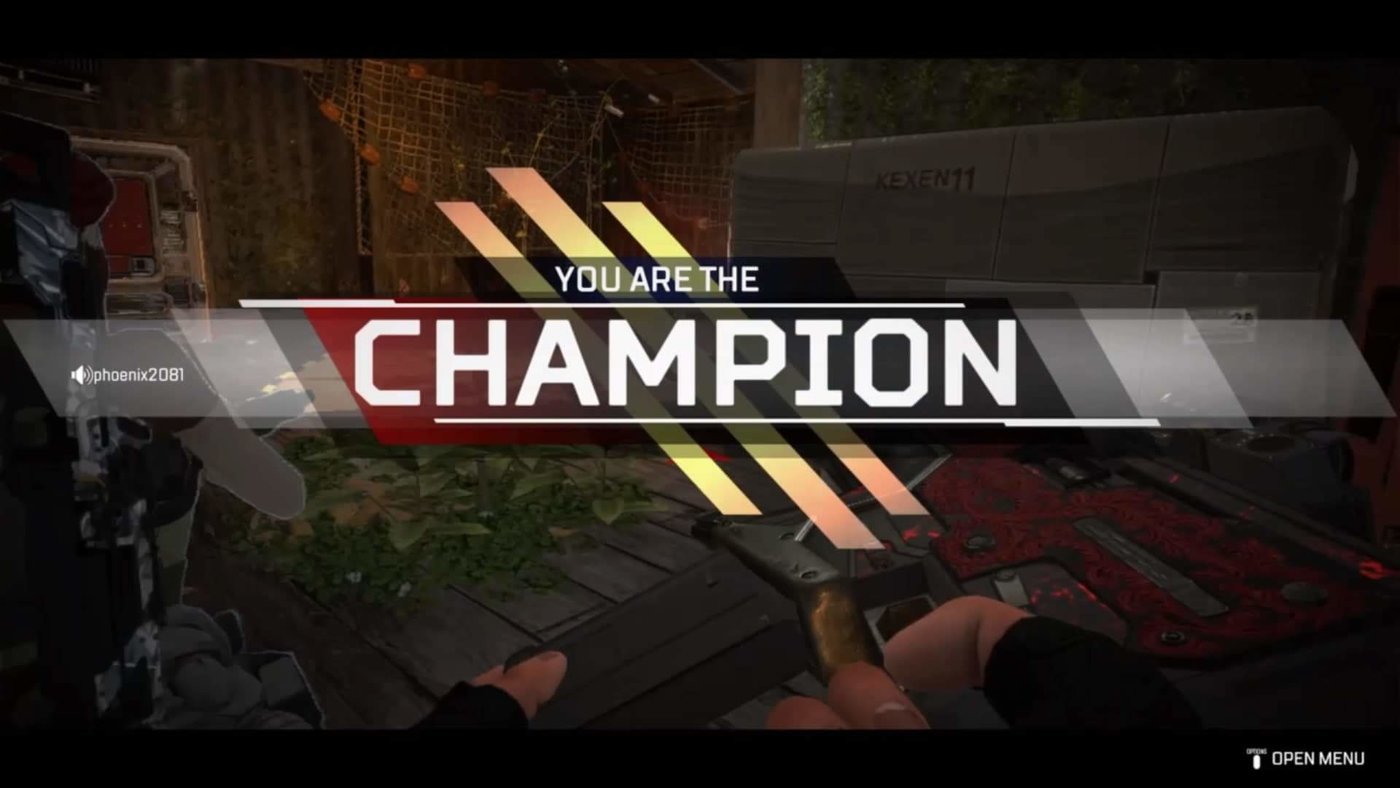
Apex legends is another battle royal game that has taken the world by storm. Some would say its a watered down genre however apex legends redefines the format adding its own spin on the mode.
Graphically it is stunning. A good amount of fauna, desert, buildings and caverns to showcase different textures whilst not quite being as cartoon like as fortnite.
The player handling is fantastic with vaulting, sliding and using zip lines. It does not feel clunky but rather smooth and fluid.
Sound is fantastic. Weapons sound so good and you can distinguish weapons prior to a fight just from hearing them. Footsteps alter from the terrain that is being ran on and dulled by crouching.
Currently the game is 3 person squads and has a max player count at 60 lower than the 4 person squad and 100 player count. This works well for the pace of the game and map size. You are never too far away from getting in the action should you wish after surviving the initial 5 minute onslaught for areas and that sweet precious loot.
You'll notice I put squad / team work in both positive and negative. The positive is it semi forces you to land as a squad. This can be cancelled by those who aren't the jump master and want to go rogue. I have noticed this but not is often as other games of the genre. 3 players allows for a good amount of mutual support, mixing and matching legend abilities to secure a win and having a diverse amount of weapons to cover all ranges. I have also negatived it due to the rogues, item/weapon/ammo stealing, lack of pinging (more on this after) and absolute lack of microphone communication. That last one is not a fault of the game or dev but merely an observation for the ps4 platform.
The ping system is the single point that makes this game fantastic. If you have a child or a broken mic you can opt to ping. Let's travel here, I'm watching here, enemy sighted and so forth. If you're not talking use the feature it's fantastic and also ends the classic e emy over there, where? There group conversation.
Legends have unique abilities but in a nutshell play what you like. Pick a character that has perks that fit your style. You can pick up that elusive 'dub' in any combination of legends. I still haven't settled. On one but enjoy 3-4 that I switch around. Its also good to have that incase someone rudely steals your character.
Minor bugs so far that I've encountered are falling through the floor (now patched allegedly and in fairness it hasn't happened to me in a while), items fallingb, through building/ dropship floor, death boxes dissapearing and falling through floors. The devs are however extremely good currently at updating and listening to the community.
Weapon balance is pretty damn bad (personal opinion). Peacekeeper is a beast shotgun at close range and mid range. The range for me needs dropping and that's prior to finding the attachment hop ups to strengthen it. The Mozambique is just a dreadful shotgun that you will find left on the floor to rust by just about everyone.
Very quickly on microtransactions. They are cosmetic only. You can warn everything including new legends in time but prepare to grind. Real money does not need to be used.
Time will tell if this game will survive the test of time as the devs release the battle pass and future content. Currently I'd give it 7/10. Solid game and worth a try by anyone. It is free after all.
Graphically it is stunning. A good amount of fauna, desert, buildings and caverns to showcase different textures whilst not quite being as cartoon like as fortnite.
The player handling is fantastic with vaulting, sliding and using zip lines. It does not feel clunky but rather smooth and fluid.
Sound is fantastic. Weapons sound so good and you can distinguish weapons prior to a fight just from hearing them. Footsteps alter from the terrain that is being ran on and dulled by crouching.
Currently the game is 3 person squads and has a max player count at 60 lower than the 4 person squad and 100 player count. This works well for the pace of the game and map size. You are never too far away from getting in the action should you wish after surviving the initial 5 minute onslaught for areas and that sweet precious loot.
You'll notice I put squad / team work in both positive and negative. The positive is it semi forces you to land as a squad. This can be cancelled by those who aren't the jump master and want to go rogue. I have noticed this but not is often as other games of the genre. 3 players allows for a good amount of mutual support, mixing and matching legend abilities to secure a win and having a diverse amount of weapons to cover all ranges. I have also negatived it due to the rogues, item/weapon/ammo stealing, lack of pinging (more on this after) and absolute lack of microphone communication. That last one is not a fault of the game or dev but merely an observation for the ps4 platform.
The ping system is the single point that makes this game fantastic. If you have a child or a broken mic you can opt to ping. Let's travel here, I'm watching here, enemy sighted and so forth. If you're not talking use the feature it's fantastic and also ends the classic e emy over there, where? There group conversation.
Legends have unique abilities but in a nutshell play what you like. Pick a character that has perks that fit your style. You can pick up that elusive 'dub' in any combination of legends. I still haven't settled. On one but enjoy 3-4 that I switch around. Its also good to have that incase someone rudely steals your character.
Minor bugs so far that I've encountered are falling through the floor (now patched allegedly and in fairness it hasn't happened to me in a while), items fallingb, through building/ dropship floor, death boxes dissapearing and falling through floors. The devs are however extremely good currently at updating and listening to the community.
Weapon balance is pretty damn bad (personal opinion). Peacekeeper is a beast shotgun at close range and mid range. The range for me needs dropping and that's prior to finding the attachment hop ups to strengthen it. The Mozambique is just a dreadful shotgun that you will find left on the floor to rust by just about everyone.
Very quickly on microtransactions. They are cosmetic only. You can warn everything including new legends in time but prepare to grind. Real money does not need to be used.
Time will tell if this game will survive the test of time as the devs release the battle pass and future content. Currently I'd give it 7/10. Solid game and worth a try by anyone. It is free after all.

Kim Kardashian: Hollywood
Games and Entertainment
App
Join KIM KARDASHIAN on a red carpet adventure in Kim Kardashian: Hollywood! Create your own aspiring...