

Dawn of the Zeds (Third edition)
8.0 Rate It
Tabletop Game
The postcards in every local drug store read, "Welcome to Fabulous Farmingdale!", an ad campaign...
Solo game

Feudum
7.0 Rate It
Tabletop Game
Blimey! You and your blokes have been banished and stripped of everything but a few shillings and...
BoardGames 2018Games
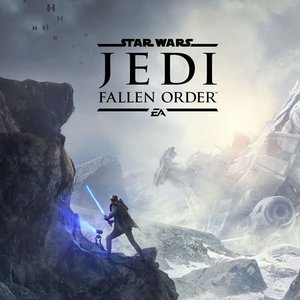
Star Wars Jedi: Fallen Order
7.9
Rate It
Video Game Watch
A galaxy-spanning adventure awaits in Star Wars Jedi: Fallen Order, a new 3rd person...

Moon over Soho (Rivers of London #2)
5.0 Rate It
Book
I was my dad's vinyl-wallah: I changed his records while he lounged around drinking tea, and that's...

Purple Phoenix Games (2266 KP) rated Viceroy in Tabletop Games
Jun 12, 2019
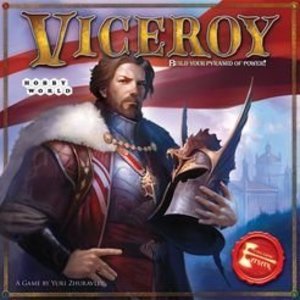
Power. That’s what everyone wants, isn’t it? Well, at least it is in Viceroy! As an inhabitant of the world of Laar, you are fighting to become the ultimate ruler. Recruit allies who provide strategic advantages and enact laws that solidify your claim for power. Do you have what it takes to build and maintain a powerful kingdom, or will your attempts fall short?
DISCLAIMER: There is an expansion to this game, but we are not reviewing it at this time. Should we review it in the future we will either update this review or post a link to the new material here. -T
Viceroy, a game of card drafting and tile placement, is played over 12 turns in which players build a pyramid with their cards – paying to place each card and collecting rewards based upon which level of the pyramid a card is placed. Each turn is divided into two phases: Auction and Development. During the Auction Phase, players bid gemstones to buy a card from the auction line. Once every player has either collected 1 card from auction or passed, play moves to the Development Phase. During the Development Phase, players can either play a card into their pyramid, pass, or discard a card and take 2 gemstones from the reserve. To play a Law card into your pyramid, you place it for free. To play a Character card into your pyramid, you have to pay for it with gems. The cost is dependent upon which level of the pyramid the card is to be placed. You must pay for the level the card will sit on, as well as pay the cost for every level beneath it. For example, to add a card to the third level of the pyramid, you must pay the cost for the 3rd level, AND 2nd level, AND 1st level. The rewards gained from adding a card to the pyramid, however, are taken only for the level on which the card sits. In the earlier example, you would only get the reward for the third level alone, since that is the level on which the card sits. The Development Phase is played over 3 rounds, so a player could play up to 3 cards into their pyramid during 1 Development Phase. After the 3 rounds are up, the next turn begins again in the Auction Phase. When all cards are gone from the Auction Deck, the game ends. Players count up all of their Power Points, and the player with the highest Power value wins!
The only change in Viceroy between a group and solo game is during the Auction Phase. Obviously, if you are playing solo, there is nobody to bid against for cards. How that is alleviated is that you still bid your gemstone as normal, and you randomly draw an unused gemstone from the box as an AI bid. If the colors match, you lose your gem and go on to the next auction. If the colors do not match, you collect your choice card, and the card the AI would have collected gets discarded. If the AI color does not match an available card, you just discard one of the remaining cards. This mimics group play in the sense that you might not always get the card you want from auction! The Development Phase is played as normal. At the end of the game, count points as normal and try to beat your own high score.
Viceroy is a neat game. Every card has so many options that there is no one single strategy that is a sure-win every time. Maybe one game I’ll go for Magic tokens. And maybe the next I’ll try to go for raw Power Point tokens. The possibilities really are endless, and that keeps this game fresh for me. I don’t feel like I’m just going through the motions because every card will act differently depending on where it is played. Strategy really is everything here. On the flip-side of that, however, is that sometimes the options can be a little overwhelming. With so many possibilities for each card, it can get hard for me to decide on what strategy I really want to use. It should also be noted that a card can only be played onto a level if it can sit on exactly 2 cards on the level beneath it. So sometimes I buy a card to play on a certain level only to get to the Development Phase and realize I don’t have a legal place to which I can play it. So do I sacrifice other cards/gemstones to build a slot for this one card, or do I play it to a different level and change my strategy a bit? There’s a little bit of a learning curve, but the more I play, the better I get (or at least, the better I think I get).
Another grievance with Viceroy is that I find myself running out of cards in my hand a lot. The only opportunity to draw cards is if you play a card into your pyramid that allows you to do so. And since I’m usually focused on other strategic routes, I don’t use those cards for those purposes. So then I play all of the cards in my hand (leaving me empty-handed), get 1 card at the next auction, play it, and am again left with no cards in my hand. To fix this issue, I wish one of the actions you could take during the Development Phase was to draw 1 card. I’m not sure if other people have this issue, or if it’s just me, but it’s a problem I run into almost every game.
Overall, I think Viceroy is a good game. It’s unique in the sense that there are so many possibilities that you’ll probably never play the same game twice, even if you decide to play by the same strategy. The mechanics and gameplay are cool too – it’s fun to watch your pyramid literally grow in front of you as the game progresses. This game takes a little more focus and thought than you might think, so it’s not one I’d necessarily just pull out for some light fun. I think Viceroy is as exciting as a solo game as it is as a group game since there really aren’t any differences between the two settings. If you like Viceroy, give it a try solo! If you’ve never played Viceroy, try it either solo or in a group – it’s the same game after all!
https://purplephoenixgames.wordpress.com/2019/04/18/solo-chronicles-viceroy/
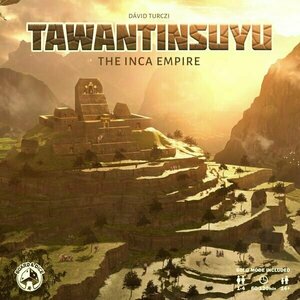
Tawantinsuyu: The Inca Empire
Tabletop Game
The great Sapa Inca Pachacuti turned to his offspring and ordered them to worship Inti, the Sun God,...

Gareth von Kallenbach (980 KP) rated Mario + Rabbids Kingdom Battle in Video Games
Jun 19, 2019

Mario vs. Rabbids: Kingdom Battle blends the iconic Nintendo characters with the Ubisoft Rabbids in a new turn based adventure that fans will love.
Mario, Yoshi, Luigi, and others blend with the mischievous Rabbids after a hysterical accident combines the two franchises.
Using a guide, players will move across a map, collecting coins as they go which can be used to upgrade your gear at various times.
When players enter certain arenas, the game becomes a turn based tactical combat game. Think X-Com but more family friendly and you begin to understand the fun and challenges that await them.
A typical round involves players moving to a point on the field, taking cover, and firing an attack shot at an enemy. Players may also opt to use a defensive skill when available or charge in for a close-quarters attack.
Should players complete the round with at least one of their three players still standing, they can move onto a new area and fight a new set of challenges.
I was doing very well until the first Mid-Boss who along with his minions presented a large challenge. The game gave me the option to play in an easier mode, but that did not seem to matter much as the enemies used travel tubes, exploding boxes, and other tactics to dominate.
Being able to upgrade your weapons is a big help as often the extra amount of damage you can deal an enemy is the key to winning a battle or failing miserably.
The game offers a co-op mode for players looking to play with another player and it is an easy game to play, but one that is very difficult to master.
The Game did very well at E3 when it was announced and won several awards which are well-deserved as after several days of playing the game, I am not bored with it at all and still keep coming back to it again and again.
This is a big deal for me as I often become bored with Nintendo games after a few days as I often find the dated graphics and gameplay difficult to hold my attention for long compared to other options that are out there. This time, I found a game that I love and enjoy the challenge and whimsical blend of styles which makes this one the first real reason to own a Nintendo Switch as I have found it far more enjoyable than any other title currently available for the system, Zelda included.
http://sknr.net/2017/08/28/mario-vs-rabbids-kingdom-battle/

Hands up alias charades and heads up activity game for fun friends company
Games and Entertainment
App
Hands up – Charades, Activity and Alias in one app! Exciting game for friends will make your party...

Media Center for Xbox 360 and Xbox One
Photo & Video and Music
App
Works on Xbox 360 and Xbox One!! Just bought your Xbox or already have one at home? This Media...

Hands up alias charades and heads up activity game for fun friends company Free
Games and Entertainment
App
Hands up – Charades, Activity and Alias in one app! Exciting game for friends will make your party...