

European Football History 2011-2012
Sports and Entertainment
App
"European Football History 2011-2012" - is an application about European Football 2011-2012. With...

Ukrainian Football History 2013-2014
Sports and Entertainment
App
«Ukrainian Football History 2013-2014» - is an application about Ukrainian Football – Season...

Russian Football History 2012-2013
Sports and Entertainment
7.0 Rate It
App
"Russian Football history 2012-2013" - is an application about Russian Football 2012-2013. With...

Russian Football History 2011-2012
Sports and Entertainment
App
"Russian Football History 2011-2012" - is an application about Russian Football 2011-2012. With...

Ukrainian Football History 2012-2013
Sports and Entertainment
App
«Ukrainian Football History 2012-2013» - is an application about Ukrainian Football – Season...
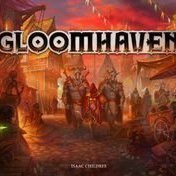
Gloomhaven
9.0 Rate It
Tabletop Game Watch
Gloomhaven is a game of Euro-inspired tactical combat in a persistent world of shifting motives....

Purple Phoenix Games (2266 KP) rated Strife: Legacy of the Eternals in Tabletop Games
Jun 12, 2019


War rages across the land as the Eternals (immortal beings) fight each other for dominance over the realm. Calling forth their chosen Champions, battle after battle is fought until one Eternal emerges victorious. Will your Champions aid you on your quest for supremacy, or will you be forced to cede to another Eternal in the end? Choose your Champions wisely, and may your legacy and power reign supreme!
Strife: Legacy of the Eternals is a competitive two-player game of perfect information – each player has an identical hand of 10 cards from which to play. At its core, Strife is like War – players simultaneously reveal their chosen card and the highest number wins that battle. Players earn Victory Points for battles won. But there’s a twist. Each card has a unique ability (Battle Ability) that, when played, can influence the total power of either your or your opponent’s card for the given turn. And that’s not all – each card also has a secondary ability (Legacy Ability) that can be used the turn after it was initially played to also influence the total power for that next turn. Strategy is key! How can you play your cards in a way that both the initial and secondary powers can benefit you? One power is immediate and one is delayed by a turn, so think carefully about how to best combo your cards/powers! Don’t forget, as a game of perfect information you also know exactly what your opponent is working with too! Use your deduction skills to determine which card they might play and figure out how to use your remaining cards to undermine their total power. The game is played over the course of 3 rounds, and the player with the most Victory Points at the end is the winner!
For a game that seems so simple, Strife actually has a steep learning curve. Every card in your hand has a unique Battle Ability AND Legacy Ability that you have to learn to successfully play. You can’t just pick this game up and play if you don’t know the powers and understand how they work. It might be a little easier to learn if there was a player reference guide for all of the powers so you could just look in one place, but there isn’t one. So I’m left flipping through all of my cards trying to find a power that I thought I saw that could maybe combo with a power on a different card. The rule sheet suggests using ONLY Legacy Abilities your first game to get a feel for the flow, which I appreciate. But when you finally add in the Battle Abilities, you have to be paying attention to 2 different powers on 2 different cards each turn and it can be confusing if you don’t fully know all of those powers.
That being said, I think this game would be great if it used ONLY a Battle Ability or ONLY a Legacy Ability. Having both just feels like too much to me. Until you understand all of the abilities, it’s hard to decide on a strategy since you don’t really know how certain powers will work with each other across different cards. I have played this game multiple times, but since I don’t play 2-player only games often, I haven’t had the opportunity to totally learn all of the powers. And if you play with someone that has never played Strife before, it feels a little unfair if YOU know the abilities and how they work while your opponent is totally in the dark. It would be a much easier game to grasp if there was only 1 power on 1 card to consider for each turn.
I got Strife from Travis when he was doing a small purge of his collection, and I can see why he was getting rid of it. It’s a part of my collection, but I can’t guarantee how long it’ll stay there. In theory, it’s a cool game. But in actual execution, it’s just a little too complicated for what I feel it should be. Give Strife a try if you want, but I don’t really think you’re missing much if you don’t. That’s why Purple Phoenix Games gives Strife a 4/12.
https://purplephoenixgames.wordpress.com/2019/03/20/strife-legacy-of-the-eternals-review/
Purple Phoenix Games (2266 KP) rated Rucksack in Tabletop Games
Jul 20, 2020 (Updated Jul 20, 2020)
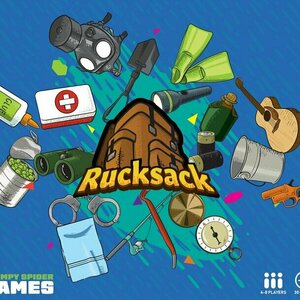

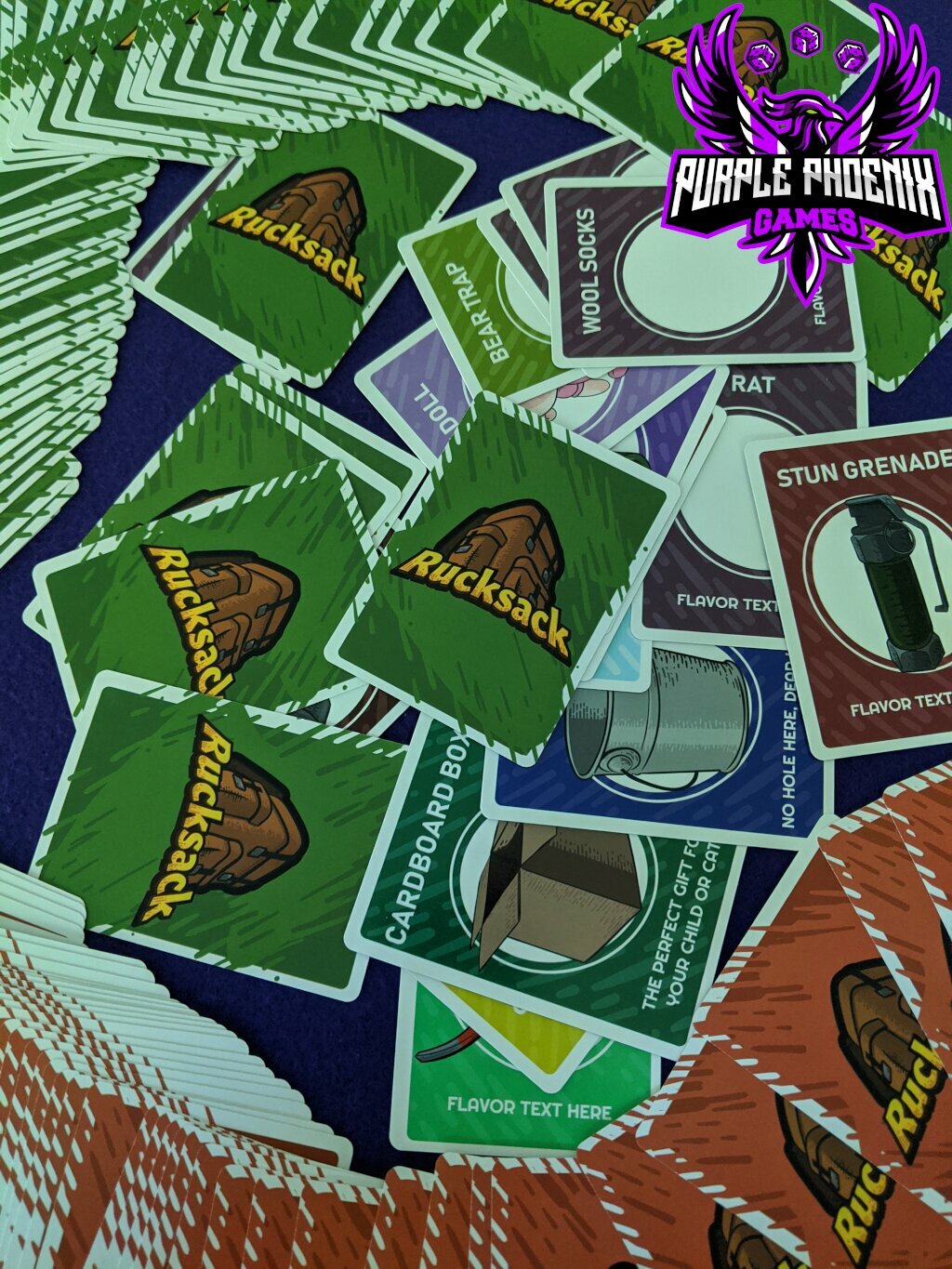
Rucksack is a card drafting storytelling and voting game for 4-8 players. Each player will be drafting a hand of five item cards in order to create the greatest survival story satisfying the active scenario.
DISCLAIMER: We were provided a prototype copy of this game for the purposes of this review. These are preview copy components, and the final components may be different from these shown. Also, it is not my intention to detail every rule in the game, as there are just too many. You are invited to back the game through the upcoming Kickstarter campaign, order from your FLGS, or purchase through any retailers stocking it after fulfillment. -T
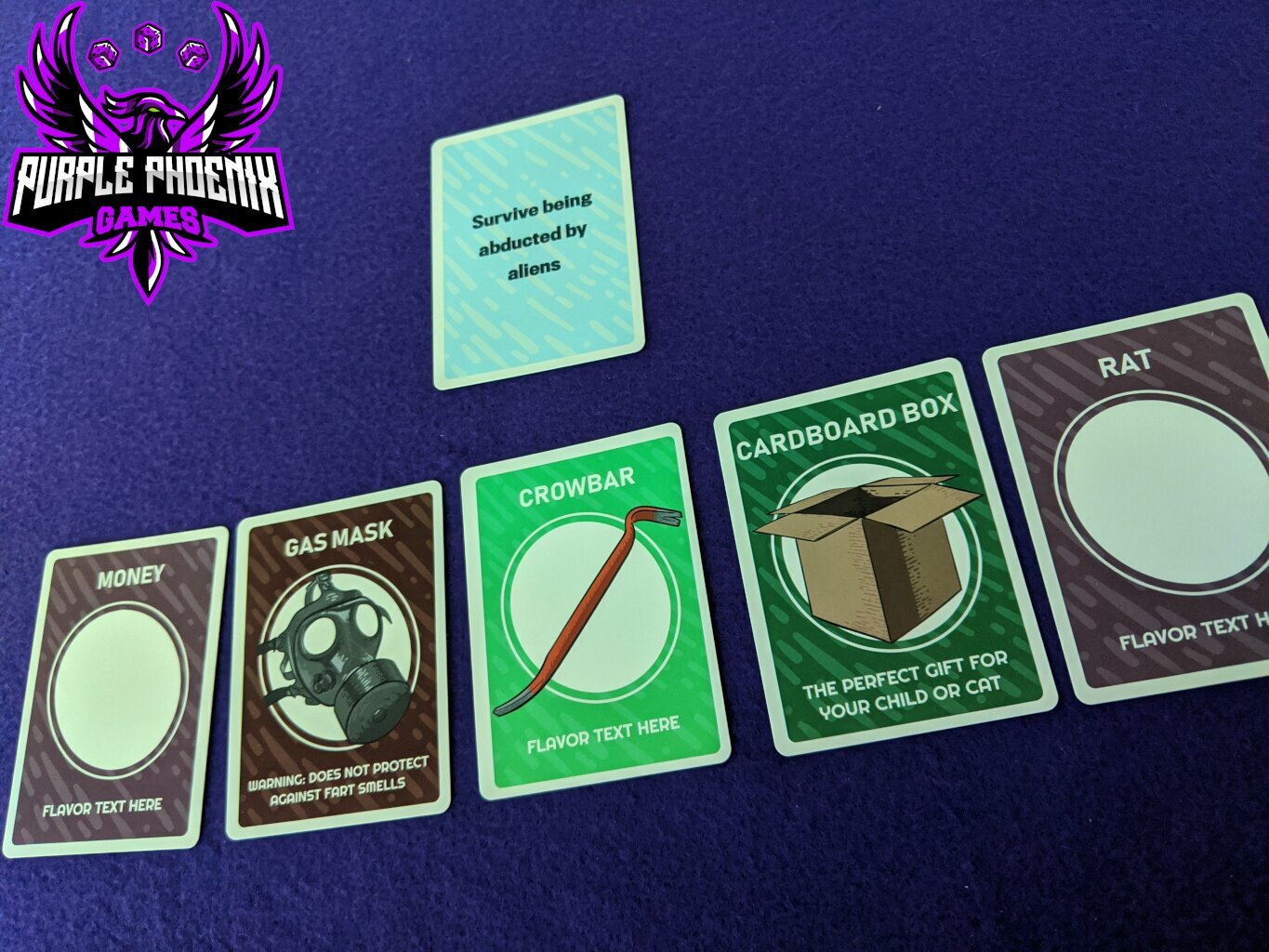
To setup, give each player a voting sheet and pencil. Shuffle the scenario cards into a draw deck. Shuffle the item cards into a draw deck. Flip over the top scenario card and the game is ready to be played.
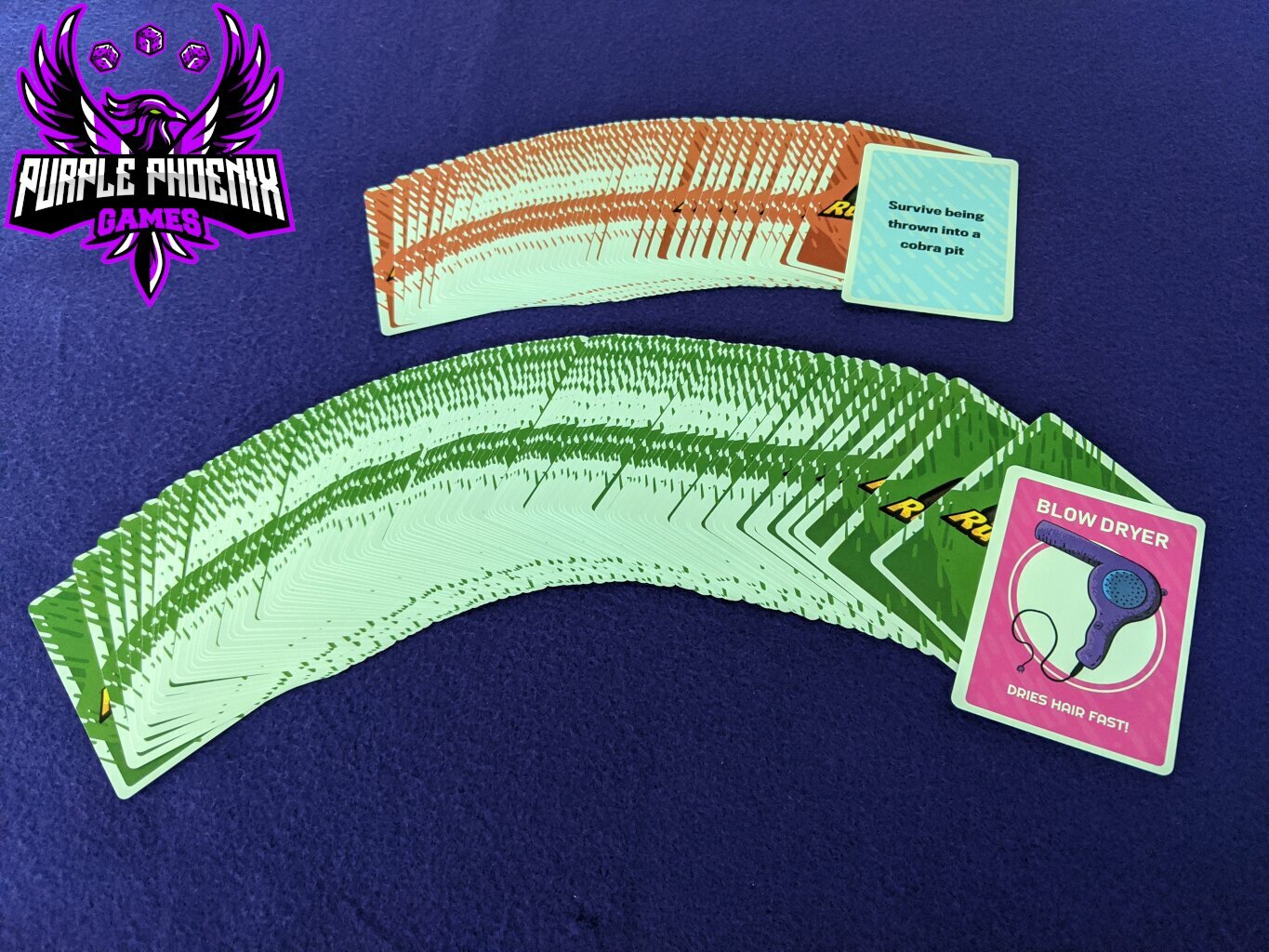
The game is played over three rounds and each round is played in two halves. During the first half of the game players will be drawing one card from the item deck and deciding whether to keep or discard it. If kept, the next player will do the same. If discarded, the player will add the card to the face-up discard pile and MUST keep the next card drawn. The next player may then choose the topmost card of the discard pile or draw from the item card draw stack. This continues until all players have five cards in hand and the game then transitions into the second phase – storytelling.
Using the drafted five cards each player will explain how they would survive the active scenario, and this is the crux of the game. How would someone use tweezers, a towel, a stun grenade, binoculars, and a wine glass to last 40 days on an island full of hostile inhabitants? Well this may be exactly what you are presented with while playing Rucksack. Each player will give their ideas and pitch them to the group. Once all players have made their cases, each player will mark on their voting sheet who created the best plan to combat the scenario. After three rounds the votes are tallied and the winner is crowned! Well, not with a real crown. Unless you want. But those are sold separately.
Components. Again, we were provided a prototype copy of this game, so all comments on components should be taken with that in mind. In fact, some cards came without art or flavor text on them. This in no way detracted from our plays. The components here are a bunch of cards, a pack of golf pencils, and a pad of voting sheets. The pencils and voting sheets are fine. The cards, though not final quality and missing many art pieces, are also fine. The art style on this game is interesting and I like it. Rucksack could be played with no art and I would feel the same way about it. So in summation, the components here are good.
This is another game that I thought would be a dud upon reading the rules and knowing the people I am able to play games with currently. However, once we started playing a whole new side of these people came forth to weave these intricate stories of how someone would use marbles to help them be rescued from an uninhabited island. I found myself also prodding the creative part of my brain (that I don’t use much anymore). It has been a surprise for me that I like this one so well. I’m not usually into storytelling games, but using these item cards to help guide the final answers prove to add such a unique facet to what could have been such a disaster for our group. I am proud to have this game in my collection to scratch a very different itch that I never thought I had.
Should you be in the market for a good and light storytelling game to get the creative juices flowing and the hilarity of others’ answers out, then do consider backing or purchasing Rucksack. You will enjoy it immensely and think about it even after you’ve played. That is the sign of a great game to me.

Purple Phoenix Games (2266 KP) rated Apotheca in Tabletop Games
Jun 12, 2019

After years of study, you have finally become a master apothecary, and making magic potions is your passion. You buy all of your ingredients in a secret marketplace with no problem until one day, you come across another apothecary trying to buy all of the same ingredients as you! Who does this person think they are?? Using your quick wit, and some sleight of hand, you manage to scatter the ingredients around the marketplace to hide them from your rival. Now all you’ve got to do is give them the slip so you can go pick up the ingredients. Be careful, though – you’re rival is as sly as you are, and is scouring the marketplace to find them first!
In Apotheca, players are racing to create three magic potions before their opponents do. To craft a magic potion, players must make a match of three potions of the same color in a row. Played on a 4×4 grid, potions are manipulated by apothecary powers from recruited apothecary cards in a manner similar to movement in chess, or better yet – Onitama. Complete three matches, and you win! As a whole, I could describe Apotheca as chess with a helping of tic-tac-toe.
One thing I really like about this game is that it’s a game of semi-hidden information. Some things are hidden and some things are not. You do know the apothecary power(s) your opponent has, but you don’t know the color of the potions they put into play. Based on how they use their powers to manipulate potions, both face-up and face-down, you must deduce their strategy and thwart their attempts at making a match! Of course, they are doing the exact same thing to you – only you know the color of potions you place, but your power is known to your opponent. It’s a unique game of deduction and deception that requires more strategy than meets the eye.
Apotheca can be played with 1-4 players, but I think the best player count is 2. In a 3-4 player game, it can be difficult to build a concrete strategy because the board can significantly change between your turns. In a 2-player game, the board changes as well, but not nearly as quickly since it is just a back-and-forth with turn order. Also, more players means more hidden information – it can be tedious trying to remember who performed what action and who has what powers as you try to deduce everyone’s strategy. I don’t mind Apotheca as a 3-4 player game, but I would certainly prefer to play it as a 2-player game.
As you can see by our individual ratings, we are a little split on this game. It requires a decent amount of strategy and deduction, which work well together in this game. Apotheca was one of the first games in my collection, and it’s one that will stay there. Overall, Purple Phoenix Games gives Apotheca a sneaky 12 / 18.
https://purplephoenixgames.wordpress.com/2019/02/01/apotheca-review/

Wendake
Tabletop Game
"Wendake" is the name that the Wyandot People use for their traditional territory. This population,...
BoardGames 2017Games Nativegames