Search
Search results

Hudl Technique
Sports and Health & Fitness
App
Record. Analyze. Improve. Athletes and coaches in more than 40 sports use Hudl Technique to improve...
3rd Grade Math - Multiplication Facts & Kids Games
Education and Games
7.0 Rate It
App
We make math fun & engaging. Over 15 Million kids use the Splash Math program to Boost Confidence,...



Bob Mann (459 KP) rated Deepwater Horizon (2016) in Movies
Sep 29, 2021


“Full of sound and fury, Signifying nothing” could be a summary of this modern-age disaster movie. In 2010 the “Deepwater Horizon” drilling rig off the coast of Louisiana failed in spectacular fashion, bursting into flames and spewing millions of barrels of crude oil into the Gulf of Mexico in what was the worst oil-spill in American history. Mark Wahlberg plays the well-respected electrical ‘Mr fixit’ Mike Williams on the rig, reporting to the Operations Manager Jimmy Harrell (Kurt Russell).
The exploratory project is way-behind and BP are not happy. Big-wigs from the company add support to Donald Vidrine, the BP site leader, in applying mounting pressure on Harrell to press on regardless without all the necessary and time-consuming tests by Schlumberger being completed. Rogue numbers in further tests are waved away as ‘glitches’. A familiar story of corporate greed and pressure overriding the expert’s better judgment.
When disaster strikes it strikes quickly, with some spectacular and exciting special effects that leave the audience especially hot under the collar. Female support is provided by the comely Andrea Fleytas (Gina Rodriguez), given the almost impossible job of keeping the floating bomb on station as chaos reigns about her. As an audience we are back on familiar ground here from classic Irwin Allen disaster movies such as “The Towering Inferno” and “The Poseidon Adventure”. Who will make it, and who won’t?
A more telling question here is “Do we care?” and unfortunately for the film, the answer is “Not really”. This feels a callous thing to say when this was a real and recent event and eleven people and – as touchingly illustrated at the end of the film in tribute – many of them family men with young kids, never went home again. But film-wise, we only really get bought into the fate of Williams, whose back-story, with cute wife (Kate Hudson) and cute daughter (Stella Allen) we get to meet and sympathize with.
We get a minimalist view of Fleytas’s backstory, but only enough to provide a recurring “Mustang” reference. And that’s it. All the other characters are just two-dimensional “rig crew”: cannon-fodder for the special effects team. The screenplay by Matthew Sand and Matthew Carnahan really doesn’t deliver enough heft to get us bought in.
While the special effects are good, the sound design isn’t, with much of the dialogue being incomprehensible.
All the acting is fine, with the ever-watchable John Malkovich nicely portraying the corporate head you love to hate. Wahlberg as well delivers enough range to make you forget in this “action mode” that he was also in “Ted”. And Rodriguez as a junior lead holds her own against the big guns in what is a creditable performance in a big film role for her.
While “Lone Survivor”/”Battleship” director Peter Berg neatly provides an insight into life on and around rigs, and (via subtitles) descriptions of the drilling process which I found interesting, this comes down to the sum of a tense build up, an hour of frenetic disaster, and then a whimper of an ending. Where were some of the dramatic scenes of conflict in the congressional hearing that the film’s opening implies might come? Where are the scenes of ecological disaster and local financial ruin to add emotional angles to the story? None of this is really exploited and the whole concoction comes across a bit “meh” as a result. Not a bad film by any means. But not one I will remember in a month or two’s time.
The exploratory project is way-behind and BP are not happy. Big-wigs from the company add support to Donald Vidrine, the BP site leader, in applying mounting pressure on Harrell to press on regardless without all the necessary and time-consuming tests by Schlumberger being completed. Rogue numbers in further tests are waved away as ‘glitches’. A familiar story of corporate greed and pressure overriding the expert’s better judgment.
When disaster strikes it strikes quickly, with some spectacular and exciting special effects that leave the audience especially hot under the collar. Female support is provided by the comely Andrea Fleytas (Gina Rodriguez), given the almost impossible job of keeping the floating bomb on station as chaos reigns about her. As an audience we are back on familiar ground here from classic Irwin Allen disaster movies such as “The Towering Inferno” and “The Poseidon Adventure”. Who will make it, and who won’t?
A more telling question here is “Do we care?” and unfortunately for the film, the answer is “Not really”. This feels a callous thing to say when this was a real and recent event and eleven people and – as touchingly illustrated at the end of the film in tribute – many of them family men with young kids, never went home again. But film-wise, we only really get bought into the fate of Williams, whose back-story, with cute wife (Kate Hudson) and cute daughter (Stella Allen) we get to meet and sympathize with.
We get a minimalist view of Fleytas’s backstory, but only enough to provide a recurring “Mustang” reference. And that’s it. All the other characters are just two-dimensional “rig crew”: cannon-fodder for the special effects team. The screenplay by Matthew Sand and Matthew Carnahan really doesn’t deliver enough heft to get us bought in.
While the special effects are good, the sound design isn’t, with much of the dialogue being incomprehensible.
All the acting is fine, with the ever-watchable John Malkovich nicely portraying the corporate head you love to hate. Wahlberg as well delivers enough range to make you forget in this “action mode” that he was also in “Ted”. And Rodriguez as a junior lead holds her own against the big guns in what is a creditable performance in a big film role for her.
While “Lone Survivor”/”Battleship” director Peter Berg neatly provides an insight into life on and around rigs, and (via subtitles) descriptions of the drilling process which I found interesting, this comes down to the sum of a tense build up, an hour of frenetic disaster, and then a whimper of an ending. Where were some of the dramatic scenes of conflict in the congressional hearing that the film’s opening implies might come? Where are the scenes of ecological disaster and local financial ruin to add emotional angles to the story? None of this is really exploited and the whole concoction comes across a bit “meh” as a result. Not a bad film by any means. But not one I will remember in a month or two’s time.

BankofMarquis (1832 KP) rated The Pale Blue Eye (2022) in Movies
Jan 15, 2023

Haunting and Intriguing
An eerie, gothic murder mystery pairing an ingenious Detective with a young Edgar Allan Poe is now streaming on Netflix and is the perfect way to shut out the January winds and hibernate on your couch and get involved in the mystery while sitting in front of a warm, roaring fire (or heat lamp) and your favorite warm (possibly adult) beverage).
Written for the screen (from book by Louis Bayard) and Directed by Scott Cooper (OUT OF THE FURNACE), THE PALE BLUE EYE stars the always good Christian Bale (probably my favorite actor working today) as Civilian Detective Augustus Landor who is summoned to 1830’s West Point Military Academy to solve a murder. He is aided by a young cadet played by Harry Melling (Dudley Dursley in the HARRY POTTER FILMS) who turns out to be none other than Edgar Allan Poe.
Cooper films this movie in shadow and dark brown and yellow tones, giving the 1830’s setting a certain dream-like, dreary quality that underscores the gruesome goings-on happening behind the scenes at the fledgling United States Military Academy. These types of films - and the mood that is permeated throughout - can often be slow slogs and often times bogs down under the weight of it’s own pretentiousness - but Cooper keeps the action moving forward (though at a deliberate pace) often-times mimicking the piecing together of the circumstances that Bale’s character is doing.
Thank goodness Cooper had the good sense to reunite with his OUT OF THE FURNACE star and cast Bale in the lead role. The character of Detective Augustus Landor is dark and brooding - himself still working through the emotions of a tragedy from his past. But he is also thoughtful and deliberate in his detective work and Bale handles these moods…and the pacing of the film…like the pro that he is. If for no other reason, check out THE PALE BLUE EYE (a reference to Poe’s TELL TALE HEART) for Bale’s performance at the center of things.
Fortunately, Bale is aided in this film by a strong ensemble of (mostly) British actors from Toby Jones to Gillian Anderson to Simon McBurney and Timothy Spall - they all bring their considerable talents to lesser roles as suspects and/or witnesses in this “whodunnit”. Cooper also trots out good ol’ (and I do mean old) Robert Duvall for a “blink or you’ll miss it” cameo. The casting works well for this gothic murder mystery.
And then there is Melling as Edgar Allan Poe. He plays Poe as you might expect one to play a young Edgar Allan Poe - as an “odd duck” who is fascinated by macabre scenarios (which would be later found in his storytelling), but Melling gives him an intelligence and gentleness of soul that really works in this case.
The Cinematography of this movie is bleak and dark - as befits a gothic murder mystery - and the pacing is not fast in any sense of the word, but if you click into this world, you’ll be rewarding by an interesting murder mystery that resolves itself in a surprising - and satisfactory - way.
Letter Grade: B+
8 stars (out of 10) and you can take that to the Bank(ofMarquis)
Written for the screen (from book by Louis Bayard) and Directed by Scott Cooper (OUT OF THE FURNACE), THE PALE BLUE EYE stars the always good Christian Bale (probably my favorite actor working today) as Civilian Detective Augustus Landor who is summoned to 1830’s West Point Military Academy to solve a murder. He is aided by a young cadet played by Harry Melling (Dudley Dursley in the HARRY POTTER FILMS) who turns out to be none other than Edgar Allan Poe.
Cooper films this movie in shadow and dark brown and yellow tones, giving the 1830’s setting a certain dream-like, dreary quality that underscores the gruesome goings-on happening behind the scenes at the fledgling United States Military Academy. These types of films - and the mood that is permeated throughout - can often be slow slogs and often times bogs down under the weight of it’s own pretentiousness - but Cooper keeps the action moving forward (though at a deliberate pace) often-times mimicking the piecing together of the circumstances that Bale’s character is doing.
Thank goodness Cooper had the good sense to reunite with his OUT OF THE FURNACE star and cast Bale in the lead role. The character of Detective Augustus Landor is dark and brooding - himself still working through the emotions of a tragedy from his past. But he is also thoughtful and deliberate in his detective work and Bale handles these moods…and the pacing of the film…like the pro that he is. If for no other reason, check out THE PALE BLUE EYE (a reference to Poe’s TELL TALE HEART) for Bale’s performance at the center of things.
Fortunately, Bale is aided in this film by a strong ensemble of (mostly) British actors from Toby Jones to Gillian Anderson to Simon McBurney and Timothy Spall - they all bring their considerable talents to lesser roles as suspects and/or witnesses in this “whodunnit”. Cooper also trots out good ol’ (and I do mean old) Robert Duvall for a “blink or you’ll miss it” cameo. The casting works well for this gothic murder mystery.
And then there is Melling as Edgar Allan Poe. He plays Poe as you might expect one to play a young Edgar Allan Poe - as an “odd duck” who is fascinated by macabre scenarios (which would be later found in his storytelling), but Melling gives him an intelligence and gentleness of soul that really works in this case.
The Cinematography of this movie is bleak and dark - as befits a gothic murder mystery - and the pacing is not fast in any sense of the word, but if you click into this world, you’ll be rewarding by an interesting murder mystery that resolves itself in a surprising - and satisfactory - way.
Letter Grade: B+
8 stars (out of 10) and you can take that to the Bank(ofMarquis)

Purple Phoenix Games (2266 KP) rated Fire in the Library in Tabletop Games
Feb 11, 2020

My main job currently is working in an academic library. I have lots of different responsibilities to handle. So when I heard about a game with a title, “Fire in the Library,” I knew we HAD to play it. What employee wouldn’t want to play a game where the game ends once your workplace inevitably burns down? Imagine my giddiness as I learned this game and set it up for the first time.
Fire in the Library is a push-your-luck card game that rewards players for pushing their luck well beyond their comfort zones… but as with all push-your-luck games, defeat is also imminent.
DISCLAIMER: We were provided a copy of this game for the purposes of this review. This is a retail copy of the game, so what you see in these photos is exactly what would be received in your box. I do not intend to cover every single rule included in the rulebook, but will describe the overall game flow and major rule set so that our readers may get a sense of how the game plays. For more in depth rules, you may purchase a copy online or from your FLGS. -T
To setup, each player will choose a player color, place their Libreeple (I think it’s Libreeple anyway) near the scoring track, and take the corresponding Player Reference Card. The Library will next be built from sequential Library Cards. The Library is a group of individual decks of cards arranged in a 2×2 pattern, and the card fronts create a lovely picture of the Library. Add all cubes of five different colors to the Library Bag (keeping aside 10 red “fire” cubes). Shuffle the Tool Cards deck, deal each player two Tool Cards, place the top three Tool Cards face-up next to its deck to form the Tool Card Market. Shuffle the Turn Order Cards per the player count rules in the rulebook, deal one to each player, and the game can begin!
Phase One of the game is Choosing Turn Order. Once the turn order has been established (just for the first round – after that, the player who is in last place will choose which Turn Order Card they would like to use for the round) the 1st Player will move onto Phase Two. Yes, Choosing Turn Order is an entire phase by itself. This becomes more important once I explain Tool Cards a little later.
Phase Two is the meat of the game. It is split into two sections, but they flow so nicely into each other. The active player consults their Turn Order Card to understand how many book cubes they would like to pull from the bag, thus “saving” them from the impending fire. The Turn Order Cards will have blank square spaces for “safe” areas, and spaces with fire icons in “risky” spaces. More points can be scored by placing cubes into the risky spaces, but also is more dangerous. You see, a player can pull out a red fire cube from the bag and still choose to continue to pull cubes, assuming the red cube is placed on a safe space on their card. But pull a second fire cube and their turn is immediately over. However, pulling just one red cube and having to place it in a risky space ends the turn immediately. A player can choose to stop pulling cubes at any time and earn the rewards on the Turn Order Card printed directly below the last cube placed as well as the points for each book saved, which are the large numbers printed on the Library Cards (the 2×2 grid with the picture of the Library). These rewards from the Turn Order Card could be merely a Tool Card (under safe spaces), or it could result in points on the scoreboard (under risky spaces). Even if a player busts with the red cubes, they will be able to take a Tool Card as consolation. If the active player did not bust and voluntarily stopped pulling cubes, they add their points for the turn and adjust their Libreeple accordingly. On the other hand, if a player had to end their turn due to pulling red fire cubes, then the fire spreads!
When the Fire Spreads all the books that the active player had thought they saved are burned (returned to the bag). These lost books will also cause the fire to burn down portions of the Library that match the colors of the cubes pulled. Remove the top cards for each of these cubes from the Library. Sometimes this will reveal a printed fire icon on the revealed Library cards. Every time a fire icon is revealed in this way, one of the red cubes that was set aside at setup will be added to the Library Bag – thus increasing the ratio of fire to safe books in the bag.
Phase Three is called “After Scoring.” Every Tool Card in the deck will have an icon printed to show when it can be played during a turn (check the Reference Card). The Tool Cards can be played during Choosing Turn Order, Saving Books, Fire Spreading, and After Scoring.
Once all players have had their turn for the round, a portion of the Library will burn. Remove the appropriate card (according to the rulebook). All players will have a chance to discard one of their Tool Cards and replace it with a Tool Card from the top of the deck. When complete, a new round begins. Play continues in this fashion until a section of the Library is revealed with an icon signifying the end of the game. Players will have one last round to earn as many points as— I mean, save as many books as they can.
Components. There’s a lot going on in this game, and the components are really really good. First, the game box is one of those awesome magnetic boxes (like Biblios) that unfolds and reveals the score tracker. The Libreeples are normal meeple fare, the cubes are normal cube fare, and the Library Bag is one that is loved by Guy Fieri (probably). The cards are great quality and feature really amazing artwork by Katie Khau and Beth Sobel. Overall, the components are wonderful and we really enjoyed playing with them.
As you can tell from our score, we genuinely enjoyed this game. The push-your-luck mechanic is so central to the game and the Tool Cards help to mitigate frustrating pulls, or help to manipulate other areas of the game, and we love both of those aspects. All in all, Fire in the Library is a truly enjoyable experience, and one that I find myself thinking about outside of game night. I cannot wait to play again, and hopefully save more books. I would suggest adding this to my workplace library’s board game collection, but I don’t want any students getting any great ideas… Purple Phoenix Games gives this one a hot hot hot 15 / 18. Check it out for a different take on push-your-luck, where you actually care about what you’re doing. Oh, and of course I won – I work in a college library.
Fire in the Library is a push-your-luck card game that rewards players for pushing their luck well beyond their comfort zones… but as with all push-your-luck games, defeat is also imminent.
DISCLAIMER: We were provided a copy of this game for the purposes of this review. This is a retail copy of the game, so what you see in these photos is exactly what would be received in your box. I do not intend to cover every single rule included in the rulebook, but will describe the overall game flow and major rule set so that our readers may get a sense of how the game plays. For more in depth rules, you may purchase a copy online or from your FLGS. -T
To setup, each player will choose a player color, place their Libreeple (I think it’s Libreeple anyway) near the scoring track, and take the corresponding Player Reference Card. The Library will next be built from sequential Library Cards. The Library is a group of individual decks of cards arranged in a 2×2 pattern, and the card fronts create a lovely picture of the Library. Add all cubes of five different colors to the Library Bag (keeping aside 10 red “fire” cubes). Shuffle the Tool Cards deck, deal each player two Tool Cards, place the top three Tool Cards face-up next to its deck to form the Tool Card Market. Shuffle the Turn Order Cards per the player count rules in the rulebook, deal one to each player, and the game can begin!
Phase One of the game is Choosing Turn Order. Once the turn order has been established (just for the first round – after that, the player who is in last place will choose which Turn Order Card they would like to use for the round) the 1st Player will move onto Phase Two. Yes, Choosing Turn Order is an entire phase by itself. This becomes more important once I explain Tool Cards a little later.
Phase Two is the meat of the game. It is split into two sections, but they flow so nicely into each other. The active player consults their Turn Order Card to understand how many book cubes they would like to pull from the bag, thus “saving” them from the impending fire. The Turn Order Cards will have blank square spaces for “safe” areas, and spaces with fire icons in “risky” spaces. More points can be scored by placing cubes into the risky spaces, but also is more dangerous. You see, a player can pull out a red fire cube from the bag and still choose to continue to pull cubes, assuming the red cube is placed on a safe space on their card. But pull a second fire cube and their turn is immediately over. However, pulling just one red cube and having to place it in a risky space ends the turn immediately. A player can choose to stop pulling cubes at any time and earn the rewards on the Turn Order Card printed directly below the last cube placed as well as the points for each book saved, which are the large numbers printed on the Library Cards (the 2×2 grid with the picture of the Library). These rewards from the Turn Order Card could be merely a Tool Card (under safe spaces), or it could result in points on the scoreboard (under risky spaces). Even if a player busts with the red cubes, they will be able to take a Tool Card as consolation. If the active player did not bust and voluntarily stopped pulling cubes, they add their points for the turn and adjust their Libreeple accordingly. On the other hand, if a player had to end their turn due to pulling red fire cubes, then the fire spreads!
When the Fire Spreads all the books that the active player had thought they saved are burned (returned to the bag). These lost books will also cause the fire to burn down portions of the Library that match the colors of the cubes pulled. Remove the top cards for each of these cubes from the Library. Sometimes this will reveal a printed fire icon on the revealed Library cards. Every time a fire icon is revealed in this way, one of the red cubes that was set aside at setup will be added to the Library Bag – thus increasing the ratio of fire to safe books in the bag.
Phase Three is called “After Scoring.” Every Tool Card in the deck will have an icon printed to show when it can be played during a turn (check the Reference Card). The Tool Cards can be played during Choosing Turn Order, Saving Books, Fire Spreading, and After Scoring.
Once all players have had their turn for the round, a portion of the Library will burn. Remove the appropriate card (according to the rulebook). All players will have a chance to discard one of their Tool Cards and replace it with a Tool Card from the top of the deck. When complete, a new round begins. Play continues in this fashion until a section of the Library is revealed with an icon signifying the end of the game. Players will have one last round to earn as many points as— I mean, save as many books as they can.
Components. There’s a lot going on in this game, and the components are really really good. First, the game box is one of those awesome magnetic boxes (like Biblios) that unfolds and reveals the score tracker. The Libreeples are normal meeple fare, the cubes are normal cube fare, and the Library Bag is one that is loved by Guy Fieri (probably). The cards are great quality and feature really amazing artwork by Katie Khau and Beth Sobel. Overall, the components are wonderful and we really enjoyed playing with them.
As you can tell from our score, we genuinely enjoyed this game. The push-your-luck mechanic is so central to the game and the Tool Cards help to mitigate frustrating pulls, or help to manipulate other areas of the game, and we love both of those aspects. All in all, Fire in the Library is a truly enjoyable experience, and one that I find myself thinking about outside of game night. I cannot wait to play again, and hopefully save more books. I would suggest adding this to my workplace library’s board game collection, but I don’t want any students getting any great ideas… Purple Phoenix Games gives this one a hot hot hot 15 / 18. Check it out for a different take on push-your-luck, where you actually care about what you’re doing. Oh, and of course I won – I work in a college library.
Purple Phoenix Games (2266 KP) rated Stellar Leap in Tabletop Games
Apr 23, 2020

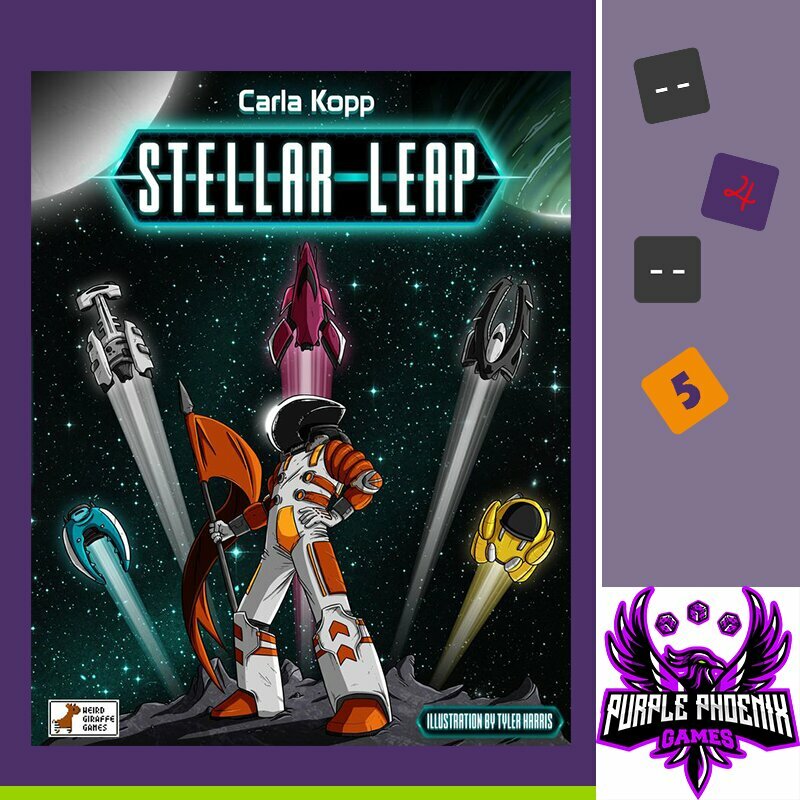
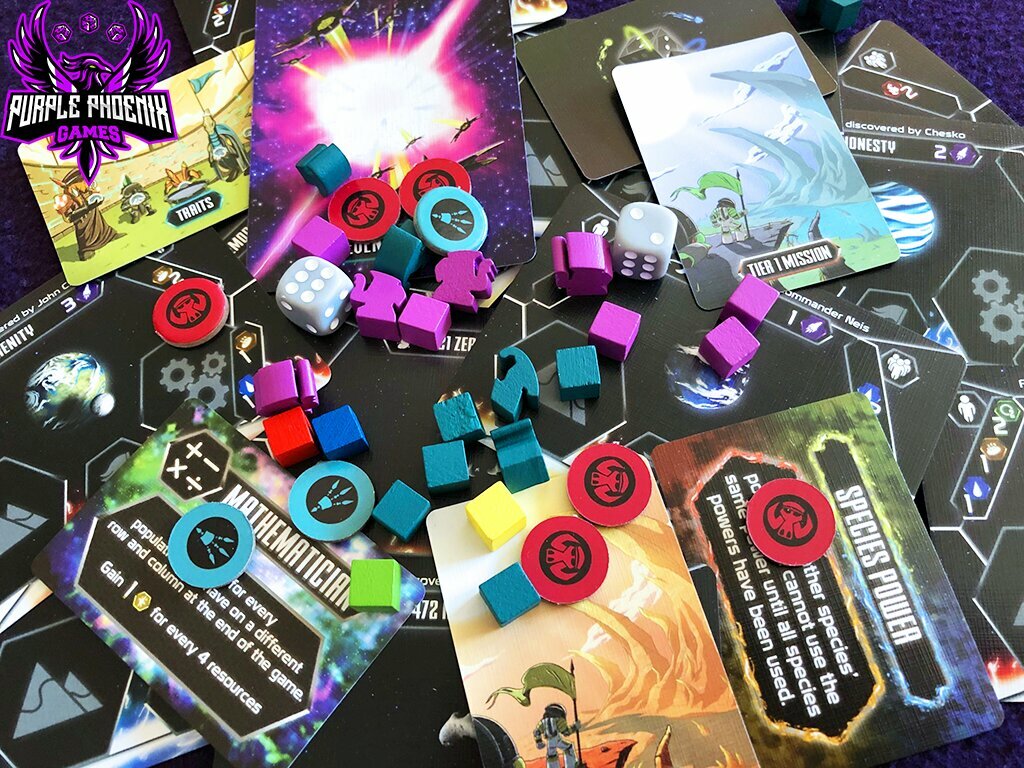
You are the member of an alien species, and your mission is to explore the galaxy! Discover new solar systems, build colonies on new planets, and gather resources along the way to sustain your species. Some neighboring alien species have also decided to foray into exploration, and will likely cross your path at some point or another. Are you a friendly race, willing to cooperate and maybe even cohabit a new planet? Or are you more aggressive and less willing to share? Only time, the cards, and the dice, will tell. Put your strategy to the test as you race to become the most prestigious alien species in the galaxy. So suit up and get ready for blast off!
DISCLAIMER: We were provided a copy of this game for the purposes of this review. This is a retail copy of the game, so what you see in these photos is exactly what would be received in your box. We do not intend to cover every single rule included in the rulebook, but will describe the overall game flow and major rule set so that our readers may get a sense of how the game plays. For more in depth rules, you may purchase a copy online or from your FLGS. -T
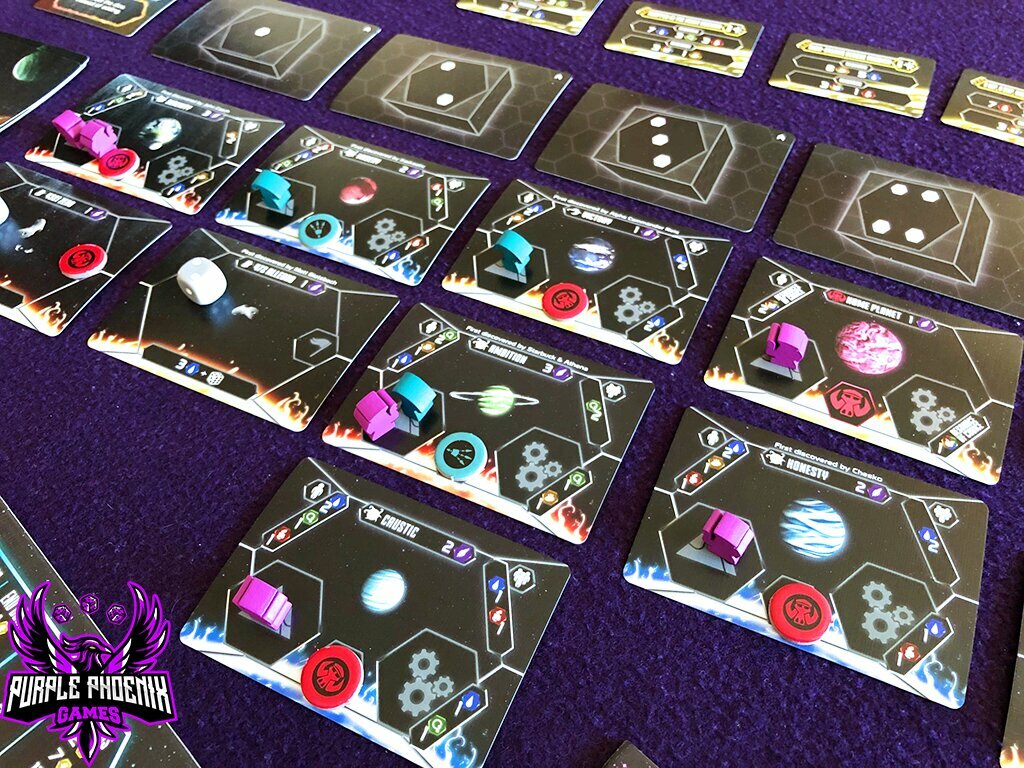
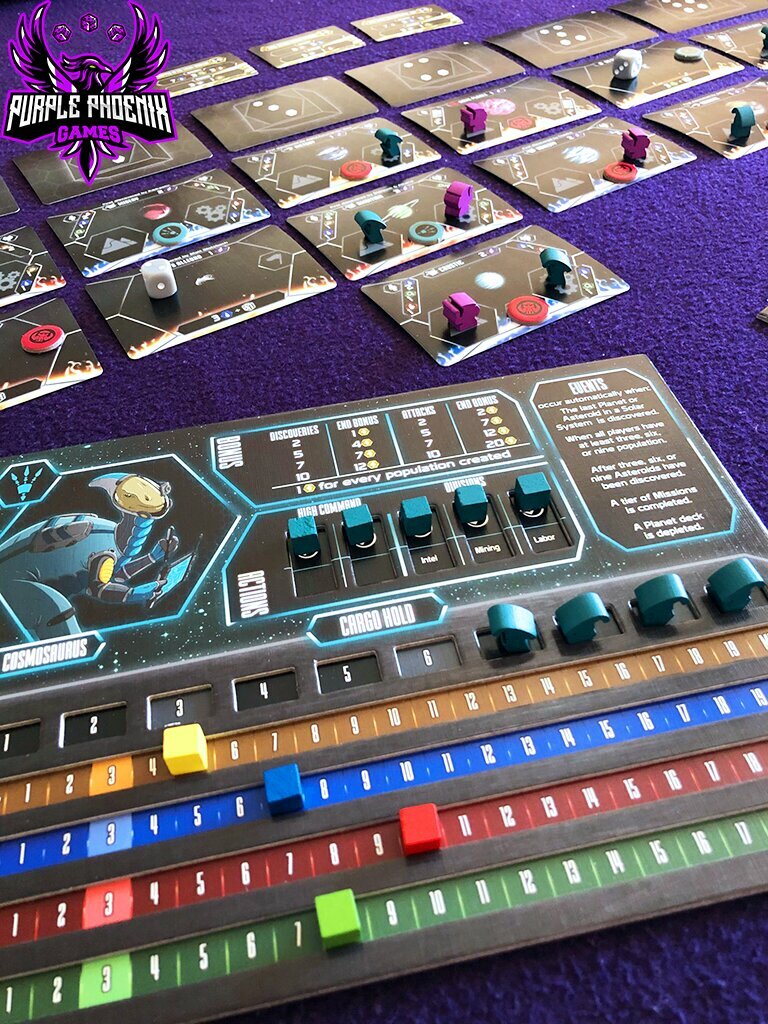
Stellar Leap is, at its core, a worker placement game with elements of dice rolling, variable powers, and a modular ‘board’ sprinkled in. To setup, each player receives an individual player board and components, while the Galaxy is set up for use by all players. Players then add their home planet, as well as 1 population marker, to the Galaxy, and the game is ready to begin! Stellar Leap is played over a series of rounds in which players take turns performing any or all actions available to them.
To begin a turn, players first recover any Population markers that may have been exhausted on their last turn (more on that in a bit). Next, the player rolls the two dice, manipulating them with Special Dice Powers if desired, and resources are collected. The Galaxy is set up in columns, each column numbered 1-6, to which these dice rolls will correspond. If you have a Population marker on a planet in one of the columns that corresponds to your die roll (you have a Population in column 4 and you rolled a 4), you collect the resources provided by that planet. It is important to note that any player can receive resources from a die roll, even if it is not their turn!
The next phase of play involves three elements: Movement, High Command Actions, and Division Actions. There is no limit to the amount of Movement you can take on your turn, as long as you have resources available to perform that action. You may take two High Command Actions: Populate (add a new Population marker to a planet), Tax (collect any two resources), Discover (add planets/asteroids to the Galaxy), or Attack (fight an opponent located on the same planet as yourself). The same High Command Action could be performed twice on your turn, but you can only perform two per turn. The Division Actions can each be taken once per turn. Those actions are: Intelligence (complete a Mission), Mining (mine an asteroid for resources), or Labor (exhaust one of your populations on a planet to receive additional resources). Movement, High Command Actions, and Division Actions can be taken in any order on your turn – turns are not ‘set’ in a specific order and actions can be taken at your discretion. You also are not required to take every available action on your turn if you do not want to – your turns could be as long or as brief as you want them to be, depending on which actions you want to take.
At certain points throughout play, Events will be triggered. When an Event is triggered, draw the top Event card and resolve its effect. Some are resolved immediately, and some remain in play for the rest of the game. The game ends once six Events have been triggered. Players then tally up their Prestige points (earned by completing Missions, discovering planets, winning combats, and fulfilling their secret objectives), and the player with the highest Prestige is declared the winner!
So as you can see, there is quite a bit going on in Stellar Leap. Admittedly, it seemed pretty daunting to me as I first read through the rules. But in all actuality, the game flows pretty efficiently and calmly. How? Player Reference cards! I absolutely looooove a game that includes good references cards for player turns because it makes it so much easier to check instead of digging through the entire rulebook for an answer. The Player Reference cards included in this game are well-written, clear, and concise, and that truly helps the game flow smoothly even though there are many elements to every turn. Another thing that I love about Stellar Leap is that you have so many strategic options. Everyone has their own secret objectives for end-game scoring to complete, but you also have to decide which Missions you’d like to accomplish to earn points as well. And do you want to risk many combats, or would you rather live harmoniously with your opponents? When adding planets/asteroids to the Galaxy, you also have to strategize where you should put them – do you want them close to you for easy access? Or do you want to keep them as far away from opponents as necessary? The modular board makes this a different game every time you play, so you can’t just pick a blanket strategy for every play.
The only thing that gives me pause with this game are the rules regarding Movement. You pay certain resources to move, but it depends on the ‘threat level’ of the destination as well as its location in your Solar System or a neighboring Solar System. It just was a little tricky to keep track of how many of each resource I had to pay to move, when moving more than just one planet away. That aspect takes a little bit more concentration, but other than that, the game gave me no issues.
Speaking of no issues, let’s touch on components. The player boards are dual-layered and they are awesome. The text is clear, the organization is logical, and they are just of a great quality. The cards are nice and sturdy, the ‘meeples’ are cute and chunky, and the cardboard chits are good too. The space theme is definitely translated well in this game, and that adds to the immersion.
Overall, I would say Stellar Leap is stellar. (Ha, see what I did there?) The gameplay is engaging and the strategy is adaptable. Some of the rules seem a little tedious in some aspects, but for the most part, they are logical and easy to remember. Weird Giraffe Games is a publisher that has made a blip on our radar, and we are excited to see what other games they will put out in the future – we’ve been impressed so far! Purple Phoenix Games gives Stellar Leap an other-worldly 9 / 12.
DISCLAIMER: We were provided a copy of this game for the purposes of this review. This is a retail copy of the game, so what you see in these photos is exactly what would be received in your box. We do not intend to cover every single rule included in the rulebook, but will describe the overall game flow and major rule set so that our readers may get a sense of how the game plays. For more in depth rules, you may purchase a copy online or from your FLGS. -T
Stellar Leap is, at its core, a worker placement game with elements of dice rolling, variable powers, and a modular ‘board’ sprinkled in. To setup, each player receives an individual player board and components, while the Galaxy is set up for use by all players. Players then add their home planet, as well as 1 population marker, to the Galaxy, and the game is ready to begin! Stellar Leap is played over a series of rounds in which players take turns performing any or all actions available to them.
To begin a turn, players first recover any Population markers that may have been exhausted on their last turn (more on that in a bit). Next, the player rolls the two dice, manipulating them with Special Dice Powers if desired, and resources are collected. The Galaxy is set up in columns, each column numbered 1-6, to which these dice rolls will correspond. If you have a Population marker on a planet in one of the columns that corresponds to your die roll (you have a Population in column 4 and you rolled a 4), you collect the resources provided by that planet. It is important to note that any player can receive resources from a die roll, even if it is not their turn!
The next phase of play involves three elements: Movement, High Command Actions, and Division Actions. There is no limit to the amount of Movement you can take on your turn, as long as you have resources available to perform that action. You may take two High Command Actions: Populate (add a new Population marker to a planet), Tax (collect any two resources), Discover (add planets/asteroids to the Galaxy), or Attack (fight an opponent located on the same planet as yourself). The same High Command Action could be performed twice on your turn, but you can only perform two per turn. The Division Actions can each be taken once per turn. Those actions are: Intelligence (complete a Mission), Mining (mine an asteroid for resources), or Labor (exhaust one of your populations on a planet to receive additional resources). Movement, High Command Actions, and Division Actions can be taken in any order on your turn – turns are not ‘set’ in a specific order and actions can be taken at your discretion. You also are not required to take every available action on your turn if you do not want to – your turns could be as long or as brief as you want them to be, depending on which actions you want to take.
At certain points throughout play, Events will be triggered. When an Event is triggered, draw the top Event card and resolve its effect. Some are resolved immediately, and some remain in play for the rest of the game. The game ends once six Events have been triggered. Players then tally up their Prestige points (earned by completing Missions, discovering planets, winning combats, and fulfilling their secret objectives), and the player with the highest Prestige is declared the winner!
So as you can see, there is quite a bit going on in Stellar Leap. Admittedly, it seemed pretty daunting to me as I first read through the rules. But in all actuality, the game flows pretty efficiently and calmly. How? Player Reference cards! I absolutely looooove a game that includes good references cards for player turns because it makes it so much easier to check instead of digging through the entire rulebook for an answer. The Player Reference cards included in this game are well-written, clear, and concise, and that truly helps the game flow smoothly even though there are many elements to every turn. Another thing that I love about Stellar Leap is that you have so many strategic options. Everyone has their own secret objectives for end-game scoring to complete, but you also have to decide which Missions you’d like to accomplish to earn points as well. And do you want to risk many combats, or would you rather live harmoniously with your opponents? When adding planets/asteroids to the Galaxy, you also have to strategize where you should put them – do you want them close to you for easy access? Or do you want to keep them as far away from opponents as necessary? The modular board makes this a different game every time you play, so you can’t just pick a blanket strategy for every play.
The only thing that gives me pause with this game are the rules regarding Movement. You pay certain resources to move, but it depends on the ‘threat level’ of the destination as well as its location in your Solar System or a neighboring Solar System. It just was a little tricky to keep track of how many of each resource I had to pay to move, when moving more than just one planet away. That aspect takes a little bit more concentration, but other than that, the game gave me no issues.
Speaking of no issues, let’s touch on components. The player boards are dual-layered and they are awesome. The text is clear, the organization is logical, and they are just of a great quality. The cards are nice and sturdy, the ‘meeples’ are cute and chunky, and the cardboard chits are good too. The space theme is definitely translated well in this game, and that adds to the immersion.
Overall, I would say Stellar Leap is stellar. (Ha, see what I did there?) The gameplay is engaging and the strategy is adaptable. Some of the rules seem a little tedious in some aspects, but for the most part, they are logical and easy to remember. Weird Giraffe Games is a publisher that has made a blip on our radar, and we are excited to see what other games they will put out in the future – we’ve been impressed so far! Purple Phoenix Games gives Stellar Leap an other-worldly 9 / 12.
Purple Phoenix Games (2266 KP) rated Peak Oil Profiteer in Tabletop Games
Jun 11, 2021

One of the most important energy resources in the world is oil. We have a finite amount, it is used in our everyday lives, and it is always in demand. So imagine if a country found a new supply of oil – everyone would be fighting for a piece! Enter Peak Oil Profiteer, a game that puts you in charge of an oil corporation vying for money and oil in this new-found oil vein. Sound like something you might be interested in? Keep reading and see what it’s all about!
Disclaimer: For this preview, we played the Tabletopia version of the game. The pictures you will see below are screenshots from my plays online. Also, I do not intend to rehash the entire rulebook, but rather provide a general overview of the rules and gameplay. For a more in-depth look, check it out when it hits Kickstarter! -L
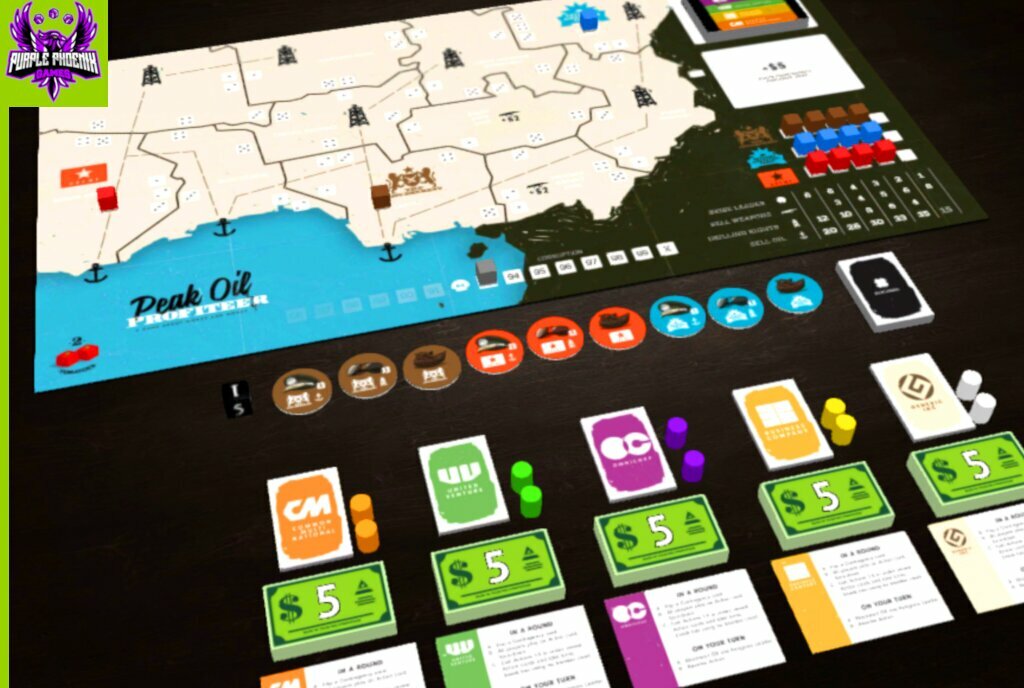
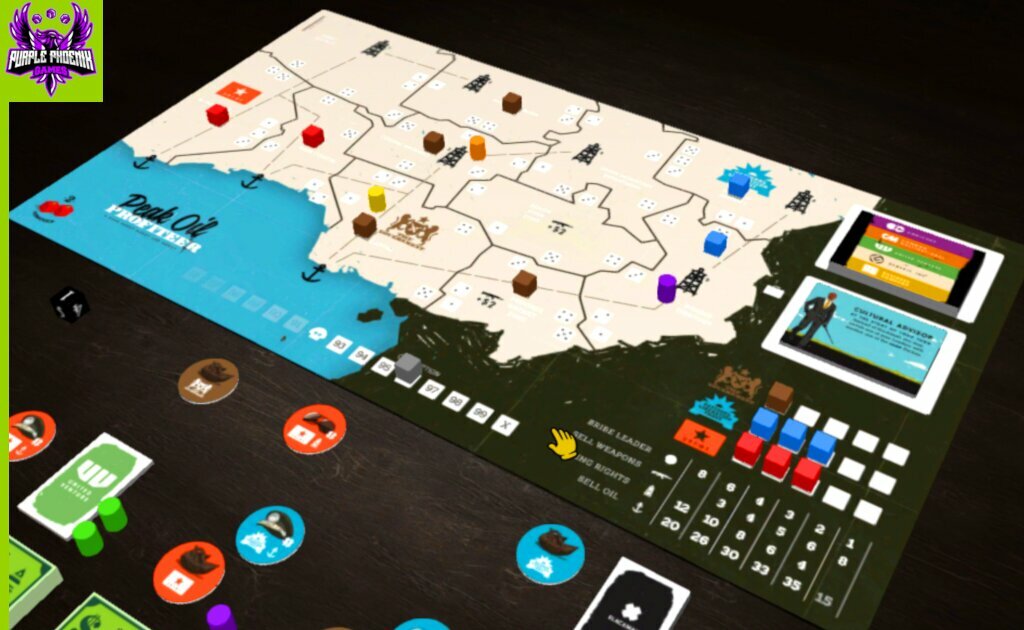
Peak Oil Profiteer is an economic game of area majority/movement, network building, and simultaneous action selection in which players take on the roles of oil corporations competing to make the most money in an oil-rich country before corruption overtakes the land. There is a power struggle between 3 Factions, so play your cards right (literally) to come out ahead. To setup for a game, set the board in the middle of the table, populate the 3 Faction Tracks with their corresponding cubes, place the Corruption cube on 93%, create the Contingency deck (as described in the rules), shuffle the Blackmail deck, and give each player their 5 Action cards, starting Money, and 3 Pawns in their color. Flip all 9 Leader tokens face-down, shuffle them, and randomly give one to each player, placing the remaining Leader tokens face-up near the board.
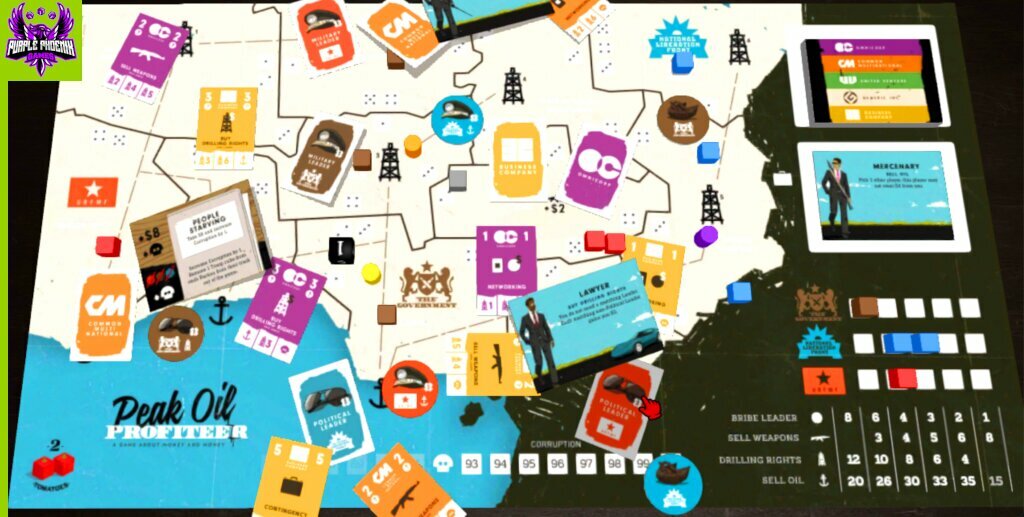
The game is played over a series of rounds. At the start of every round, one card from the Contingency deck will be revealed/resolved. Contingency cards will either be Events (that will most likely alter the rules for the current round), or Consultants (to be ‘hired’ by an individual player for special abilities). Once the Contingency card has been dealt with, the round moves to the next phase: Action Selection. All players have the same 5 Action cards, numbered 1-5, available to them every round. Players will select one of their 5 Action cards and place it face-down in front of them. Then, in numerical order, all Action cards will be resolved. When your Action number has been called, you will reveal your Action card, perform the corresponding action, and take the card back into your hand. Once all players have performed their Action for the round, check the Corruption track – if it has reached 100% then the game ends, and if not then the game moves to a new round.
The 5 Actions available to all player are: 1. Networking, 2. Sell Weapons, 3. Buy Drilling Rights, 4. Sell Oil, and 5. Contingency. Networking allows you to collect Blackmail in order to win control of Faction Leaders. You may only Sell Weapons to a Faction if you control at least one of its Leaders. You will earn a set amount of Money, and a new Troop cube will be added to the game board. To Buy Drilling Rights from a Faction, you again need to control at least one of its Leaders. Pay for the rights, and then add one of your Pawns to that region of the board. Once you’ve got Drilling Rights, you can Sell Oil. Remove your Pawn from the corresponding region, and collect the appropriate amount of Money. And lastly, Contingency allows you to either ‘hire’ a Consultant, or perform an extra action as a result of an Event.
The amount of Money that you pay/earn for each of the actions is dictated by the Faction Tracks. For example, the price of Weapons decreases as Factions get more Troops on the board, which means you won’t earn as much selling to a Faction with lots of Troops in play. You have to time your Actions wisely in order to maximize your profit! If, at the end of a round, the Corruption track has reached 100%, the game ends. Players count up their Money, and the player with the highest earnings is declared the winner.
Although the theme isn’t something that would normally appeal to me, I have to say that Peak Oil
Profiteer is a solid game. The gameplay is straightforward, the player interaction is competitive but not combative, and the strategy keeps you engaged all game. The ultimate goal is to earn the most Money, and the Faction Track creates sort of a “commodity speculation” type mechanic to the gameplay. The costs vary depending on the Faction Track, and it can be manipulated by all players. That in and of itself creates some fun player interaction because the Faction Track affects all players. Doing something to block an opponent now may come back to bite you next round. Another neat element about Peak Oil Profiteer is that players select their Actions simultaneously, and they are then resolved in numerical order. Depending on where your turn falls in the round, you might be able to do just what you had planned, unless an opponent went before you and changed the game layout. There is an amount of uncertainty that forces players to adjust their strategy on the fly and adapt to the current situation.
I will say that resolving Actions in numerical order does kind of add an element of Action Programming, if you will. Once you have selected your Action this round, you are locked in. No matter what happens before your turn, you must perform your selected Action if at all possible. It creates some neat strategic opportunities, but at the same time, can feel like you’ve been blocked out. Just something to consider! Normally, I would touch on components, but as this was a Tabletopia version of the game, I can’t really do so. I will say that the art style and card/board layouts online are thematic and immersive. If the physical version of the game looks anything like this digital version, it’ll be a good looking game! One component that I especially appreciated was that each player gets a Player Reference/Round Reference card. It gives you the information you need without being too wordy, and it stops you from having to refer back to the rule book every turn. So big thanks from me for that!
Having never played the original Peak Oil game, I have to say that Peak Oil Profiteer made a good impression on me. It’s fast to teach and learn, engaging, and strategic enough to keep you thinking. The fluctuation of the Faction Track, and the order of Action resolution add elements of uncertainty and ‘luck’ (if you will) that keep the game from having a clear run-away winner. Everyone is in it until the very end, and the race for the most Money is a nail-biter for sure. If you’re looking for something interactive but not too confrontational, while also putting your strategic chops to the test, consider backing Peak Oil Profiteer on Kickstarter!
Disclaimer: For this preview, we played the Tabletopia version of the game. The pictures you will see below are screenshots from my plays online. Also, I do not intend to rehash the entire rulebook, but rather provide a general overview of the rules and gameplay. For a more in-depth look, check it out when it hits Kickstarter! -L
Peak Oil Profiteer is an economic game of area majority/movement, network building, and simultaneous action selection in which players take on the roles of oil corporations competing to make the most money in an oil-rich country before corruption overtakes the land. There is a power struggle between 3 Factions, so play your cards right (literally) to come out ahead. To setup for a game, set the board in the middle of the table, populate the 3 Faction Tracks with their corresponding cubes, place the Corruption cube on 93%, create the Contingency deck (as described in the rules), shuffle the Blackmail deck, and give each player their 5 Action cards, starting Money, and 3 Pawns in their color. Flip all 9 Leader tokens face-down, shuffle them, and randomly give one to each player, placing the remaining Leader tokens face-up near the board.
The game is played over a series of rounds. At the start of every round, one card from the Contingency deck will be revealed/resolved. Contingency cards will either be Events (that will most likely alter the rules for the current round), or Consultants (to be ‘hired’ by an individual player for special abilities). Once the Contingency card has been dealt with, the round moves to the next phase: Action Selection. All players have the same 5 Action cards, numbered 1-5, available to them every round. Players will select one of their 5 Action cards and place it face-down in front of them. Then, in numerical order, all Action cards will be resolved. When your Action number has been called, you will reveal your Action card, perform the corresponding action, and take the card back into your hand. Once all players have performed their Action for the round, check the Corruption track – if it has reached 100% then the game ends, and if not then the game moves to a new round.
The 5 Actions available to all player are: 1. Networking, 2. Sell Weapons, 3. Buy Drilling Rights, 4. Sell Oil, and 5. Contingency. Networking allows you to collect Blackmail in order to win control of Faction Leaders. You may only Sell Weapons to a Faction if you control at least one of its Leaders. You will earn a set amount of Money, and a new Troop cube will be added to the game board. To Buy Drilling Rights from a Faction, you again need to control at least one of its Leaders. Pay for the rights, and then add one of your Pawns to that region of the board. Once you’ve got Drilling Rights, you can Sell Oil. Remove your Pawn from the corresponding region, and collect the appropriate amount of Money. And lastly, Contingency allows you to either ‘hire’ a Consultant, or perform an extra action as a result of an Event.
The amount of Money that you pay/earn for each of the actions is dictated by the Faction Tracks. For example, the price of Weapons decreases as Factions get more Troops on the board, which means you won’t earn as much selling to a Faction with lots of Troops in play. You have to time your Actions wisely in order to maximize your profit! If, at the end of a round, the Corruption track has reached 100%, the game ends. Players count up their Money, and the player with the highest earnings is declared the winner.
Although the theme isn’t something that would normally appeal to me, I have to say that Peak Oil
Profiteer is a solid game. The gameplay is straightforward, the player interaction is competitive but not combative, and the strategy keeps you engaged all game. The ultimate goal is to earn the most Money, and the Faction Track creates sort of a “commodity speculation” type mechanic to the gameplay. The costs vary depending on the Faction Track, and it can be manipulated by all players. That in and of itself creates some fun player interaction because the Faction Track affects all players. Doing something to block an opponent now may come back to bite you next round. Another neat element about Peak Oil Profiteer is that players select their Actions simultaneously, and they are then resolved in numerical order. Depending on where your turn falls in the round, you might be able to do just what you had planned, unless an opponent went before you and changed the game layout. There is an amount of uncertainty that forces players to adjust their strategy on the fly and adapt to the current situation.
I will say that resolving Actions in numerical order does kind of add an element of Action Programming, if you will. Once you have selected your Action this round, you are locked in. No matter what happens before your turn, you must perform your selected Action if at all possible. It creates some neat strategic opportunities, but at the same time, can feel like you’ve been blocked out. Just something to consider! Normally, I would touch on components, but as this was a Tabletopia version of the game, I can’t really do so. I will say that the art style and card/board layouts online are thematic and immersive. If the physical version of the game looks anything like this digital version, it’ll be a good looking game! One component that I especially appreciated was that each player gets a Player Reference/Round Reference card. It gives you the information you need without being too wordy, and it stops you from having to refer back to the rule book every turn. So big thanks from me for that!
Having never played the original Peak Oil game, I have to say that Peak Oil Profiteer made a good impression on me. It’s fast to teach and learn, engaging, and strategic enough to keep you thinking. The fluctuation of the Faction Track, and the order of Action resolution add elements of uncertainty and ‘luck’ (if you will) that keep the game from having a clear run-away winner. Everyone is in it until the very end, and the race for the most Money is a nail-biter for sure. If you’re looking for something interactive but not too confrontational, while also putting your strategic chops to the test, consider backing Peak Oil Profiteer on Kickstarter!

Purple Phoenix Games (2266 KP) rated Sheepy Time in Tabletop Games
May 27, 2021

Have you ever had trouble falling asleep? One method that supposedly helps lull you into a gentle slumber is counting sheep – imagine sheep prancing across a field and jumping over a fence. What seems like a simple and mundane task to us is actually a full-time job for these Dream Sheep! So put on your PJ’s, lace up your slippers (?), and clock in for a night of fence-jumping, all while avoiding the spooky Nightmares that will try to scare you awake!
Disclaimer: We were provided with a copy of Sheepy Time for the purposes of this preview. What you see pictured below are the retail components. -L
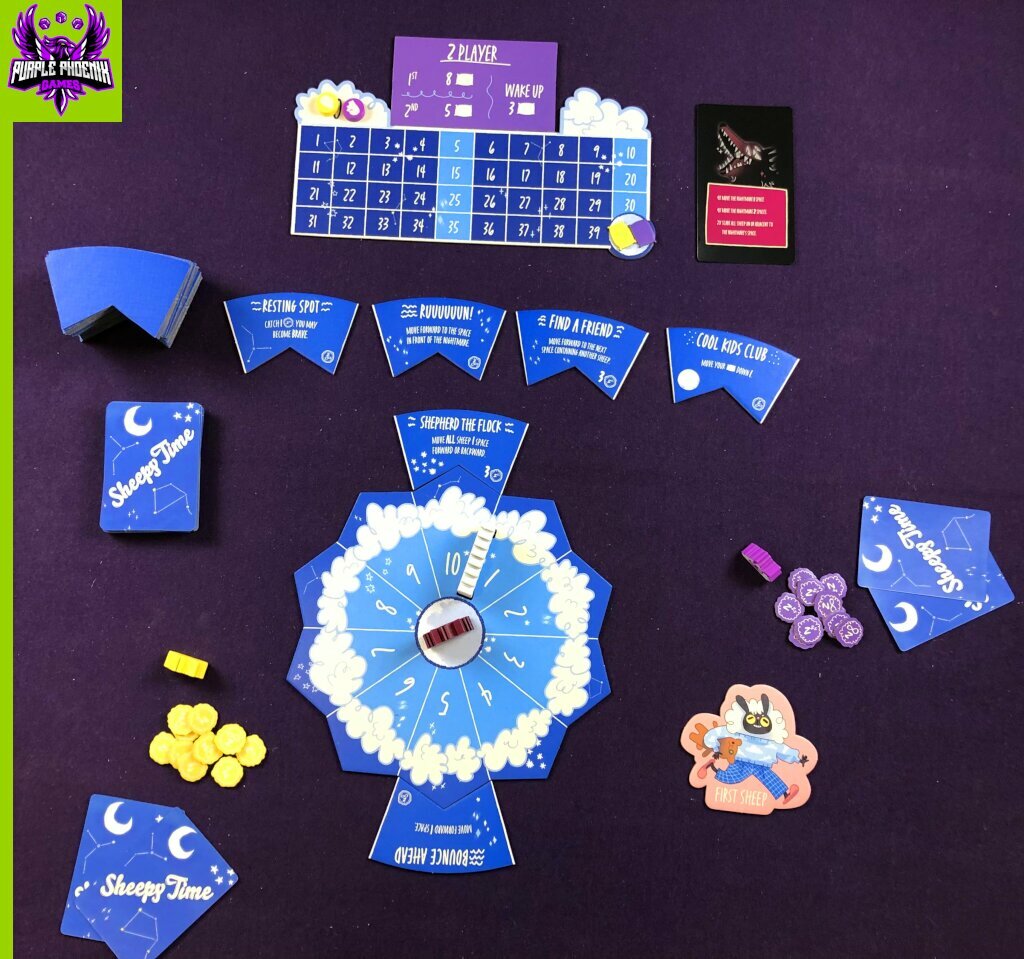
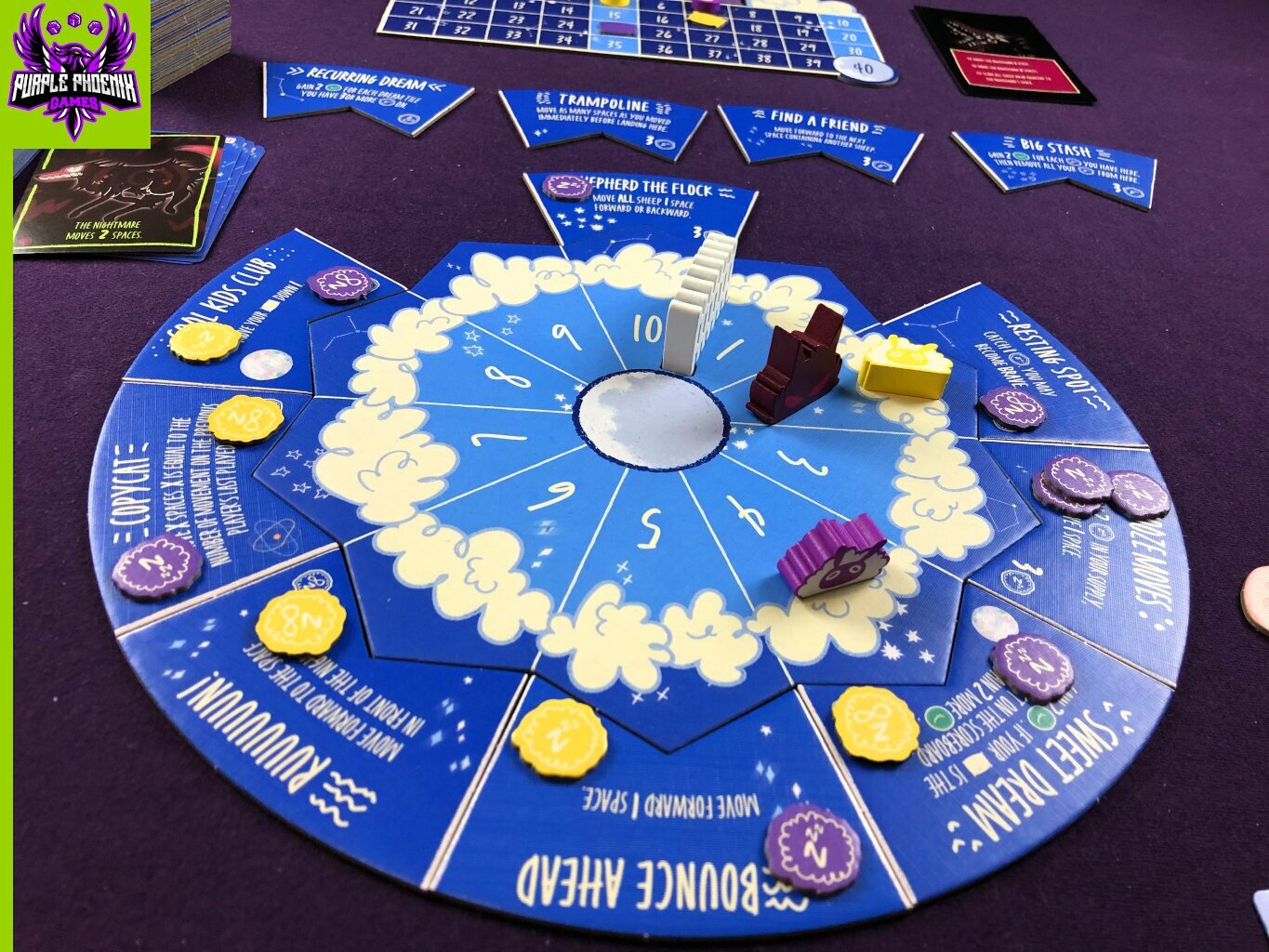
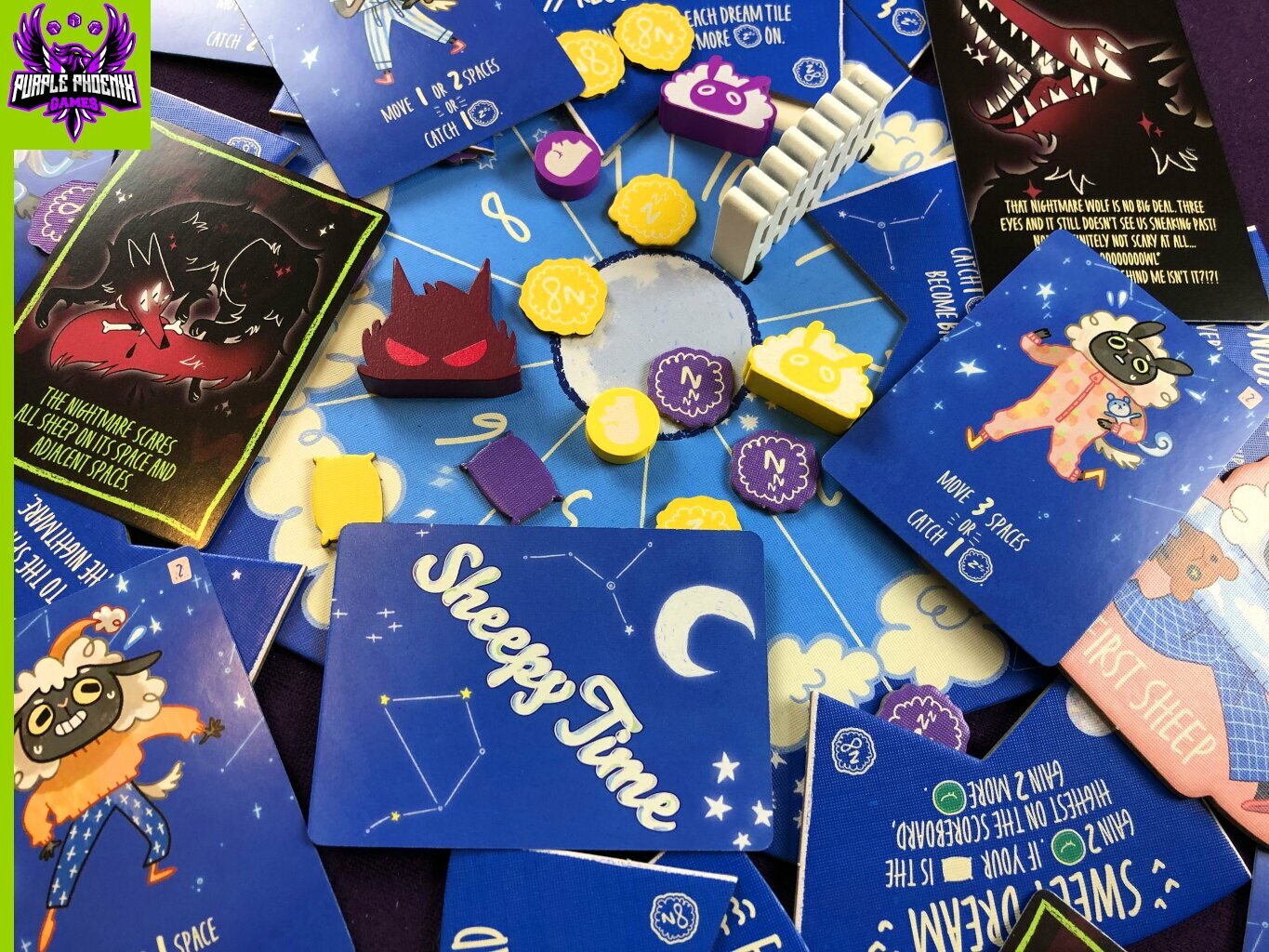
Sheepy Time is a push-your-luck game in which players take on the roles of Dream Sheep, tasked with helping humans fall asleep. Played over a series of rounds, players will take turns racing their Sheep around the board, using special Dream powers, and avoiding the Nightmare that lurks around the board. The player that earns the most points (as described in the rules) will be declared the dreamiest sheep of all! To setup for a game, place the board within reach of all players and attach the Fence between spaces 10 and 1. Place the scoreboard and Pillow Reference tile nearby, and give all players a Sheep, Wink, Pillow, and Zzz tokens in their chosen color. Select one of the three provided Nightmares to use this game, shuffle their cards into the deck of Sheep cards, and place the Nightmare meeple in the center of the board. Shuffle the Dream tiles, drawing and placing one randomly on spaces 1 and 5 of the board, and reveal four more tiles to create a market. Place all Pillow tokens on the 40 Winks space of the scoreboard, choose a starting player, and the game is ready to begin!
Each round of Sheepy Time is broken into two phases: the Racing phase, and the Resting phase. To begin the Racing phase, all players will draw 2 cards into their hand. A turn consists of 4 steps: Play a card, Use Dream tiles, Resolve Fence crossing, and Draw cards. The first action you will take on your turn is to play a card from your hand. Most cards will have you move your Sheep around the board a set number of spaces, or will give you the option to ‘Catch some Zzz’s’ (place one of your Zzz tokens on a Dream tile in play). The next step, if applicable, is to use Dream tiles. Dream tiles provide special/extra abilities that can be beneficial to you. In order to use a Dream tile, however, you must have a Zzz token on it – remove your Zzz token from the tile to use its power. So you’ve got to decide when to move your Sheep, or when it’s necessary to Catch some Zzz’s! The third step is to resolve Fence crossing, if applicable. If a cards movement causes your Sheep to cross the Fence, you immediately gain 5 Winks (on the Scoreboard), and decide whether to keep playing this round or ‘Call it a Night.’ If you decide to keep playing, you move to step 4, and draw a new card into your hand. If you Call it a Night, you will discard your hand, and sit out for the remainder of this Racing phase.
If at any point in the Racing phase, you draw a Nightmare card, it must immediately be revealed and resolved. The Nightmare moves around the board, much like the Sheep, but it will Scare any Sheep that it passes! Being Scared once is ok, but if you were to be Scared AGAIN, you get Woken Up, lose all Winks for this round, and are out of the Racing phase. If the Nightmare completes a lap of the board and crosses the Fence before all players have Called it a Night, the remaining players get Woken Up. How risky are you willing to be once the Nightmare comes into play? That’s for you to decide. Once all players have either Called it a Night or been Woken Up, the Racing phase ends. Check the scoreboard for a winner – when a player earns enough Winks in the Racing phase to surpass their Pillow token. If nobody has met that requirement, players will lower their Pillow tokens by the amount specified on the Pillow Reference tile. The lower you can get your Pillow token, the fewer Winks you need to get to win in future rounds! When all Pillow tokens have been adjusted, the game moves to the Resting phase. In this phase, each player will have the choice to either add a new Dream tile to the board, or to Catch 2 Zzz’s. In turn order, players can select one of the Dream tiles from the market to place on an open space of the board, or place 2 Zzz tokens on Dream tiles in play. When everyone has performed their action, the round ends and a new Racing phase begins. Play continues in this manner until one player has been declared the winner!
I’m not typically a fan of push-your-luck games, but Sheepy Time really surprised me! Yes, that mechanic is definitely present in the gameplay, but there is also quite a bit of strategic variability that makes turns feel a little more controlled. The Dream tiles in play will always be different, providing unique abilities to help give you a strategic boost during play. And you always have 2 cards to decide between to play – you are not limited to only one course of action each turn. So yes, there is a riskiness involved with how many laps you think you can get, can you avoid the Nightmare, etc. But there is also a light element of strategy that makes the game more exciting for me. The gameplay itself is also very smooth and intuitive. The turn order makes sense and the flow of the game is pretty seamless. It is fast to teach and learn, and even though the box says 30-45 minutes, it feels fast to play.
Let me touch on components for a minute. As I said earlier, this is a retail copy of the game, and the production quality is great. The cardboard components are nice and thick, the wooden meeples are large and cute, and the overall art style reflects the theme and lightness of the game well. I want to mention that the insert is nice as well – I know it doesn’t effect the gameplay, but it makes set-up/tear-down quick and efficient. AEG definitely knocked it over the fence (get it?) with the production of this game!
So where does Sheepy Time fit into my collection? I think it’s a great game to use to introduce newer gamers to the hobby. The rules and gameplay are not overwhelming, but they offer more of a modern gaming feel than some of the older classics. I would even say that this game can be used with younger gamers as well – take out the Dream tile powers, and just race to see who can earn the most Winks before the Nightmare gets them, or something like that! It is really accessible for everyone, and that earns a big thumbs up from me. So if you’re not quite sure what to think of this game based on the theme/art style, I can assure you that the gameplay is quite excellent. When Sheepy Time hits retail, make sure you jump at the chance to play this game. Definitely don’t sleep on it.
Disclaimer: We were provided with a copy of Sheepy Time for the purposes of this preview. What you see pictured below are the retail components. -L
Sheepy Time is a push-your-luck game in which players take on the roles of Dream Sheep, tasked with helping humans fall asleep. Played over a series of rounds, players will take turns racing their Sheep around the board, using special Dream powers, and avoiding the Nightmare that lurks around the board. The player that earns the most points (as described in the rules) will be declared the dreamiest sheep of all! To setup for a game, place the board within reach of all players and attach the Fence between spaces 10 and 1. Place the scoreboard and Pillow Reference tile nearby, and give all players a Sheep, Wink, Pillow, and Zzz tokens in their chosen color. Select one of the three provided Nightmares to use this game, shuffle their cards into the deck of Sheep cards, and place the Nightmare meeple in the center of the board. Shuffle the Dream tiles, drawing and placing one randomly on spaces 1 and 5 of the board, and reveal four more tiles to create a market. Place all Pillow tokens on the 40 Winks space of the scoreboard, choose a starting player, and the game is ready to begin!
Each round of Sheepy Time is broken into two phases: the Racing phase, and the Resting phase. To begin the Racing phase, all players will draw 2 cards into their hand. A turn consists of 4 steps: Play a card, Use Dream tiles, Resolve Fence crossing, and Draw cards. The first action you will take on your turn is to play a card from your hand. Most cards will have you move your Sheep around the board a set number of spaces, or will give you the option to ‘Catch some Zzz’s’ (place one of your Zzz tokens on a Dream tile in play). The next step, if applicable, is to use Dream tiles. Dream tiles provide special/extra abilities that can be beneficial to you. In order to use a Dream tile, however, you must have a Zzz token on it – remove your Zzz token from the tile to use its power. So you’ve got to decide when to move your Sheep, or when it’s necessary to Catch some Zzz’s! The third step is to resolve Fence crossing, if applicable. If a cards movement causes your Sheep to cross the Fence, you immediately gain 5 Winks (on the Scoreboard), and decide whether to keep playing this round or ‘Call it a Night.’ If you decide to keep playing, you move to step 4, and draw a new card into your hand. If you Call it a Night, you will discard your hand, and sit out for the remainder of this Racing phase.
If at any point in the Racing phase, you draw a Nightmare card, it must immediately be revealed and resolved. The Nightmare moves around the board, much like the Sheep, but it will Scare any Sheep that it passes! Being Scared once is ok, but if you were to be Scared AGAIN, you get Woken Up, lose all Winks for this round, and are out of the Racing phase. If the Nightmare completes a lap of the board and crosses the Fence before all players have Called it a Night, the remaining players get Woken Up. How risky are you willing to be once the Nightmare comes into play? That’s for you to decide. Once all players have either Called it a Night or been Woken Up, the Racing phase ends. Check the scoreboard for a winner – when a player earns enough Winks in the Racing phase to surpass their Pillow token. If nobody has met that requirement, players will lower their Pillow tokens by the amount specified on the Pillow Reference tile. The lower you can get your Pillow token, the fewer Winks you need to get to win in future rounds! When all Pillow tokens have been adjusted, the game moves to the Resting phase. In this phase, each player will have the choice to either add a new Dream tile to the board, or to Catch 2 Zzz’s. In turn order, players can select one of the Dream tiles from the market to place on an open space of the board, or place 2 Zzz tokens on Dream tiles in play. When everyone has performed their action, the round ends and a new Racing phase begins. Play continues in this manner until one player has been declared the winner!
I’m not typically a fan of push-your-luck games, but Sheepy Time really surprised me! Yes, that mechanic is definitely present in the gameplay, but there is also quite a bit of strategic variability that makes turns feel a little more controlled. The Dream tiles in play will always be different, providing unique abilities to help give you a strategic boost during play. And you always have 2 cards to decide between to play – you are not limited to only one course of action each turn. So yes, there is a riskiness involved with how many laps you think you can get, can you avoid the Nightmare, etc. But there is also a light element of strategy that makes the game more exciting for me. The gameplay itself is also very smooth and intuitive. The turn order makes sense and the flow of the game is pretty seamless. It is fast to teach and learn, and even though the box says 30-45 minutes, it feels fast to play.
Let me touch on components for a minute. As I said earlier, this is a retail copy of the game, and the production quality is great. The cardboard components are nice and thick, the wooden meeples are large and cute, and the overall art style reflects the theme and lightness of the game well. I want to mention that the insert is nice as well – I know it doesn’t effect the gameplay, but it makes set-up/tear-down quick and efficient. AEG definitely knocked it over the fence (get it?) with the production of this game!
So where does Sheepy Time fit into my collection? I think it’s a great game to use to introduce newer gamers to the hobby. The rules and gameplay are not overwhelming, but they offer more of a modern gaming feel than some of the older classics. I would even say that this game can be used with younger gamers as well – take out the Dream tile powers, and just race to see who can earn the most Winks before the Nightmare gets them, or something like that! It is really accessible for everyone, and that earns a big thumbs up from me. So if you’re not quite sure what to think of this game based on the theme/art style, I can assure you that the gameplay is quite excellent. When Sheepy Time hits retail, make sure you jump at the chance to play this game. Definitely don’t sleep on it.