
Search
Search results

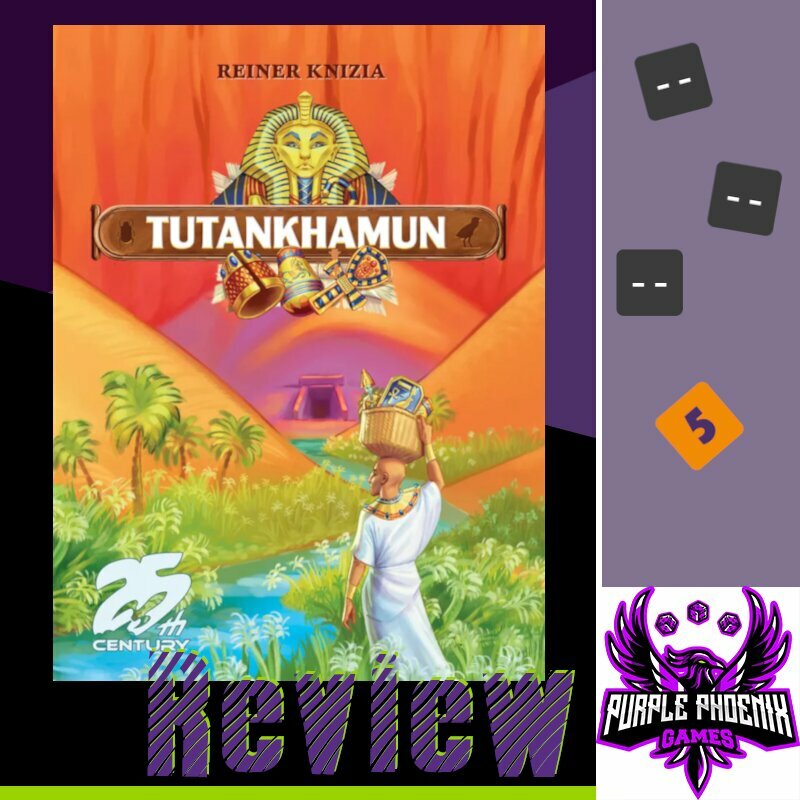
Purple Phoenix Games (2266 KP) rated Tutankhamun in Tabletop Games
Jul 9, 2021
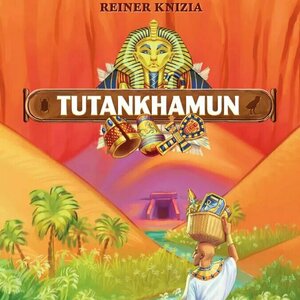

Tutankhamun (per dictionary.com, the pronunciation is as such: [ toot-ahng-kah-muhn ]) is regularly shortened and often referred to as “King Tut.” My real question is that if the first syllable is “toot,” why do we not call him King Toot? I have a 5 year old boy and a 2 year old girl at the time of this writing, so I can tell you EXACTLY why we don’t call him King Toot, but that’s for another discussion. Never having played the original version, will I enjoy this new version of the game by world-renowned designer Dr. Reiner Knizia?
In Tutankhamun, players take on the roles of Egyptian priests attempting to cleanse their souls by gifting the sarcophagus with relics found along the Nile River. The priest who can cleanse their soul quickest will be proclaimed the next High Priest and winner of the game!
DISCLAIMER: We were provided a copy of this game for the purposes of this review. This is a retail copy of the game, so what you see in these photos is exactly what would be received in your box. I do not intend to cover every single rule included in the rulebook, but will describe the overall game flow and major rule set so that our readers may get a sense of how the game plays. For more in depth rules, you may purchase a copy online or from your FLGS. -T
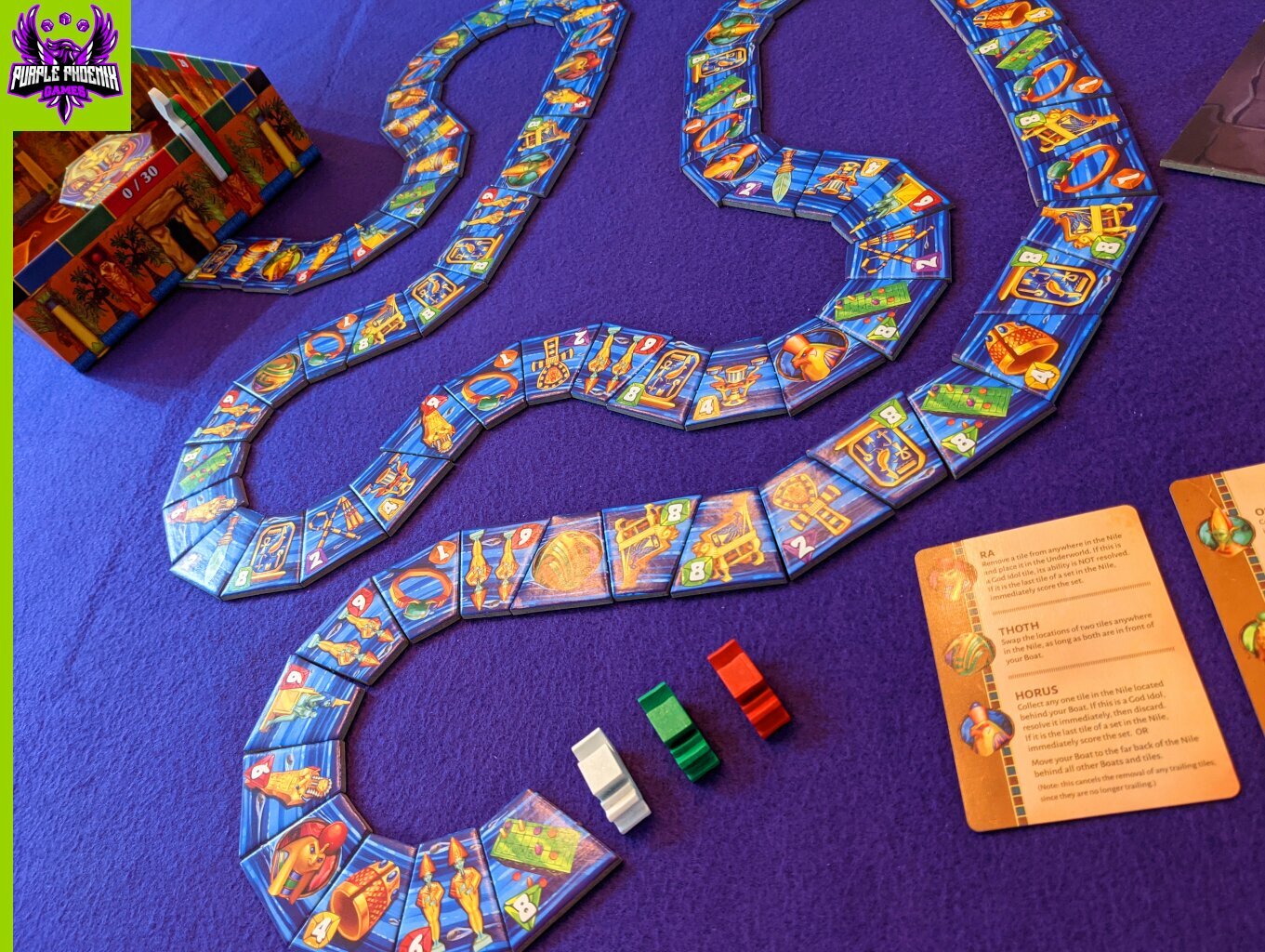
To setup, place the King Tut sarcophagus on the table somewhere inside the box bottom. From this starting place (or you could place these components last I suppose), begin the laborious job of creating the Nile from the trapezoidal Relic TIles. This part took me a good several minutes each game. Place out the Underworld Mat near the start of the Nile, and place upon it the two Guardian Statue standees. From there give every player a reference card, have them choose a player color, place their boats at the start of the Nile, and Canopic Jar scoring markers on the appropriate space along the box bottom score track. The game may now begin!
Tutankhamun is played in turns starting with the starting player and proceeding clockwise. The starting player will choose ANY Relic Tile to collect and move their boat to that location. Once collected, the player will check to make sure there are still matching Relics along the Nile. If so, then play continues to the next player. If the active player had collected the last Relic of that type still active in the game, then the Relic type is scored.
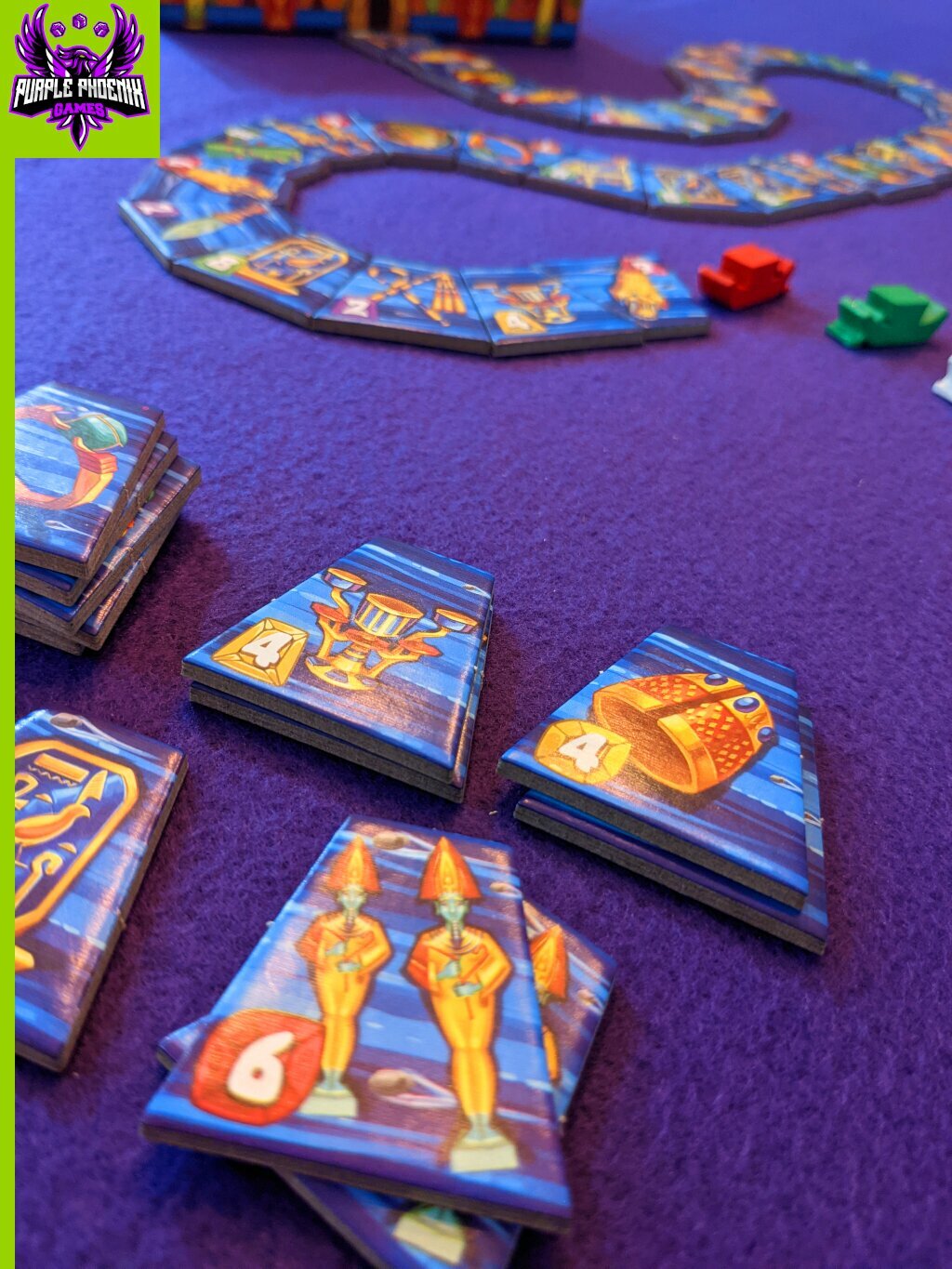
Each Relic Tile features art of a Relic, a God, or a Scarab Ring. Relics come in sets, and when the final Relic of its type is collected, scoring immediately follows. Whichever player possesses the most Relic Tiles of the one being scored will earn points (or rather, negative points, as the priests are trying to cleanse their souls down to the winning score of zero) equal to the number printed on the tile. That number stands for the score earned as well as the number of Relics of that type in the game. The player with the second most Relics of the scored type will score half the number printed on the tile. All others do not score.
God Tiles feature art of one of five ancient Egyptian Gods: Osiris, Isis, Ra, Thoth, and Horus. Each of these Gods provide the collecting player with special powers to be used during the turn, and are always positive for the player.
Finally, Scarab Ring tiles are special in that they feature no number upon them. There are 10 tiles in the game, and as soon as a player collects one they immediately score one point (or one negative point). These tiles are not thrown into the box bottom, as the other scoring tiles are once scored, but are kept with the players to be scored at the end of the game. The player holding the most Scarab Tiles scores five negative points.
Any tile along the Nile that has been passed by all players is deposited onto the Underworld Mat and not added to the box bottom with the King Tut sarcophagus. Tiles may still be collected from the Underworld by permission of the Gods being collected in-game. Whichever priest is able to dwindle down their points and cleanse their soul first will win the game and become the next High Priest of Egypt!
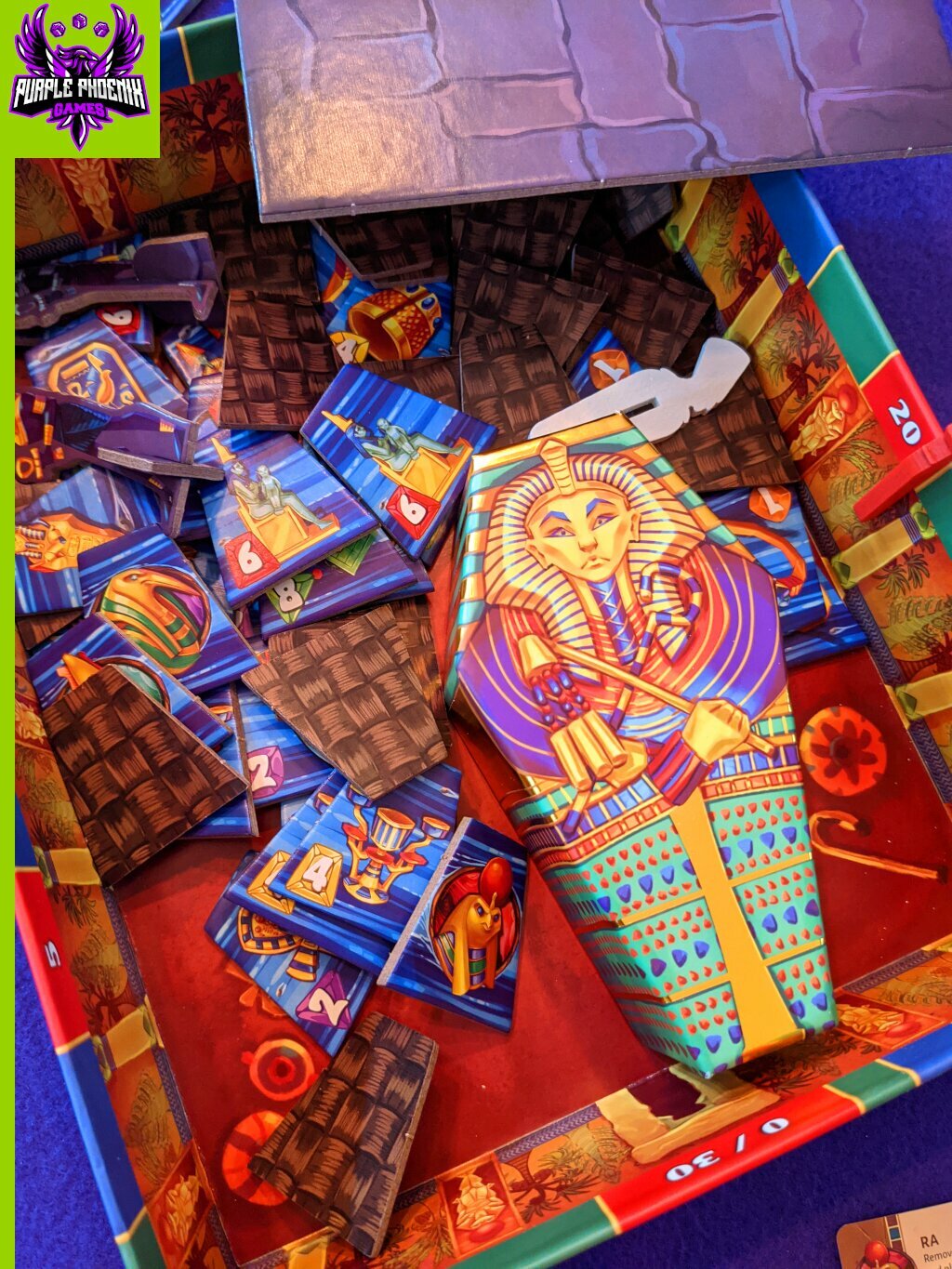
Components. I am more and more becoming a fan of everything 25th Century Games is putting out. This is certainly no exception. I have seen photos of the original versions of this game, entitled Tutankhamen (with an E at the end instead of a U) and this game was certainly begging for a renovation. All the components have updated art, more vibrant colors, and the game even includes luxurious (and completely unnecessary) components. These are the very cool, but very unnecessary King Tut sarcophagus, and the Guardian Statue standees that add nothing to the gameplay but definitely help set the mood and theme. That all said, this version looks amazing on the table and has nearly infinite setup configurations!
What I like most about the game is the fact that on a player’s turn they can literally move forward to ANYWHERE along the Nile to gather whatever Relic they wish. They can pass up a tile or twelve along the way to snatch exactly what they want. However, the quicker a player reaches the sarcophagus does not automatically make them the winner. No, they still need to reduce their soul spirit score to zero in order to win (or be closest by the time all players reach the final spot). Conversely, dilly-dallying along the River just picking up every available tile also will not guarantee a victory. Specializing in a select few items may be the ticket to a victory, or setting oneself to win a couple types and win runner-up on the remainder may be a great path to victory.
Unlike many other games with this lazy race mechanic, the player furthest back does NOT get to keep taking turns to catch up (I’m looking at you, Tokaido), but rather just means that player has many more options ahead of themselves than the other players have. This is very interesting to me, and definitely something worth exploring more. It makes for tough turns when players have to really crunch which options are best for them: take the tile right ahead of them, diversify vs bolster the collection, or hate block another player by taking what you know they need. Ahh, so beautiful are the choices given!
At the end of the day (and this review), Purple Phoenix Games gives this one an Obama-meme-where-he-is-drinking-a-beer-and-giving-a-thumbs-up 5 / 6. I would certainly not have purchased this game in its original form had I seen it in a game store. However, with the changes made to make it more pretty, I would have given it a chance. I am so very glad I have the opportunity to play this a lot, as I can see this getting to the table allllllll the time. It is right up my alley, and I place it high among other Knizia games. Long live King Toot!!
In Tutankhamun, players take on the roles of Egyptian priests attempting to cleanse their souls by gifting the sarcophagus with relics found along the Nile River. The priest who can cleanse their soul quickest will be proclaimed the next High Priest and winner of the game!
DISCLAIMER: We were provided a copy of this game for the purposes of this review. This is a retail copy of the game, so what you see in these photos is exactly what would be received in your box. I do not intend to cover every single rule included in the rulebook, but will describe the overall game flow and major rule set so that our readers may get a sense of how the game plays. For more in depth rules, you may purchase a copy online or from your FLGS. -T
To setup, place the King Tut sarcophagus on the table somewhere inside the box bottom. From this starting place (or you could place these components last I suppose), begin the laborious job of creating the Nile from the trapezoidal Relic TIles. This part took me a good several minutes each game. Place out the Underworld Mat near the start of the Nile, and place upon it the two Guardian Statue standees. From there give every player a reference card, have them choose a player color, place their boats at the start of the Nile, and Canopic Jar scoring markers on the appropriate space along the box bottom score track. The game may now begin!
Tutankhamun is played in turns starting with the starting player and proceeding clockwise. The starting player will choose ANY Relic Tile to collect and move their boat to that location. Once collected, the player will check to make sure there are still matching Relics along the Nile. If so, then play continues to the next player. If the active player had collected the last Relic of that type still active in the game, then the Relic type is scored.
Each Relic Tile features art of a Relic, a God, or a Scarab Ring. Relics come in sets, and when the final Relic of its type is collected, scoring immediately follows. Whichever player possesses the most Relic Tiles of the one being scored will earn points (or rather, negative points, as the priests are trying to cleanse their souls down to the winning score of zero) equal to the number printed on the tile. That number stands for the score earned as well as the number of Relics of that type in the game. The player with the second most Relics of the scored type will score half the number printed on the tile. All others do not score.
God Tiles feature art of one of five ancient Egyptian Gods: Osiris, Isis, Ra, Thoth, and Horus. Each of these Gods provide the collecting player with special powers to be used during the turn, and are always positive for the player.
Finally, Scarab Ring tiles are special in that they feature no number upon them. There are 10 tiles in the game, and as soon as a player collects one they immediately score one point (or one negative point). These tiles are not thrown into the box bottom, as the other scoring tiles are once scored, but are kept with the players to be scored at the end of the game. The player holding the most Scarab Tiles scores five negative points.
Any tile along the Nile that has been passed by all players is deposited onto the Underworld Mat and not added to the box bottom with the King Tut sarcophagus. Tiles may still be collected from the Underworld by permission of the Gods being collected in-game. Whichever priest is able to dwindle down their points and cleanse their soul first will win the game and become the next High Priest of Egypt!
Components. I am more and more becoming a fan of everything 25th Century Games is putting out. This is certainly no exception. I have seen photos of the original versions of this game, entitled Tutankhamen (with an E at the end instead of a U) and this game was certainly begging for a renovation. All the components have updated art, more vibrant colors, and the game even includes luxurious (and completely unnecessary) components. These are the very cool, but very unnecessary King Tut sarcophagus, and the Guardian Statue standees that add nothing to the gameplay but definitely help set the mood and theme. That all said, this version looks amazing on the table and has nearly infinite setup configurations!
What I like most about the game is the fact that on a player’s turn they can literally move forward to ANYWHERE along the Nile to gather whatever Relic they wish. They can pass up a tile or twelve along the way to snatch exactly what they want. However, the quicker a player reaches the sarcophagus does not automatically make them the winner. No, they still need to reduce their soul spirit score to zero in order to win (or be closest by the time all players reach the final spot). Conversely, dilly-dallying along the River just picking up every available tile also will not guarantee a victory. Specializing in a select few items may be the ticket to a victory, or setting oneself to win a couple types and win runner-up on the remainder may be a great path to victory.
Unlike many other games with this lazy race mechanic, the player furthest back does NOT get to keep taking turns to catch up (I’m looking at you, Tokaido), but rather just means that player has many more options ahead of themselves than the other players have. This is very interesting to me, and definitely something worth exploring more. It makes for tough turns when players have to really crunch which options are best for them: take the tile right ahead of them, diversify vs bolster the collection, or hate block another player by taking what you know they need. Ahh, so beautiful are the choices given!
At the end of the day (and this review), Purple Phoenix Games gives this one an Obama-meme-where-he-is-drinking-a-beer-and-giving-a-thumbs-up 5 / 6. I would certainly not have purchased this game in its original form had I seen it in a game store. However, with the changes made to make it more pretty, I would have given it a chance. I am so very glad I have the opportunity to play this a lot, as I can see this getting to the table allllllll the time. It is right up my alley, and I place it high among other Knizia games. Long live King Toot!!
Purple Phoenix Games (2266 KP) rated Slip Strike in Tabletop Games
Jan 28, 2020
Super spies. We have all dreamed of being one – don’t lie! What about teleporting super spies? What about time-traveling teleporting super spies?! As a huge Doctor Who fan, that is right up my alley. Well, minus the eventual assassination that comes with winning the game. Dat theme tho…
Slip Strike is a card game of bluffing, running, and managing your resources. The goal of the game is to get one hit on your opponent: the final strike. This could come from a bullet, a knife wound, or several other injuries that lead to your opponent’s demise. You each have ways of “slipping” out of trouble, but they are limited and certainly give your opponent the upper hand.
DISCLAIMER: We were provided a prototype copy of this game for the purposes of this review. These are preview copy components, and the final components will probably be different from these shown. Also, it is not my intention to detail every rule in the game, but to give our readers an idea of how the game plays. If you would like to read the rulebook, you may purchase the game through the publisher, back the game through the Kickstarter campaign, or through any retailers stocking it after fulfillment. -T
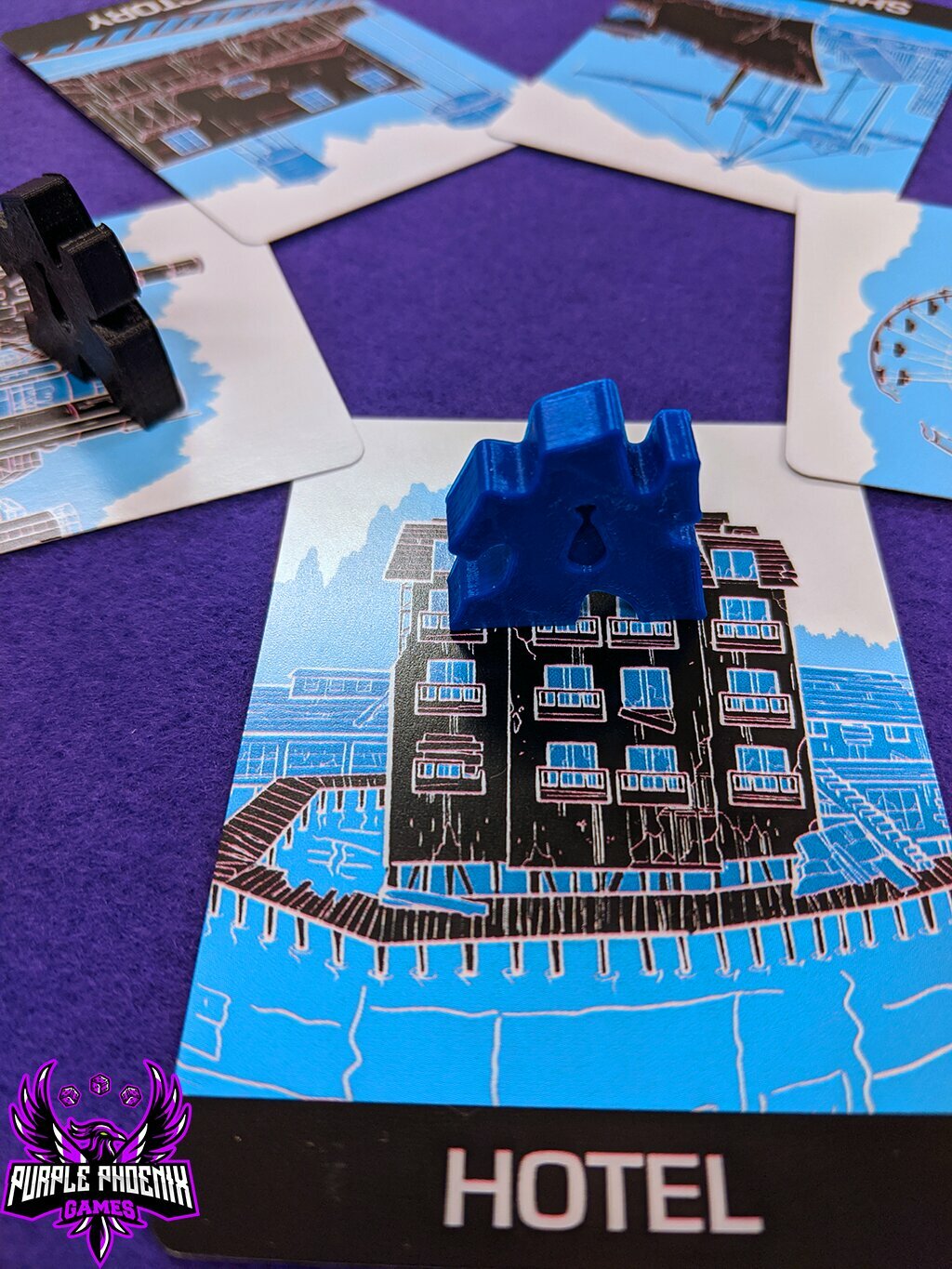
To setup, each player chooses a color (in this edition either blue or black) and receives the cards and spy-eeple (speeple?) of that color. Randomly place the location cards in a circle, or pentagon shape, to mark the map. Each player will select a location card at which they would like to begin the game, and reveal these simultaneously. Players will place their speeples on those locations and the game is setup and ready to play! For a more hardcore game, you may include one or two special Asset cards. We did that.
Slip Strike has no “turns” in the traditional sense. Instead, players will be choosing two cards to be played in succession. These cards are all from their hands and can include movement, teleportation, and weapon cards. Once the players have set their two cards in front of themselves, the cards in the first slot will be revealed simultaneously and resolved. Movement happens first, then any teleportations, then weapon effects.
If a player chose to play a movement card (left or right), simply move the speeple one space in that direction. Teleportation cards have the speeples moving directly to the location specified on the card. Weapon cards will have text on them referring to which spaces will be affected by the weapon – same space, one space away, or two spaces away usually. Should an enemy speeple reside in a space and is to be hit, the attacking player either wins with a successful strike or the defending player will need to “slip” to another location by playing (and therefore also discarding) a location card. This location card is now out of play and essentially is used as a countdown to their end, as players only have one card per location to use for a future slip.
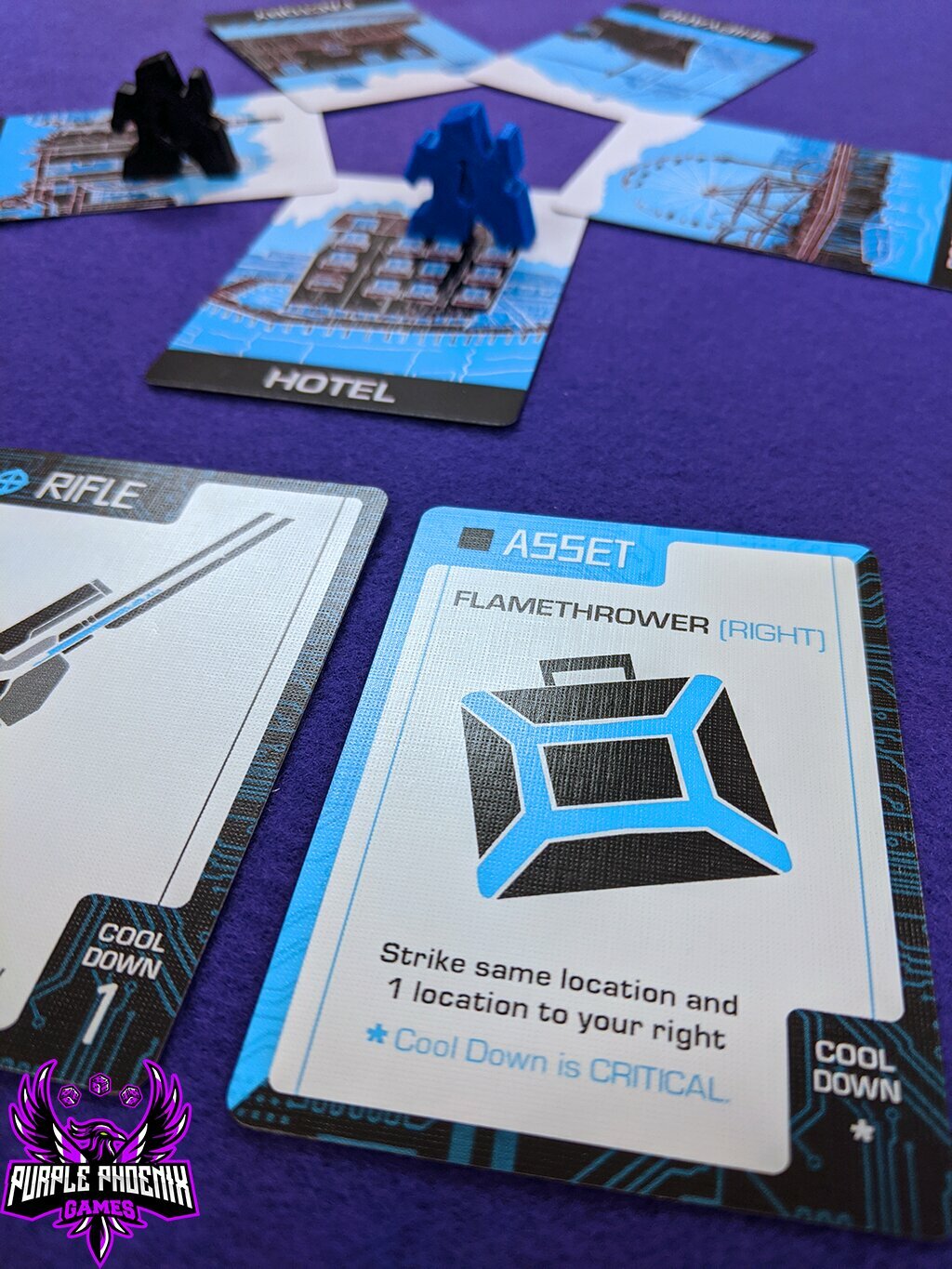
Each card will also feature a cooldown number on it. This number reflects how many game rounds this card will need to sit on the table before it can be shuffled back into the player’s hand. I believe this to be the greatest aspect of this game: utilizing the cool downs effectively in order to exact the most damaging tactics for victory. Some more powerful cards will also show an asterisk in place of a cool down number. This means that the card must remain out of play for three or more rounds before entering the player’s hand (see photo below for the Flamethrower Asset).
The player that can guess their opponent’s next moves, play their corresponding cards, and whittle down the location slips the fastest will become the ultimate spy and someone I definitely do NOT want to play against.
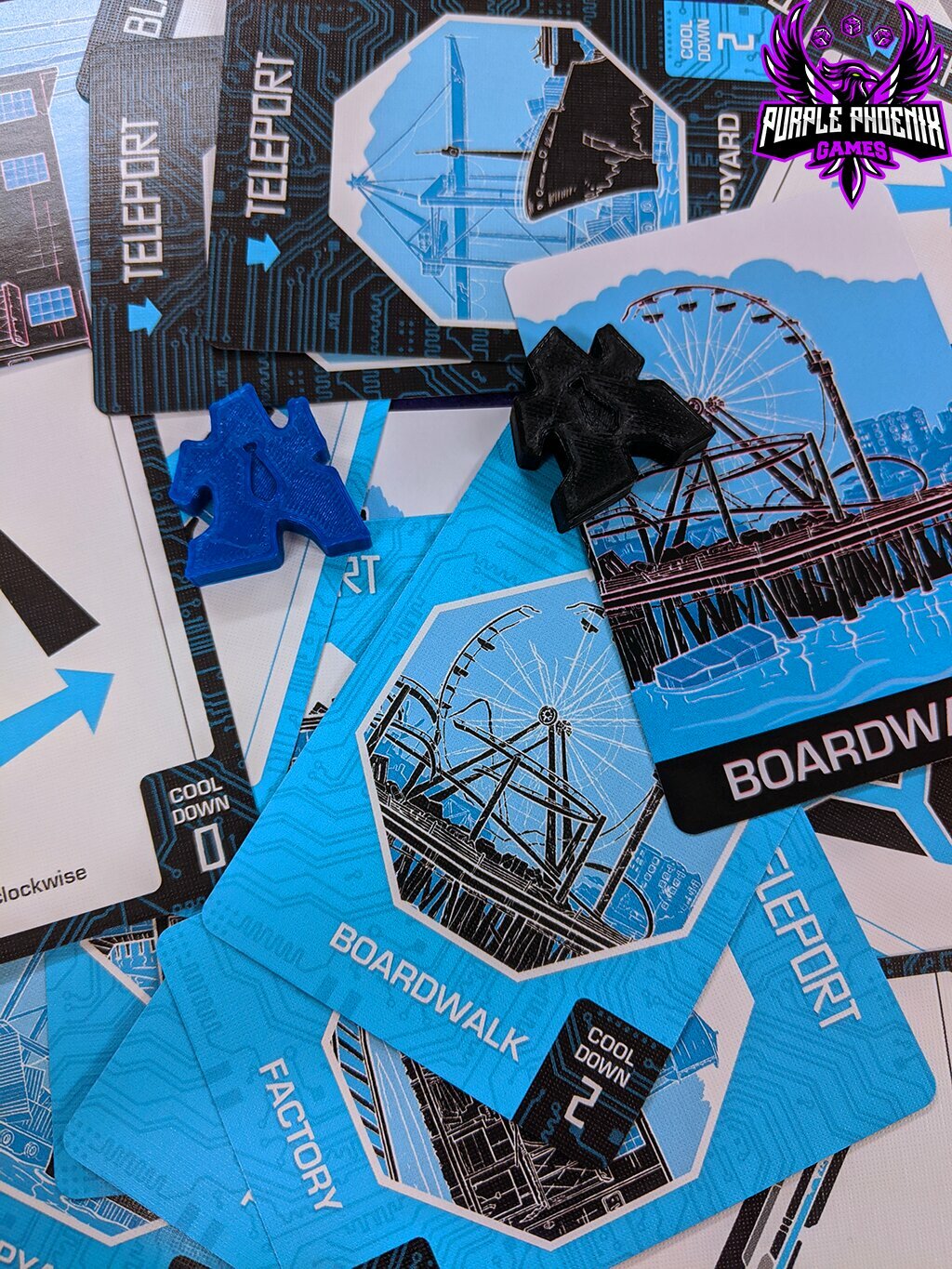
Components. As previously mentioned, we were provided a prototype copy of Slip Strike, and the components may change during the Kickstarter campaign. That said, this game is a bunch of cards and two speeples. The cards look incredible and the art is spot-in with the theme. I quite enjoy the art style and it stays out of the way while playing, but is also interesting enough that you can spend lots of time inspecting it when playing against AP-prone opponents. The speeples are cool, and I am excited to see where they end up as a result of a successful Kickstarter campaign. All thumbs up from us on components!
The game play is super solid. We had no questions on how to play the game after reading the rules (which are super short – thank you!), and we were off to murder each other in seconds flat. What I really appreciate about this game is that anyone can be successful with it and really get into the theme. Do you want to play as Agent Smith from The Matrix? Go for it! Want to play as Hiro Nakamura from Heroes (when he could control his powers, that is)? Do it! Slip Strike is quick, super engaging, and gives me the feeling of high-stakes, adrenaline rushing, globetrotting secret agents that I have been looking for. If you are interested in picking this one up, consider backing it on Kickstarter, purchasing from the publisher directly, from your FLGS, or your favorite online retailer once this one hits market. You won’t regret it.
Slip Strike is a card game of bluffing, running, and managing your resources. The goal of the game is to get one hit on your opponent: the final strike. This could come from a bullet, a knife wound, or several other injuries that lead to your opponent’s demise. You each have ways of “slipping” out of trouble, but they are limited and certainly give your opponent the upper hand.
DISCLAIMER: We were provided a prototype copy of this game for the purposes of this review. These are preview copy components, and the final components will probably be different from these shown. Also, it is not my intention to detail every rule in the game, but to give our readers an idea of how the game plays. If you would like to read the rulebook, you may purchase the game through the publisher, back the game through the Kickstarter campaign, or through any retailers stocking it after fulfillment. -T
To setup, each player chooses a color (in this edition either blue or black) and receives the cards and spy-eeple (speeple?) of that color. Randomly place the location cards in a circle, or pentagon shape, to mark the map. Each player will select a location card at which they would like to begin the game, and reveal these simultaneously. Players will place their speeples on those locations and the game is setup and ready to play! For a more hardcore game, you may include one or two special Asset cards. We did that.
Slip Strike has no “turns” in the traditional sense. Instead, players will be choosing two cards to be played in succession. These cards are all from their hands and can include movement, teleportation, and weapon cards. Once the players have set their two cards in front of themselves, the cards in the first slot will be revealed simultaneously and resolved. Movement happens first, then any teleportations, then weapon effects.
If a player chose to play a movement card (left or right), simply move the speeple one space in that direction. Teleportation cards have the speeples moving directly to the location specified on the card. Weapon cards will have text on them referring to which spaces will be affected by the weapon – same space, one space away, or two spaces away usually. Should an enemy speeple reside in a space and is to be hit, the attacking player either wins with a successful strike or the defending player will need to “slip” to another location by playing (and therefore also discarding) a location card. This location card is now out of play and essentially is used as a countdown to their end, as players only have one card per location to use for a future slip.
Each card will also feature a cooldown number on it. This number reflects how many game rounds this card will need to sit on the table before it can be shuffled back into the player’s hand. I believe this to be the greatest aspect of this game: utilizing the cool downs effectively in order to exact the most damaging tactics for victory. Some more powerful cards will also show an asterisk in place of a cool down number. This means that the card must remain out of play for three or more rounds before entering the player’s hand (see photo below for the Flamethrower Asset).
The player that can guess their opponent’s next moves, play their corresponding cards, and whittle down the location slips the fastest will become the ultimate spy and someone I definitely do NOT want to play against.
Components. As previously mentioned, we were provided a prototype copy of Slip Strike, and the components may change during the Kickstarter campaign. That said, this game is a bunch of cards and two speeples. The cards look incredible and the art is spot-in with the theme. I quite enjoy the art style and it stays out of the way while playing, but is also interesting enough that you can spend lots of time inspecting it when playing against AP-prone opponents. The speeples are cool, and I am excited to see where they end up as a result of a successful Kickstarter campaign. All thumbs up from us on components!
The game play is super solid. We had no questions on how to play the game after reading the rules (which are super short – thank you!), and we were off to murder each other in seconds flat. What I really appreciate about this game is that anyone can be successful with it and really get into the theme. Do you want to play as Agent Smith from The Matrix? Go for it! Want to play as Hiro Nakamura from Heroes (when he could control his powers, that is)? Do it! Slip Strike is quick, super engaging, and gives me the feeling of high-stakes, adrenaline rushing, globetrotting secret agents that I have been looking for. If you are interested in picking this one up, consider backing it on Kickstarter, purchasing from the publisher directly, from your FLGS, or your favorite online retailer once this one hits market. You won’t regret it.
Purple Phoenix Games (2266 KP) rated Ticket to Ride in Tabletop Games
Jan 9, 2020
I am one of the remaining few who reviewers who haven’t put in their two cents on Ticket to Ride. Why? Is it bad? No. Am I lazy? No. It’s really because I don’t think I have anything new to say about it that hasn’t already been said a hundred times. So this review on this game will be a little different from me. Instead of going over the rules and such (however truncated they typically are from me) I will question how well this game has aged for me.
Ticket to Ride is one of those games that has really hit it big in the mass market. You can find it all over in big box stores, in FLGS, online, secondary market, just everywhere. But why? And for this long? Ticket to Ride (TTR) came out in 2004. A mere 15 years ago. While that doesn’t really sound like a long time, in contrast to today’s game industry it is an eternity. With thousands upon thousands of games being released into the market through direct publish, Kickstarter/crowd funding, and big releases at conventions it’s hard to believe that you can still find this hanging with the exciting, fresh new games.
What I truly believe is magical about this game is its simplicity. “You have two main options: take some cards or play some cards.” When you can start a teach of a game by saying that, your players are invested right away because they know you aren’t going to bog them down with rules upon rules. “If you decide to take cards you can take these colored train cards or you can take new route ticket cards.” So now players have two choices from gaining cards. “If you decide to play cards you need to play cards of a color and number matching whichever route between two connecting cities on the map you like.” Done. The game is explained. Yeah, you can fight me about the endgame scoring stuff like longest route and whatnot, but for new gamers, you have explained this classic in three sentences. It’s so beautiful when a game allows you to teach it so quickly.
But that surely means that this is an easy game, right? With so few rules and such. Well, no. It’s not really “easy” at all. While your main rules are light, the strategy and tactics during play can cause feelings of joy and delight as well as frustration and concern as you see someone claim the route you need to connect to two cities on the map. Of course, you can’t explain that to your new players right away. You want them to experience these feelings organically and fully. It’s what makes TTR a really great game: having your well-laid plans just shot to smithereens by the guy who can’t tell the difference between the white train cars and the wild rainbow train cars.
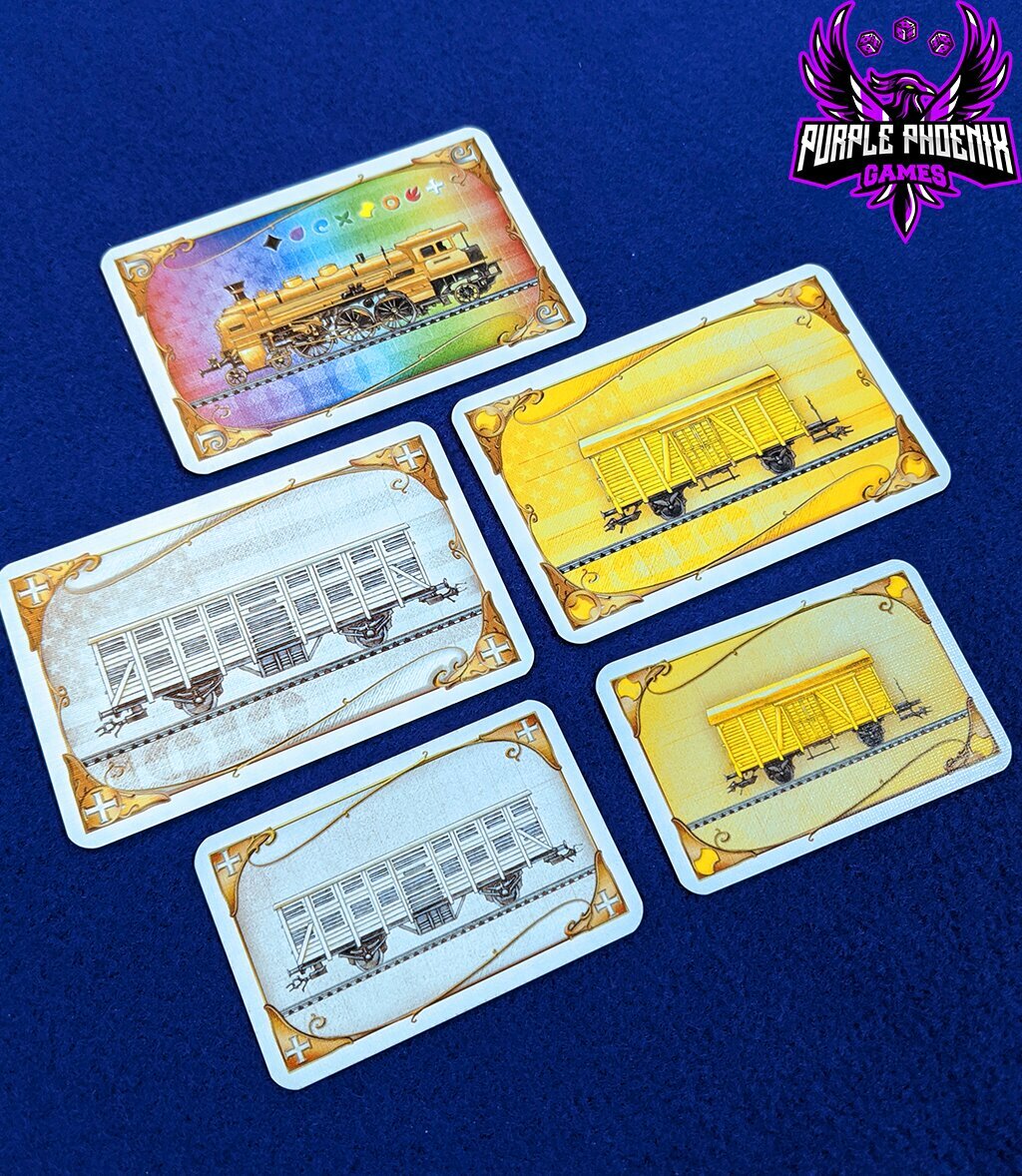
DISCLAIMER: I play with the 1910 expansion, which is a MUST. The larger cards are way easier to play with. See photo below with comparisons from base game on bottom with the larger 1910 cards above. YMMV, but I will always play using this expansion. -T
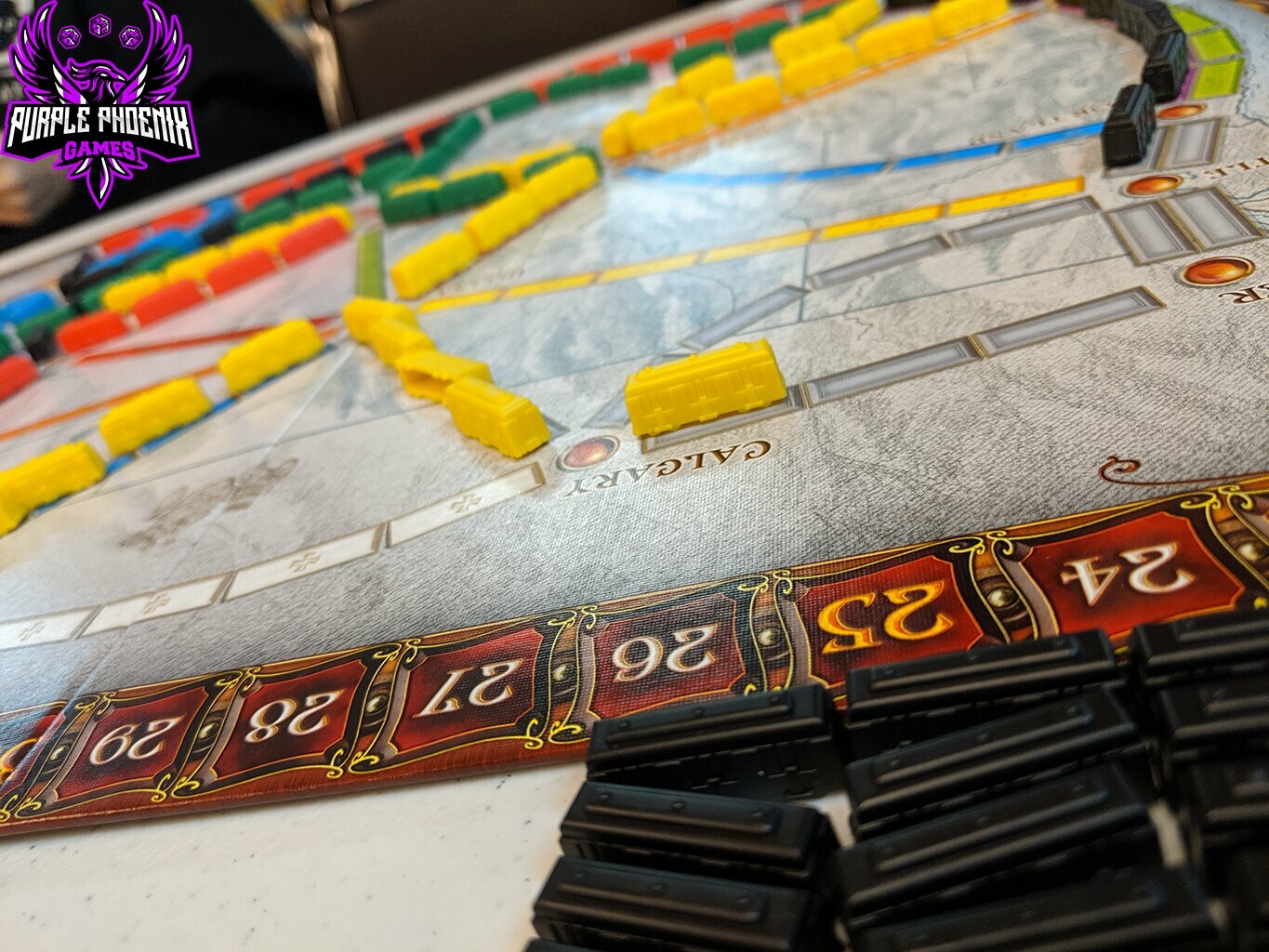
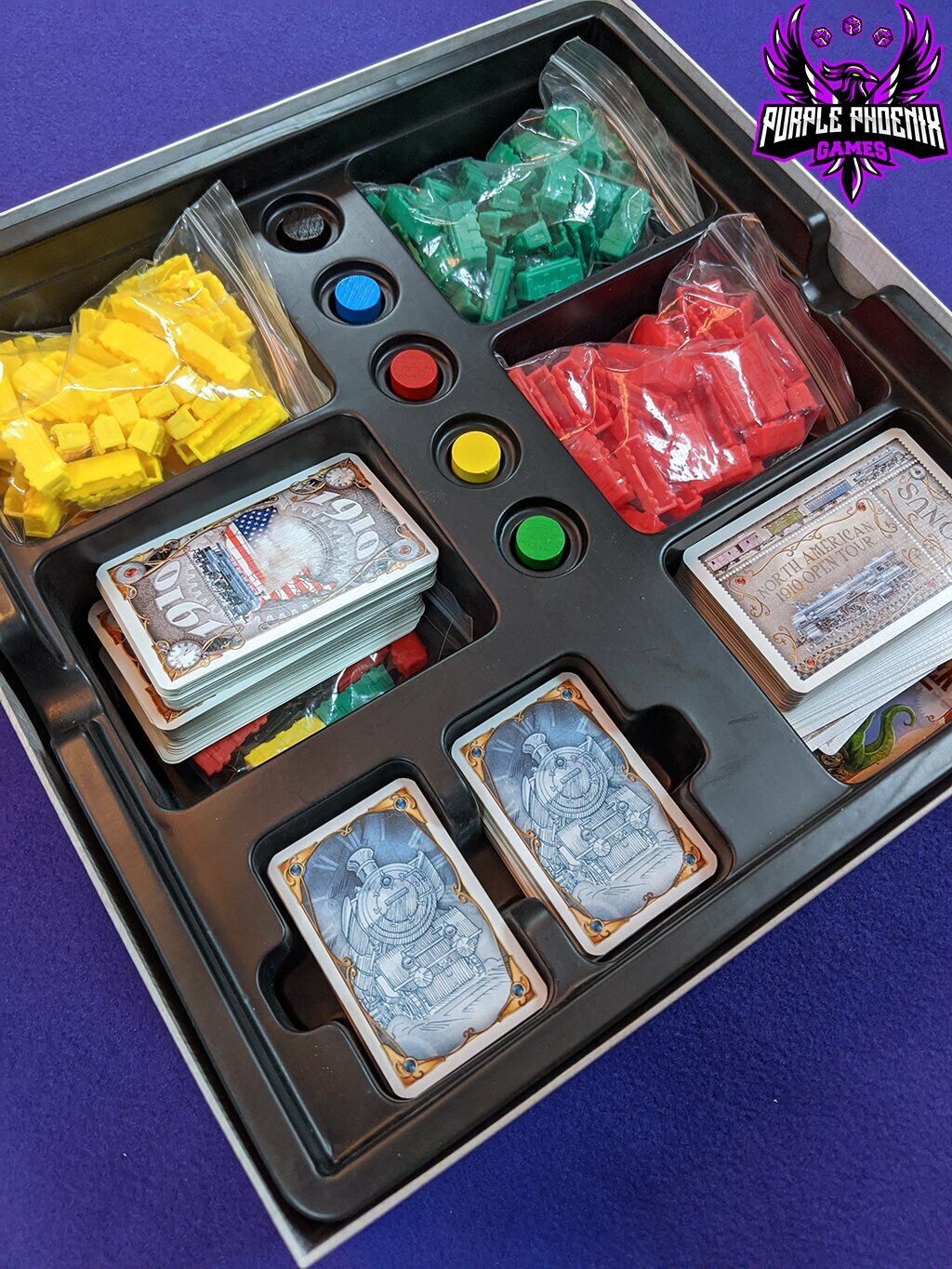
Components. Let’s compare components to some current or newer games. The game board is laid out really well, and the artwork is sparse and not over-busy on the board. This is a HUGE plus for me. I like nothing more than for the board to offer thematic elements and feeling without pelting my eyes with too much distraction. The cards were a bad choice. Not because the art or the quality on them is bad – because that’s not what I am saying. The size of the cards was a poor choice. I did purchase the 1910 expansion and simply will not play my copy without it. I recently played TTR for GenCan’t 2019 at my FLGS with OG base cards and found myself dreaming of the 1910 cards. The score tracker discs are of industry-standard quality for scoring discs. The plastic train car pieces are still just as wonderful to handle and play with as are many other more modern components. Seriously just as good. TTR components (and really, most of the time Days of Wonder components in general) are really great.
So do I still enjoy playing it? You betcha, don’tcha know. I still love seeing the board in front of me, agonizing over the route tickets I am dealt, and trying to decide if I should go for the New York to Los Angeles, or keep it simple with multiple routes along the Mississippi River. I still love the panic that ensues when I see people hoarding train cards, just knowing that they will soon be on the attack and their train car collection will dwindle to almost endgame levels in too few rounds for me to complete my masterpiece. I guess I still really love it.
Is Ticket to Ride my favorite game? No. But I’ll tell you what. I hadn’t played it in a couple years, and after this weekend’s play, it has moved up on my list by several spaces. It still holds a special place in my heart, and also the hearts of my team. That’s why Purple Phoenix Games gives Ticket to Ride a retrospective 20 / 24. It’s still great!
Ticket to Ride is one of those games that has really hit it big in the mass market. You can find it all over in big box stores, in FLGS, online, secondary market, just everywhere. But why? And for this long? Ticket to Ride (TTR) came out in 2004. A mere 15 years ago. While that doesn’t really sound like a long time, in contrast to today’s game industry it is an eternity. With thousands upon thousands of games being released into the market through direct publish, Kickstarter/crowd funding, and big releases at conventions it’s hard to believe that you can still find this hanging with the exciting, fresh new games.
What I truly believe is magical about this game is its simplicity. “You have two main options: take some cards or play some cards.” When you can start a teach of a game by saying that, your players are invested right away because they know you aren’t going to bog them down with rules upon rules. “If you decide to take cards you can take these colored train cards or you can take new route ticket cards.” So now players have two choices from gaining cards. “If you decide to play cards you need to play cards of a color and number matching whichever route between two connecting cities on the map you like.” Done. The game is explained. Yeah, you can fight me about the endgame scoring stuff like longest route and whatnot, but for new gamers, you have explained this classic in three sentences. It’s so beautiful when a game allows you to teach it so quickly.
But that surely means that this is an easy game, right? With so few rules and such. Well, no. It’s not really “easy” at all. While your main rules are light, the strategy and tactics during play can cause feelings of joy and delight as well as frustration and concern as you see someone claim the route you need to connect to two cities on the map. Of course, you can’t explain that to your new players right away. You want them to experience these feelings organically and fully. It’s what makes TTR a really great game: having your well-laid plans just shot to smithereens by the guy who can’t tell the difference between the white train cars and the wild rainbow train cars.
DISCLAIMER: I play with the 1910 expansion, which is a MUST. The larger cards are way easier to play with. See photo below with comparisons from base game on bottom with the larger 1910 cards above. YMMV, but I will always play using this expansion. -T
Components. Let’s compare components to some current or newer games. The game board is laid out really well, and the artwork is sparse and not over-busy on the board. This is a HUGE plus for me. I like nothing more than for the board to offer thematic elements and feeling without pelting my eyes with too much distraction. The cards were a bad choice. Not because the art or the quality on them is bad – because that’s not what I am saying. The size of the cards was a poor choice. I did purchase the 1910 expansion and simply will not play my copy without it. I recently played TTR for GenCan’t 2019 at my FLGS with OG base cards and found myself dreaming of the 1910 cards. The score tracker discs are of industry-standard quality for scoring discs. The plastic train car pieces are still just as wonderful to handle and play with as are many other more modern components. Seriously just as good. TTR components (and really, most of the time Days of Wonder components in general) are really great.
So do I still enjoy playing it? You betcha, don’tcha know. I still love seeing the board in front of me, agonizing over the route tickets I am dealt, and trying to decide if I should go for the New York to Los Angeles, or keep it simple with multiple routes along the Mississippi River. I still love the panic that ensues when I see people hoarding train cards, just knowing that they will soon be on the attack and their train car collection will dwindle to almost endgame levels in too few rounds for me to complete my masterpiece. I guess I still really love it.
Is Ticket to Ride my favorite game? No. But I’ll tell you what. I hadn’t played it in a couple years, and after this weekend’s play, it has moved up on my list by several spaces. It still holds a special place in my heart, and also the hearts of my team. That’s why Purple Phoenix Games gives Ticket to Ride a retrospective 20 / 24. It’s still great!

Movie Metropolis (309 KP) rated Harry Potter and the Deathly Hallows - Part 2 (2011) in Movies
Jun 11, 2019

The moment has come for every budding witch and wizard to say goodbye to the cash cow that has been the Harry Potter franchise and what a send-off he’s been given.
David Yates has once again returned to helm the final instalment in the most profitable movie franchise in history and whilst he has created a near perfect film technically, it falls down on a few points like a lack of character development and overly rushed script.
Deathly Hallows Part 2 picks up immediately from the 1st chapter with a quick reminder of what preceded it. This is a welcome start as the film feels a little disjointed in parts and if you’re not a loyal Harry Potter fan; chances are you won’t understand what’s going on.
Voldermort is gaining power as Harry, Ron and Hermione search for the missing horcruxes in order to destroy them and cripple the fearsome villain. Their travels bring them back to where it all started; Hogwarts school of witchcraft and wizardy; which has changed since we saw it last. Hogwarts has been rendered fabulously and is perhaps the best use of the 3D technology in the entire film. The sweeping shots of the lush, yet foreboding landscape surrounding the iconic castle are given new depth as we literally fly through the sky and smash through castle windows.
The decision to convert the film into 3D was met with mixed reviews from critics who said it would spoil a film which didn’t need it. To some extent this is true, there is a definite lack of focus throughout the film as the eye tries to focus on too many things at once, but it is far from the worst 3D conversion I’ve seen.
Performance wise, everyone has upped their game. The main trio have developed strong bonds with each other in real life and this really shows in the film as they battle against near certain death to protect one another. Daniel Radcliffe (Harry) is perhaps the weakest of the three in this film with Emma Watson (Hermione) and Rupert Grint (Ron) tied in first place. Their quiet demeanour is excitingly suffocating and brings a sense of claustrophobia to the film.
Of our veteran stars, Maggie Smith and Alan Rickman who play Professor McGonnagall and new headmaster Severus Snape are by far the standouts in a cast which are given a much greater chance to shine in this film. For a woman of Smiths age (76), she is exceptional and her performance really shows why Chris Columbus thought she would be perfect for the role all those years ago. Alan Rickman has been a favourite throughout the series and hasn’t let Potter fans down here, his final scenes are heart-breaking and worthy of a few tears.
Most of the other favourites make a welcome return, though all of them feel like cardboard cutouts, because their speech is limited to a couple of lines. Jim Broadbent (Horace Slughorn), Emma Thompson (Sybil Trelawny), Miriam Margolyes (Pomona Sprout) all make cameos in the film which is both a lovely and disappointing sight to see.
Ralph Fiennes does a lot of shouting throughout the film as vicious enemy Lord Voldermort but he performs well and does the role justice.
The only real flaw in the characters is that many of them aren’t given enough screen time. Helena Bonham Carter’s fabulous Bellatrix Lestrange is unfortunately lost as the army of Death Eaters grows and many other brilliant characters are only seen, not heard. (David Thewlis – Remus Lupin is the most prominent example of this.)
Being just over two hours in length means that this film is by far the shortest of the bunch and this shows in its pacing. Unfortunately, cutting the running time to this length has meant that certain scenes feel a little disjointed and certain parts, which were gut-wrenching in the book aren’t given enough time to digest in the film, which is disappointing seeing as an extra 10 or 20 minutes would’ve improved things greatly.
The climatic battle of Hogwarts as it’s been titled is fabulous and the special effects come into their own here as giants, acromantulas, death eaters and students pit themselves against one another with terrifying results. It’s a real treat to behold.
Yates’ cinematography is superb and every single shot he uses is beautiful in its own way. In one particular scene, located in the never before seen boathouse at Hogwarts, Yates manages to get around the 12A certificate which has blighted the last 4 films by shooting through frosted glass. I won’t spoil the scene for you, but it’s an emotional part of the film.
Moreover, the limbo scenes between Harry and Dumbledore, which were a low point in the novel, have been pleasingly shortened so that enough time is given to the main storylines. Unfortunately, the much talked about epilogue is too short and is a slightly anti-climatic send off for a film franchise that has been around for 10 years.
Overall, Harry Potter gets the send-off he deserved in a film which returns the magic and sparkle lost as the movies got darker. Yates has crafted a beautifully shot movie which doesn’t forget the action packed nature of its source material. Coupled with brilliant special effects and excellent performances by everyone involved, it’s a winning formula all round. The Harry Potter film franchise may have had a few lapses and a couple of disappointing outings, but thankfully the Deathly Hallows has made sure it ends on a high note. It may finish here, but when it ends this well, it most certainly won’t be forgotten.
https://moviemetropolis.net/2011/07/18/harry-potter-the-deathly-hallows-part-2-2011/
David Yates has once again returned to helm the final instalment in the most profitable movie franchise in history and whilst he has created a near perfect film technically, it falls down on a few points like a lack of character development and overly rushed script.
Deathly Hallows Part 2 picks up immediately from the 1st chapter with a quick reminder of what preceded it. This is a welcome start as the film feels a little disjointed in parts and if you’re not a loyal Harry Potter fan; chances are you won’t understand what’s going on.
Voldermort is gaining power as Harry, Ron and Hermione search for the missing horcruxes in order to destroy them and cripple the fearsome villain. Their travels bring them back to where it all started; Hogwarts school of witchcraft and wizardy; which has changed since we saw it last. Hogwarts has been rendered fabulously and is perhaps the best use of the 3D technology in the entire film. The sweeping shots of the lush, yet foreboding landscape surrounding the iconic castle are given new depth as we literally fly through the sky and smash through castle windows.
The decision to convert the film into 3D was met with mixed reviews from critics who said it would spoil a film which didn’t need it. To some extent this is true, there is a definite lack of focus throughout the film as the eye tries to focus on too many things at once, but it is far from the worst 3D conversion I’ve seen.
Performance wise, everyone has upped their game. The main trio have developed strong bonds with each other in real life and this really shows in the film as they battle against near certain death to protect one another. Daniel Radcliffe (Harry) is perhaps the weakest of the three in this film with Emma Watson (Hermione) and Rupert Grint (Ron) tied in first place. Their quiet demeanour is excitingly suffocating and brings a sense of claustrophobia to the film.
Of our veteran stars, Maggie Smith and Alan Rickman who play Professor McGonnagall and new headmaster Severus Snape are by far the standouts in a cast which are given a much greater chance to shine in this film. For a woman of Smiths age (76), she is exceptional and her performance really shows why Chris Columbus thought she would be perfect for the role all those years ago. Alan Rickman has been a favourite throughout the series and hasn’t let Potter fans down here, his final scenes are heart-breaking and worthy of a few tears.
Most of the other favourites make a welcome return, though all of them feel like cardboard cutouts, because their speech is limited to a couple of lines. Jim Broadbent (Horace Slughorn), Emma Thompson (Sybil Trelawny), Miriam Margolyes (Pomona Sprout) all make cameos in the film which is both a lovely and disappointing sight to see.
Ralph Fiennes does a lot of shouting throughout the film as vicious enemy Lord Voldermort but he performs well and does the role justice.
The only real flaw in the characters is that many of them aren’t given enough screen time. Helena Bonham Carter’s fabulous Bellatrix Lestrange is unfortunately lost as the army of Death Eaters grows and many other brilliant characters are only seen, not heard. (David Thewlis – Remus Lupin is the most prominent example of this.)
Being just over two hours in length means that this film is by far the shortest of the bunch and this shows in its pacing. Unfortunately, cutting the running time to this length has meant that certain scenes feel a little disjointed and certain parts, which were gut-wrenching in the book aren’t given enough time to digest in the film, which is disappointing seeing as an extra 10 or 20 minutes would’ve improved things greatly.
The climatic battle of Hogwarts as it’s been titled is fabulous and the special effects come into their own here as giants, acromantulas, death eaters and students pit themselves against one another with terrifying results. It’s a real treat to behold.
Yates’ cinematography is superb and every single shot he uses is beautiful in its own way. In one particular scene, located in the never before seen boathouse at Hogwarts, Yates manages to get around the 12A certificate which has blighted the last 4 films by shooting through frosted glass. I won’t spoil the scene for you, but it’s an emotional part of the film.
Moreover, the limbo scenes between Harry and Dumbledore, which were a low point in the novel, have been pleasingly shortened so that enough time is given to the main storylines. Unfortunately, the much talked about epilogue is too short and is a slightly anti-climatic send off for a film franchise that has been around for 10 years.
Overall, Harry Potter gets the send-off he deserved in a film which returns the magic and sparkle lost as the movies got darker. Yates has crafted a beautifully shot movie which doesn’t forget the action packed nature of its source material. Coupled with brilliant special effects and excellent performances by everyone involved, it’s a winning formula all round. The Harry Potter film franchise may have had a few lapses and a couple of disappointing outings, but thankfully the Deathly Hallows has made sure it ends on a high note. It may finish here, but when it ends this well, it most certainly won’t be forgotten.
https://moviemetropolis.net/2011/07/18/harry-potter-the-deathly-hallows-part-2-2011/
Purple Phoenix Games (2266 KP) rated Aldabas: Doors of Cartagena in Tabletop Games
May 16, 2021


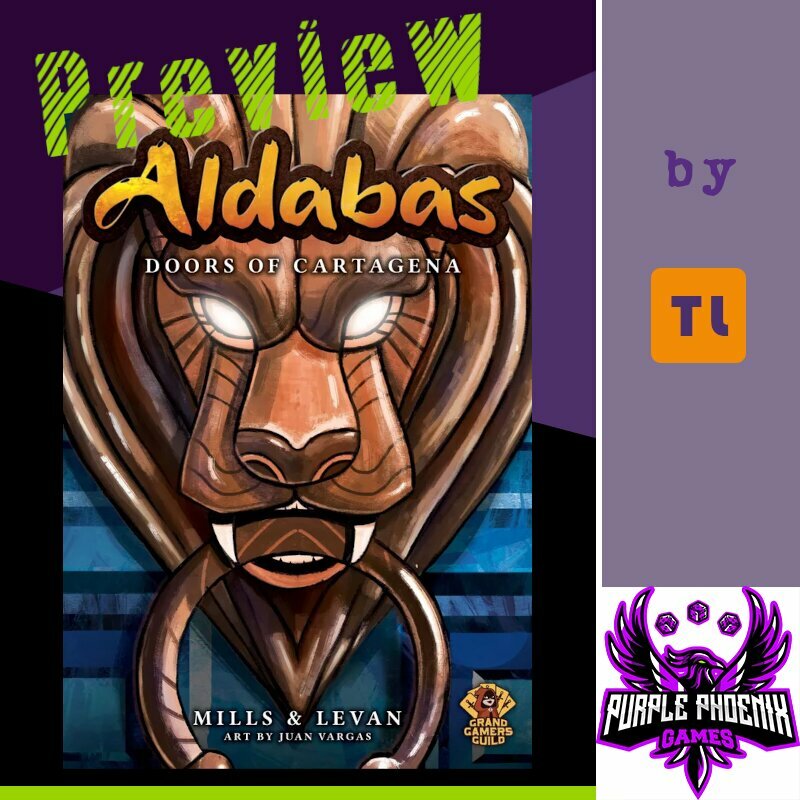
I’m just going to come right out with it so I can get it out of the way. This game has some really nice knockers. Yes, it is kid-friendly – I am referencing the door knockers that adorn the Doors of Cartagena. These ornate knockers have historically signified professions held by the residence’s inhabitants and can still be found in this Colombian city today. So how does this translate into a board game? Well, let’s dive into the world of Aldabas: Doors of Cartagena.
In Aldabas, players are (loose) urban planners in historic Cartagena attempting to build their city block with the most influential people in town. By drafting the most strategic door cards the winning player is they who scores the most points at the end of the game.
DISCLAIMER: We were provided a prototype copy of this game for the purposes of this review. These are preview copy components, and I do not know for sure if the final components will be any different from these shown. Also, it is not my intention to detail every rule in the game, as there are just too many. You are invited to download the rulebook, back the game through the Kickstarter campaign, or through any retailers stocking it after fulfillment. -T
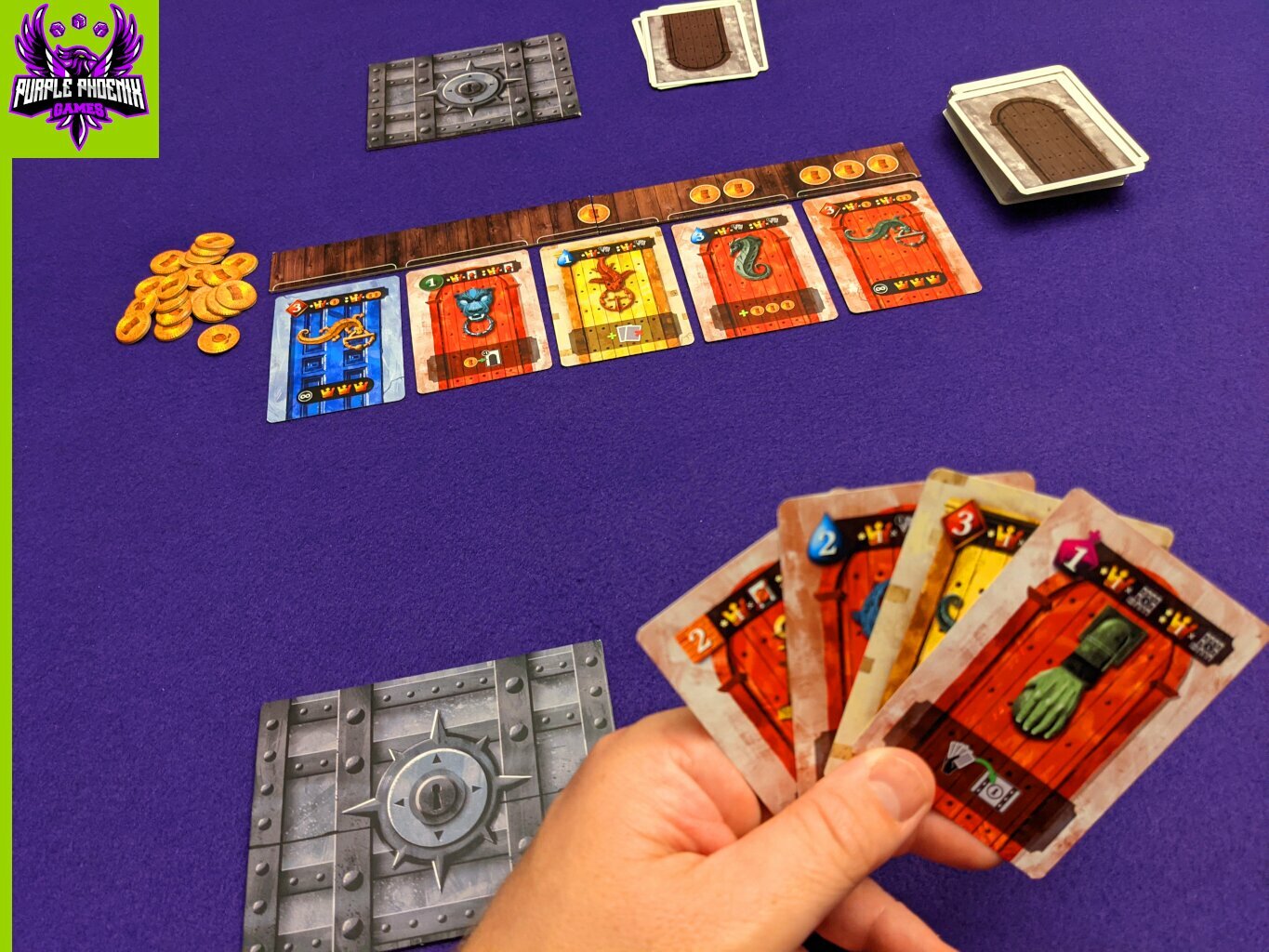
To setup, place out 12 coins per player on the table, create the door offer dock, shuffle the Doors deck, and give each player five Doors and one Vault board. Each player then chooses one card from their hand to secretly place under their vault for endgame scoring. Place the shuffled Doors deck next to the Dock and deal one card to each space beneath the Dock. The game is now setup and ready to play!
On a turn the active player will take two actions. The actions are: Take Two Coins, Buy One Door, and Place One Door. Obviously, the first action has the player adding two coins from the supply to their play area (called the purse). To Buy One Door the player simply chooses one of the Door cards from the Dock area and pays its cost to the supply. The two cards on the leftmost spaces of the Dock are free, while the other cards cost coins according to their placement at the Dock. Once a card has been purchased, a new card is revealed and added to the rightmost space, sliding all other Doors cards to the left.
To Place One Door, the active player will choose a Doors card from their hand and place it on their block they are building in front of them. The Vault card acts as the bottom leftmost space, with the block encompassing a 4×3 grid above it and to the right (as shown below). Once the Door is placed, any special power it offers is triggered immediately, as are the Doors cards’ powers adjacently below and beside the newly placed Door card.
The catch here is that when placing Doors, it is illegal to place them orthogonally adjacent to Doors of the same color, and the spaces both below and to the left of the placed Door cannot be empty. Essentially, Doors need to be placed in a cone starting from the Vault. Play continues in this fashion with players taking turns until either the supply runs out of coins, a player fills up their 4×3 grid with Doors, or the Dock cannot be refilled because the Doors deck is empty. Then final scoring occurs, which is based on individual cards as well as any suit-specific bonuses offered.
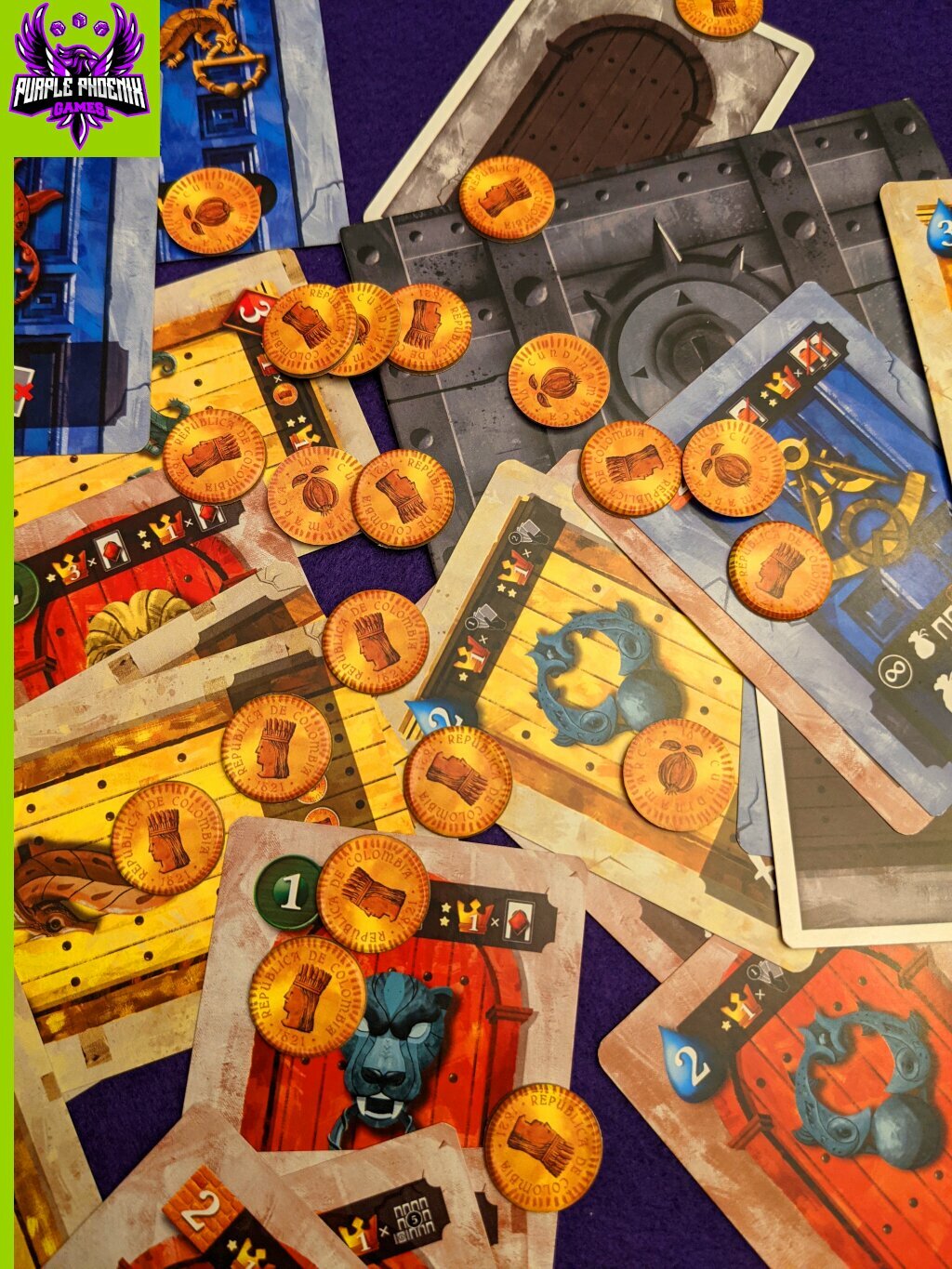
Components. Again, this is a prototype copy of the game, so final components may be different in many different ways upon a successful Kickstarter campaign. That said, this game looks GORGEOUS on the table. The colors are all super vibrant, and the great knockers really pop. Excellent theme and art here carry an already-spiffy game. The game is basically a bunch of cards and some coin tokens. They are all fine quality, especially for a prototype. I have no issues at all. I love the way this looks!
So I love the way it looks, but do I love the way it plays? I think it’s a good little game. It reminds me a little of Viceroy with the color combinations and placement rules. While Viceroy is good, Aldabas is much better in almost all ways. Aldabas plays quicker and has more easily digestible rules. If you check Viceroy’s profile on BGG you will see that many users enjoy it, and it currently sits just above rank 1000. So when I say Aldabas gives a similar feel but delivers a more enjoyable game experience, I expect Aldabas to perform better in the BGG rankings, if that’s your thing.
The special powers on the Doors cards, though I didn’t really mention them, range from VPs at game end, to moving coins to and from the Vault onto Doors to make them more valuable, to gaining coins from the supply or stealing them from other players, to offering discounts on purchasing Doors from the Dock. There are some other fun rules used in scoring, but I will let you experience those on your own with your backed copy.
So final word from me on this one is that I highly recommend it and hope you give it a shot. It offers lots of strategic game play with a medium-sized table footprint, but boy it looks great on that table! Turns are fast, and everyone is in the game until end scoring, so I never felt there was a runaway winner issue. If you are like me, you will definitely want to be adding this to your collection. Big recommendations from me, I know you will enjoy it.
In Aldabas, players are (loose) urban planners in historic Cartagena attempting to build their city block with the most influential people in town. By drafting the most strategic door cards the winning player is they who scores the most points at the end of the game.
DISCLAIMER: We were provided a prototype copy of this game for the purposes of this review. These are preview copy components, and I do not know for sure if the final components will be any different from these shown. Also, it is not my intention to detail every rule in the game, as there are just too many. You are invited to download the rulebook, back the game through the Kickstarter campaign, or through any retailers stocking it after fulfillment. -T
To setup, place out 12 coins per player on the table, create the door offer dock, shuffle the Doors deck, and give each player five Doors and one Vault board. Each player then chooses one card from their hand to secretly place under their vault for endgame scoring. Place the shuffled Doors deck next to the Dock and deal one card to each space beneath the Dock. The game is now setup and ready to play!
On a turn the active player will take two actions. The actions are: Take Two Coins, Buy One Door, and Place One Door. Obviously, the first action has the player adding two coins from the supply to their play area (called the purse). To Buy One Door the player simply chooses one of the Door cards from the Dock area and pays its cost to the supply. The two cards on the leftmost spaces of the Dock are free, while the other cards cost coins according to their placement at the Dock. Once a card has been purchased, a new card is revealed and added to the rightmost space, sliding all other Doors cards to the left.
To Place One Door, the active player will choose a Doors card from their hand and place it on their block they are building in front of them. The Vault card acts as the bottom leftmost space, with the block encompassing a 4×3 grid above it and to the right (as shown below). Once the Door is placed, any special power it offers is triggered immediately, as are the Doors cards’ powers adjacently below and beside the newly placed Door card.
The catch here is that when placing Doors, it is illegal to place them orthogonally adjacent to Doors of the same color, and the spaces both below and to the left of the placed Door cannot be empty. Essentially, Doors need to be placed in a cone starting from the Vault. Play continues in this fashion with players taking turns until either the supply runs out of coins, a player fills up their 4×3 grid with Doors, or the Dock cannot be refilled because the Doors deck is empty. Then final scoring occurs, which is based on individual cards as well as any suit-specific bonuses offered.
Components. Again, this is a prototype copy of the game, so final components may be different in many different ways upon a successful Kickstarter campaign. That said, this game looks GORGEOUS on the table. The colors are all super vibrant, and the great knockers really pop. Excellent theme and art here carry an already-spiffy game. The game is basically a bunch of cards and some coin tokens. They are all fine quality, especially for a prototype. I have no issues at all. I love the way this looks!
So I love the way it looks, but do I love the way it plays? I think it’s a good little game. It reminds me a little of Viceroy with the color combinations and placement rules. While Viceroy is good, Aldabas is much better in almost all ways. Aldabas plays quicker and has more easily digestible rules. If you check Viceroy’s profile on BGG you will see that many users enjoy it, and it currently sits just above rank 1000. So when I say Aldabas gives a similar feel but delivers a more enjoyable game experience, I expect Aldabas to perform better in the BGG rankings, if that’s your thing.
The special powers on the Doors cards, though I didn’t really mention them, range from VPs at game end, to moving coins to and from the Vault onto Doors to make them more valuable, to gaining coins from the supply or stealing them from other players, to offering discounts on purchasing Doors from the Dock. There are some other fun rules used in scoring, but I will let you experience those on your own with your backed copy.
So final word from me on this one is that I highly recommend it and hope you give it a shot. It offers lots of strategic game play with a medium-sized table footprint, but boy it looks great on that table! Turns are fast, and everyone is in the game until end scoring, so I never felt there was a runaway winner issue. If you are like me, you will definitely want to be adding this to your collection. Big recommendations from me, I know you will enjoy it.


Bob Mann (459 KP) rated Alien: Covenant (2017) in Movies
Sep 29, 2021

Horrific Beasts and How to Avoid Them.
I seem to be in a bit of a minority in quite liking Ridley Scott’s last Alien outing – 2012’s “Prometheus”: a heady, if at times ponderous, theory to the origins of man. The first hour of that film is really good. But for me, what made the original 1979 film so enthralling was the life cycle of the ‘traditional’ Xenomorph aliens through egg to evil hatchling to vicious killing machine. This somewhat got lost with “Prometheus” with a range of alien-like-things ranging from wiggly black goo to something more familiar… and frankly I was confused. Some – repeat, some – of the explanation for that diversity of forms in “Prometheus” is made clearer in the sequel “Alien: Covenant”.
“Covenant” (named again after the spaceship at its heart) is a follow-on sequel to “Prometheus”, so it is worth re-watching it if you can before a cinema trip. At the end of that film we saw Elizabeth Shaw (Noomi Rapace, “The Girl with the Dragon Tattoo”) and a reconstructed android David (Michael Fassbender, “Steve Jobs“) flying off in an alien craft still loaded with its cargo of nasty alien black goo. Shaw had a mission to seek out The Engineer’s home world – named “Paradise” – to find out why after creating man they were intent on going back to finish them off with a WMD. A neat prologue has been released which documents this… here:
We pick up the action 10 years later in a totally improbable 2104. (Give us a break writing team! [Story by Jack Paglen and Michael Green; screenplay by John Logan and Dante Harper]. We know they won’t have got through planning permission on the third Heathrow runway by then, let alone invented interplanetary travel…! 2504, maybe!)
Daniels (Katherine Waterston, “Fantastic Beasts And Where To Find Them“) has just suffered a sudden bereavement (an uncredited James Franco – – blink and you’ll miss him). She has also been rudely awakened from hypersleep due to a sudden system mishap: no, not to find Chris Pratt there like “Passengers“, but by the ship’s android Walter (also Michael Fassbender) who’s also revived the rest of the crew. While effecting repairs they receive a garbled John Denver track mysteriously beamed to them from an earth-like planet not too far away. As this might be a suitable homestead, and as spending weeks more in hypersleep is unattractive, Captain Oram (Billy Crudup, “Spotlight“) votes to check it out, against Daniels’ strong objections. Needless to say, this proves to be a BIG MISTAKE as the new film neatly links hands with the first film.
Kick-ass… Katherine Waterston being careful not to slip in the shower.
There’s a limit to what more I can say about the film without delivering spoilers (so I have added a few more comments in the spoiler section BELOW the trailer). It’s a far more action-oriented film than “Prometheus” and has enough jump scares and gore to please most Alien fans. (In fact, it’s a surprise to me that it got a UK “15” certificate rather than an “18”: how much more violence do you need to show in the film?) A shower scene towards the end of the film is particularly effective and will likely put an end to relaxing shower sex for many people for good!
It also looks visually stunning (cinematography is by Dariusz Wolski (“The Martian“, “Pirates of the Caribbean”) with location shooting in Milford Sound in New Zealand. The special effects are also a cut-above the normal CGI with a devastated Pompeii-like city, a picture of blacks and greys, being particularly effective.
In the acting stakes it is really all down to Waterston and Fassbinder. I wasn’t a great fan of Waterston in “Fantastic Beasts” – a bit insipid I thought – but here she adopts Ripley’s kick-ass mantle with ease but blends it beautifully with doe-eyed vulnerability. Some of her scenes reminded me strongly of Demi Moore in “Ghost”. Fassbinder is fascinating to watch with his dual roles of Walter and David, both slightly different versions of the same being. And the special effects around the Fassbinder-on-Fassbinder action, tending somewhat towards the homoerotic in places, are well done.
Unfortunately the rest of the crew get little in the way of background development, which limits the impact of the inevitable demises. They are also about as clinically stupid as the spaceship crew in “Life” in some of their actions; I guess you could put some of this down to the effects of panic, but in other cases you might see it as a simple cleansing of the gene pool in Darwinian fashion.
Also making uncredited guest appearances are Guy Pearce as Weyland (in a flashback scene) and Noomi Rapace.
Music is “by” Jed Kurzel, but to be honest he does little than wrap around re-versions of the original Jerry Goldsmith classics: not that this is a bad thing, since those themes are iconic and a joy to hear again on the big screen.
My expectations for this movie were sky-high, as it was hinted as a return to form for the franchise. And in many ways it was, with a “man, Gods and androids” theme adding depth to the traditional anatomical-bursting gore. But to be honest, some of the storytelling was highly predictable, and I left slightly disappointed with the overall effort. If my expectations were an 11/10, my reality was more like a 7/10. It’s still a good film, and I look forward to watching it again. But perhaps this is a franchise that has really run its course now for Mr Scott and he should look to his next “Martian”-type movie for a more novel foundation to build his next movie “log cabin on the lake” on.
“Covenant” (named again after the spaceship at its heart) is a follow-on sequel to “Prometheus”, so it is worth re-watching it if you can before a cinema trip. At the end of that film we saw Elizabeth Shaw (Noomi Rapace, “The Girl with the Dragon Tattoo”) and a reconstructed android David (Michael Fassbender, “Steve Jobs“) flying off in an alien craft still loaded with its cargo of nasty alien black goo. Shaw had a mission to seek out The Engineer’s home world – named “Paradise” – to find out why after creating man they were intent on going back to finish them off with a WMD. A neat prologue has been released which documents this… here:
We pick up the action 10 years later in a totally improbable 2104. (Give us a break writing team! [Story by Jack Paglen and Michael Green; screenplay by John Logan and Dante Harper]. We know they won’t have got through planning permission on the third Heathrow runway by then, let alone invented interplanetary travel…! 2504, maybe!)
Daniels (Katherine Waterston, “Fantastic Beasts And Where To Find Them“) has just suffered a sudden bereavement (an uncredited James Franco – – blink and you’ll miss him). She has also been rudely awakened from hypersleep due to a sudden system mishap: no, not to find Chris Pratt there like “Passengers“, but by the ship’s android Walter (also Michael Fassbender) who’s also revived the rest of the crew. While effecting repairs they receive a garbled John Denver track mysteriously beamed to them from an earth-like planet not too far away. As this might be a suitable homestead, and as spending weeks more in hypersleep is unattractive, Captain Oram (Billy Crudup, “Spotlight“) votes to check it out, against Daniels’ strong objections. Needless to say, this proves to be a BIG MISTAKE as the new film neatly links hands with the first film.
Kick-ass… Katherine Waterston being careful not to slip in the shower.
There’s a limit to what more I can say about the film without delivering spoilers (so I have added a few more comments in the spoiler section BELOW the trailer). It’s a far more action-oriented film than “Prometheus” and has enough jump scares and gore to please most Alien fans. (In fact, it’s a surprise to me that it got a UK “15” certificate rather than an “18”: how much more violence do you need to show in the film?) A shower scene towards the end of the film is particularly effective and will likely put an end to relaxing shower sex for many people for good!
It also looks visually stunning (cinematography is by Dariusz Wolski (“The Martian“, “Pirates of the Caribbean”) with location shooting in Milford Sound in New Zealand. The special effects are also a cut-above the normal CGI with a devastated Pompeii-like city, a picture of blacks and greys, being particularly effective.
In the acting stakes it is really all down to Waterston and Fassbinder. I wasn’t a great fan of Waterston in “Fantastic Beasts” – a bit insipid I thought – but here she adopts Ripley’s kick-ass mantle with ease but blends it beautifully with doe-eyed vulnerability. Some of her scenes reminded me strongly of Demi Moore in “Ghost”. Fassbinder is fascinating to watch with his dual roles of Walter and David, both slightly different versions of the same being. And the special effects around the Fassbinder-on-Fassbinder action, tending somewhat towards the homoerotic in places, are well done.
Unfortunately the rest of the crew get little in the way of background development, which limits the impact of the inevitable demises. They are also about as clinically stupid as the spaceship crew in “Life” in some of their actions; I guess you could put some of this down to the effects of panic, but in other cases you might see it as a simple cleansing of the gene pool in Darwinian fashion.
Also making uncredited guest appearances are Guy Pearce as Weyland (in a flashback scene) and Noomi Rapace.
Music is “by” Jed Kurzel, but to be honest he does little than wrap around re-versions of the original Jerry Goldsmith classics: not that this is a bad thing, since those themes are iconic and a joy to hear again on the big screen.
My expectations for this movie were sky-high, as it was hinted as a return to form for the franchise. And in many ways it was, with a “man, Gods and androids” theme adding depth to the traditional anatomical-bursting gore. But to be honest, some of the storytelling was highly predictable, and I left slightly disappointed with the overall effort. If my expectations were an 11/10, my reality was more like a 7/10. It’s still a good film, and I look forward to watching it again. But perhaps this is a franchise that has really run its course now for Mr Scott and he should look to his next “Martian”-type movie for a more novel foundation to build his next movie “log cabin on the lake” on.

Heather Cranmer (2721 KP) rated Those People in Books
Apr 20, 2019
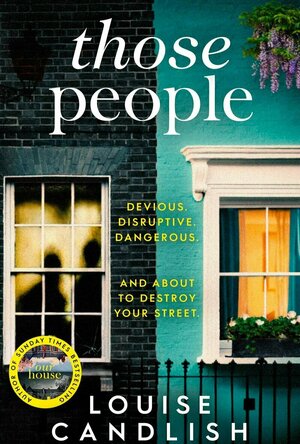
Enthralling Read
I must admit that I was sucked into Those People by Louise Candlish as soon as I read the synopsis. I had a feeling this was going to be a good read, and I was correct. I found this book to be very interesting.
The plot of Those People really held my attention. Basically, the short of it is, Lowland Way, the road where the story takes place, is full of rich people. When neighbors Darren and Jodie inherit a house from a relative, they make their neighbors' lives a nightmare by being loud, playing loud music all day and night, taking up a lot of space with their car business, and not following the neighborly rules of being good neighbors. When a murder occurs, the rich folk of Lowland Way think it will be an open and shut case and that their lives will return to normal. However, nothing could be further from the truth. After reading about Darren and Jodie, I could definitely relate to the feelings of the people on Lowland Way because I've had some pretty bad neighbors. Luckily, they've never been as bad as Darren and Jodie though. I found the plot to be extreme, but it was believable. Sometimes people will go too far if they are driven mad enough (not that I agreed with their actions) as was the case in Those People. There were a few good plot twists. However, I felt like I need more closure at the end of the book. Those People is not part of a series, so I feel like I will never get answers. It's more of a speculative ending which I am never a fan of.
I did enjoy reading about the lives of the characters in Those People. I felt they were all written perfectly and were fleshed out enough to feel like real people instead of just characters in a book. I did find many of the characters to be snobby especially Naomi. She was written really well, but I felt her character had a giant chip on her shoulder. Emma was a complete basket case. I get that she just had a baby, but some of her actions were quite extreme. However, I do know someone like her in real life. Sissy was my overall favorite character. She was the oldest, and she also had the most to lose especially as Darren and Jodie's actions were causing her to lose her bed and breakfast business. My heart really went out to her. I did think Darren and Jodie made for great baddies. I like how Darren would keep his cool for the most part when the others of Lowland Way would lose their cool towards him. For the most part, I felt that females in this book overshadowed the men with the exception of Darren and Jodie. The females seemed to be the stronger characters. This wasn't necessarily a bad thing though.
The pacing for Those People always stayed consistent and held my attention throughout. In fact, I never wanted to put this book down because I was so entranced with what was going on and what would happen next.
Trigger warnings for Those People include violence, death, profanity, and alcohol and drug use.
Overall, Those People is a really good read. I was consistently absorbed by all the drama happening at Lowland Way. The characters were written well, and the plot definitely held my attention. I would definitely recommend Those People by Louise Candlish to everyone aged 18+ especially those who have ever had to deal with some horrible neighbors.
--
(A special thank you to the publisher for providing me with an ARC paperback of Those People by Louise Candlish in exchange for an honest and unbiased review.)
The plot of Those People really held my attention. Basically, the short of it is, Lowland Way, the road where the story takes place, is full of rich people. When neighbors Darren and Jodie inherit a house from a relative, they make their neighbors' lives a nightmare by being loud, playing loud music all day and night, taking up a lot of space with their car business, and not following the neighborly rules of being good neighbors. When a murder occurs, the rich folk of Lowland Way think it will be an open and shut case and that their lives will return to normal. However, nothing could be further from the truth. After reading about Darren and Jodie, I could definitely relate to the feelings of the people on Lowland Way because I've had some pretty bad neighbors. Luckily, they've never been as bad as Darren and Jodie though. I found the plot to be extreme, but it was believable. Sometimes people will go too far if they are driven mad enough (not that I agreed with their actions) as was the case in Those People. There were a few good plot twists. However, I felt like I need more closure at the end of the book. Those People is not part of a series, so I feel like I will never get answers. It's more of a speculative ending which I am never a fan of.
I did enjoy reading about the lives of the characters in Those People. I felt they were all written perfectly and were fleshed out enough to feel like real people instead of just characters in a book. I did find many of the characters to be snobby especially Naomi. She was written really well, but I felt her character had a giant chip on her shoulder. Emma was a complete basket case. I get that she just had a baby, but some of her actions were quite extreme. However, I do know someone like her in real life. Sissy was my overall favorite character. She was the oldest, and she also had the most to lose especially as Darren and Jodie's actions were causing her to lose her bed and breakfast business. My heart really went out to her. I did think Darren and Jodie made for great baddies. I like how Darren would keep his cool for the most part when the others of Lowland Way would lose their cool towards him. For the most part, I felt that females in this book overshadowed the men with the exception of Darren and Jodie. The females seemed to be the stronger characters. This wasn't necessarily a bad thing though.
The pacing for Those People always stayed consistent and held my attention throughout. In fact, I never wanted to put this book down because I was so entranced with what was going on and what would happen next.
Trigger warnings for Those People include violence, death, profanity, and alcohol and drug use.
Overall, Those People is a really good read. I was consistently absorbed by all the drama happening at Lowland Way. The characters were written well, and the plot definitely held my attention. I would definitely recommend Those People by Louise Candlish to everyone aged 18+ especially those who have ever had to deal with some horrible neighbors.
--
(A special thank you to the publisher for providing me with an ARC paperback of Those People by Louise Candlish in exchange for an honest and unbiased review.)

Becs (244 KP) rated Silent Lee and the Adventure of the Side Door Key in Books
May 30, 2019
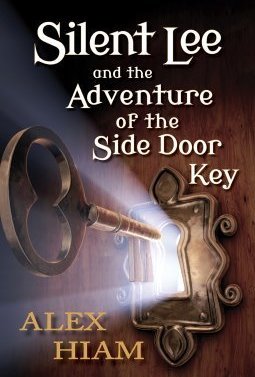

Story Development (2 more)
Character Development
Plot was amazing
Cute and simple read!
My rating: ☆☆☆☆☆
Review:
I received Silent Lee and the Adventure of the Side Door Key by Alex Hiam from Smith Publicity to read and review for my honest opinion. Since this novel has such a long title, I will be shortening it to just Silent Lee.
Silent Lee is about a young girl about the age of fourteen named Silent Lee, (she prefers Sie). Sie has been living in the Side Door world majority of her life.
A note on the Side Door world and the Front Door world:
Side Door world - the magical world that you can only enter through the side door of a house. You must have the special key in order to activate this world. Not all side doors are a part of the Side Door world. If there is a side door that doesn't have an exit, then you're in luck!
Front Door world - the modern world that you enter via the front door, back door, or windows. This is the world that Raahi lives in along with Sie's mother.
One day, Sie's mother takes Sie away from her Auntie Gen's. Then, before Sie realizes, Auntie Gen dies (or so we think). The story continues to follow Sie as she gets dropped off at her cousins house, who eventually leave her for summer vacation, and Raahi entering Sie's life. Sie gets a note from her Auntie Gen and she begins questioning what it could mean and whether her Aunt is actually dead. So, being the curious soul that she is, she follows the note as best as she can. Raahi is by her side throughout the entirety of the story and even to the very ending when they find and rescue Auntie Gen from being held captive by Sie's mother who is a CIA agent.
This was a fast-paced, middle grade novel that will keep your attention until the very end. I can't wait to read more of Sie's story!
Characters:
Silent Lee (Sie) - the protagonist, fourteen years old and a witch who travels from the Side Door world and the Front Door world. Mixed ethnicity - African American and European.
Raahi - a minor protagonist who befriends Sie because he has a crush on her. Same age as Sie and follows her throughout the story. Indian ethnicity.
Auntie Gen - Sie's aunt who is originally presumed dead, but was actually held captive by the CIA and Sie's mother. Also a witch and the holder of the Side Door key until she gives it to Sie.
Agent Lee - Sie's adoptive mother, may not actually be a part of the Side Door world at all. She tries to steal the power within the Side Door world to bring back into the Front Door world.
Mr. Vose - art gallery owner who helps Sie and Raahi.
The Custodian - balance keeper of the Front Door world, helps Sie and Raahi in a time of need.
Reasons why I rated it 5 stars:
1. The plot:
The plot was very driven and I did not find any plot holes. The story was written in a very high level for a middle grade novel and I truly enjoyed it.
2. My enjoyment:
I loved Silent Lee and the Adventure of the Side Door Key so much!
3. Character and story development:
Man oh man! There was a ton of background and development for both the characters and the story!! I was really blown away as there was more then the average young adult novel.
4. Grammar and spelling:
I did not find any grammatical or spelling errors and Silent Lee was very well-written.
5. The overall story:
This was such an adorable story! I really loved the modern and historical balance that the author created while also adding a bit of magic into the story.
"Bookworms ate books - they didn't read them. And what was wrong with reading, anyway?"
Review:
I received Silent Lee and the Adventure of the Side Door Key by Alex Hiam from Smith Publicity to read and review for my honest opinion. Since this novel has such a long title, I will be shortening it to just Silent Lee.
Silent Lee is about a young girl about the age of fourteen named Silent Lee, (she prefers Sie). Sie has been living in the Side Door world majority of her life.
A note on the Side Door world and the Front Door world:
Side Door world - the magical world that you can only enter through the side door of a house. You must have the special key in order to activate this world. Not all side doors are a part of the Side Door world. If there is a side door that doesn't have an exit, then you're in luck!
Front Door world - the modern world that you enter via the front door, back door, or windows. This is the world that Raahi lives in along with Sie's mother.
One day, Sie's mother takes Sie away from her Auntie Gen's. Then, before Sie realizes, Auntie Gen dies (or so we think). The story continues to follow Sie as she gets dropped off at her cousins house, who eventually leave her for summer vacation, and Raahi entering Sie's life. Sie gets a note from her Auntie Gen and she begins questioning what it could mean and whether her Aunt is actually dead. So, being the curious soul that she is, she follows the note as best as she can. Raahi is by her side throughout the entirety of the story and even to the very ending when they find and rescue Auntie Gen from being held captive by Sie's mother who is a CIA agent.
This was a fast-paced, middle grade novel that will keep your attention until the very end. I can't wait to read more of Sie's story!
Characters:
Silent Lee (Sie) - the protagonist, fourteen years old and a witch who travels from the Side Door world and the Front Door world. Mixed ethnicity - African American and European.
Raahi - a minor protagonist who befriends Sie because he has a crush on her. Same age as Sie and follows her throughout the story. Indian ethnicity.
Auntie Gen - Sie's aunt who is originally presumed dead, but was actually held captive by the CIA and Sie's mother. Also a witch and the holder of the Side Door key until she gives it to Sie.
Agent Lee - Sie's adoptive mother, may not actually be a part of the Side Door world at all. She tries to steal the power within the Side Door world to bring back into the Front Door world.
Mr. Vose - art gallery owner who helps Sie and Raahi.
The Custodian - balance keeper of the Front Door world, helps Sie and Raahi in a time of need.
Reasons why I rated it 5 stars:
1. The plot:
The plot was very driven and I did not find any plot holes. The story was written in a very high level for a middle grade novel and I truly enjoyed it.
2. My enjoyment:
I loved Silent Lee and the Adventure of the Side Door Key so much!
3. Character and story development:
Man oh man! There was a ton of background and development for both the characters and the story!! I was really blown away as there was more then the average young adult novel.
4. Grammar and spelling:
I did not find any grammatical or spelling errors and Silent Lee was very well-written.
5. The overall story:
This was such an adorable story! I really loved the modern and historical balance that the author created while also adding a bit of magic into the story.
"Bookworms ate books - they didn't read them. And what was wrong with reading, anyway?"
Movie Metropolis (309 KP) rated Jurassic World (2015) in Movies
Jun 10, 2019

A Trip down memory lane
Can you believe it’s been 14 years since genetically modified dinosaurs rampaged across our screens in Joe Johnston’s underwhelming Jurassic Park III?
After being stuck in development hell for over a decade, Steven Spielberg handpicked indie director Colin Trevorrow to helm the fourth instalment of the popular adventure franchise, Jurassic World, but can it return the much-loved series to form?
Man of the moment Chris Pratt (Guardians of the Galaxy), Bryce Dallas Howard (The Village), Ty Simpkins (Iron Man 3) and Omar Sy (X-Men: Days of Future Past) lead a cast of characters in a visually spectacular film that whilst paying homage to 1993’s Jurassic Park, lacks a little of the original’s soul.
Jurassic World is now a fully functioning theme park taken over from John Hammond’s InGen by Simon Masrani (Irrfan Khan in a pleasingly comedic performance). Welcoming over 20,000 visitors a day, the park sees the need to create something bigger, louder and with more teeth to sustain visitor interest – the Indominus Rex.
Naturally, this doesn’t go quite to plan.
The performances from all of the cast are on-point with Bryce Dallas Howard being a particular highlight. There were worries that her ability would match Tea Leoni from Jurassic Park III rather than Laura Dern’s brilliant Ellie Sattler from the original. Thankfully, this isn’t the case.
Her story arc is particularly intriguing if predictable with her uptight corporate image being shed throughout the film’s succinct 123 minute running time.
Chris Pratt proves why he is the man every director wants to work with. His less comedic side comes out in Jurassic World and proves that he has the acting chops to go with his good looks.
Vincent D’Onofrio stars as the obligatory villain but his side story is never really explored – possibly setting up for a sequel should the film perform well at the box office and with it making up 90% of global ticket sales this weekend, things look promising.
Music wise, Jurassic World treads a very careful path. Make no mistake, this is a standalone movie, but the references to the original are there for all to hear. Michael Giacchino, one of the best composers of the moment, takes over from Don Davis of Jurassic Park III and provides the series with its best score since John Williams’ original.
Special effects too are top notch with the park looking stunning and the dinosaurs, on the whole, faring the same way. There are a couple of moments where things start to look a little video game like, but this never takes away from the beauty of this film.
Unfortunately, whilst the last 30 minutes are breath-taking, edge of your seat stuff, it’s difficult to differentiate Jurassic World from the plethora of high budget blockbusters that litter the cinema these days and whilst Trevorrow chooses references to the original carefully, it lacks a little of that film’s soul and ultimately charm.
Overall, Jurassic World is better than the majority of blockbusters that have come and gone from cinemas over the last year and it tops The Lost World: Jurassic Park and Jurassic Park III to become a sequel worthy of the original.
Yes it’s not perfect, with the gorgeous finale lacking substance, but after waiting 14 years it comes pretty darn close and will no doubt be, along with Star Wars: Episode VII, one of the most memorable films of the noughties.
Do you remember seeing Jurassic Park for the first time? That’s the question everyone asks, and whilst Jurassic World won’t be making anywhere near the same impact, it’s a film worthy of the brand.
https://moviemetropolis.net/2015/06/14/a-trip-down-memory-lane-jurassic-world-review/
After being stuck in development hell for over a decade, Steven Spielberg handpicked indie director Colin Trevorrow to helm the fourth instalment of the popular adventure franchise, Jurassic World, but can it return the much-loved series to form?
Man of the moment Chris Pratt (Guardians of the Galaxy), Bryce Dallas Howard (The Village), Ty Simpkins (Iron Man 3) and Omar Sy (X-Men: Days of Future Past) lead a cast of characters in a visually spectacular film that whilst paying homage to 1993’s Jurassic Park, lacks a little of the original’s soul.
Jurassic World is now a fully functioning theme park taken over from John Hammond’s InGen by Simon Masrani (Irrfan Khan in a pleasingly comedic performance). Welcoming over 20,000 visitors a day, the park sees the need to create something bigger, louder and with more teeth to sustain visitor interest – the Indominus Rex.
Naturally, this doesn’t go quite to plan.
The performances from all of the cast are on-point with Bryce Dallas Howard being a particular highlight. There were worries that her ability would match Tea Leoni from Jurassic Park III rather than Laura Dern’s brilliant Ellie Sattler from the original. Thankfully, this isn’t the case.
Her story arc is particularly intriguing if predictable with her uptight corporate image being shed throughout the film’s succinct 123 minute running time.
Chris Pratt proves why he is the man every director wants to work with. His less comedic side comes out in Jurassic World and proves that he has the acting chops to go with his good looks.
Vincent D’Onofrio stars as the obligatory villain but his side story is never really explored – possibly setting up for a sequel should the film perform well at the box office and with it making up 90% of global ticket sales this weekend, things look promising.
Music wise, Jurassic World treads a very careful path. Make no mistake, this is a standalone movie, but the references to the original are there for all to hear. Michael Giacchino, one of the best composers of the moment, takes over from Don Davis of Jurassic Park III and provides the series with its best score since John Williams’ original.
Special effects too are top notch with the park looking stunning and the dinosaurs, on the whole, faring the same way. There are a couple of moments where things start to look a little video game like, but this never takes away from the beauty of this film.
Unfortunately, whilst the last 30 minutes are breath-taking, edge of your seat stuff, it’s difficult to differentiate Jurassic World from the plethora of high budget blockbusters that litter the cinema these days and whilst Trevorrow chooses references to the original carefully, it lacks a little of that film’s soul and ultimately charm.
Overall, Jurassic World is better than the majority of blockbusters that have come and gone from cinemas over the last year and it tops The Lost World: Jurassic Park and Jurassic Park III to become a sequel worthy of the original.
Yes it’s not perfect, with the gorgeous finale lacking substance, but after waiting 14 years it comes pretty darn close and will no doubt be, along with Star Wars: Episode VII, one of the most memorable films of the noughties.
Do you remember seeing Jurassic Park for the first time? That’s the question everyone asks, and whilst Jurassic World won’t be making anywhere near the same impact, it’s a film worthy of the brand.
https://moviemetropolis.net/2015/06/14/a-trip-down-memory-lane-jurassic-world-review/

I didn't know too much about the premise before I started the book beyond frequent comparisons to Ready Player One and it being about a hacker/gamer - which I think was a good thing. I didn't go into it with any expectations (especially because I have never read Ready Player one) and came out fantastically entertained.
The world in which we find ourselves is a more advanced version of the one that we are familiar with. Virtual or augmented reality has made a technological leap due to the creation of Hideo Tanaka. The sleeker AR/VR glasses make the experience more user-friendly and the game Warcross has exploded across the globe. Each year there are Warcross Championships, which pit teams of the best players (and some wild cards) against one another.
Although Emika is a gamer and hacker she is forced to turn to a life of bounty hunting to support herself, and even that is not enough. She is days away from being kicked out of her apartment and with $13 to her name, she takes the biggest risk of her life and hacks the Warcross Championships. This one act flips her entire world upside down and sets the rest of the story in motion.
Emika is a very relatable character, despite her criminal record, incredible hacking skills, and ingenuity. She has an incredible love for her father, a strong backbone and the tenacity to do what is necessary. Emika's character has a nice balance so that she is not incompetent, but she is also not the perfect chosen one, she is an incredible hacker, but she is not infallible, etc.
Hideo, on the other hand, is a genius and innovator. At first glance, he seems aloof and professional, but there is a real person with emotions once you get to know him. I really enjoyed watching him open up over the course of the book and get more of his backstory. Lu brilliantly weaves the stories into both character's narratives so that we are able to see the events and people that made them who they are today.
The story was fast-paced and the Warcross games were so vibrantly described that it felt as if you were genuinely watching them. The world was slowly but surely populated, from the buildings and city streets we may be familiar with to the addition of virtual reality advertisements and signage, an underground black market, and more.
Even the game of Warcross itself was a really interesting aspect of the story. Although the game seems simple, there are limitless ways to manipulate and change the game as it is being played. It is an intense game similar to Capture the Flag, in that teams must capture the other's artifact but power-ups, changing landscapes and team members with special skills make the game infinitely more enjoyable to read about.
While the ending likely won't be a complete surprise, the overall motivations and events that lead up to the final pages will hit you hard. You're so invested in the characters and the world that any reveals will make you wonder (and need to know) what happens next. I definitely didn't want to leave the world that Lu had built, so I am incredibly pleased that there will be more books in this series. There is so much that she can add to the story, the world and I can't wait to see where she goes with it next.
I highly recommend this book to young adult/teen readers even you don't consider yourself a gamer or think you will relate. This is a very accessible book that many will enjoy (plus that cover is gorgeous, right?)
The world in which we find ourselves is a more advanced version of the one that we are familiar with. Virtual or augmented reality has made a technological leap due to the creation of Hideo Tanaka. The sleeker AR/VR glasses make the experience more user-friendly and the game Warcross has exploded across the globe. Each year there are Warcross Championships, which pit teams of the best players (and some wild cards) against one another.
Although Emika is a gamer and hacker she is forced to turn to a life of bounty hunting to support herself, and even that is not enough. She is days away from being kicked out of her apartment and with $13 to her name, she takes the biggest risk of her life and hacks the Warcross Championships. This one act flips her entire world upside down and sets the rest of the story in motion.
Emika is a very relatable character, despite her criminal record, incredible hacking skills, and ingenuity. She has an incredible love for her father, a strong backbone and the tenacity to do what is necessary. Emika's character has a nice balance so that she is not incompetent, but she is also not the perfect chosen one, she is an incredible hacker, but she is not infallible, etc.
Hideo, on the other hand, is a genius and innovator. At first glance, he seems aloof and professional, but there is a real person with emotions once you get to know him. I really enjoyed watching him open up over the course of the book and get more of his backstory. Lu brilliantly weaves the stories into both character's narratives so that we are able to see the events and people that made them who they are today.
The story was fast-paced and the Warcross games were so vibrantly described that it felt as if you were genuinely watching them. The world was slowly but surely populated, from the buildings and city streets we may be familiar with to the addition of virtual reality advertisements and signage, an underground black market, and more.
Even the game of Warcross itself was a really interesting aspect of the story. Although the game seems simple, there are limitless ways to manipulate and change the game as it is being played. It is an intense game similar to Capture the Flag, in that teams must capture the other's artifact but power-ups, changing landscapes and team members with special skills make the game infinitely more enjoyable to read about.
While the ending likely won't be a complete surprise, the overall motivations and events that lead up to the final pages will hit you hard. You're so invested in the characters and the world that any reveals will make you wonder (and need to know) what happens next. I definitely didn't want to leave the world that Lu had built, so I am incredibly pleased that there will be more books in this series. There is so much that she can add to the story, the world and I can't wait to see where she goes with it next.
I highly recommend this book to young adult/teen readers even you don't consider yourself a gamer or think you will relate. This is a very accessible book that many will enjoy (plus that cover is gorgeous, right?)