

Home yoga practice
Health & Fitness and Lifestyle
App
What is preventing you from living your life to the fullest TODAY? Body aches? Stress? Your mood? ...

Khmer Video Dictionary - Translate, Learn and Speak with Video Phrasebook
Travel and Reference
App
In Khmer speaking Cambodia, the title 'Lok' is used to address a man and 'Lok Srey' for a woman,...

Chris Sawin (602 KP) rated Demon Slayer: Kimetsu no Yaiba The Movie: Mugen Train (2020) in Movies
Oct 6, 2021



When it comes to anime films they are generally connected to the anime television series they’re based on by featuring the same characters or taking place in the same universe. However, the movies almost always are their own stories that don’t cross paths with the stories being told in the series. Mugen Train picks up right after the first season ends.
Tanjiro, Zenitsu, and Inosuke board the train Rengoku, the Flame Hashira, is already on. They’ve been summoned to the train because people keep disappearing and there’s said to be demons aboard including a demon who has supposedly killed several demon slayers. He has pawns, who are usually children, who infiltrate the dreams of Enmu’s victims that bypass their subconscious and destroy their spiritual core.
There is usually a drastic difference in animation quality between an anime series and its films, but Demon Slayer already features such impressive animation that it’s difficult to top it. Mugen Train features all of the glorious breathing and sword techniques animated to blissful perfection, but what it does differently with its animation lies within its backgrounds. Trees and water are either 3D elements or are somehow lifted from realistic backgrounds because they’re amazingly detailed and look genuine.
The main demon on the train, Enmu, utilizes 3D animation in unique ways. Going into too much detail will spoil the film and where the Enmu character is taken, but keep in mind a certain form of Enmu is animated in 3D. It’s pink, slimy, wet sounding, and gross. Enmu’s English voice actor sounds like he’s doing a Michael Jackson on South Park impersonation. Enmu has the ability to put people to sleep, but he feeds them pleasant dreams at first and then injects them full of the worst nightmares imaginable during their gruesome death. He has the ability to detach his left hand, which has one eye near its thumb and a talking mouth on the back of its palm.
The main issues you may have with the Demon Slayer series are still relevant here. Tanjiro still cries and whines about stuff way too much and the film suffers a bit too much from over explaining things; a trait most anime titles fall victim to. Zenitsu’s unbearable yelling about how much of a weakling he is gets tiresome, as well. But you knew all of this going into it.
The film makes up for its few shortcomings by having jaw-dropping action sequences and laugh out loud humor at every turn. Inosuke’s dream about being the real leader of the group and being the voice of reason when Tanjiro is too emotional to move on is both hilarious and justifiable. And Zenitsu fantasizing about being with Nezuko is too good. He also has bucked teeth in more than one person’s “good” dream, which is only funnier in the long run. Also, why does everyone seem to purposely call Tanjiro the wrong name?
The highlight of Mugen Train is Rengoku. His fight sequences are the highlight of the film, but he’s also hysterical. Rengoku will forever be associated with the term, “TASTY!” Rengoku has a fight at the end of the film that is lengthy, memorable, and just downright amazing. He talks in a bold and boisterous voice and is slightly ridiculous in nature; think All Might from My Hero Academia engulfed in fire.
Demon Slayer: Mugen Train won’t make you a fan of the franchise if you aren’t already, but it will absolutely strengthen your love for it if you’re already an established fan. It’s also an anime film that covers just about everything; it tries to tear at your heartstrings, it has two awesomely sinister villains, it has significantly kick-ass action sequences, and it further develops a supporting character you were only briefly introduced to previously. Mugen Train is outrageously funny and action packed and is an impressive feat of animation even if you aren’t an anime fan.

Hazel (1853 KP) rated He Walks Among Us: Encounters with Christ in a Broken World in Books
Dec 17, 2018


Richard Stearns is the president of World Vision United States who, along with his wife Reneé, regularly visits the poorer countries of our world to see the ways the charity is helping to change people's lives. <i>He Walks Among Us</i> is a compilation of short thoughts and observations (two-to-three pages, including photographs) they have both had while conducting their work. As they alternate the writing, we are given opinions and experiences that we may be able to relate to our own. As Richard is the president of the organisation, he can give an insight into the way World Vision works, however, he can also express his opinions as a father, grandfather and believer in Christ. Reneé is also a World Vision worker, but due to her nature, gives a more maternal impression of the scenes she witnesses.
The individuals written about in this book come from all over the world. Most are located in Africa, but there are also similar stories in Asia, South and North America, and even Eastern Europe. The terrors these people have faced are shocking (AIDs, war, sexual abuse, natural disasters etc), but each family has been aided in some way by World Vision and their donors.
The purpose of <i>He Walks Among Us</i> is not to promote World Vision, but to encourage us to let God and Jesus into our lives. Richard and Reneé assume their readers are Christians, however, they realise that being a Christian does not equate to fully accepting God's plans. The victims of war, rape, and poverty mentioned have also been touched by Jesus. Many did not know him before World Vision came into their lives, but they have now been transformed through the power of his love - although their situation may not have significantly improved.
The actual stories used to illustrate the work of World Vision are only brief mentions, providing the bare bones of the situations. What Richard and Reneé have focused on is linking these lives, their lives and our lives to passages from the Bible. Either taken literally or metaphorically, the pair manage to relate everything to the actions and fates of a number of key Biblical characters. This emphasises that Our Lord is walking among us, giving life, peace, hope and steadfast faith.
<b>Ideas</b>
Giving someone new hope or purpose in their life can be related to Jesus raising Lazarus from the dead. Whether people are literally dying, or on the edge of hopelessness and despair, improving their situation can turn their lives around.
The donors and workers at World Vision are like the Good Samaritan in Jesus' parable. We do not know these people, know their religion or circumstances, yet we send money and aid. To do nothing would make us the Priest or Levite in the story.
David was only a young boy when he had to face Goliath, yet, against all odds, he defeated him. The children mentioned in this book are similar to David. They each have their metaphorical Goliath's: poverty, illness, loss of parents, war, hunger etc, but with God working through us, these can be overcome.
<b>Noteworthy Bible Verses</b>
Each chapter of the book begins with a Bible verse, and often more are included within the text. Here are a few that really relate to the work of World Vision and the ways in which we can involve ourselves:
Philippians 4:12-13
Luke 21:3-4
Luke 6:20-21
Psalm 23:4
<b>Statistics</b>
23 million people in sub-Sahara Africa are suffering from HIV.
In Soviet-controlled Georgia, churches were banned. Some villages are only just seeing their first church in over 400 years.
20 thousand children under the age of 5 die every day.
Every 4 seconds a child under 5 dies.
Over 2 billion people in the world are living on $2 or less a day.
1 billion people have no access to clean drinking water.
41% of the population in Niger have no clean water.
<b>Citations</b>
Helen Keller: "So much has been given to me, I have no time to ponder over that which is denied."
Oswald Chambers: "The great hindrance in spiritual life is that we will look for big things to do. Jesus took a towel ... and began to wash the disciples' feet."
Mother Theresa: "I am a pencil in the hand of a writing God who is sending a love letter to the world."
C.S. Lewis: "Humility is not thinking less of yourself but thinking of yourself less."
<b>Other Mentions</b>
Hymn - Frances R. Havergal, <i>Take my Life and let it be.</i>
Film - <i>Pushing the Elephant</i>

Deep Sleep and Relaxation Hypnosis- Cure Insomnia
Medical and Lifestyle
App
Does it work? 3.5 million people have used Mindifi's Deep Sleep and Relaxation hypnosis, a #1...

Best Islamic, Arabic and Ramadan Ringtones
Music and Entertainment
App
We have crafted the best Ringtones from the best songs about Ramadan, Islamic and Arabic traditional...

Kristy H (1252 KP) rated The Nowhere Girls in Books
Dec 24, 2017


This is an incredibly timely, wonderfully descriptive, and well-written novel that encapsulates the struggle felt by teenagers and young women in dealing with sexual assault, rape, and violence against women. There's a definite trigger for sexual assault/rape, so do avoid this novel if that is an issue for you. This book can certainly be painful to read, but it's an amazing read and incredibly powerful, as well.
The theme of boys and men getting away with horrible things in their towns seems so popular of late in books I've been reading. That could mean that The Nowhere Girls is repetitive, but it's not at all. It's a wonderful additional to this topic, which is a discouraging one and quite representative of how things are in our current society.
For me, the strength of this novel came with its characters and its brutal honesty. I really loved the three main characters, especially Erin, and just felt for all three girls. This is the first book I've read by Amy Reed (but won't be the last), and I was so impressed by her writing. The girls pop off the pages. The novel is written from the perspective of Grace, Erin, and Rosina, as well as Lucy and "Us"--a section that depicts the state of things from various high school females. Reed gives us a fairly diverse cast, including Rosina, whose family are Mexican immigrants; a character with autism in Erin; and several LGBTQIA characters. And, of course, it's wonderful to have so many female perspectives represented. We also get a few glimpses of some of the boys via excerpts from a despicable blog, which is quite effective in its own right.
As I said, so much of the strength of this book comes from its honesty. It doesn't shy away from the fact that the female teens are dealing with some very harsh realities in relation to sex, and it makes it clear how much they truly have to deal with. There are some extremely powerful moments in this novel (there's a chapter that occurs with some of the girls in a model home, and it's just wow. Amazing). It lays so much bare about what high school girls truly must go through. I found the brutal and realistic look at women and sex refreshing--albeit terrifying and heartbreaking. Rape, sexual assault, the power of sex, the way these women use sex to relate to each other and to boys--it's all there, and the result is heartbreaking, sad, powerful, and yes, sometimes hopeful.
A few times, I wasn't sure if I always believed how the authority figures dealt with the girls and their group, but, truly, it's probably a realistic portrayal of small town America. The ending was also a little neat, but still worked in the context of this novel. I kept thinking how much I'd like my daughters to read this book when they're older, because there is so much here: so many talking points and truths and so many wonderful and strong women among all the sadness.
In the end, this was a slow-moving book at times, but it was so well-written and a very powerful read. The characters are so strong, and you truly become part of their world as you read. I feel as if this is a must-read for female teens, and it's just so timely now in our culture, where the news brings more sexual assault talk each evening. There is something about this book that will leave you with hope, despite the horrors, and that's so important right now. Definitely a worthwhile read.
Grace and her family have just moved to a new town after her Baptist preacher mother has a spiritual experience and their small Kentucky town decides she is far too progressive for their community. Grace is shunned and the family basically flees for more open-minded pastures. Erin is a beautiful girl who loves science and Star Trek: The Next Generation. She also has Asperger's and a secret. Rosina is a lesbian struggling to be herself within the confines of her conservative Mexican family. She dreams only of playing music and escaping her town, instead of taking care of her gaggle of cousins and working in her uncle's restaurant. Grace soon learns that the former occupant of her new house was Lucy Moynihan, who accused some popular boys of rape. Lucy wasn't believed, had a breakdown, and left town. While she's never been one to stand up for anything before, this angers Grace in a way she cannot fully describe. Erin and Rosina empathize with Lucy's situation, too. So the three find themselves an unlikely trio, and they do something even more unlikely: they form a secret group, made up entirely of girls, to protest the horrible culture at their school--a culture that condones things like rape and mistreatment of women. The group quickly takes off and the three girls realize that the group--and this cause--is far bigger than themselves.
This is an incredibly timely, wonderfully descriptive, and well-written novel that encapsulates the struggle felt by teenagers and young women in dealing with sexual assault, rape, and violence against women. There's a definite trigger for sexual assault/rape, so do avoid this novel if that is an issue for you. This book can certainly be painful to read, but it's an amazing read and incredibly powerful, as well.
The theme of boys and men getting away with horrible things in their towns seems so popular of late in books I've been reading. That could mean that The Nowhere Girls is repetitive, but it's not at all. It's a wonderful additional to this topic, which is a discouraging one and quite representative of how things are in our current society.
For me, the strength of this novel came with its characters and its brutal honesty. I really loved the three main characters, especially Erin, and just felt for all three girls. This is the first book I've read by Amy Reed (but won't be the last), and I was so impressed by her writing. The girls pop off the pages. The novel is written from the perspective of Grace, Erin, and Rosina, as well as Lucy and "Us"--a section that depicts the state of things from various high school females. Reed gives us a fairly diverse cast, including Rosina, whose family are Mexican immigrants; a character with autism in Erin; and several LGBTQIA characters. And, of course, it's wonderful to have so many female perspectives represented. We also get a few glimpses of some of the boys via excerpts from a despicable blog, which is quite effective in its own right.
As I said, so much of the strength of this book comes from its honesty. It doesn't shy away from the fact that the female teens are dealing with some very harsh realities in relation to sex, and it makes it clear how much they truly have to deal with. There are some extremely powerful moments in this novel (there's a chapter that occurs with some of the girls in a model home, and it's just wow. Amazing). It lays so much bare about what high school girls truly must go through. I found the brutal and realistic look at women and sex refreshing--albeit terrifying and heartbreaking. Rape, sexual assault, the power of sex, the way these women use sex to relate to each other and to boys--it's all there, and the result is heartbreaking, sad, powerful, and yes, sometimes hopeful.
A few times, I wasn't sure if I always believed how the authority figures dealt with the girls and their group, but, truly, it's probably a realistic portrayal of small town America. The ending was also a little neat, but still worked in the context of this novel. I kept thinking how much I'd like my daughters to read this book when they're older, because there is so much here: so many talking points and truths and so many wonderful and strong women among all the sadness.
In the end, this was a slow-moving book at times, but it was so well-written and a very powerful read. The characters are so strong, and you truly become part of their world as you read. I feel as if this is a must-read for female teens, and it's just so timely now in our culture, where the news brings more sexual assault talk each evening. There is something about this book that will leave you with hope, despite the horrors, and that's so important right now. Definitely a worthwhile read.

okletmereviewit (4 KP) rated Doctor Strange (2016) in Movies
May 11, 2018
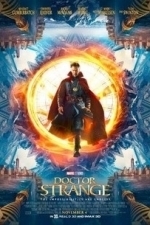
If you don't know the story of Doctor Strange, well let me fill you in. Dr. Steven Strange was a brilliant neurosurgeon, and an egotist. In the movie, we find Doctor Strange (played by Benedict Cumberbatch) washing up to perform brain surgery. His prideful, ways have him showboating the surgery by not waiting for any imaging equipment and dislodging a bullet from the brain of a person who was thought to be dead.
After he has preformed a miracle surgery, he is rushing through traffic to go to a gala, when he hits another car, and crashes. In the process of crashing he crushes his hands, the very tools to which he was made famous for. After countless surgeries and experimental procedures he is left in destitute.
He then begins to wander the city and comes across a man who had sever spinal cord injury and was supposed to never walk again, but was and playing basketball, who tells him of a spiritual retreat that he went on in order to heal himself. Using what money he has left Dr. Strange flies to Kathmandu to search out this mystical temple and its healer.
He wanders the streets of Kathmandu, looking for any signs of where this holy temple may be. Getting desperate, and weary of looking. He makes a fated turn down a back alley street, where he is assaulted by a group of Pick Pockets, who target him as easy prey. They are quickly dispatched as Mordo (played by Chiwetel Ejiofor) beats them down, thus saving Strange from certain death by the hands of petty thugs.
Mordo takes Dr. Strange to the temple, explaining that The Ancient One (played by Tilda Swinton) may be able to help him, but that he would have to be very humble in asking for help. Dr. Strange with his medical, and scientific knowledge, begins to dismiss the teachings and workings of The Ancient One, as no more than metaphysical BS. The Ancient One then sends Dr. Strange on a quick out of body journey throughout the multiverse the whole time narrating the journey with deep wisdom. And then quickly after he is brought back from this journey he is banished to the streets and the doors locked behind him. Begging and pleading for hours, Mordo convinces The Ancient One to accept him for training.
Through what can be assumed as months of training, Dr. Steven Strange begins learning the mystical arts and excelling at a phenomenal rate. While studying he discovers The Eye of Agamotto. A powerful talisman capable of augmenting time and space. He then uses it to reveal the missing pages of a manuscript, and discovers that The Ancient One has been harnessing energies from a dark dimension to prolong her life, and a realm of a dimensional being known as Dormammu. Dormammu wants nothing else than to absorb the Earth into his being and make it part of the dark dimension. Doctor Strange then learns that Dormammu's henchmen are devising a plot to overtake 3 power houses throughout the world, in order to allow his reign of power to be complete.
Doctor Strange then must battle Kaecilius (played by Mads Mikkelsen) a former student of The Ancient One, and top disciple of Dormammu, for control of the Sanctum's (three mystical power houses that create a magical shield that protects the earth). This is the point in the movie where Steven begins to really take point and understand the extent of the power that he has learned. An epic magical battle of the wills ensues where Dr. Strange, Mordo, and Kaecillius, all take the the streets of New York in 'Mirror Dimension' where Kaecillius bends space and time to create an augmented reality (if you have seen Inception this is where they flip the world upside down and sideways and things get really visually intense), The battle of wills continues until finally The Ancient One joins the fight and battles her former pupil in a no holds battle. She is then critically injured and all of reality returns to normal. As she lays dying in a hospital room, she and Strange exchange an emotional yet sagely goodbye on the Astral Plane.
Doctor Strange returns to the New York Sanctum only to find that it had been destroyed. He and Mordo go to Hong Kong, the where they discover that the last Sanctum has fallen and that Dormammu is in the process of over taking the Earth with help from his lackey Kaecillius. Acting on instinct and whim, Doctor Strange uses The Eye of Agamotto to turn back time and restore the city and Sanctum back to its original form, when Kaecillius breaks the spell and concentration of Doctor Strange. DS then flies into the heart of the dark dimension bringing along with him The Eye of Agamotto, where he then traps Dormammu and himself in an endless time loop. Driving Dormammu mad realizing that he is trapped inside of time and no longer existing outside of time. Strange strikes a bargain that Dormammu will retreat from the Earth and take with him all of his followers never to return again, to which a defeated and angry Dormammu agrees and calls back his forces. The movie ends with Doctor Strange taking up the mantel of Sorcerer Supreme.

Sass Perilla (36 KP) rated The Master and Margarita in Books
Aug 9, 2019
Firstly, I didn’t intend to write an essay on this novel. However, once started I found I had a lot to say, and the more I thought about the plot and characters, the more ideas and parallels were sparked, so I am hopeful that the verbosity of this review can be forgiven.
At the risk of sounding both ignorant and uncultured, I found this novel (at least at first) bloody hard slog; not least because the Russian characters have three names, plus a nickname, plus a pun on their name (none of which work particularly well in translation and all of which sound rather similar to the English untrained ear). As an example- Ivan Nikolaevich Ponyrev (who seems to be referred to by any and all of these names) is also known as “Homeless” and “the poet” is a key character in the opening section of the novel. To further demonstrate: there are 17 different names that start with A that are used to refer to 15 different characters with Andreyevich used as the middle name of a bereaved uncle, who makes a journey from Kiev after his nephew is beheaded in a freak tram accident- and Andrey the buffet manager at a Moscow theatre. Clear as mud right? And that is before starting on similarly named characters with the initials M, P, L and S! At my last count there were 45 distinct characters, and I am fairly sure there will be some that I have missed. Hence, I did a lot of re-reading to work out exactly who was doing what to whom.
Additionally, I would suggest you need to be wary of the different translations. The distinct changes in meaning are subtle but important. To triangulate I had three versions at my disposal: Hugh Aplin’s translation (available for free on Kindle), the audiobook version translated by Richard Pevear and Larissa Volokhonsky (which I listened to simultaneously when reading the book to come to my own interpretation, and the subtitles for the Russian TV miniseries from 2005 when I gave up trying to work out who was who from name alone!
So those were my “technical” issues (if you like) with engaging with this novel, and this lack of clarity and understanding (and my own lack of contextual knowledge of Stalinist Russia) meant I missed many of the (what I am sure are hysterically funny to those in the know) satirical jokes in the opening section. That said, the random action and quick changes of focus, undercurrent of chaos in Moscow despite entrenched hierarchal structures and clear threat that (any) one could go missing at any time, for an unclear reason gave a clear insight into the mind and fears of a 1930s Russian citizen. No wonder it was available only in censored form for so long.
Despite these hardships, there were some genuinely laugh out loud moments in the first Moscow based part of the novel. The citizens have not lost their individuality, as they scrabble and fight for bank notes in the theatre, which are later revealed to be worthless. Nor have they lost their sense of pride and vanity, which we see in the female theatre goers, so desperate to attain the fashionable French couture (which later literally disappears from their bodies leaving semi-naked citizenesses desperately trying to cover themselves in a scene reminiscent of “Allo Allo” meets “Benny Hill”). When Professor Woland says his show will “expose” what the locals have failed to realise is that it is their (moral) shortcomings that are about to be revealed. The message is clearly, that no government can successfully legislate against human nature.
Oooh- and another fun fact, apparently Woland (later revealed- or perhaps is implied- to be Satan) was the inspiration to the Rolling Stones 1968 hit “Sympathy for the Devil”, well at least that is what my Google-Fu tells me.
Obviously, there were substantial hurdles to leap, however, I found by the second half of the novel, when we finally meet the eponymous characters, I had got in to the swing of things and begun to embrace the farcical surrealism of the novel.
The second “book” marks a change in tone, although it continues to cut away to scenes of Jesus’ sentencing by Pilate and execution (here known in the Aramaic form Yeshua). Ironically it is these scenes that are the most “real” and substantially human, as Pilate’s decision weighs head achingly heavily on him throughout. The Master and Margarita seem to be the only two characters fully invested in the authenticity of literature, and serve as a counterpoint to the heavily censored “monstrous” writing of Ivan and the rest of the writers’ union Massolit, more interested in fine dining and what their positions can do for them then the production of quality writing.
And it is Margarita’s journey of discovery and liberation from the stodgy, miserable societal expectations of that leads her back to her Master. Bulgakov mixes classical myth, Russian folklore and Bible stories to give us an impression of the timelessness of the central romance. As the worlds of communist Moscow and the inner worlds of the Master and Margarita collide, we are informed of the former’s desire to excuse all magic (and mischief) as the product of mass hypnosis, when the latter (and the reader) are fully aware of the spiritual significance and dimension of the events.
Clever, astute and in places laugh out loud funny, this novel none-the-less requires a level of dedication from the non-Russian speaking reader. Worth a read? Yes. Worth a re-read? Maybe not.

Purple Phoenix Games (2266 KP) rated Lagoon: Land of Druids in Tabletop Games
Jun 12, 2019
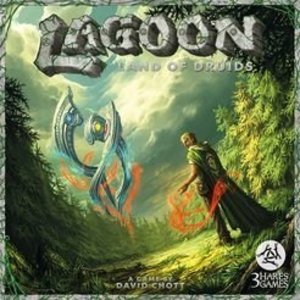


Lagoon is a land of harmony and balance. Or at least it WAS until the rise of humanity. The three spiritual energies that once existed in a perfect equilibrium are now fighting for dominance and control over the destiny of Lagoon. Each energy has amassed a following of druids who are working to ensure that their chosen energy is victorious! Which energy will you choose to serve, and will your choice be the correct one in the end? There’s only one way to find out!
Lagoon: Land of the Druids is a game of tile placement and exploration. You are the leader of a circle of druids, and they will do your bidding throughout the game. On your turn, you will take any/all of these five actions: Move, Summon (add one of your reserve druids to the play area), Explore (add a new site tile to the table), Invoke (use a Site Action), or Unravel (remove a site tile from play). You can perform as many of these actions as you want, as long as you have the appropriate resources to spend. Each tile in the game is double-sided, and each side has a unique action/ability associated with it. Strategy is everything – which tile side should you choose to bring into play, and how can you best use the available abilities to benefit your chosen energy? You also have to keep an eye on your opponents because they might be trying to undermine your plans to help their energy achieve success! The game ends when all tiles have been explored, and then players count up points dependent upon which energy was ultimately dominant. The player with the most points is the winner!
As a solo game, Lagoon plays similarly to the multi-player game. Instead of competing against other humans, you are playing against an AI opponent (fondly referred to as “AJ” in the rulebook). On its turn, alternating with yours, the AI executes three steps – Explore, Unravel, and Invoke (perform an action dependent on which druids the AI currently has in play). Each of those steps is explained in more detail in the rulebook. The game ends as in a normal group game, and the player (either you or the AI) with the highest score wins.
The first thing I should mention are the solo rules themselves – they are very wordy and contain lots of ambiguity. It took me a couple of read-throughs before I felt comfortable trying to play, and even now I still keep the solo rules easily accessible when I do play. With so many moving elements in this game, clear and concise rules are necessary for an unencumbered game.
When I say there are a lot of moving elements, I mean it. At any point, you could have up to 5 druids in play, with access to up to 5 unique site powers to invoke in addition to the basic actions you can take on your turn. And on top of that, your druids are spiritually connected, so a druid on one site can use the power of a different site as long as you have a druid there as well. There are also lots of opportunities to combo powers this way, and unless you’re 100% focused, you could lose track of what you already did or forget to pay for an action. And in a solo game, you’re not only tracking this for yourself, you also have to make sure you’re executing the AI turns correctly. There’s just a lot going on and it can be easy to accidentally skip a step.
The thing I dislike most about playing Lagoon solo is that I have to make decisions for the AI. When placing tiles on AI turns, I get to choose which side to play. When the AI unravels a site, I get to choose which site to remove. It’s hard to play this game honestly because I can just choose whatever will benefit ME the most, and not necessarily act in the AI’s best interest. Obviously, a human opponent would do whatever they want for themselves, but in a solo game I am in control of my opponent. The rulebook does offer ways to alleviate this, but I either honestly forget to refer back to the rules for certain situations, or I just choose to ignore the suggestions. I know, I know, that sounds like a personal problem. And I guess it is. I just don’t like the responsibility of having to play two competing sides because it is hard to stay honest. Since this game is so dependent on strategy and personal decisions, there is no good way for an AI opponent to be successful.
Lagoon: Land of the Druids is a complex game that requires more strategy than you think. That being said, I don’t like to play it solo. Each turn offers lots of opportunities, but so many options can be overwhelming. Having to make decisions for the AI is not enjoyable for me because I am aware that I do not always make the best decision for the AI – it’s just hard for me to consciously make decisions detrimental to my game. The idea of this game is neat, but the execution of the solo rules (from their editing to their actual gameplay) just doesn’t work well for me. Give it a try solo if you want, but you’re not really missing a lot if you don’t.
https://purplephoenixgames.wordpress.com/2019/03/11/solo-chronicles-lagoon-land-of-the-druids/