Search
Search results
Purple Phoenix Games (2266 KP) rated Tales of Evil in Tabletop Games
Oct 1, 2020
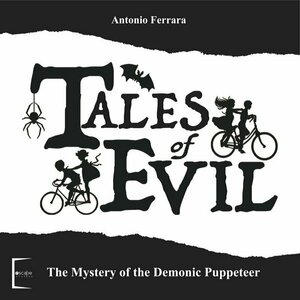

It is no surprise that following the enormous success of Netflix’s “Stranger Things” that creators would begin developing ideas borrowed from the show’s setting or characters. Of course we have seen games in this “80s kids Goonie-esque adventure game” genre before, and I have to say that I love the setting. When I saw the Kickstarter campaign for Tales of Evil I was immediately drawn to it. Did my investment pay off or is this one a gnarly bust?
Tales of Evil is a cooperative, horror, storytelling, adventure game that uses a unique new “Fusion System” throughout the game. Players will be taking on personas of kids from the 1980s who belong to a club named “Pizza & Investigation.” I do not wish to reveal too much in this review, so I will be covering this as a Solo Chronicles using one character going through the introductory tutorial mission.
DISCLAIMER: We are using the Kickstarter Deluxe version of the game. We do have the expansions from the KS campaign, but will not be using those for this review. Also, we do not intend to cover every single rule included in the rule book, but will describe the overall game flow and major rule set so that our readers may get a sense of how the game plays. For more in depth rules, you may purchase a copy from the publisher directly or from your FLGS. -T
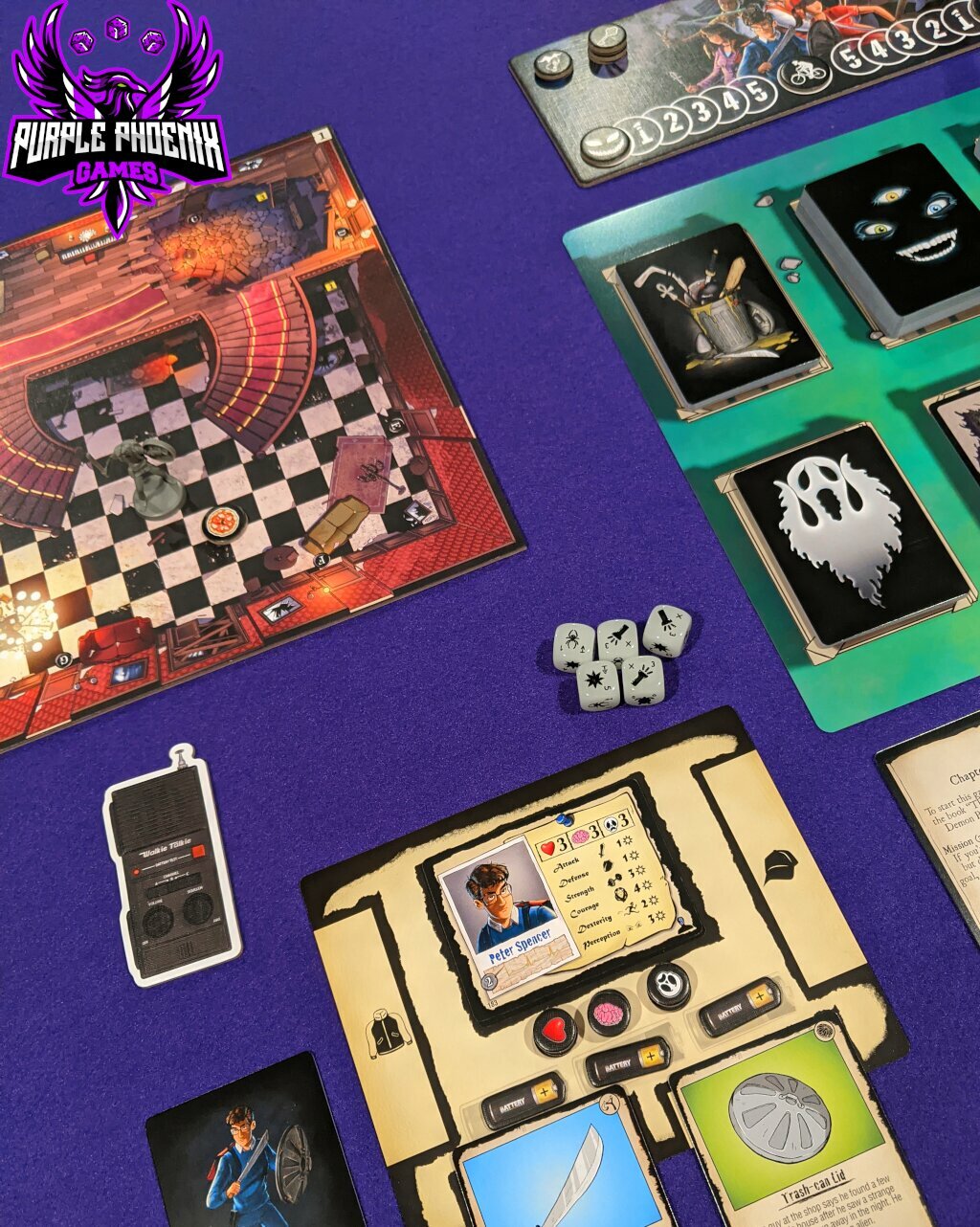
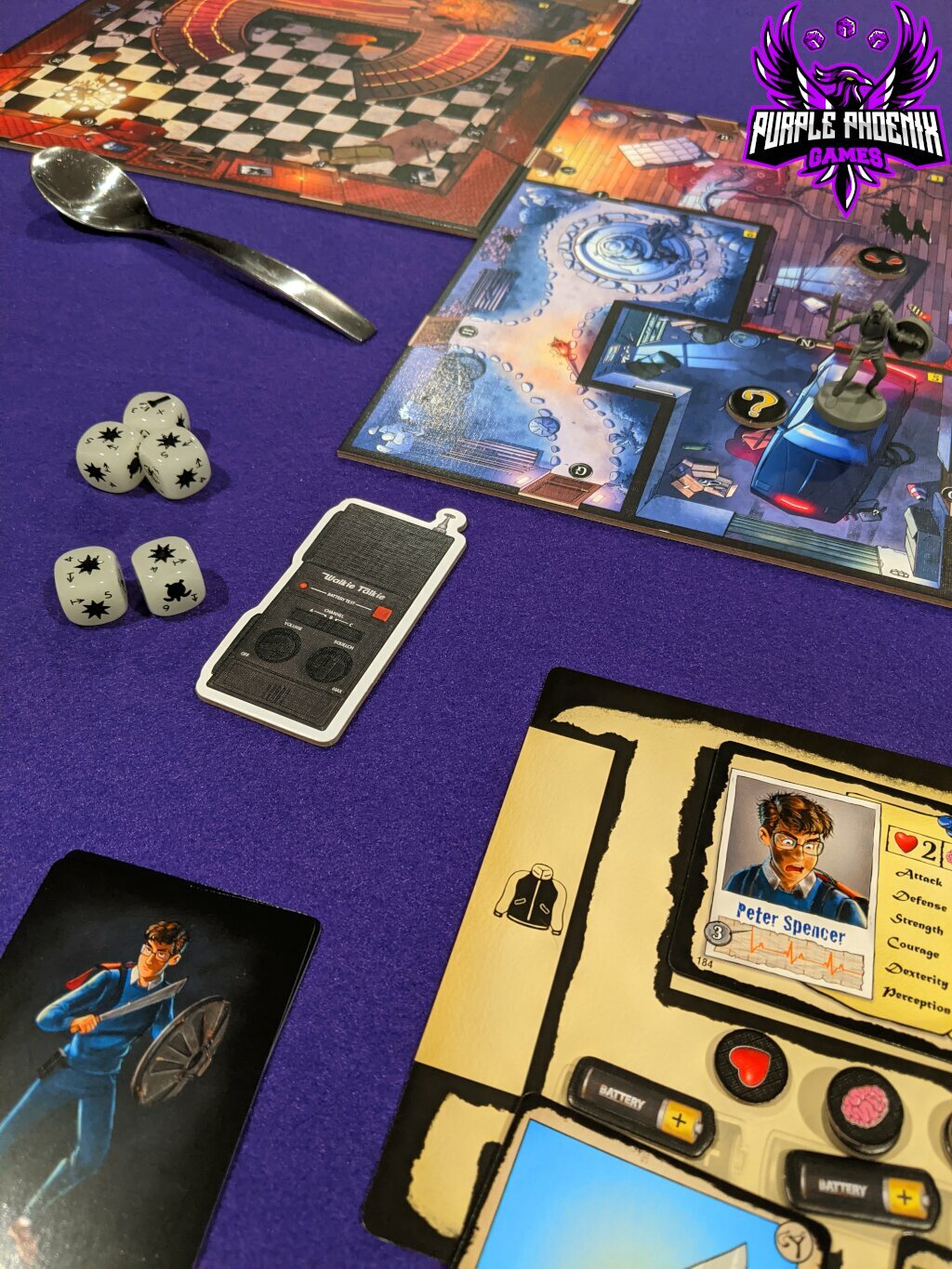
To setup, well, just follow the setup instructions in the rulebook. There’s too much for me to explain here. For one character playing the tutorial scenario, the game setup should look similar to what is pictured below. Maybe. The rulebook does not specifically state WHERE each item should be placed, so players will have ultimate freedom to setup items where they see fit to be most efficient for themselves.
Players in Tales of Evil will have no real “turn structure” as most games do, because all players will be adventuring together as a group. So characters will be moving as a group and never splitting the party (RPGers breathe a sigh of relief… maybe). However, as with many adventure games of this style, once players explore into new areas certain markers will placed on the board (Clue, Darkness, Mystery, Search, etc). These markers signify different actions that can be taken, or entrances to areas that are blocked or found, or something that could be traced from one area to another. The leader of the group for the time being is in possession of the Walkie-Talkie and will make all final decisions for the group after any discussion (for solo players, it is just a nice prop). Usually searching for items will result in a card draw and upon the card will be a test to pass using the stats on the player character mat to roll dice for successes. Of course, the other side of that are horrible losses as well.
Players will be traipsing through the area and reading passages from two actual books: the Story Book and the Event Book. Most of the action happens in the Story Book and it will guide players through the story and once choices are made or tests succeeded/failed, the book will instruct players what to do next and to which section to turn to further the story (a la Tales of the Arabian Nights). The game continues in this fashion until the story ends with victory or defeat.
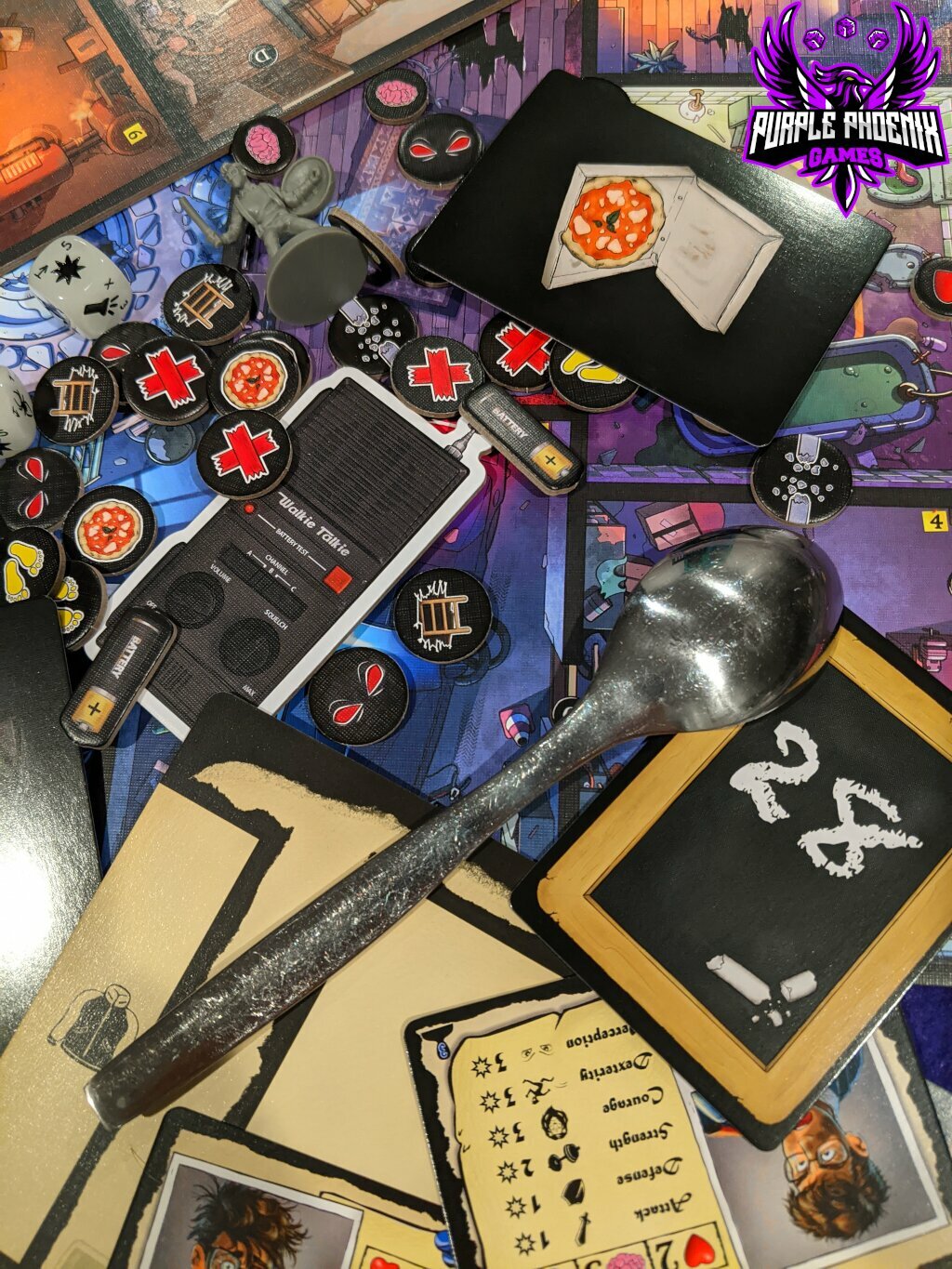
Components. Why yes, that is a real spoon in the photo above. No, it does not come with the game. I will explain in a bit. The components in this game are great. Each character has their own mat for organization, action cards, equipment cards, and status cards that dictate the difficulty of the game and how the character degrades over time in the horror-filled mission. Some components are even glow-in-the-dark! A nice touch, but certainly unnecessary. I find everything to be wonderful quality, even the cards that are kind of polarizing on the KS comments are nice (people are complaining that they are not linen-finished, but I believe the publisher made the right call to make them matte finished if the linen obscured the look and art on them). Thumbs up for components from me.
I wanted to wait until my final thoughts to explain the whole “Fusion System” that is in play here. Tales of Evil uses the catchphrase, “You will get into the game and the game will get into you!” Now, I’m not sure exactly how this game is getting into me, but I’m certainly digging the game and this Fusion System. You see, some cards (in the tutorial, remember, so I’m not really giving much away here) will give players 60 seconds to grab a kitchen spoon for some benefit and a debilitation if they are unable to find one – hence the spoon in my photos. Another card relies on the character (and also then the player) removing their shoes. Still yet another deals with fire or people smoking in the vicinity. If there is fire nearby in real life, it affects the effects of the card drawn. It’s ingenious and I love every little bit of it! I can’t wait to see how the Fusion System will work in this game more and how it can be applied to other games in the future.
All in all I love everything about Tales of Evil. The setting is great, the Pizza & Investigation kids are awesome, and the game itself is incredibly engaging and makes you really think about the choices you make within. Perhaps the haunting feeling of doubting some choices is how the game gets into you, because I did find myself wondering what would have happened had I chosen a different course for some instances. I am very drawn to this game and I want to tackle all of the scenarios. Even solo! And another great thing about Tales of Evil is the fact that a player (or players) can join a game already in progress! So if I am exploring solo and my wife decides she wants to hop in, she just grabs a character mat, sets up the character, and dives right in with me. I LOVE games like that. So versatile.
While I should probably stop gushing at this point I just can’t. This game is so much fun and worth every penny spent on it. I implore you, if you are a fan of exploration adventure games in this vein you definitely need to snatch up a copy whenever you see one. And if you love it as much as I do let me know. We can swap adventure stories.
Oh did I mention the designer is even created a way for us normies to create our own scenarios and upload them to other Tales of Evil players? Yeah, I’m fascinated by that as well…
Tales of Evil is a cooperative, horror, storytelling, adventure game that uses a unique new “Fusion System” throughout the game. Players will be taking on personas of kids from the 1980s who belong to a club named “Pizza & Investigation.” I do not wish to reveal too much in this review, so I will be covering this as a Solo Chronicles using one character going through the introductory tutorial mission.
DISCLAIMER: We are using the Kickstarter Deluxe version of the game. We do have the expansions from the KS campaign, but will not be using those for this review. Also, we do not intend to cover every single rule included in the rule book, but will describe the overall game flow and major rule set so that our readers may get a sense of how the game plays. For more in depth rules, you may purchase a copy from the publisher directly or from your FLGS. -T
To setup, well, just follow the setup instructions in the rulebook. There’s too much for me to explain here. For one character playing the tutorial scenario, the game setup should look similar to what is pictured below. Maybe. The rulebook does not specifically state WHERE each item should be placed, so players will have ultimate freedom to setup items where they see fit to be most efficient for themselves.
Players in Tales of Evil will have no real “turn structure” as most games do, because all players will be adventuring together as a group. So characters will be moving as a group and never splitting the party (RPGers breathe a sigh of relief… maybe). However, as with many adventure games of this style, once players explore into new areas certain markers will placed on the board (Clue, Darkness, Mystery, Search, etc). These markers signify different actions that can be taken, or entrances to areas that are blocked or found, or something that could be traced from one area to another. The leader of the group for the time being is in possession of the Walkie-Talkie and will make all final decisions for the group after any discussion (for solo players, it is just a nice prop). Usually searching for items will result in a card draw and upon the card will be a test to pass using the stats on the player character mat to roll dice for successes. Of course, the other side of that are horrible losses as well.
Players will be traipsing through the area and reading passages from two actual books: the Story Book and the Event Book. Most of the action happens in the Story Book and it will guide players through the story and once choices are made or tests succeeded/failed, the book will instruct players what to do next and to which section to turn to further the story (a la Tales of the Arabian Nights). The game continues in this fashion until the story ends with victory or defeat.
Components. Why yes, that is a real spoon in the photo above. No, it does not come with the game. I will explain in a bit. The components in this game are great. Each character has their own mat for organization, action cards, equipment cards, and status cards that dictate the difficulty of the game and how the character degrades over time in the horror-filled mission. Some components are even glow-in-the-dark! A nice touch, but certainly unnecessary. I find everything to be wonderful quality, even the cards that are kind of polarizing on the KS comments are nice (people are complaining that they are not linen-finished, but I believe the publisher made the right call to make them matte finished if the linen obscured the look and art on them). Thumbs up for components from me.
I wanted to wait until my final thoughts to explain the whole “Fusion System” that is in play here. Tales of Evil uses the catchphrase, “You will get into the game and the game will get into you!” Now, I’m not sure exactly how this game is getting into me, but I’m certainly digging the game and this Fusion System. You see, some cards (in the tutorial, remember, so I’m not really giving much away here) will give players 60 seconds to grab a kitchen spoon for some benefit and a debilitation if they are unable to find one – hence the spoon in my photos. Another card relies on the character (and also then the player) removing their shoes. Still yet another deals with fire or people smoking in the vicinity. If there is fire nearby in real life, it affects the effects of the card drawn. It’s ingenious and I love every little bit of it! I can’t wait to see how the Fusion System will work in this game more and how it can be applied to other games in the future.
All in all I love everything about Tales of Evil. The setting is great, the Pizza & Investigation kids are awesome, and the game itself is incredibly engaging and makes you really think about the choices you make within. Perhaps the haunting feeling of doubting some choices is how the game gets into you, because I did find myself wondering what would have happened had I chosen a different course for some instances. I am very drawn to this game and I want to tackle all of the scenarios. Even solo! And another great thing about Tales of Evil is the fact that a player (or players) can join a game already in progress! So if I am exploring solo and my wife decides she wants to hop in, she just grabs a character mat, sets up the character, and dives right in with me. I LOVE games like that. So versatile.
While I should probably stop gushing at this point I just can’t. This game is so much fun and worth every penny spent on it. I implore you, if you are a fan of exploration adventure games in this vein you definitely need to snatch up a copy whenever you see one. And if you love it as much as I do let me know. We can swap adventure stories.
Oh did I mention the designer is even created a way for us normies to create our own scenarios and upload them to other Tales of Evil players? Yeah, I’m fascinated by that as well…

Chris Sawin (602 KP) rated Black Widow (2021) in Movies
Oct 6, 2021


Florence Pugh (2 more)
The free-fall sequence at the end.
Taskmaster before the mask comes off.
It's way too long. (3 more)
The Taskmaster changes are weak.
It's as if the characters are fighting over who gets to be the comedic relief.
Familiar storyline.
Espionage Exhaustion
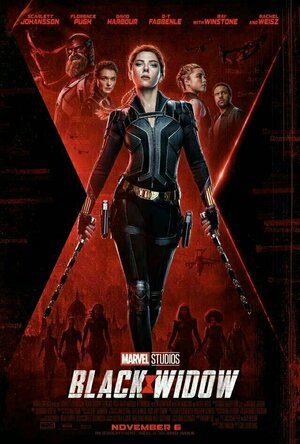
Black Widow is a film explaining what Natasha Romanoff (Scarlett Johansson) was up to in-between Captain America: Civil War and Avengers: Infinity War. The film was originally set to be released in May of 2020, but was pushed back and had three different release dates thanks to COVID-19. Unfortunately, most completed films that sit on the shelf and are in limbo for over a year rarely live up to the anticipation. Black Widow is worthwhile for a few key action sequences and notable characters that steal the spotlight, but is otherwise a mostly forgettable superhero film.
Marketed as a superhero film, Black Widow is also a spy thriller. Johansson has stated that films such as Logan, Harrison Ford’s The Fugitive, and Terminator 2: Judgment Day were influences. After Civil War, Thaddeus Ross (William Hurt) is on the hunt for Natasha Romanoff. Women like Natasha who have had similar training in a torturous training facility known as The Red Room are victims to brainwashing by a man named Dreykov (Ray Winstone), but a serum ends up in Natasha’s hands that can break Dreykov’s brainwashing. Natasha begins searching for The Red Room and Dreykov, which also has her crossing paths with other spies that posed as her family members; her “sister” Yelena Belova (Florence Pugh), her “father” Alexai Shostakov (David Harbour), and her “mother” Melina Vostokoff (Rachel Weisz).
The biggest selling point for Black Widow is that it’s a mostly female cast in front of and behind the camera. The film is directed by Cate Shortland and Black Widow is her first big budget feature. It’s also co-written by female screenwriter Jac Schaeffer (uncredited co-screenwriter of Captain Marvel) and Ned Benson (director of The Disappearance of Eleanor Rigby).
Taskmaster is cool in the film until you realize the character has been altered from his comic book origins. This isn’t uncommon in the MCU or even other live-action superhero adaptations, but what the character has become in the film will be received with mixed results. In the comics, Taskmaster’s real identity is Anthony Masters and he’s a mercenary not unlike Deadpool (the two have fought together and against each other). Copying fighting styles and weapon techniques is similar to the film, but it’s all thanks to his incredible memory and photographic reflexes.
The character is altered to fit the story in the Black Widow film. It’s not necessarily a bad thing as it gives a bigger purpose for the character since it suddenly becomes a major part of Natasha’s storyline, but how the character evolves over the course of the film seems to almost relieve Natasha of her past sins rather than continue to serve as a catalyst. Taskmaster is generally involved in some of the best hand-to-hand combat sequences, but seems to be left hanging by the end of the film. We could see the character again, but whether or not the desire is there to see Taskmaster return is debatable.
The free-fall sequence that has been teased in the trailers is Black Widow’s most unique source of action. There’s exploding elements and falling debris, Natasha trying to save someone’s life, and Taskmaster thrown in attempting to mess up whatever she has planned; plus a bunch of goons bringing up the rear that will obviously be taken out in peak fashion. The sequence is like a duel to the death taking place on the edge of a volcano that’s about to erupt. It’s on the verge of being overkill, but is just awesome enough to trigger all of the adrenaline in your body.
Kevin Feige apparently wanted an equal amount of screen time for both Natasha and Yelena. With the after-credits sequence, Natasha being very dead after the events of Infinity War, and the reports that Yelena may be the new Black Widow, she’s essentially the star of the film and for good reason. The character begins as an individual with a chip on her shoulder from someone from her past, but Florence Pugh is able to add humor and empathy with her performance. Yelena has the best one-liners in the film (“That would be a cool way to die,”) and is essentially the best source of comedic relief (i.e. her hysterectomy rant), as well. She is the one character in the film you’d want to see more of after Black Widow ends.
The storyline of Black Widow doesn’t feel like anything you haven’t experienced cinematically before, especially within the confines of the MCU. An evil man is responsible for pulling the strings of a bunch of women that would kick his ass otherwise. Unfortunately, Ray Winstone doesn’t feel all that intimidating as Dreykov since he doesn’t do much besides talk in Black Widow. The point is made in the film that is all there’s really needed of the character, but Dreykov’s biggest weapon is his mouth. However, his verbal skills don’t seem advantageous enough to make him such a threat let alone keep him alive for over 20 years.
It also feels like every MCU film has its on-screen characters competing over who can get the most laughs; this is something that only got worse after Thor: Ragnarok proved to be a success. Marvel films are already so formulaic with most villains being introduced and killed within the confines of a single film. Natasha’s spy family all feel like minor extensions of herself. Rachel Weisz, despite not aging a day in nearly 30 years, is forgettable as Melina. David Harbour is essentially his character from Stranger things cosplaying as Mr. Incredible with a Russian accent. Even Florence Pugh’s Yelena Belova character is basically a blonde younger version of Natasha even though they’re not related by blood.
Black Widow clocks in at over two hours and it feels like a film that could have been edited down. Witnessing the events of a dysfunctional spy family who then spend good chunks of the film reminiscing about those moments the audience has already seen is redundant storytelling that feels like nothing more than filler.
Black Widow is worth seeing for Florence Pugh, the free-fall action sequence, and anything involving Taskmaster before it’s revealed who is under the mask. Everything else about Black Widow feels like it was done better by the films it was supposedly influenced by and mostly feels like a diluted imitation of Captain America: The Winter Soldier. It’s fantastic that women are getting more opportunities in big summer blockbusters like this one, but it’s also disheartening since their filmmaking skills are shackled to formulaic superfluity that obviously stands in the way of creating extraordinary cinema.
Marketed as a superhero film, Black Widow is also a spy thriller. Johansson has stated that films such as Logan, Harrison Ford’s The Fugitive, and Terminator 2: Judgment Day were influences. After Civil War, Thaddeus Ross (William Hurt) is on the hunt for Natasha Romanoff. Women like Natasha who have had similar training in a torturous training facility known as The Red Room are victims to brainwashing by a man named Dreykov (Ray Winstone), but a serum ends up in Natasha’s hands that can break Dreykov’s brainwashing. Natasha begins searching for The Red Room and Dreykov, which also has her crossing paths with other spies that posed as her family members; her “sister” Yelena Belova (Florence Pugh), her “father” Alexai Shostakov (David Harbour), and her “mother” Melina Vostokoff (Rachel Weisz).
The biggest selling point for Black Widow is that it’s a mostly female cast in front of and behind the camera. The film is directed by Cate Shortland and Black Widow is her first big budget feature. It’s also co-written by female screenwriter Jac Schaeffer (uncredited co-screenwriter of Captain Marvel) and Ned Benson (director of The Disappearance of Eleanor Rigby).
Taskmaster is cool in the film until you realize the character has been altered from his comic book origins. This isn’t uncommon in the MCU or even other live-action superhero adaptations, but what the character has become in the film will be received with mixed results. In the comics, Taskmaster’s real identity is Anthony Masters and he’s a mercenary not unlike Deadpool (the two have fought together and against each other). Copying fighting styles and weapon techniques is similar to the film, but it’s all thanks to his incredible memory and photographic reflexes.
The character is altered to fit the story in the Black Widow film. It’s not necessarily a bad thing as it gives a bigger purpose for the character since it suddenly becomes a major part of Natasha’s storyline, but how the character evolves over the course of the film seems to almost relieve Natasha of her past sins rather than continue to serve as a catalyst. Taskmaster is generally involved in some of the best hand-to-hand combat sequences, but seems to be left hanging by the end of the film. We could see the character again, but whether or not the desire is there to see Taskmaster return is debatable.
The free-fall sequence that has been teased in the trailers is Black Widow’s most unique source of action. There’s exploding elements and falling debris, Natasha trying to save someone’s life, and Taskmaster thrown in attempting to mess up whatever she has planned; plus a bunch of goons bringing up the rear that will obviously be taken out in peak fashion. The sequence is like a duel to the death taking place on the edge of a volcano that’s about to erupt. It’s on the verge of being overkill, but is just awesome enough to trigger all of the adrenaline in your body.
Kevin Feige apparently wanted an equal amount of screen time for both Natasha and Yelena. With the after-credits sequence, Natasha being very dead after the events of Infinity War, and the reports that Yelena may be the new Black Widow, she’s essentially the star of the film and for good reason. The character begins as an individual with a chip on her shoulder from someone from her past, but Florence Pugh is able to add humor and empathy with her performance. Yelena has the best one-liners in the film (“That would be a cool way to die,”) and is essentially the best source of comedic relief (i.e. her hysterectomy rant), as well. She is the one character in the film you’d want to see more of after Black Widow ends.
The storyline of Black Widow doesn’t feel like anything you haven’t experienced cinematically before, especially within the confines of the MCU. An evil man is responsible for pulling the strings of a bunch of women that would kick his ass otherwise. Unfortunately, Ray Winstone doesn’t feel all that intimidating as Dreykov since he doesn’t do much besides talk in Black Widow. The point is made in the film that is all there’s really needed of the character, but Dreykov’s biggest weapon is his mouth. However, his verbal skills don’t seem advantageous enough to make him such a threat let alone keep him alive for over 20 years.
It also feels like every MCU film has its on-screen characters competing over who can get the most laughs; this is something that only got worse after Thor: Ragnarok proved to be a success. Marvel films are already so formulaic with most villains being introduced and killed within the confines of a single film. Natasha’s spy family all feel like minor extensions of herself. Rachel Weisz, despite not aging a day in nearly 30 years, is forgettable as Melina. David Harbour is essentially his character from Stranger things cosplaying as Mr. Incredible with a Russian accent. Even Florence Pugh’s Yelena Belova character is basically a blonde younger version of Natasha even though they’re not related by blood.
Black Widow clocks in at over two hours and it feels like a film that could have been edited down. Witnessing the events of a dysfunctional spy family who then spend good chunks of the film reminiscing about those moments the audience has already seen is redundant storytelling that feels like nothing more than filler.
Black Widow is worth seeing for Florence Pugh, the free-fall action sequence, and anything involving Taskmaster before it’s revealed who is under the mask. Everything else about Black Widow feels like it was done better by the films it was supposedly influenced by and mostly feels like a diluted imitation of Captain America: The Winter Soldier. It’s fantastic that women are getting more opportunities in big summer blockbusters like this one, but it’s also disheartening since their filmmaking skills are shackled to formulaic superfluity that obviously stands in the way of creating extraordinary cinema.
Chris Sawin (602 KP) rated The Batman (2022) in Movies
Mar 6, 2022

Paul Dano and Colin Farrell's Performances (2 more)
The Batmobile car chase with Oz
The different/damaged take on Bruce Wayne
Entirely too long - too much detective work (2 more)
Little to no chemistry between The Bat and The Cat
The raspy adventures of Batsy and Jimbo
When is a Bat Not Quite a Bat?
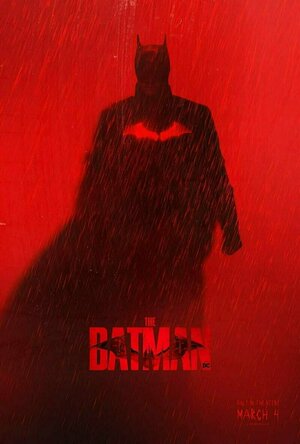
Matt Reeves’ The Batman isn’t an origin story. Instead Bruce Wayne (Robert Pattinson) treats every villain and every thug as if they were the ones to take his parents away from him. This is a version of Bruce Wayne that hates being Bruce Wayne; Batman is his legacy. The tragedy of losing his parents is his most defining characteristic. Bruce is a social hermit and the world’s biggest introvert in The Batman.
The Riddler (Paul Dano) kills Gotham’s mayor on Halloween night and he continues to target key political figures throughout the film. A cryptic riddle is left for Batman at every crime scene revealing just a big enough clue to keep Batman and Jim Gordon (Jeffrey Wright) entangled in Riddler’s enigmatic bloodbath. As Batman crosses paths with a cat-loving thief named Selina Kyle (Zoe Kravitz) and the magnificently sleazy Iceberg Lounge owner Oswald Cobblepot (Colin Farrell), he soon realizes that the Wayne family may be a bigger piece of the puzzle than he originally imagined.
Paul Dano is essentially the highlight of the film. Matt Reeves stated that his inspiration for his version of the character was The Zodiac Killer and it shows. Riddler’s costume is basically a camouflage gimp outfit with tactical advantages and a fetish for duct tape. Dano’s performance is haunting. His riddles are more akin to Jigsaw’s games from the Saw franchise. The character is at his best when he’s showcased in grainy cell phone videos where his shouting and heavy breathing are even more distorted than if he was standing right in front of you. The intriguing aspect is that Dano seems to be even more mesmerizing as the character once he’s unmasked. He’s able to tap into this lunacy, this dread, and this hypnotic terror that defines the character whether he’s hiding his face or not.
Featured less prominently is Colin Farrell as Oswald Cobblepot, who also delivers a fantastic performance. Farrell is so unrecognizable thanks to the facial prosthetics and fat suit that he’s wearing. Some of the aspects of The Penguin that makes him so dangerous is that he’s incredibly resourceful and he can talk his way into and out of just about anything. Farrell’s best moments as the character come during the Batmobile chase featured in the trailer followed by the conversation Batman and Gordon have with him immediately afterwards. You never knew how much you needed a Spanish lesson from Oz until Matt Reeves came along.
The Batmobile car chase is the best sequence of the film. It’s absolutely explosive and worth seeing in a theater. Michael Giacchino’s score is also bold and thrilling; it helps define the Batman character for a new generation with an undeniably epic theme. Matt Reeves compared Bruce Wayne to Kurt Cobain in this film. Bruce’s relationship with the spotlight and how he’d rather stay away from it is a lot like how Cobain viewed being famous. “Something in the Way” by Nirvana fits the Batman universe so well and it’s surprising nobody has ever thought of utilizing it until now.
This unusual version of Bruce Wayne in The Batman makes it feel unlike any other Batman film. Bruce Wayne is typically a playboy that is consistently showcased at public events that flaunts his fortune and bounces from woman to woman on a nightly basis. In The Batman, we see the smudged black eye makeup as Bruce takes off his cowl. Robert Pattinson didn’t bulk up for the role, so he has this pale and gaunt appearance. He has no interest in the business his father left him in charge of. Vengeance is his only purpose.
The Batman is also the first Batman film to actually feel like a detective story. So much time is devoted to the investigation aspect of the film; maybe too much time. The film is five minutes shy of being three hours long and The Batman feels like a three hour film. Some of these sequences feel like they could have been trimmed (did we really need to see Batman or Bruce Wayne go to the Iceberg Lounge so many times?) or cut entirely, but everything feels like it’s part of the bigger picture of capturing The Riddler. Every little stop along the way leads to the next clue or next big encounter. Unfortunately, it feels like a chore listening to Batman answer riddles for the sixth time in the midst of three hours.
Robert Pattinson is a seriously talented actor outside of the Twilight franchise and Zoe Kravitz chooses interesting projects to be a part of, but their chemistry in The Batman feels forced. Batman tracks down Selina Kyle almost like a stalker as he starts inserting himself into her life after a random encounter at The Iceberg Lounge. Despite being friends in real life, the two actors seem stiff and awkward when they’re around each other. These are two versions of the characters that don’t have the history the comics or the movies laid out for them after decades of publication and on screen appearances. This is supposed to be the first time they’ve met and they go from being bumbling partners to nearly leaving Gotham together after being shot at a few times and finding a dead girl in a trunk; it doesn’t make sense.
Matt Reeves was capable of taking The Batman into a different direction for both the Batman universe and superhero films alike. The action sequences are almost earned here as there’s much more down time while following a lead or doing research. You actually see that Bruce documents his inner monologues and his nightly outings as Batman in handwritten journals. There’s a ton of interesting concepts in The Batman that ultimately don’t pay off.
Paul Dano and Colin Farrell are extraordinary, but The Batman is a three hour slog through Gotham that culminates with an over exaggerated riddle that isn’t worth solving. Having Batman and Jim Gordon both speak in raspy, whispery grunts feels excessive as does Gordon’s insistence on calling Batman, “Chief,” every time that they’re together. The film deserves credit for prominently shining the spotlight on the underbelly of crime in Gotham, but the storytelling in The Batman is a lot like Bugs Bunny meaning to have taken that left turn at Albuquerque; a meandering foray down a dark rabbit hole that isn’t entirely necessary.
The Riddler (Paul Dano) kills Gotham’s mayor on Halloween night and he continues to target key political figures throughout the film. A cryptic riddle is left for Batman at every crime scene revealing just a big enough clue to keep Batman and Jim Gordon (Jeffrey Wright) entangled in Riddler’s enigmatic bloodbath. As Batman crosses paths with a cat-loving thief named Selina Kyle (Zoe Kravitz) and the magnificently sleazy Iceberg Lounge owner Oswald Cobblepot (Colin Farrell), he soon realizes that the Wayne family may be a bigger piece of the puzzle than he originally imagined.
Paul Dano is essentially the highlight of the film. Matt Reeves stated that his inspiration for his version of the character was The Zodiac Killer and it shows. Riddler’s costume is basically a camouflage gimp outfit with tactical advantages and a fetish for duct tape. Dano’s performance is haunting. His riddles are more akin to Jigsaw’s games from the Saw franchise. The character is at his best when he’s showcased in grainy cell phone videos where his shouting and heavy breathing are even more distorted than if he was standing right in front of you. The intriguing aspect is that Dano seems to be even more mesmerizing as the character once he’s unmasked. He’s able to tap into this lunacy, this dread, and this hypnotic terror that defines the character whether he’s hiding his face or not.
Featured less prominently is Colin Farrell as Oswald Cobblepot, who also delivers a fantastic performance. Farrell is so unrecognizable thanks to the facial prosthetics and fat suit that he’s wearing. Some of the aspects of The Penguin that makes him so dangerous is that he’s incredibly resourceful and he can talk his way into and out of just about anything. Farrell’s best moments as the character come during the Batmobile chase featured in the trailer followed by the conversation Batman and Gordon have with him immediately afterwards. You never knew how much you needed a Spanish lesson from Oz until Matt Reeves came along.
The Batmobile car chase is the best sequence of the film. It’s absolutely explosive and worth seeing in a theater. Michael Giacchino’s score is also bold and thrilling; it helps define the Batman character for a new generation with an undeniably epic theme. Matt Reeves compared Bruce Wayne to Kurt Cobain in this film. Bruce’s relationship with the spotlight and how he’d rather stay away from it is a lot like how Cobain viewed being famous. “Something in the Way” by Nirvana fits the Batman universe so well and it’s surprising nobody has ever thought of utilizing it until now.
This unusual version of Bruce Wayne in The Batman makes it feel unlike any other Batman film. Bruce Wayne is typically a playboy that is consistently showcased at public events that flaunts his fortune and bounces from woman to woman on a nightly basis. In The Batman, we see the smudged black eye makeup as Bruce takes off his cowl. Robert Pattinson didn’t bulk up for the role, so he has this pale and gaunt appearance. He has no interest in the business his father left him in charge of. Vengeance is his only purpose.
The Batman is also the first Batman film to actually feel like a detective story. So much time is devoted to the investigation aspect of the film; maybe too much time. The film is five minutes shy of being three hours long and The Batman feels like a three hour film. Some of these sequences feel like they could have been trimmed (did we really need to see Batman or Bruce Wayne go to the Iceberg Lounge so many times?) or cut entirely, but everything feels like it’s part of the bigger picture of capturing The Riddler. Every little stop along the way leads to the next clue or next big encounter. Unfortunately, it feels like a chore listening to Batman answer riddles for the sixth time in the midst of three hours.
Robert Pattinson is a seriously talented actor outside of the Twilight franchise and Zoe Kravitz chooses interesting projects to be a part of, but their chemistry in The Batman feels forced. Batman tracks down Selina Kyle almost like a stalker as he starts inserting himself into her life after a random encounter at The Iceberg Lounge. Despite being friends in real life, the two actors seem stiff and awkward when they’re around each other. These are two versions of the characters that don’t have the history the comics or the movies laid out for them after decades of publication and on screen appearances. This is supposed to be the first time they’ve met and they go from being bumbling partners to nearly leaving Gotham together after being shot at a few times and finding a dead girl in a trunk; it doesn’t make sense.
Matt Reeves was capable of taking The Batman into a different direction for both the Batman universe and superhero films alike. The action sequences are almost earned here as there’s much more down time while following a lead or doing research. You actually see that Bruce documents his inner monologues and his nightly outings as Batman in handwritten journals. There’s a ton of interesting concepts in The Batman that ultimately don’t pay off.
Paul Dano and Colin Farrell are extraordinary, but The Batman is a three hour slog through Gotham that culminates with an over exaggerated riddle that isn’t worth solving. Having Batman and Jim Gordon both speak in raspy, whispery grunts feels excessive as does Gordon’s insistence on calling Batman, “Chief,” every time that they’re together. The film deserves credit for prominently shining the spotlight on the underbelly of crime in Gotham, but the storytelling in The Batman is a lot like Bugs Bunny meaning to have taken that left turn at Albuquerque; a meandering foray down a dark rabbit hole that isn’t entirely necessary.
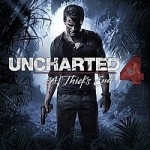
Daniel Boyd (1066 KP) rated UNCHARTED 4: A Thief's End in Video Games
Jul 21, 2017

Visuals (1 more)
Characters
Lack of set pieces (1 more)
Nadine
One Last Time...
This game was definitely my most anticipated of the year. Production was shaky, with the lead game designers being swapped over during the early stages of the game’s development, but the fact that Neil Druckman and Bruce Strailey had just finished developing the masterpiece that was The Last Of Us when they took this project on, I had every faith that this game was going to be great and it was, for the most part. The game opens with an aged Nathan who has left the treasure hunting life to settle down with his wife Elena. He now works as a diver for a salvaging company, but it is clear that he misses the more adventurous life. Then, long story short, Nate’s brother Sam is introduced into the fold and we get a fairly generic reason why Nate has never mentioned him in the past. Essentially Sam is in trouble and needs to pay off some dangerous people, which is why he needs Nate’s help in tracking down the pirate treasure that they began chasing a good number of years ago. Nate then lies to Elena about having to go to Malaysia for work reasons and their adventure begins.
The first thing that I want to praise this game for is its insanely impressive visuals. This is probably the best looking game that I have ever played through. Throughout the duration of the story, the player is granted with several outright beautiful landscapes and vistas. During the first half of Sam and Nate’s adventure, we see them go to Scotland, (which is actually where I’m from,) but that is probably the most boring location that they visit, everywhere else is warm and exotic and truly stunning. The incredible visuals caused me several times to get confused when I was given control of the player character, often times thinking that I was still watching a cutscene before realising, “wait, I can play this?!” The animations are also smooth for the majority of the game, for example early on in the game there is a mass brawl scene that takes place in a prison and although I was playing and controlling the punches that Nate was throwing, it looked like a choreographed fight from a movie like the Raid, which really did impress me in a big way. Although there are some animations that are a little more janky looking, especially when climbing and using the rope, but I’ll get back to that later.
As a character study, this is by far the best Uncharted game. The script is the best it’s been, the majority of the actors are brilliant in their roles and the relationships and emotions that are explored in this game are complex and compelling. However Uncharted is as much known for its characters and their relationships as it is for its epic, insane set pieces and that is sorely lacking here. There a few rinse and repeat building collapse and escape set pieces, which is nothing new to the Uncharted series and other than that, the big set piece of the game is the jeep chase that we saw at E3. Yeah, the biggest set piece in this game is a glorified car chase, as in pretty much the exact same jeep chase as we played though in Uncharted 2, but in Uncharted 2 it led to an epic train battle, which then led to the escape of the collapsed train. So basically, the biggest set piece in this game is only a portion of the awesome set piece that we already played through seven years ago. That is where this game sorely misses Amy Hennig’s influence, she really is a genius when it comes to epic action set pieces, whereas because Neil and Bruce are better are character, this is the main focus of Uncharted 4, but that’s never been the main selling point of the Uncharted series for me, but hey, it’s what we got, so let’s go through the characters that appear in Uncharted 4.
First of all, I do like this version of Nate, he is older more restrained and more reluctant to get himself into danger than he was before. His brother Sam is an okay character, if a bit of an arse at times, although he clearly knows his way around a treasure map and his relationship with Nate is quite an interesting one. It’s also nice to see Sully again even though his role in this game is fairly reserved, he is getting pretty old after all. The villains in this game aren’t great, which is pretty par for the course in the Uncharted series. The main antagonist is a wealthy man called Raef, he is about ages with Nate and he is a spoiled brat. He is a serviceable villain, but fairly generic and nothing to write home about. His sidekick, Nadine is the most unnecessary character I have seen in a game in a long time. There is literally no reason for her to be there other than for them to say, “look at us, we have a strong female character that can kick the male character’s ass, we aren’t sexist at all!” She brings absolutely nothing to the plot and if she didn’t exist the game would literally be no different to what it is now.
As I played through the game I marvelled at how well made everything was and up until about halfway through the game, my experience was totally smooth and seamless, but as I started making my way towards the end of the game, Nate started to randomly jut around as the animations felt more stiff and less free flowing. His hand was going through rocks, rather than leaning on them, his feet would either sink below the ground under him or hover above it slightly and then during one of the last chapters in the game, during yet another collapsing building escape sequence, while Nate was sliding, because I didn’t quite slide into the spot that I was supposed to, he got caught on a piece of debris and the game glitched out indefinitely. Eventually I had to restart the game from the last checkpoint to proceed. This was the only major glitch that I experienced during my playthrough, but when the rest of the game is so smooth, and that smooth standard is what you expect from all Naughty Dog games, this moment stands out like a sore thumb.
I feel like I have been quite critical of the game so far, but I really did enjoy my time with it. I was working full time while playing the game at nights, so it served as a nice respite from work and I savoured every moment of it, I had no intention to rush my way through to the end of the game, I think I beat it over 10 nights or so and that to me was a nice rate to play through the game at, because after you beat this one, that’s it, no more Uncharted, ever, so yeah, enjoy it. The game was a suitable send off for the epic series and as of now, it is my second favourite Uncharted game, behind Among Thieves. Unfortunately the glitches that I experienced towards the end of the game and the disturbing lack of set pieces throughout did detract from my experience, but if you are a long time Uncharted fan this is a must play and the standard of storytelling is truly astonishing.
The first thing that I want to praise this game for is its insanely impressive visuals. This is probably the best looking game that I have ever played through. Throughout the duration of the story, the player is granted with several outright beautiful landscapes and vistas. During the first half of Sam and Nate’s adventure, we see them go to Scotland, (which is actually where I’m from,) but that is probably the most boring location that they visit, everywhere else is warm and exotic and truly stunning. The incredible visuals caused me several times to get confused when I was given control of the player character, often times thinking that I was still watching a cutscene before realising, “wait, I can play this?!” The animations are also smooth for the majority of the game, for example early on in the game there is a mass brawl scene that takes place in a prison and although I was playing and controlling the punches that Nate was throwing, it looked like a choreographed fight from a movie like the Raid, which really did impress me in a big way. Although there are some animations that are a little more janky looking, especially when climbing and using the rope, but I’ll get back to that later.
As a character study, this is by far the best Uncharted game. The script is the best it’s been, the majority of the actors are brilliant in their roles and the relationships and emotions that are explored in this game are complex and compelling. However Uncharted is as much known for its characters and their relationships as it is for its epic, insane set pieces and that is sorely lacking here. There a few rinse and repeat building collapse and escape set pieces, which is nothing new to the Uncharted series and other than that, the big set piece of the game is the jeep chase that we saw at E3. Yeah, the biggest set piece in this game is a glorified car chase, as in pretty much the exact same jeep chase as we played though in Uncharted 2, but in Uncharted 2 it led to an epic train battle, which then led to the escape of the collapsed train. So basically, the biggest set piece in this game is only a portion of the awesome set piece that we already played through seven years ago. That is where this game sorely misses Amy Hennig’s influence, she really is a genius when it comes to epic action set pieces, whereas because Neil and Bruce are better are character, this is the main focus of Uncharted 4, but that’s never been the main selling point of the Uncharted series for me, but hey, it’s what we got, so let’s go through the characters that appear in Uncharted 4.
First of all, I do like this version of Nate, he is older more restrained and more reluctant to get himself into danger than he was before. His brother Sam is an okay character, if a bit of an arse at times, although he clearly knows his way around a treasure map and his relationship with Nate is quite an interesting one. It’s also nice to see Sully again even though his role in this game is fairly reserved, he is getting pretty old after all. The villains in this game aren’t great, which is pretty par for the course in the Uncharted series. The main antagonist is a wealthy man called Raef, he is about ages with Nate and he is a spoiled brat. He is a serviceable villain, but fairly generic and nothing to write home about. His sidekick, Nadine is the most unnecessary character I have seen in a game in a long time. There is literally no reason for her to be there other than for them to say, “look at us, we have a strong female character that can kick the male character’s ass, we aren’t sexist at all!” She brings absolutely nothing to the plot and if she didn’t exist the game would literally be no different to what it is now.
As I played through the game I marvelled at how well made everything was and up until about halfway through the game, my experience was totally smooth and seamless, but as I started making my way towards the end of the game, Nate started to randomly jut around as the animations felt more stiff and less free flowing. His hand was going through rocks, rather than leaning on them, his feet would either sink below the ground under him or hover above it slightly and then during one of the last chapters in the game, during yet another collapsing building escape sequence, while Nate was sliding, because I didn’t quite slide into the spot that I was supposed to, he got caught on a piece of debris and the game glitched out indefinitely. Eventually I had to restart the game from the last checkpoint to proceed. This was the only major glitch that I experienced during my playthrough, but when the rest of the game is so smooth, and that smooth standard is what you expect from all Naughty Dog games, this moment stands out like a sore thumb.
I feel like I have been quite critical of the game so far, but I really did enjoy my time with it. I was working full time while playing the game at nights, so it served as a nice respite from work and I savoured every moment of it, I had no intention to rush my way through to the end of the game, I think I beat it over 10 nights or so and that to me was a nice rate to play through the game at, because after you beat this one, that’s it, no more Uncharted, ever, so yeah, enjoy it. The game was a suitable send off for the epic series and as of now, it is my second favourite Uncharted game, behind Among Thieves. Unfortunately the glitches that I experienced towards the end of the game and the disturbing lack of set pieces throughout did detract from my experience, but if you are a long time Uncharted fan this is a must play and the standard of storytelling is truly astonishing.
Mandy and G.D. Burkhead (26 KP) rated Sir Apropos of Nothing in Books
May 20, 2018
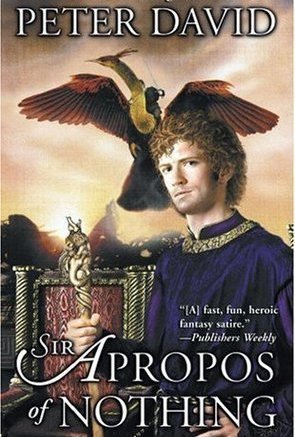

Shelf Life – Sir Apropos of Nothing Skewers the Hero’s Journey
Contains spoilers, click to show
Fantasy and satire are two of my favorite genres in any medium, but especially so in books. Satirical fantasy, then, holds a special place on my shelves. I grew up on Sir Terry Pratchett’s Discworld series, and desire to imitate him and his style is what led me in middle school to begin writing in earnest, for fun, and for myself rather than just for my teachers and their assignments.
So when I picked up Sir Apropos of Nothing, I did so based on the title pun and the back-of-the-book synopsis that promised “a berserk phoenix, murderous unicorns, mutated harpies, homicidal warrior kings, and – most problematic of all – a princess who may or may not be a psychotic arsonist.” I expected another lighthearted riff on the familiar archetypes. Murderous unicorns? Unicorns are not typically described as such! Oh teehee, how unexpectedly humorous!
Sir Apropos of Nothing is a satirical fantasy, just like it promised, though at times it’s hard to tell how much of the story is played for laughs and how much is played straight. See, the thing about satire that’s easy to forget at times is that it’s not synonymous with buffoonery. Make no mistake – Apropos is a funny book, full of witty dialogue and groan-inducing puns. It’s a book that takes great delight in lampshading traditional fantasy tropes and archetypes, as well as the entirety of Joseph Campbell’s Hero’s Journey idea. But it is not always a silly lampshade; sometimes a cliche or trope is pointed out to have its inherit ridiculousness laughed at, and sometimes it is pointed out because it is causing real and lasting pain or damage, either to the society in which it is set or, more often, to the titular Apropos himself and his ever-degrading esteem of both the people around him and himself.
The tone, at first, is hard to pin down. The story starts in media res with the main character being caught by a knight while in mid-coitus with that knight’s wife and escalates from there. The second chapter opens with a fourth wall-breaking narrative admission by Apropos himself that this was done with the express purpose of catching your attention, and now we’re going back to cover Apropos’s childhood, which ends up being equal parts dark, tragic, punny, and conveniently trope-filled – all of which Apropos, as narrator, approaches with the same resigned, blasé outlook.
If this sounds a bit jarring, well, it kind of is. Early on, I wasn’t sure what to think of where the story was trying to go or what I was expected to feel about it. After the first turn from cliché to dark and visceral to light and punny, all within a few pages, I caught myself thinking, “Crap, is this book gonna try and mix goofy jokes with serious drama and thoughtful moral quandary?”
The answer is yes. And it pulls it off fantastically.
This is due in large part to the interesting depths of the antihero, Apropos, who seems to be so named purely for the joke in the title. In Apropos we see a deep sense of justice and rightness that is entirely eclipsed by an even deeper cynicism and an unshakeable instinct for self-preservation. His life is objectively terrible, but rather than brood and lament, he adjusts. He keeps his head down when he can, weathers abuse when he can’t, and learns to deal with the constant shit storm, all the while bottling his growing anger and resentment at a world that would allow such amounts of suffering and hypocrisy to go unchecked. The fact that he himself becomes a selfish, hypocritical, and generally awful person is not lost on him, and the result is a flawed, unheroic, pathetic coward of a protagonist, a magnificently multifaceted bastard who doesn’t spare even himself from his vast and withering contempt.
And it’s a blast. It really is. Apropos is refreshingly pragmatic and unabashedly pessimistic, a welcome change from the typical righteous-yet-humble heroes of traditional fantasy, or even the loveable and untalented everyman in over his head of traditional fantasy spoofs. Despite a portentous birthmark (on his ass, no less) and beginnings that are not “humble” so much as “poverty of the dirtiest kind,” Apropos is everything a hero should not be short of outright evil.
And this, as it turns out, is entirely the point. This is where the satire, funny or otherwise, really shines through. This is the crux that elevates Sir Apropos of Nothing from a generically self-aware fantasy story to an original and memorable subversion of storytelling as a whole.
Without giving too much away, there comes a point in the plot where Apropos realizes that the events surrounding his miserable life are part of a heroic tale that has been preordained by Fate and is now being epically written out by Destiny. And despite his birthmark, his tragic past, and his mother’s constant reassurances that he has some sort of great destiny hovering over him, he is not the hero. He is only a minor character. A walk-on role on the hero’s stage. A brief pit-stop along the hero’s journey. An NPC whose dreams, desires, and continued existence are so far below importance to the story as to be utterly negligible.
And once this finally clicks with him, he violently, brazenly rebels against it. He gives an emphatic middle finger to Fate’s ideas and sets about making Destiny sit up and take notice of him again. He momentarily and violently overcomes his own abject cowardice just long enough to find a way to completely wreck the traditional heroic ballad in which he lives, all on the basis that, dammit, the world owes him more than this, and nobody should be so miserably cursed as to live their entire life as a foil character.
At this point in my own reading, I didn’t know whether to cheer him on or worry about the repercussions of his actions, because he doesn’t suddenly become heroic when this happens. He’s exactly as much of a selfish, lying bastard as before, and however bad you feel for him, you can completely understand why he was never cast for this role in the first place. Add to this the complete disregard of the author for following what seems to be the obvious progression of events in favor of twists that take you completely by surprise, but still make complete sense and arise organically from the story itself, and you eventually give up thinking that you have any sense of where the story’s going or how any event is going to play out. From beginning to end, it feeds you familiar ideas and then completely subverts them, introduces clichés and then proceeds to tear them apart, and you laugh and pity and feel something the entire way through.
In short, Sir Apropos of Nothing is a book that will keep you turning page after page – not necessarily because of the gripping drama (although it has that) or because of any breezy humor (although it has that too), or because the narration itself oozes suspense (although it often does), but because, with the rapid infusion of new and creative ideas and the hidden depths of character constantly bubbling to the surface in everyone involved, you honestly never know what’s going to happen next. If you like fantasy and can stand to have your expectations messed with, Apropos is certainly apropos.
So when I picked up Sir Apropos of Nothing, I did so based on the title pun and the back-of-the-book synopsis that promised “a berserk phoenix, murderous unicorns, mutated harpies, homicidal warrior kings, and – most problematic of all – a princess who may or may not be a psychotic arsonist.” I expected another lighthearted riff on the familiar archetypes. Murderous unicorns? Unicorns are not typically described as such! Oh teehee, how unexpectedly humorous!
Sir Apropos of Nothing is a satirical fantasy, just like it promised, though at times it’s hard to tell how much of the story is played for laughs and how much is played straight. See, the thing about satire that’s easy to forget at times is that it’s not synonymous with buffoonery. Make no mistake – Apropos is a funny book, full of witty dialogue and groan-inducing puns. It’s a book that takes great delight in lampshading traditional fantasy tropes and archetypes, as well as the entirety of Joseph Campbell’s Hero’s Journey idea. But it is not always a silly lampshade; sometimes a cliche or trope is pointed out to have its inherit ridiculousness laughed at, and sometimes it is pointed out because it is causing real and lasting pain or damage, either to the society in which it is set or, more often, to the titular Apropos himself and his ever-degrading esteem of both the people around him and himself.
The tone, at first, is hard to pin down. The story starts in media res with the main character being caught by a knight while in mid-coitus with that knight’s wife and escalates from there. The second chapter opens with a fourth wall-breaking narrative admission by Apropos himself that this was done with the express purpose of catching your attention, and now we’re going back to cover Apropos’s childhood, which ends up being equal parts dark, tragic, punny, and conveniently trope-filled – all of which Apropos, as narrator, approaches with the same resigned, blasé outlook.
If this sounds a bit jarring, well, it kind of is. Early on, I wasn’t sure what to think of where the story was trying to go or what I was expected to feel about it. After the first turn from cliché to dark and visceral to light and punny, all within a few pages, I caught myself thinking, “Crap, is this book gonna try and mix goofy jokes with serious drama and thoughtful moral quandary?”
The answer is yes. And it pulls it off fantastically.
This is due in large part to the interesting depths of the antihero, Apropos, who seems to be so named purely for the joke in the title. In Apropos we see a deep sense of justice and rightness that is entirely eclipsed by an even deeper cynicism and an unshakeable instinct for self-preservation. His life is objectively terrible, but rather than brood and lament, he adjusts. He keeps his head down when he can, weathers abuse when he can’t, and learns to deal with the constant shit storm, all the while bottling his growing anger and resentment at a world that would allow such amounts of suffering and hypocrisy to go unchecked. The fact that he himself becomes a selfish, hypocritical, and generally awful person is not lost on him, and the result is a flawed, unheroic, pathetic coward of a protagonist, a magnificently multifaceted bastard who doesn’t spare even himself from his vast and withering contempt.
And it’s a blast. It really is. Apropos is refreshingly pragmatic and unabashedly pessimistic, a welcome change from the typical righteous-yet-humble heroes of traditional fantasy, or even the loveable and untalented everyman in over his head of traditional fantasy spoofs. Despite a portentous birthmark (on his ass, no less) and beginnings that are not “humble” so much as “poverty of the dirtiest kind,” Apropos is everything a hero should not be short of outright evil.
And this, as it turns out, is entirely the point. This is where the satire, funny or otherwise, really shines through. This is the crux that elevates Sir Apropos of Nothing from a generically self-aware fantasy story to an original and memorable subversion of storytelling as a whole.
Without giving too much away, there comes a point in the plot where Apropos realizes that the events surrounding his miserable life are part of a heroic tale that has been preordained by Fate and is now being epically written out by Destiny. And despite his birthmark, his tragic past, and his mother’s constant reassurances that he has some sort of great destiny hovering over him, he is not the hero. He is only a minor character. A walk-on role on the hero’s stage. A brief pit-stop along the hero’s journey. An NPC whose dreams, desires, and continued existence are so far below importance to the story as to be utterly negligible.
And once this finally clicks with him, he violently, brazenly rebels against it. He gives an emphatic middle finger to Fate’s ideas and sets about making Destiny sit up and take notice of him again. He momentarily and violently overcomes his own abject cowardice just long enough to find a way to completely wreck the traditional heroic ballad in which he lives, all on the basis that, dammit, the world owes him more than this, and nobody should be so miserably cursed as to live their entire life as a foil character.
At this point in my own reading, I didn’t know whether to cheer him on or worry about the repercussions of his actions, because he doesn’t suddenly become heroic when this happens. He’s exactly as much of a selfish, lying bastard as before, and however bad you feel for him, you can completely understand why he was never cast for this role in the first place. Add to this the complete disregard of the author for following what seems to be the obvious progression of events in favor of twists that take you completely by surprise, but still make complete sense and arise organically from the story itself, and you eventually give up thinking that you have any sense of where the story’s going or how any event is going to play out. From beginning to end, it feeds you familiar ideas and then completely subverts them, introduces clichés and then proceeds to tear them apart, and you laugh and pity and feel something the entire way through.
In short, Sir Apropos of Nothing is a book that will keep you turning page after page – not necessarily because of the gripping drama (although it has that) or because of any breezy humor (although it has that too), or because the narration itself oozes suspense (although it often does), but because, with the rapid infusion of new and creative ideas and the hidden depths of character constantly bubbling to the surface in everyone involved, you honestly never know what’s going to happen next. If you like fantasy and can stand to have your expectations messed with, Apropos is certainly apropos.
Charlie Cobra Reviews (1840 KP) rated Resident Alien in TV
Apr 14, 2021 (Updated Apr 14, 2021)
Laugh out loud funny (3 more)
Excellent mix of comedy, drama, and sci-fi
Full of unique and different characters
Decent special effects and CGI
Not for everyone kind of show (2 more)
Sometimes the CGI and effects can be lacking
Some characters can be a little annoying at times
A Comedy That's Out Of This World Funny
https://youtu.be/v9iwDu2OP3E
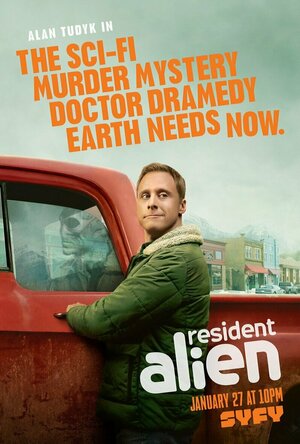
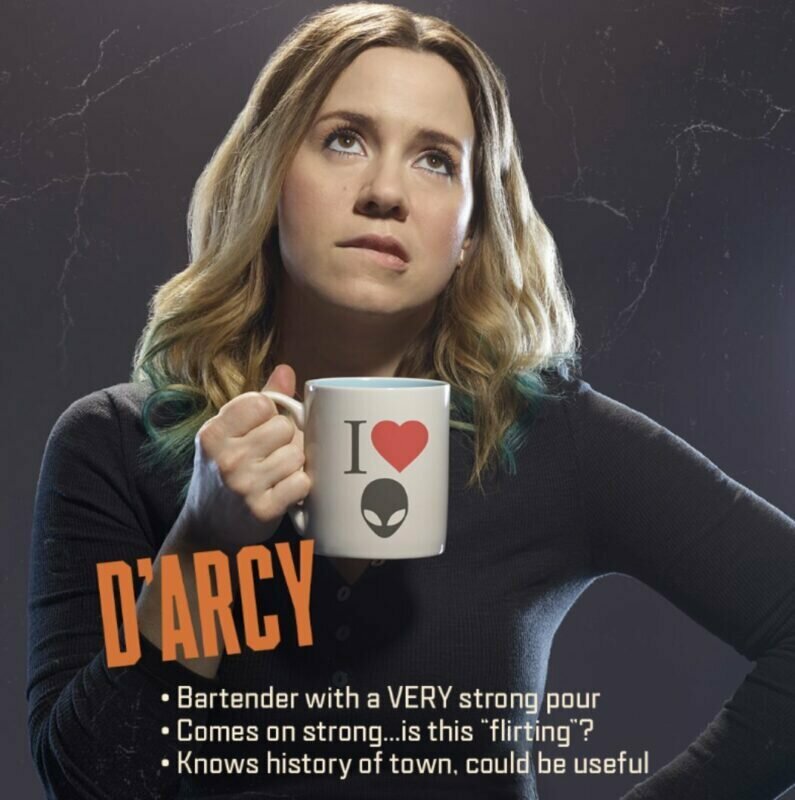
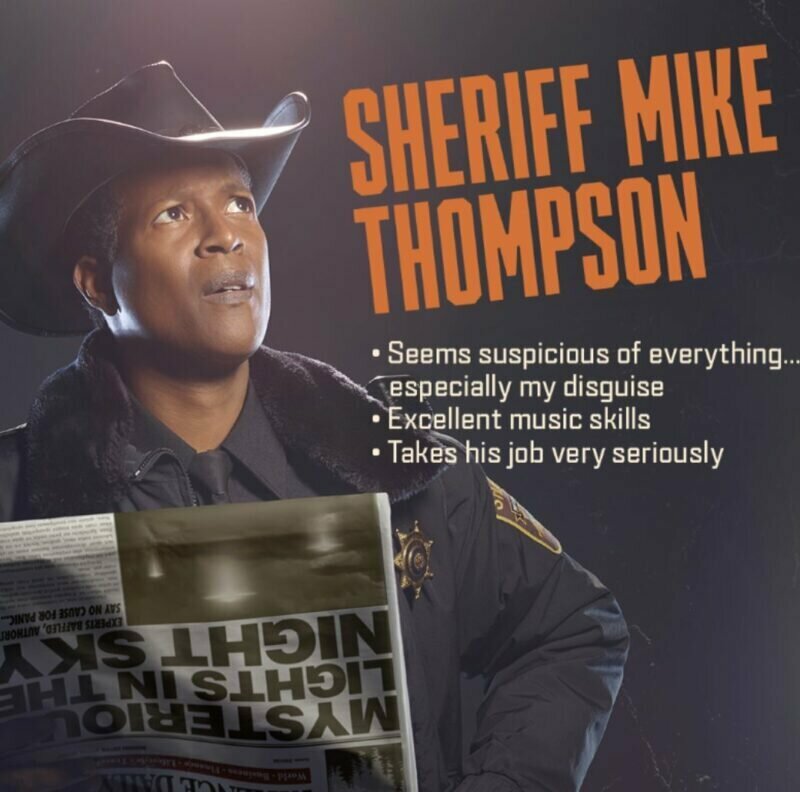
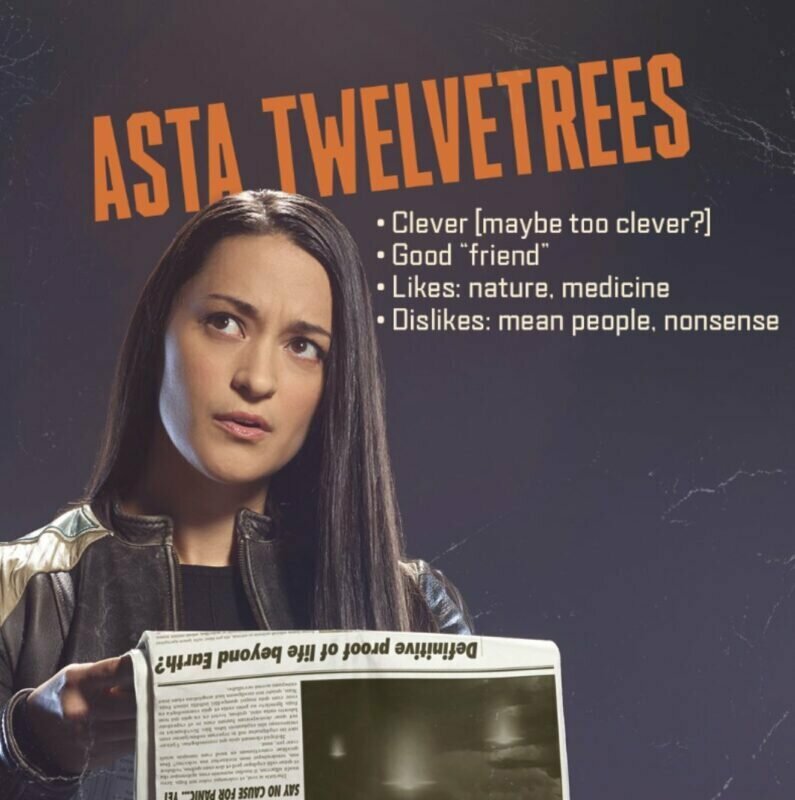
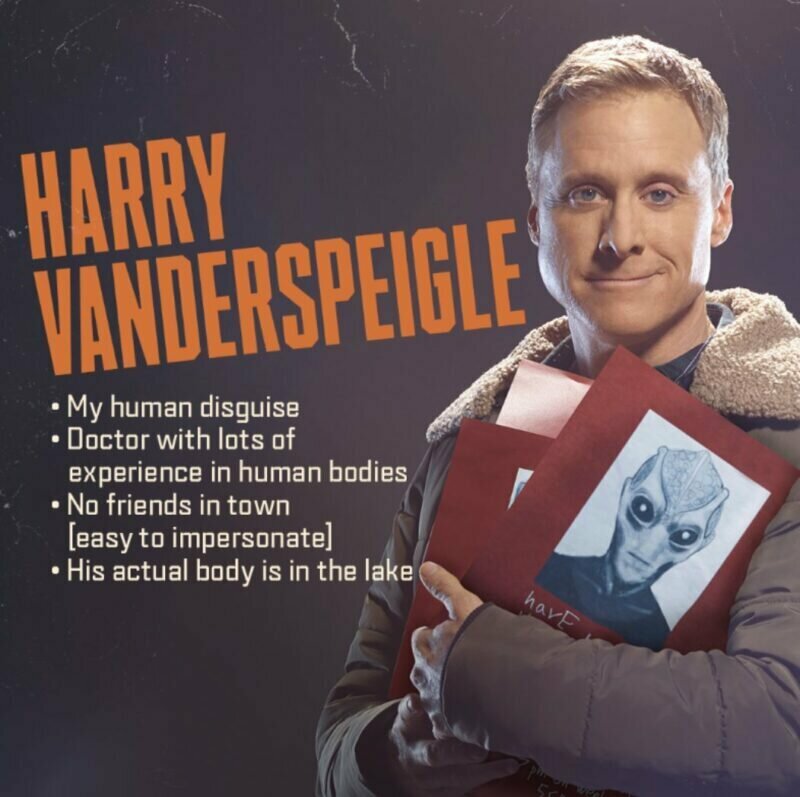
This show is just great and a real treat. I have to admit that I had no idea what I was in store for watching this show and I think that was half the fun of watching it. This show is part mystery and part CSI but also equal parts comedy and drama. It's full of scenes that are laugh out loud funny and some that are quite drama filled and serious in-tone at times. I really like the way it balances them and how each episode gets us a little bit further into the mystery of who killed the town doctor and if anyone is close to finding out the alien's secret identity or his secret mission. The character of the alien; who takes on the name Harry, after the doctor whose identity he steals, Dr. Harry Vanderspiegle, is a pretty funny character. It really shows in how he is trying his best to navigate through everyday situations with no prior knowledge of how or what it is to be human and really understand the subtle nuances of human nature and interaction while having a superiority complex and believing all humans are barely smarter than lizards in his opinion. He is totally oblivious to many things that are second nature to people like sarcasm and sense of humor. There are actually quite a few likeable characters on the show like Asta Twelvetrees played by Sara Tomko who is arguably the heart of the show, a central and integral character and super relatable. She is an important character to "Harry" learning to be more human. Also there's Sheriff Mike who is played by Corey Reynolds and is full of catch-phrases and just ridiculous things he says that are funny as hell. His completely blunt personality and no non-sense approach to crime leaves him to rub people the wrong way but he never apologies for himself or tries to tip-toe around people either. Then there's D'arcy who's played by Alice Wetterlund who is the town's bar owner and ex-Olympic athlete. She's a pretty cool character and quite different from the others and really kind of compliments the other characters by rounding them out. The whole mix of characters in the show are pretty diverse personality wise and how the show revolves around them and it's just a really funny show that's also full of alien sci-fi things going on at the same time but manages to ring through on an emotional level as "Harry" the alien begins to understand more and more about humans. I'll go over more in the spoiler section but I give this show a 8/10 and you should definitely check it out, especially if you are into sci-fi and looking for something that'll make you laugh at the same time too.
-------------------------------------------------------
Spoiler Section Review:
This show is just one of those shows that you don't expect for it to be as good as it is. I was really surprised when I saw the first episode and decided that I had to show my brother the first episode too and we actually got our dad into it too. I really like Alan Tudyk and how he not only plays the alien "Harry" but also the actual Dr. Harry Vanderspeigle in the flashbacks that happen as well. He's pretty talented and extremely funny in playing the alien, especially the parts where he's learning how to walk and talk and watching "Law & Order". So the whole thing with the show is that "Harry" is an alien that has crash-landed on Earth before he could finish his mission and is looking for his ship or parts of it that he needs to recover so he can finish his mission. He wakes up and searches the mountainside where he believes it is and pretty much avoids all human contact. That's when things change and the local authorities seek him out because the person whose identity he has taken is a known doctor and they need him to investigate the death of the town doctor. He now has to not only go into town where there are humans everywhere but also interact with them and hope that no one can tell that he's really an alien in disguise. The storytelling, plot and character development in the show are done in such a great way in how it progresses forward but also shows things that occurred earlier in flashbacks and you get to know or see things that make the characters more 3-dimensional and feel more realistic. Harry is very smart for an alien but has no clue when it comes to a lot of the things we take for granted when it comes to being human, things like sarcasm, humor, and more. So his behavior is off-putting but tolerated and accepted for the most part. He reluctantly takes on the job of the town doctor when asked because he doesn't want for anyone to suspect anything which makes it harder for him especially when he learns the Mayor's son Max can see his true identity, something like only one in a million humans might be able to do. The head nurse Asta Twelvetrees make his job easier by assisting him and they bond rather quickly when he takes her up on the offer to go for a drink after work to the local bar. That's where they meet D'arcy the bartender and owner of the bar who is also Asta's best friend and they have fun drinking and dancing and "Harry" drinks heavily to fit in. There's some pretty funny scenes of the alien dancing too. The next day Asta asks "Harry" to help her get somethings from her abusive ex-boyfriend Jimmy's house and "Harry" saves her from him when begins attacking her. He helps her to leave and she confides in him, that she had a child with Jimmy when she was really young but gave it up for adoption as they were too young to take care of it. Like I said in the non-spoiler section this show has a good mix of mystery, comedy and drama and does it in a really good way. Just as it pulls you in one direction like the drama part about Asta's child then it steers you in a completely different direction like comedy again when you find out at the end of the first episode that "Harry's" first patient is Max, the Mayor's son who can see that he's really an alien. I really enjoyed this show and I'm so glad that they decided to renew it for another season and there will be a season 2 coming soon. I liked it so much that I'm actually thinking about checking out the comic books by Dark Horse comics to see how good they are too. Anyways I give this show a 8/10 and can't wait for it to return.
This show is just great and a real treat. I have to admit that I had no idea what I was in store for watching this show and I think that was half the fun of watching it. This show is part mystery and part CSI but also equal parts comedy and drama. It's full of scenes that are laugh out loud funny and some that are quite drama filled and serious in-tone at times. I really like the way it balances them and how each episode gets us a little bit further into the mystery of who killed the town doctor and if anyone is close to finding out the alien's secret identity or his secret mission. The character of the alien; who takes on the name Harry, after the doctor whose identity he steals, Dr. Harry Vanderspiegle, is a pretty funny character. It really shows in how he is trying his best to navigate through everyday situations with no prior knowledge of how or what it is to be human and really understand the subtle nuances of human nature and interaction while having a superiority complex and believing all humans are barely smarter than lizards in his opinion. He is totally oblivious to many things that are second nature to people like sarcasm and sense of humor. There are actually quite a few likeable characters on the show like Asta Twelvetrees played by Sara Tomko who is arguably the heart of the show, a central and integral character and super relatable. She is an important character to "Harry" learning to be more human. Also there's Sheriff Mike who is played by Corey Reynolds and is full of catch-phrases and just ridiculous things he says that are funny as hell. His completely blunt personality and no non-sense approach to crime leaves him to rub people the wrong way but he never apologies for himself or tries to tip-toe around people either. Then there's D'arcy who's played by Alice Wetterlund who is the town's bar owner and ex-Olympic athlete. She's a pretty cool character and quite different from the others and really kind of compliments the other characters by rounding them out. The whole mix of characters in the show are pretty diverse personality wise and how the show revolves around them and it's just a really funny show that's also full of alien sci-fi things going on at the same time but manages to ring through on an emotional level as "Harry" the alien begins to understand more and more about humans. I'll go over more in the spoiler section but I give this show a 8/10 and you should definitely check it out, especially if you are into sci-fi and looking for something that'll make you laugh at the same time too.
-------------------------------------------------------
Spoiler Section Review:
This show is just one of those shows that you don't expect for it to be as good as it is. I was really surprised when I saw the first episode and decided that I had to show my brother the first episode too and we actually got our dad into it too. I really like Alan Tudyk and how he not only plays the alien "Harry" but also the actual Dr. Harry Vanderspeigle in the flashbacks that happen as well. He's pretty talented and extremely funny in playing the alien, especially the parts where he's learning how to walk and talk and watching "Law & Order". So the whole thing with the show is that "Harry" is an alien that has crash-landed on Earth before he could finish his mission and is looking for his ship or parts of it that he needs to recover so he can finish his mission. He wakes up and searches the mountainside where he believes it is and pretty much avoids all human contact. That's when things change and the local authorities seek him out because the person whose identity he has taken is a known doctor and they need him to investigate the death of the town doctor. He now has to not only go into town where there are humans everywhere but also interact with them and hope that no one can tell that he's really an alien in disguise. The storytelling, plot and character development in the show are done in such a great way in how it progresses forward but also shows things that occurred earlier in flashbacks and you get to know or see things that make the characters more 3-dimensional and feel more realistic. Harry is very smart for an alien but has no clue when it comes to a lot of the things we take for granted when it comes to being human, things like sarcasm, humor, and more. So his behavior is off-putting but tolerated and accepted for the most part. He reluctantly takes on the job of the town doctor when asked because he doesn't want for anyone to suspect anything which makes it harder for him especially when he learns the Mayor's son Max can see his true identity, something like only one in a million humans might be able to do. The head nurse Asta Twelvetrees make his job easier by assisting him and they bond rather quickly when he takes her up on the offer to go for a drink after work to the local bar. That's where they meet D'arcy the bartender and owner of the bar who is also Asta's best friend and they have fun drinking and dancing and "Harry" drinks heavily to fit in. There's some pretty funny scenes of the alien dancing too. The next day Asta asks "Harry" to help her get somethings from her abusive ex-boyfriend Jimmy's house and "Harry" saves her from him when begins attacking her. He helps her to leave and she confides in him, that she had a child with Jimmy when she was really young but gave it up for adoption as they were too young to take care of it. Like I said in the non-spoiler section this show has a good mix of mystery, comedy and drama and does it in a really good way. Just as it pulls you in one direction like the drama part about Asta's child then it steers you in a completely different direction like comedy again when you find out at the end of the first episode that "Harry's" first patient is Max, the Mayor's son who can see that he's really an alien. I really enjoyed this show and I'm so glad that they decided to renew it for another season and there will be a season 2 coming soon. I liked it so much that I'm actually thinking about checking out the comic books by Dark Horse comics to see how good they are too. Anyways I give this show a 8/10 and can't wait for it to return.

James P. Sumner (65 KP) rated Game Of Thrones in TV
Jul 1, 2019
Winter has come and gone... and there won't ever be anything like it again!
Contains spoilers, click to show
Game of Thrones. The only show that drove people to brag on social media about the fact they've never seen it every time a new series came out!
I watched this from Season 3, quickly binging the first two seasons about a week before it aired. I'm not a huge Fantasy fan, but this show really was something else. Despite the setting, it gave us everything - blood, guts, drama, sex... even comedy. It gave us some of the most vile and hated antagonists to ever grace the screen, and it made heroes out of the unlikeliest of people.
Watching it week-to-week was difficult for a couple of reasons. One, so much is going on (especially in the earlier seasons) that you can forget a lot in a week, and you find yourself questioning everything. Two, it's so bloody good, you didn't want to wait a whole week to get your fix! Obviously, now it's finished, the second issue is no longer relevant - it's available to binge to your heart's content, which you absolutely should do.
I want to address the recent criticism of the eighth and final season. We waited over two years for it, and many people felt it was rushed, too short and too shallow. I would say 75% of people who watched the last season were left disappointed. Myself included.
But a few days after it had finished, I found myself thinking about the series as a whole more and more. I was reading articles online, theories and arguments about how and why the story played out the way it did. I realised I had felt somewhat detached watching Season 8 because it HAD been two years since I watched Season 7. It's as if I'd forgotten what it was like to watch it.
So, having never seen any episode more than once, I went back to the beginning and watched all eight seasons in a little under three weeks...
SO MUCH BETTER the second time around!
For two reasons. Firstly, there was no break in the story at all. Watching it as it aired meant you had a 12-month break every 10 hours, basically. Easy to lose your thread. Easy to forget things. When that doesn't happen, it's much more enjoyable and actually makes a lot more sense. There was so much I'd forgotten over the course of the nine years it was on, I kind of felt like I'd cheated myself, in a way, by not watching Seasons 1-7 before Season 8 aired.
Second, much in the way that Star Wars Episodes 1-3 work better if you've seen 4-6 first, Game of Thrones was actually much more enjoyable having seen the ending, because things make a lot more sense in retrospect.
***This is where it gets spoilery***
It becomes evident early on, even in the first season, that Jon Snow is one to watch. His shocking death at the end of Season 5 caused much confusion and debate. Obviously, his resurrection early in Season 6 put an end to that, and when the secret about his true identity is finally revealed in Season 8, it was a shocking moment, as everything started to fall into place and the true threat became evident.
However...
Having now done Seasons 1-8 back-to-back, the revelation that Jon Snow is, in fact, a Targaryen is far from surprising, given they've been dropping clues about it since back in the first few episodes. Obviously, at the time, these seemingly throwaway comments meant nothing, but now we know, there are numerous conversations throughout the show that border on being spoilers themselves.
Same with Arya Stark and her storyline. Second time around, even from Season 1, it's evident she was destined to slay The Night King. And as with Jon Snow, you never would've picked up on it at the time, but in hindsight it's been obvious for years.
Now, the major criticism about Season 8 was that it felt rushed and that it sacrificed too many characters arcs for the sake of finishing inside of six episodes. Watching it as it aired, I completely agreed. Jon Snow "suddenly" went from a brooding hero to a pointless extra. Daenerys Targaryen "suddenly" went from the freer of slaves and saviour of Westeros to an insane despot who slaughtered half the world because someone took her toys away.
Not true.
It seemed like that after two years of forgetting almost everything that had happened previously, but watching it from start to finish in one go, those things make perfect sense, and aren't actually that sudden. The Mother of Dragons showed clear and obvious signs of becoming The Mad Queen of Ashes very early on in the show. She was always kind and fair and just... but my goodness, did you get it if you pissed her off! Let's not forget she crucified almost 200 slave-owners long after they surrendered to prove a point. And poor Sam Tarly's father and brother! She had a mean streak, and she lived on a knife's edge. At any point since she married Khal Drogo back at the beginning of Season 1, the slightest push and she would snap. Fast forward to Season 8 and, after many years of fighting to fulfil her birthright and take the Iron Throne, she finds out she's not actually the heir to it at all... that's a pretty big push to a woman with a history of losing her shit when things don't go her way. So not much of a surprise at all, really.
And to address the criticism further, I'll analyse this as a writer. I tell stories for a living. When you're writing a novel, you look at it as a triangle, of sorts. It starts off wide and gradually gets to a point. Game of Thrones began very wide, with lots of characters and subplots. But as time goes on, it narrows and becomes more focused on the main threat... the main storylines - the battle against The Night King and the fight for the Iron Throne. Those two things are what nine years of storytelling were working towards, so yes, when you get to the final season and you have to wrap things up, it makes sense that you're going to focus on the big finish - the point of the series.
Not only that, for the first six seasons, the shows writers and creators had their hands held by George R. R. Martin and his source material. But then the TV show caught up with the books, which meant they suddenly had nothing more than a handful of bullet points to work off instead. Not easy to go from one to the other. They can't embellish things too much, because they run the risk of contradicting and undermining future books, which Mr. Martin wouldn't allow them to do. So they had to keep it simple, stick to the point and finish the job they started - nothing more.
Ultimately, no one likes to see their favourite show end. In hindsight, I think a lot of the criticism the final season received was because the audience forgot what came before it, and because they didn't want it to end.
If you're reading this having never watched it before.... first of all, sorry for ruining the story for you (but I did say it contained spoilers, in my defence). But you have the benefit of being able to binge through this, which means you'll get the full, uninterrupted experience, which is well worth the investment of your time to do.
If you HAVE watched the show before, I strongly suggest re-watching it from the beginning, because I enjoyed it far more the second time around.
This is the kind of show that comes along once a generation. The kind of show people talk about daily long after it finished. It redefines TV drama and I can promise you, you'll never see anything like it again.
That said, don't watch it if you're easily offended or grossed out. Or if you like animals. Oh, and don't watch Season 4, Episode 8 whilst you're eating. And don't watch Season 3, Episode 9 if you believe in the afterlife and have your heart set on getting into Heaven. And it's perfectly acceptable to watch Season 6, Episode 9 and feel like that's what you would do if faced with certain death.
Just perfect.
I watched this from Season 3, quickly binging the first two seasons about a week before it aired. I'm not a huge Fantasy fan, but this show really was something else. Despite the setting, it gave us everything - blood, guts, drama, sex... even comedy. It gave us some of the most vile and hated antagonists to ever grace the screen, and it made heroes out of the unlikeliest of people.
Watching it week-to-week was difficult for a couple of reasons. One, so much is going on (especially in the earlier seasons) that you can forget a lot in a week, and you find yourself questioning everything. Two, it's so bloody good, you didn't want to wait a whole week to get your fix! Obviously, now it's finished, the second issue is no longer relevant - it's available to binge to your heart's content, which you absolutely should do.
I want to address the recent criticism of the eighth and final season. We waited over two years for it, and many people felt it was rushed, too short and too shallow. I would say 75% of people who watched the last season were left disappointed. Myself included.
But a few days after it had finished, I found myself thinking about the series as a whole more and more. I was reading articles online, theories and arguments about how and why the story played out the way it did. I realised I had felt somewhat detached watching Season 8 because it HAD been two years since I watched Season 7. It's as if I'd forgotten what it was like to watch it.
So, having never seen any episode more than once, I went back to the beginning and watched all eight seasons in a little under three weeks...
SO MUCH BETTER the second time around!
For two reasons. Firstly, there was no break in the story at all. Watching it as it aired meant you had a 12-month break every 10 hours, basically. Easy to lose your thread. Easy to forget things. When that doesn't happen, it's much more enjoyable and actually makes a lot more sense. There was so much I'd forgotten over the course of the nine years it was on, I kind of felt like I'd cheated myself, in a way, by not watching Seasons 1-7 before Season 8 aired.
Second, much in the way that Star Wars Episodes 1-3 work better if you've seen 4-6 first, Game of Thrones was actually much more enjoyable having seen the ending, because things make a lot more sense in retrospect.
***This is where it gets spoilery***
It becomes evident early on, even in the first season, that Jon Snow is one to watch. His shocking death at the end of Season 5 caused much confusion and debate. Obviously, his resurrection early in Season 6 put an end to that, and when the secret about his true identity is finally revealed in Season 8, it was a shocking moment, as everything started to fall into place and the true threat became evident.
However...
Having now done Seasons 1-8 back-to-back, the revelation that Jon Snow is, in fact, a Targaryen is far from surprising, given they've been dropping clues about it since back in the first few episodes. Obviously, at the time, these seemingly throwaway comments meant nothing, but now we know, there are numerous conversations throughout the show that border on being spoilers themselves.
Same with Arya Stark and her storyline. Second time around, even from Season 1, it's evident she was destined to slay The Night King. And as with Jon Snow, you never would've picked up on it at the time, but in hindsight it's been obvious for years.
Now, the major criticism about Season 8 was that it felt rushed and that it sacrificed too many characters arcs for the sake of finishing inside of six episodes. Watching it as it aired, I completely agreed. Jon Snow "suddenly" went from a brooding hero to a pointless extra. Daenerys Targaryen "suddenly" went from the freer of slaves and saviour of Westeros to an insane despot who slaughtered half the world because someone took her toys away.
Not true.
It seemed like that after two years of forgetting almost everything that had happened previously, but watching it from start to finish in one go, those things make perfect sense, and aren't actually that sudden. The Mother of Dragons showed clear and obvious signs of becoming The Mad Queen of Ashes very early on in the show. She was always kind and fair and just... but my goodness, did you get it if you pissed her off! Let's not forget she crucified almost 200 slave-owners long after they surrendered to prove a point. And poor Sam Tarly's father and brother! She had a mean streak, and she lived on a knife's edge. At any point since she married Khal Drogo back at the beginning of Season 1, the slightest push and she would snap. Fast forward to Season 8 and, after many years of fighting to fulfil her birthright and take the Iron Throne, she finds out she's not actually the heir to it at all... that's a pretty big push to a woman with a history of losing her shit when things don't go her way. So not much of a surprise at all, really.
And to address the criticism further, I'll analyse this as a writer. I tell stories for a living. When you're writing a novel, you look at it as a triangle, of sorts. It starts off wide and gradually gets to a point. Game of Thrones began very wide, with lots of characters and subplots. But as time goes on, it narrows and becomes more focused on the main threat... the main storylines - the battle against The Night King and the fight for the Iron Throne. Those two things are what nine years of storytelling were working towards, so yes, when you get to the final season and you have to wrap things up, it makes sense that you're going to focus on the big finish - the point of the series.
Not only that, for the first six seasons, the shows writers and creators had their hands held by George R. R. Martin and his source material. But then the TV show caught up with the books, which meant they suddenly had nothing more than a handful of bullet points to work off instead. Not easy to go from one to the other. They can't embellish things too much, because they run the risk of contradicting and undermining future books, which Mr. Martin wouldn't allow them to do. So they had to keep it simple, stick to the point and finish the job they started - nothing more.
Ultimately, no one likes to see their favourite show end. In hindsight, I think a lot of the criticism the final season received was because the audience forgot what came before it, and because they didn't want it to end.
If you're reading this having never watched it before.... first of all, sorry for ruining the story for you (but I did say it contained spoilers, in my defence). But you have the benefit of being able to binge through this, which means you'll get the full, uninterrupted experience, which is well worth the investment of your time to do.
If you HAVE watched the show before, I strongly suggest re-watching it from the beginning, because I enjoyed it far more the second time around.
This is the kind of show that comes along once a generation. The kind of show people talk about daily long after it finished. It redefines TV drama and I can promise you, you'll never see anything like it again.
That said, don't watch it if you're easily offended or grossed out. Or if you like animals. Oh, and don't watch Season 4, Episode 8 whilst you're eating. And don't watch Season 3, Episode 9 if you believe in the afterlife and have your heart set on getting into Heaven. And it's perfectly acceptable to watch Season 6, Episode 9 and feel like that's what you would do if faced with certain death.
Just perfect.
Chris Sawin (602 KP) rated Once Upon a Time in Hollywood (2019) in Movies
Jul 26, 2019
Leonardo DiCaprio (1 more)
Brad Pitt
It's 2 hours and 41 minutes and feels long. (2 more)
Story elements don't seem to go together.
Charles Manson stuff feels forced.
With Once Upon a Time…in Hollywood being his ninth feature film as writer and director and a career just shy of the three decade mark, you should probably know what to expect from a Quentin Tarantino film. Amongst all of the usual Tarantino trademarks of memorable performances, long strings of dialogue, a questionable amount of dancing, the inclusion of several shots of barefoot women, interior car sequences, and a relentless tidal wave of vulgarity that drowns the audience in a sea of sharp expletives, Once Upon a Time...in Hollywood lacks the one element that truly makes a Tarantino film worthwhile; coherent storytelling.
Once Upon a Time…in Hollywood should be great based on its cast alone. Leonardo DiCaprio delivers one of his more complex performances as television star turned infrequent movie star Rick Dalton. Dalton made a name for himself in a western TV series called Bounty Law. Rick burned that bridge when he tried to make the jump to movies and failed. Now he only seems to get work as the TV villain. Rick gets an opportunity in Rome to star in Italian spaghetti westerns and reluctantly accepts. Rick is an alcoholic that struggles with a stutter when he speaks. He has low self-esteem and questions every decision he makes. The scene where he flubs his lines followed by his angry outburst in his trailer is extraordinary. He’s also the one person on the planet who seems to hate hippies more than Eric Cartman.
Brad Pitt portrays Rick’s stunt double Cliff Booth. Cliff is a Vietnam War veteran who may or may not have (but probably did) kill his wife without any repercussions. Cliff hardly works as a stunt double anymore and mostly makes his living driving Rick around and doing various odd jobs for him. Cliff is the exact opposite of Rick. Rick lives in the Hollywood Hills in a roomy luxurious house with a pool and an extravagant view. Cliff lives in a trailer by a drive-in theater, eats macaroni and cheese for dinner, and has amazing chemistry with his pitbull Brandy. Cliff seems like a handy and capable guy, but he’s also extremely blunt. His to-the-point demeanor keeps Rick’s wilder antics in check the majority of the time. Cliff doesn’t exactly babysit Rick and allows him to live his own life, but he’s the one to give Rick the “you’re better than that,” kind of pep talk after it’s over.
One of the things mentioned in the film by Kurt Russell (he plays Randy and does the voiceover as the narrator) is that Rick and Cliff share this bond that is practically as deep as a brotherhood yet lacks the commitment of a marriage. Their bond is the backbone of the film and it’s interesting because they both seem like half decent people. Cliff may have killed someone and Rick beats himself up harder than anyone else could, but they’re both hard working individuals who put everything into their work and they have each other’s backs through thick and thin. Their bond is almost wholesome to the minuscule extent Tarantino will allow.
Brad Pitt’s chemistry with Brandy is also quite entertaining. There’s something comical about seeing Cliff rummage through his pantry filled with nothing but cans of dog food only to pull out two specific cans; one rat flavored and one raccoon flavored. He opens the cans with a manual can opener, tips them over in mid-air after removing their lids, and lets gravity guide that slop into whatever is designated as a food bowl that particular evening in a sickening PLOP! And a meaty splash that overflows onto the kitchen floor tiles. Cliff and Brandy seem almost as close as Cliff and Rick. They have this partnership that is easy to detect as soon as they’re on-screen together.
Mike Moh’s Bruce Lee impression isn’t totally flawless, but it is fairly excellent regardless. Moh is Korean and Bruce Lee was Chinese-American, so it’s an intriguing fit that works way better than you expect. The scene Moh has with Pitt as Bruce Lee and Cliff Booth have a physical encounter is an entertaining highlight of the film. The outrageous violence you’ve come to expect in a Tarantino film isn’t present in Once Upon a Time…in Hollywood until the final scene and it is a glorious display of dog biting, face pummeling, and flame throwing mayhem. If Cliff Booth hasn’t already established himself as a certified badass through the first two and a half hours, those last ten minutes certainly allow him to obtain that title with ease.
The unfortunate aspect of Once Upon a Time…in Hollywood is that everything doesn’t really come together in a satisfying way. You’ve got a washed up actor trying to regain the spotlight, a stunt double struggling to find work and make a living despite his troublesome reputation, and the Charles Manson stuff with Roman Polanski (Rafal Zawierucha) and Sharon Tate (Margot Robbie) living next door to Rick and Cliff’s time at the Spahn Movie Ranch with the Manson Family. In 1968, Tate and four others were murdered in the home she shared with Polanski by members of the Manson Family while being eight-and-a-half months pregnant. It’s a horrendous statistic that puts a different perspective on the ending if you didn’t know beforehand. The Manson inclusion mostly feels like an afterthought that isn’t ever taken seriously.
So many recognizable names are a part of the cast and everyone outside of Brad Pitt and Leonardo DiCaprio are basically a waste. Margot Robbie has a few moments that mostly reside in her reacting to films starring Sharon Tate in a movie theater. Tate seems to represent this pure and positive light in the film while Rick and Cliff experience the uglier aspects of the Tarantino-skewed late 1960s. Robbie downright glows during that movie theater sequence with a bubbly and contagious attitude, but doesn’t do much else over the course of the film.
Once Upon a Time…in Hollywood feels longer than its 141-minute duration. It drags so often in between its enjoyable moments and seems to purposely lag during every dialogue heavy sequence that is just talking without any sort of payoff. Tarantino’s attention to the music of whatever era he’s depicting has always been a staple in his films, but it is on the verge of annoyance here. The dancing in the film feels like an excuse to stretch out the story that much longer for no other reason other than to blatantly rub the audience’s nose in the time period.
There are some masterful elements to Once Upon a Time…in Hollywood that shouldn’t be overlooked. Leonardo DiCaprio’s Rick F’ing Dalton sequence is explosively brilliant and Brad Pitt has this abrasive charm as Cliff Booth. It’s difficult to make the argument that Quentin Tarantino has original stories still worth telling at this point in his career though since this suffers from incoherent progression and a reasonable purpose for why we should care about these characters. At one point in the film, Rick tells Cliff with tears streaming down his face and this unhealthy cough full of cancerous phlegm, “It’s official old buddy. I’m a has-been.” Maybe this is how Tarantino feels about himself now that he’s nearing the end of his filmmaking career. That struggle to find meaning and a welcome audience for something he used to care deeply about but may have lost the passion for in recent years. He had a good run, but as it stands Once Upon a Time…in Hollywood is overstuffed yet bland despite its two zesty leads.
Once Upon a Time…in Hollywood should be great based on its cast alone. Leonardo DiCaprio delivers one of his more complex performances as television star turned infrequent movie star Rick Dalton. Dalton made a name for himself in a western TV series called Bounty Law. Rick burned that bridge when he tried to make the jump to movies and failed. Now he only seems to get work as the TV villain. Rick gets an opportunity in Rome to star in Italian spaghetti westerns and reluctantly accepts. Rick is an alcoholic that struggles with a stutter when he speaks. He has low self-esteem and questions every decision he makes. The scene where he flubs his lines followed by his angry outburst in his trailer is extraordinary. He’s also the one person on the planet who seems to hate hippies more than Eric Cartman.
Brad Pitt portrays Rick’s stunt double Cliff Booth. Cliff is a Vietnam War veteran who may or may not have (but probably did) kill his wife without any repercussions. Cliff hardly works as a stunt double anymore and mostly makes his living driving Rick around and doing various odd jobs for him. Cliff is the exact opposite of Rick. Rick lives in the Hollywood Hills in a roomy luxurious house with a pool and an extravagant view. Cliff lives in a trailer by a drive-in theater, eats macaroni and cheese for dinner, and has amazing chemistry with his pitbull Brandy. Cliff seems like a handy and capable guy, but he’s also extremely blunt. His to-the-point demeanor keeps Rick’s wilder antics in check the majority of the time. Cliff doesn’t exactly babysit Rick and allows him to live his own life, but he’s the one to give Rick the “you’re better than that,” kind of pep talk after it’s over.
One of the things mentioned in the film by Kurt Russell (he plays Randy and does the voiceover as the narrator) is that Rick and Cliff share this bond that is practically as deep as a brotherhood yet lacks the commitment of a marriage. Their bond is the backbone of the film and it’s interesting because they both seem like half decent people. Cliff may have killed someone and Rick beats himself up harder than anyone else could, but they’re both hard working individuals who put everything into their work and they have each other’s backs through thick and thin. Their bond is almost wholesome to the minuscule extent Tarantino will allow.
Brad Pitt’s chemistry with Brandy is also quite entertaining. There’s something comical about seeing Cliff rummage through his pantry filled with nothing but cans of dog food only to pull out two specific cans; one rat flavored and one raccoon flavored. He opens the cans with a manual can opener, tips them over in mid-air after removing their lids, and lets gravity guide that slop into whatever is designated as a food bowl that particular evening in a sickening PLOP! And a meaty splash that overflows onto the kitchen floor tiles. Cliff and Brandy seem almost as close as Cliff and Rick. They have this partnership that is easy to detect as soon as they’re on-screen together.
Mike Moh’s Bruce Lee impression isn’t totally flawless, but it is fairly excellent regardless. Moh is Korean and Bruce Lee was Chinese-American, so it’s an intriguing fit that works way better than you expect. The scene Moh has with Pitt as Bruce Lee and Cliff Booth have a physical encounter is an entertaining highlight of the film. The outrageous violence you’ve come to expect in a Tarantino film isn’t present in Once Upon a Time…in Hollywood until the final scene and it is a glorious display of dog biting, face pummeling, and flame throwing mayhem. If Cliff Booth hasn’t already established himself as a certified badass through the first two and a half hours, those last ten minutes certainly allow him to obtain that title with ease.
The unfortunate aspect of Once Upon a Time…in Hollywood is that everything doesn’t really come together in a satisfying way. You’ve got a washed up actor trying to regain the spotlight, a stunt double struggling to find work and make a living despite his troublesome reputation, and the Charles Manson stuff with Roman Polanski (Rafal Zawierucha) and Sharon Tate (Margot Robbie) living next door to Rick and Cliff’s time at the Spahn Movie Ranch with the Manson Family. In 1968, Tate and four others were murdered in the home she shared with Polanski by members of the Manson Family while being eight-and-a-half months pregnant. It’s a horrendous statistic that puts a different perspective on the ending if you didn’t know beforehand. The Manson inclusion mostly feels like an afterthought that isn’t ever taken seriously.
So many recognizable names are a part of the cast and everyone outside of Brad Pitt and Leonardo DiCaprio are basically a waste. Margot Robbie has a few moments that mostly reside in her reacting to films starring Sharon Tate in a movie theater. Tate seems to represent this pure and positive light in the film while Rick and Cliff experience the uglier aspects of the Tarantino-skewed late 1960s. Robbie downright glows during that movie theater sequence with a bubbly and contagious attitude, but doesn’t do much else over the course of the film.
Once Upon a Time…in Hollywood feels longer than its 141-minute duration. It drags so often in between its enjoyable moments and seems to purposely lag during every dialogue heavy sequence that is just talking without any sort of payoff. Tarantino’s attention to the music of whatever era he’s depicting has always been a staple in his films, but it is on the verge of annoyance here. The dancing in the film feels like an excuse to stretch out the story that much longer for no other reason other than to blatantly rub the audience’s nose in the time period.
There are some masterful elements to Once Upon a Time…in Hollywood that shouldn’t be overlooked. Leonardo DiCaprio’s Rick F’ing Dalton sequence is explosively brilliant and Brad Pitt has this abrasive charm as Cliff Booth. It’s difficult to make the argument that Quentin Tarantino has original stories still worth telling at this point in his career though since this suffers from incoherent progression and a reasonable purpose for why we should care about these characters. At one point in the film, Rick tells Cliff with tears streaming down his face and this unhealthy cough full of cancerous phlegm, “It’s official old buddy. I’m a has-been.” Maybe this is how Tarantino feels about himself now that he’s nearing the end of his filmmaking career. That struggle to find meaning and a welcome audience for something he used to care deeply about but may have lost the passion for in recent years. He had a good run, but as it stands Once Upon a Time…in Hollywood is overstuffed yet bland despite its two zesty leads.
Kirk Bage (1775 KP) rated The Umbrella Academy in TV
Sep 19, 2020 (Updated Jan 22, 2021)
I came to this gloriously colourful, energetic and super smart comic book adaptation in August (when Netflix advertised season 2), at a time of lockdown where I really needed something cheerful and fun to keep me going. It worked so well I watched both full seasons twice over, back to back, and key episodes 3 times! A rare thing indeed for me and a TV show.
Since then the rigours of isolation have set me back with a really long backlog for The Wasteland – currently I have a list of over 40 cultural artifacts I want to talk about and share with you- but, I am very glad to be talking about this one today, as even though it wasn’t that long ago, it evokes such fond happy memories of becoming just a little bit obsessed by something. A phenomenon that only seems to happen when you go into something with low to medium expectations and come out feeling like you have found a diamond in the rough.
The concept of 7 children with mysterious powers being adopted and raised by a shady and strict, umbrella wielding, father has been around a few years in the form of several graphic novels, penned by My Chemical Romance frontman Gerard Way. You can feel the vibe of something slightly emo and arty coming through – just cool enough but also self conscious; melancholy and dark in places but also lots of sardonic fun. But, unlike the books, which often look stark and minimal, the world created by show runner and director Steve Blackman is vivid and full to the brim with things to overwhelm the senses.
For the last few years, and especially of late, the Superhero genre has been so oversaturated that it is almost impossible to come up with anything original, but The Umbrella Academy together with Amazon’s The Boys, definitely manage to do that. It has enough mystique to be intriguingly confusing for the first few episodes, as we piece together the Hargreaves’ past that has led to the current situation, and discover the dynamic tension that exists between the adopted siblings. Oh, and there is a talking chimpanzee butler / guardian called Pogo, that feels like CGI gimmickery for a while, before growing into something truly wonderful.
The first thing you notice about this set of misfits, as they reassemble for their father’s funeral after years of bitterness and estrangement, is that they are all a little bit broken and uncomfortable in their own skins – their powers as individuals are all a bit, well frankly underwhelming, and their personalities are not exactly attractive in every case. Season one is all about re-establishing connections and working through identity crises. In many ways it is a coming of age story, as circumstances lead to them needing to grow up fast and join together to achieve true power. It works both on the surface and as a deeper allegory.
As each main character is introduced you inevitably get drawn into ranking them from most to least favourite, and the trick of it is how much those feelings shift as the story progresses. Everyone loves Klaus, the twitchy junkie who can see dead people, his completely non heroic yet hilariously stoned outlook gives him many of the best lines and most fun scenes. I changed allegiance several times with the others, but Klaus, played by the charismatic Irish actor Robert Sheehan, always remained my favourite, because of his hippie rockstar vibe. Although it’s hard not to have a soft spot for Number 5, the time travelling schoolboy that has been missing for years and re-emerges as a middle aged man still trapped in the boys’ body. Aiden Gillen is superb in conveying that he is older whilst always looking like a teenager, and in many ways he is the true pivot and anchor of the story.
I suppose before the show aired it was Ellen Page that was the “star” draw amongst the young and mostly unknown cast of “heroes”. As Vanya, the only Hargreaves child never to demonstrate a power, and held aside by their controlling father, she is the outsider and most insecure of the bunch. You sense her storyline is going to be crucial to the whole shebang, and so it turns out, but her fame as an actress of note never overshadows the show as a whole – it feels instantly like a group effort, and in that sense a true family, the deeper you get into it.
I could go on explaining each character and the details of the intricate plot forever, but I would never do it justice. The only way to see what the fuss is about is to watch it. Anything else would just sound like mad confusion to the uninitiated. All I can say is that it does an incredible job of unfolding its charms and secrets piece by piece. So much so that by the climax of season two I am still not entirely sure we have all the information necessary to know what is going on in a complete sense; there are several questions and mysteries still to be unearthed, and I like that very much.
I have recommended this show to anyone I know who enjoys something entertaining that has substance yet doesn’t take itself too seriously – so that is everyone then! I think it’s allure is that very thing: it manages to hit a zeitgeist of perfect balance between a smart script and plotline with many cliffhangers, and enough disposable moments of fun, to be exactly what the modern Netflix viewer is looking for. Super easy to watch with one eye or with both, depending on what mood you are in.
There is also the style of the thing – a veritable candy box of colours and neat visual tricks, mixed in with some of the best musical montage sequences I have ever seen. I understand from several interviews that Steve Blackman specifically wrote certain scenes around the feel of a piece of music he wanted to include. That is a clever way of building a cult following: find songs that both tell a story and appeal to the cool kids, then use them as mini music video segments that punctuate the heavier elements of storytelling. It’s not a new trick, but the song choices here are so good that it has rarely been done this well before.
It all works especially well as we move into season two and an historical context that brings up a lot of pertinent issues for some of the siblings regarding race, sexuality and other freedoms of identity that can be taken for granted in the modern era. I don’t want to spoil too much of that here, but suffice to say as a hook to pin the themes on it is a genius touch that makes season two a huge leap forward on something that was already pretty decent in season one. All the characters become more rounded and relatable, even the so called bad guys – an increasingly eccentric bunch of creations that leave you in no doubt this is a comic book world not to be confused with reality.
At time of writing, a third season has still not being given the greenlight. Considering the massive cliffhanger we are left with at the end of season two, and how big the cult following seems to be by now, it would be an absolute crime not to allow it to continue. The only reason I can see it wouldn’t is that the stories of the source material are now exhausted, and anywhere they go from here will need to be truly original. However, there is so much scope to do almost anything from here that I don’t see it as any kind of issue.
If you haven’t seen it, I urge you whole-heartedly to give it a go. There really is something in there to please everyone, except perhaps the most serious minded of realists. Even then, they’d be hard pressed not to raise a smile or tap a toe at some of the best musical moments of emo hero mayhem.
Since then the rigours of isolation have set me back with a really long backlog for The Wasteland – currently I have a list of over 40 cultural artifacts I want to talk about and share with you- but, I am very glad to be talking about this one today, as even though it wasn’t that long ago, it evokes such fond happy memories of becoming just a little bit obsessed by something. A phenomenon that only seems to happen when you go into something with low to medium expectations and come out feeling like you have found a diamond in the rough.
The concept of 7 children with mysterious powers being adopted and raised by a shady and strict, umbrella wielding, father has been around a few years in the form of several graphic novels, penned by My Chemical Romance frontman Gerard Way. You can feel the vibe of something slightly emo and arty coming through – just cool enough but also self conscious; melancholy and dark in places but also lots of sardonic fun. But, unlike the books, which often look stark and minimal, the world created by show runner and director Steve Blackman is vivid and full to the brim with things to overwhelm the senses.
For the last few years, and especially of late, the Superhero genre has been so oversaturated that it is almost impossible to come up with anything original, but The Umbrella Academy together with Amazon’s The Boys, definitely manage to do that. It has enough mystique to be intriguingly confusing for the first few episodes, as we piece together the Hargreaves’ past that has led to the current situation, and discover the dynamic tension that exists between the adopted siblings. Oh, and there is a talking chimpanzee butler / guardian called Pogo, that feels like CGI gimmickery for a while, before growing into something truly wonderful.
The first thing you notice about this set of misfits, as they reassemble for their father’s funeral after years of bitterness and estrangement, is that they are all a little bit broken and uncomfortable in their own skins – their powers as individuals are all a bit, well frankly underwhelming, and their personalities are not exactly attractive in every case. Season one is all about re-establishing connections and working through identity crises. In many ways it is a coming of age story, as circumstances lead to them needing to grow up fast and join together to achieve true power. It works both on the surface and as a deeper allegory.
As each main character is introduced you inevitably get drawn into ranking them from most to least favourite, and the trick of it is how much those feelings shift as the story progresses. Everyone loves Klaus, the twitchy junkie who can see dead people, his completely non heroic yet hilariously stoned outlook gives him many of the best lines and most fun scenes. I changed allegiance several times with the others, but Klaus, played by the charismatic Irish actor Robert Sheehan, always remained my favourite, because of his hippie rockstar vibe. Although it’s hard not to have a soft spot for Number 5, the time travelling schoolboy that has been missing for years and re-emerges as a middle aged man still trapped in the boys’ body. Aiden Gillen is superb in conveying that he is older whilst always looking like a teenager, and in many ways he is the true pivot and anchor of the story.
I suppose before the show aired it was Ellen Page that was the “star” draw amongst the young and mostly unknown cast of “heroes”. As Vanya, the only Hargreaves child never to demonstrate a power, and held aside by their controlling father, she is the outsider and most insecure of the bunch. You sense her storyline is going to be crucial to the whole shebang, and so it turns out, but her fame as an actress of note never overshadows the show as a whole – it feels instantly like a group effort, and in that sense a true family, the deeper you get into it.
I could go on explaining each character and the details of the intricate plot forever, but I would never do it justice. The only way to see what the fuss is about is to watch it. Anything else would just sound like mad confusion to the uninitiated. All I can say is that it does an incredible job of unfolding its charms and secrets piece by piece. So much so that by the climax of season two I am still not entirely sure we have all the information necessary to know what is going on in a complete sense; there are several questions and mysteries still to be unearthed, and I like that very much.
I have recommended this show to anyone I know who enjoys something entertaining that has substance yet doesn’t take itself too seriously – so that is everyone then! I think it’s allure is that very thing: it manages to hit a zeitgeist of perfect balance between a smart script and plotline with many cliffhangers, and enough disposable moments of fun, to be exactly what the modern Netflix viewer is looking for. Super easy to watch with one eye or with both, depending on what mood you are in.
There is also the style of the thing – a veritable candy box of colours and neat visual tricks, mixed in with some of the best musical montage sequences I have ever seen. I understand from several interviews that Steve Blackman specifically wrote certain scenes around the feel of a piece of music he wanted to include. That is a clever way of building a cult following: find songs that both tell a story and appeal to the cool kids, then use them as mini music video segments that punctuate the heavier elements of storytelling. It’s not a new trick, but the song choices here are so good that it has rarely been done this well before.
It all works especially well as we move into season two and an historical context that brings up a lot of pertinent issues for some of the siblings regarding race, sexuality and other freedoms of identity that can be taken for granted in the modern era. I don’t want to spoil too much of that here, but suffice to say as a hook to pin the themes on it is a genius touch that makes season two a huge leap forward on something that was already pretty decent in season one. All the characters become more rounded and relatable, even the so called bad guys – an increasingly eccentric bunch of creations that leave you in no doubt this is a comic book world not to be confused with reality.
At time of writing, a third season has still not being given the greenlight. Considering the massive cliffhanger we are left with at the end of season two, and how big the cult following seems to be by now, it would be an absolute crime not to allow it to continue. The only reason I can see it wouldn’t is that the stories of the source material are now exhausted, and anywhere they go from here will need to be truly original. However, there is so much scope to do almost anything from here that I don’t see it as any kind of issue.
If you haven’t seen it, I urge you whole-heartedly to give it a go. There really is something in there to please everyone, except perhaps the most serious minded of realists. Even then, they’d be hard pressed not to raise a smile or tap a toe at some of the best musical moments of emo hero mayhem.
Purple Phoenix Games (2266 KP) rated Final Challenge in Tabletop Games
Oct 1, 2021
Have you got some stiffs in your gaming group? Do you introduce lots of new gamers to the hobby? Are you looking to get up off the table every once in a while and just play something wacky? Well, I may have the answer for you here. I am a natural performer, so many things do not affect me, and I do not have performance anxiety AT ALL. But what if you have a table with a bunch of people who do not really know each other? What do you pull out then? I might suggest you keep reading.
Final Challenge is a crazy party game for up to six players. In it, players are attempting to earn cards from different categories in order to place themselves in the Final Challenge round where they will attempt to compete for all the marbles.
DISCLAIMER: We were provided a prototype copy of this game for the purposes of this review. These are preview copy components, and I do not know for sure if the final components will be any different from these shown. Also, it is not my intention to detail every rule in the game, as there are just too many. You are invited to download the rulebook, back the game through the Kickstarter campaign coming October 2021, or through any retailers stocking it after fulfillment. -T
To setup, shuffle all the cards in the game (in this prototype version I was given a smattering of each type of card, including several from planned expansions) and make a large draw pile. Place the timer nearby and give each player a player board and reminder card. Determine the first player and the game may begin!
On a turn, the active player will check their board to see if they have any active challenges. These are challenge cards that have specific timing applied in order to complete. Completed challenges are either placed face-down on their board or discarded. Next, the active player draws the top card from the deck and has three choices: Perform the Challenge, Ask for Volunteers, or Attack Another Player.
The active player will most often prefer to Perform the Challenge by reading the card’s challenge aloud and attempting to satisfy the requirement. Other players at the table are the judges in determining if the attempt is successful or not. If so, the challenge is placed face-down on the player’s board. If unsuccessful, the card is discarded. As this is the only way to progress in the game, it is usually the best bet on a turn.
However, the player may not wish the complete the challenge and can Ask for Volunteers to help perform the challenge. Whomever accepts and completes will win the card and be able to place it in front of themselves for a quick extra boost of completed challenges.
Should the active player not wish to complete the challenge drawn, and to Attack Another Player, they may assign the challenge to another player who already has completed a challenge of the same type previously. This offers some benefit to the assigned player, as they may collect another card of a similar type, and forces them the complete the challenge card instead of the active player. Should the attacked player lose, however, they lose not only the attacking card, but the face-down card they have previously completed!
Once a player has locked (earned completed face-down cards) one challenge card of each type, they have unlocked the Final Challenge. On the back of each challenge card is one word. When placed on the player board the words will spell out a ridiculous prompt that the active player will need to perform in order to win the Final Challenge. In the example photo below, the prompt is: Mischievous Cavegirl Uses Force On Someone’s Ear While Moaning Loudly. Therefore, in order to win this Final Challenge, the active player will need to exemplify this prompt to the satisfaction of the other players/judges. Think about how you would complete this one.
After a successful Final Challenge, the winner collects the red Personality card to add to their winnings. On the backs of red cards are abilities that are now in effect for the rest of the game. The winner is the player who collects two red cards. The rules indicate any stopping point that is agreed upon by the players is acceptable, but they suggest just to two.
Components. Again, this is a prototype copy of this game, and I do not know which, if any, components will be different in the final version. That said, what I received was a box of cards, player boards, reminder cards, and a sand timer. Also included were card dividers, which confused me since the cards are to be shuffled for play. I like the direction the game is going, especially with regards to aesthetics. In a crazy over-saturated niche of party games, Final Challenge is trying to be a little different. The art is quirky, and that is definitely not a bad thing here. All the text is easily legible and the sand timer… works. It is fine as is, but I am sure that a successful Kickstarter will improve all the components in the game.
I am definitely not a party game kind of guy. My wife always makes fun of me when I groan at them, like I am some board game snob. And maybe I guess I really am. I know how I would like to spend my gaming time, and usually it is not with a party game. That said, Final Challenge does offer something a little different by having each card present a challenge that could be storytelling, actions, impersonations, and all kinds of cuckoo… but I like it. Now, I think every game has its place, and for me and my typical game groups, this would be a great one to pull out when I introduce fresh gamers into the hobby, or as something to completely break the ice/tension. As long as all players understand that they may need to get out of their comfort zones to have a good time with it, Final Challenge can be that entry into the hobby for some.
My highest-rated party game to this point is Happy Salmon, and I use it for silliness between heavier games, or to help re-energize my players. It works wonders, and I love it for that. I don’t think Final Challenge will replace Happy Salmon for me for its purpose, but I definitely can see instances when I would need something with just a little more meat on its bones, but still in the ridiculous category. So if you are in need of a weird, quick, zany, little card game (with origins in Serbia – how many Serbian games do you have?) then check out Final Challenge, coming to Kickstarter in October.
For those more raunchy gamers, I have some insight for you as well. I said earlier that Kerber was kind enough to pepper this copy with a few cards from expansions as well, and one of them is the “Rated R Expansion.” I won’t give you exact examples of cards from that set, but just as a levels-check, two cards I pulled from the normal deck has this text on the front, “You have ended up in a talent show. Tell a joke. If no one laughs, you lose.” On the back of this it says, “Their Nipples.” Another example from the core set is, “Someone in this group just got immensely attractive. Point that person out by casually looking at them in a seductive manner until your next draw.” On the back? It says, “While Praying.” Soooooooo, the fronts and backs don’t necessarily have anything to do with each other… but they could. Enjoy the game, everyone!
Final Challenge is a crazy party game for up to six players. In it, players are attempting to earn cards from different categories in order to place themselves in the Final Challenge round where they will attempt to compete for all the marbles.
DISCLAIMER: We were provided a prototype copy of this game for the purposes of this review. These are preview copy components, and I do not know for sure if the final components will be any different from these shown. Also, it is not my intention to detail every rule in the game, as there are just too many. You are invited to download the rulebook, back the game through the Kickstarter campaign coming October 2021, or through any retailers stocking it after fulfillment. -T
To setup, shuffle all the cards in the game (in this prototype version I was given a smattering of each type of card, including several from planned expansions) and make a large draw pile. Place the timer nearby and give each player a player board and reminder card. Determine the first player and the game may begin!
On a turn, the active player will check their board to see if they have any active challenges. These are challenge cards that have specific timing applied in order to complete. Completed challenges are either placed face-down on their board or discarded. Next, the active player draws the top card from the deck and has three choices: Perform the Challenge, Ask for Volunteers, or Attack Another Player.
The active player will most often prefer to Perform the Challenge by reading the card’s challenge aloud and attempting to satisfy the requirement. Other players at the table are the judges in determining if the attempt is successful or not. If so, the challenge is placed face-down on the player’s board. If unsuccessful, the card is discarded. As this is the only way to progress in the game, it is usually the best bet on a turn.
However, the player may not wish the complete the challenge and can Ask for Volunteers to help perform the challenge. Whomever accepts and completes will win the card and be able to place it in front of themselves for a quick extra boost of completed challenges.
Should the active player not wish to complete the challenge drawn, and to Attack Another Player, they may assign the challenge to another player who already has completed a challenge of the same type previously. This offers some benefit to the assigned player, as they may collect another card of a similar type, and forces them the complete the challenge card instead of the active player. Should the attacked player lose, however, they lose not only the attacking card, but the face-down card they have previously completed!
Once a player has locked (earned completed face-down cards) one challenge card of each type, they have unlocked the Final Challenge. On the back of each challenge card is one word. When placed on the player board the words will spell out a ridiculous prompt that the active player will need to perform in order to win the Final Challenge. In the example photo below, the prompt is: Mischievous Cavegirl Uses Force On Someone’s Ear While Moaning Loudly. Therefore, in order to win this Final Challenge, the active player will need to exemplify this prompt to the satisfaction of the other players/judges. Think about how you would complete this one.
After a successful Final Challenge, the winner collects the red Personality card to add to their winnings. On the backs of red cards are abilities that are now in effect for the rest of the game. The winner is the player who collects two red cards. The rules indicate any stopping point that is agreed upon by the players is acceptable, but they suggest just to two.
Components. Again, this is a prototype copy of this game, and I do not know which, if any, components will be different in the final version. That said, what I received was a box of cards, player boards, reminder cards, and a sand timer. Also included were card dividers, which confused me since the cards are to be shuffled for play. I like the direction the game is going, especially with regards to aesthetics. In a crazy over-saturated niche of party games, Final Challenge is trying to be a little different. The art is quirky, and that is definitely not a bad thing here. All the text is easily legible and the sand timer… works. It is fine as is, but I am sure that a successful Kickstarter will improve all the components in the game.
I am definitely not a party game kind of guy. My wife always makes fun of me when I groan at them, like I am some board game snob. And maybe I guess I really am. I know how I would like to spend my gaming time, and usually it is not with a party game. That said, Final Challenge does offer something a little different by having each card present a challenge that could be storytelling, actions, impersonations, and all kinds of cuckoo… but I like it. Now, I think every game has its place, and for me and my typical game groups, this would be a great one to pull out when I introduce fresh gamers into the hobby, or as something to completely break the ice/tension. As long as all players understand that they may need to get out of their comfort zones to have a good time with it, Final Challenge can be that entry into the hobby for some.
My highest-rated party game to this point is Happy Salmon, and I use it for silliness between heavier games, or to help re-energize my players. It works wonders, and I love it for that. I don’t think Final Challenge will replace Happy Salmon for me for its purpose, but I definitely can see instances when I would need something with just a little more meat on its bones, but still in the ridiculous category. So if you are in need of a weird, quick, zany, little card game (with origins in Serbia – how many Serbian games do you have?) then check out Final Challenge, coming to Kickstarter in October.
For those more raunchy gamers, I have some insight for you as well. I said earlier that Kerber was kind enough to pepper this copy with a few cards from expansions as well, and one of them is the “Rated R Expansion.” I won’t give you exact examples of cards from that set, but just as a levels-check, two cards I pulled from the normal deck has this text on the front, “You have ended up in a talent show. Tell a joke. If no one laughs, you lose.” On the back of this it says, “Their Nipples.” Another example from the core set is, “Someone in this group just got immensely attractive. Point that person out by casually looking at them in a seductive manner until your next draw.” On the back? It says, “While Praying.” Soooooooo, the fronts and backs don’t necessarily have anything to do with each other… but they could. Enjoy the game, everyone!