
Final Challenge
7.0 Rate It
Tabletop Game
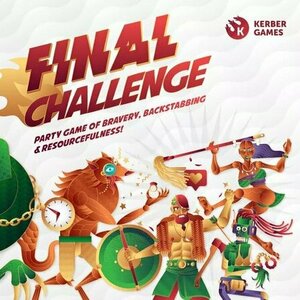
Final Challenge is a party game so packed with action it does not have to pose as a drinking game!...

Josh Burns (166 KP) rated Spartacus: A Game of Blood and Treachery in Tabletop Games
Jun 20, 2019
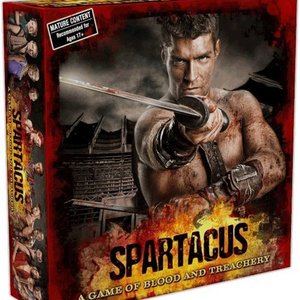

The base game is 3-4 players, there are expansions that increase that, but I'm sticking with the base game for this review. Each player controls a different House, which have their own stats, abilities, and alternate objectives, with the main objective being to reach 10 influence.
The game plays basically as follows:
Upkeep phase: collect money, try to heal wounded gladiators, and reactivate slaves that were used.
Market: A number of cards are drawn and placed face down, then one card is flipped. It could be a gladiator, a slave (can earn you money and may have abilities that are useful outside the arena) or gear for your gladiators. All players choose how many coins to bid and keep them in a closed fist until everyone is ready, then everyone reveals their bid. Whoever was highest wins. You then repeat till each card is flipped. You can also put your own cards up for auction or offer trades.
the arena: after this, 2 players chosen by another player have to either fight each other, pitting a slave or gladiator against the oppents, or forfeit at the cost of Influence. Players may place bets on who will win and if the loser will be killed, or badly injured.
The game is basically 2 games in 1: outside the arena and in it.
Outside: It is primarily about making deals, lying, setting each other up, making temporary allies and backstabbing. Literally the only rule in the actual rulebook about how to go about this is: "Don't be a dick. " It actually says that, and says they mean keep it fun, don't actually try to be a spiteful douche. There is nothing directing you when to lie or be honest, if you have to keep promises, etc.
In the arena: Combat is fun and simple. Not all fighters are equal but I have seen weak ones overcome the odds. If you're a fan of the show you will recognize many names. As a quick sidenote, an expansion can turn these fights from 1 vs 1 to 2 vs 2. I've won hard fought games, and I've lost on purpose to win a bet or fulfill a deal. Your fighter may or may not die or be injured. The player who chose the participants also decides the fate of the losing fighter (if they didn't die fighting) with a thumbs up or down. The player with the losing fighter can plead for the fighters survival or bribe, or maybe the player chosing wants the losing player to owe them a favor. There is never a clear cut choice.
In conclusion: This is a favorite of mine. It is unbelievably fun making deals (whether you keep them or not) bribing, setting players against each other etc. The combat is fun and easy to learn and the other players are typically screaming at whoever they want to win if they aren't doing well (in good fun, not actual anger). I can't think of anything to not like about it. If you like the show you'll love references such as the "Jupiter's Cock" card and seeing all the characters (slaves, gladiators, and dominas). If you don't like the show, it's still a hell of a game and you don't need to watch the show to know what's going on.
7 Wonders
8.3 Rate It
Tabletop Game Watch
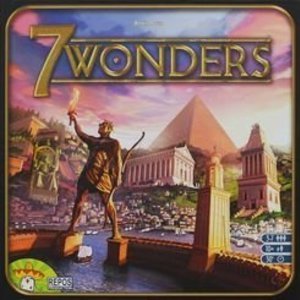
You are the leader of one of the 7 great cities of the Ancient World. Gather resources, develop...
BoardGames

Purple Phoenix Games (2266 KP) rated Werewolf: A Party Game for Devious People in Tabletop Games
Jun 24, 2021


Disclaimer: We were provided with a copy of this game for the purposes for this review. What you see is a finalized production copy, and is what would be received in a retail copy. -L
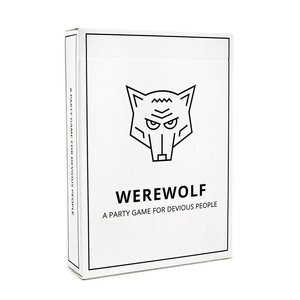
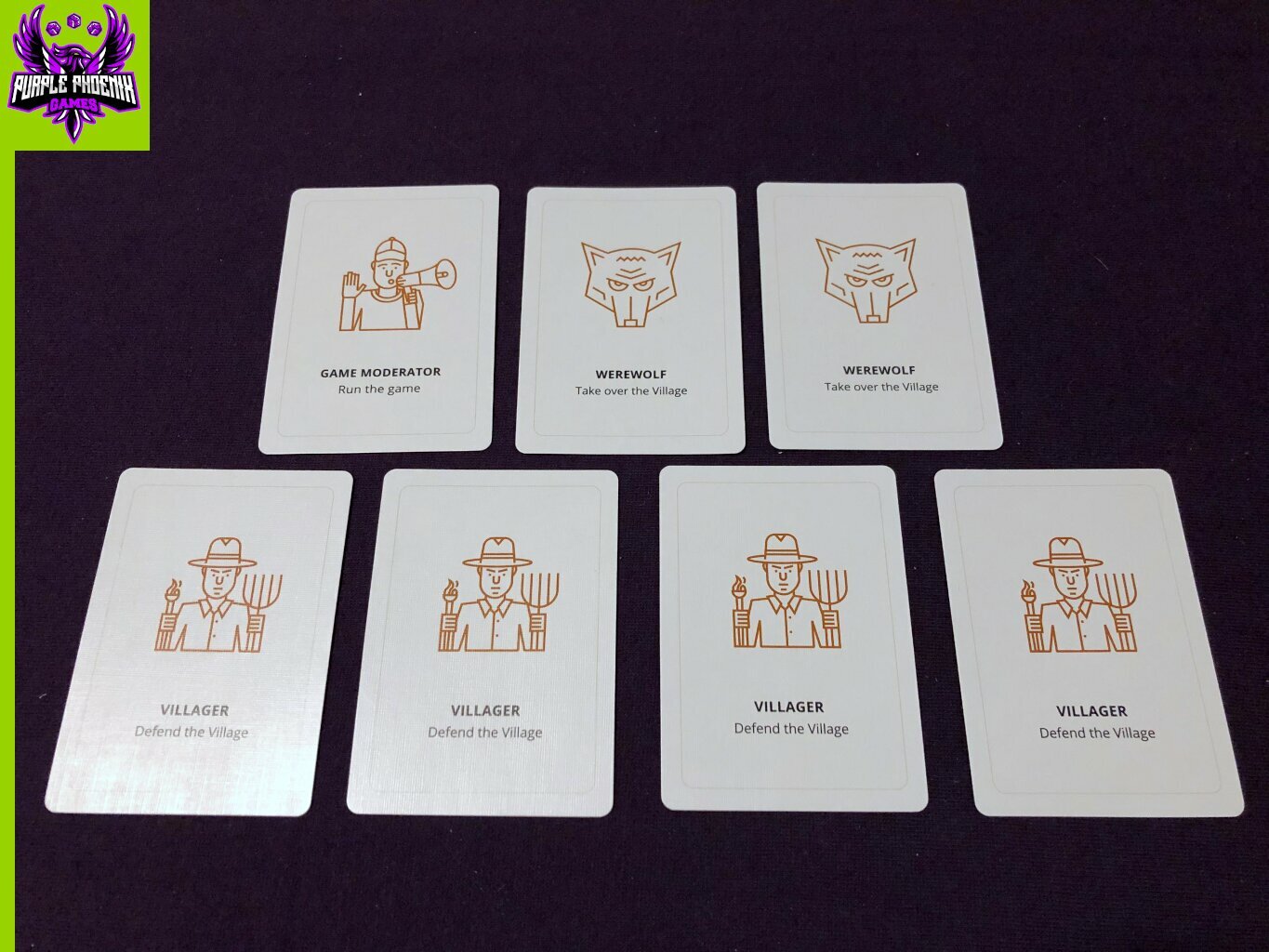
Werewolf: A Party Game for Devious People (simply referred to as Werewolf from here on out), is a game of bluffing and deduction in which players are attempting to complete their objective, based on their secret roles. Werewolves are trying to outnumber the Villagers, and Villagers are trying to kill all the Werewolves. To setup for a game, assemble the deck of role cards. Each deck will always have 1 Moderator card, a number of Werewolf cards, and a number of Villager cards depended on the player count. For example, a 5-player game would have 1 Moderator, 1 Werewolf, and 3 Villagers. Each player is dealt one card and keeps their role a secret, except the Moderator. The game is now ready to begin.
Each round consists of a Night and Day phase, all facilitated by the Moderator. To start the Night phase, all players (except for the Moderator) will close their eyes. The Moderator prompts the Werewolf to awaken (open eyes) and silently point to a Villager to kill. The Werewolf then closes their eyes, and the Night phase ends. To start the Day phase, the Moderator will have all players open their eyes, and will reveal which player has been killed in the night. All remaining ‘living’ players now have a chance to discuss amongst themselves and try to figure out the identity of the Werewolf. Accused players have a chance to defend themselves, and may even throw the blame to other players. Once players reach a consensus, they will kill off the accused Werewolf. If the accused player was the Werewolf, then the Villagers win (in a 5-player game)! If the accused player was not the Werewolf, then a new round begins with a Night phase, and the Werewolf is one step closer to winning. The game ends when either the Villagers have killed the Werewolf, or the Werewolf equals or outnumbers the Villagers.
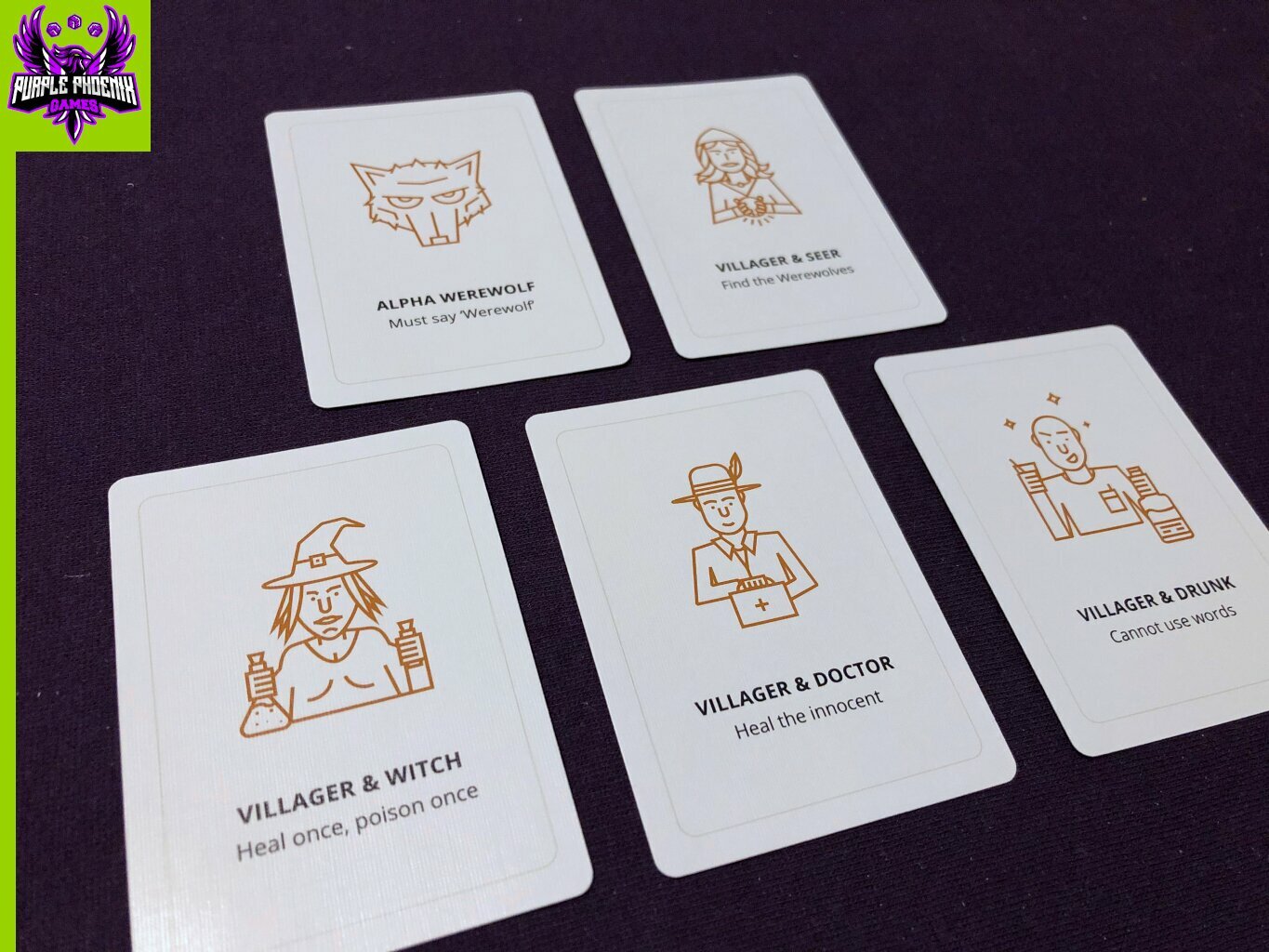
The above description is a generic rundown of the game. Many versions of Werewolf have additional roles/abilities to enhance the gameplay and add new elements to the strategy. This particular version of Werewolf does indeed include optional additional roles. Those roles are: Seer, Doctor, Drunk, Witch, and Alpha Werewolf. These optional roles grant players additional abilities/powers for use during play. For example, every Night phase, the Seer can silently ask the Moderator whether a single player is a Werewolf or not. That can definitely help in the Day phase when it is time to accuse people! The addition of these roles helps to enhance the strategic gameplay by offering more for players to do, rather than just blindly accuse and guess each round. Included in the tuck box are even some blank role cards for you to create your own roles/powers if you so choose.
The major downside to any version of Werewolf is that once a player has been killed off, if they were not the Werewolf, they are out of the game for good. So even if the game lasts for 20 more minutes, that player just has to sit there in silence.
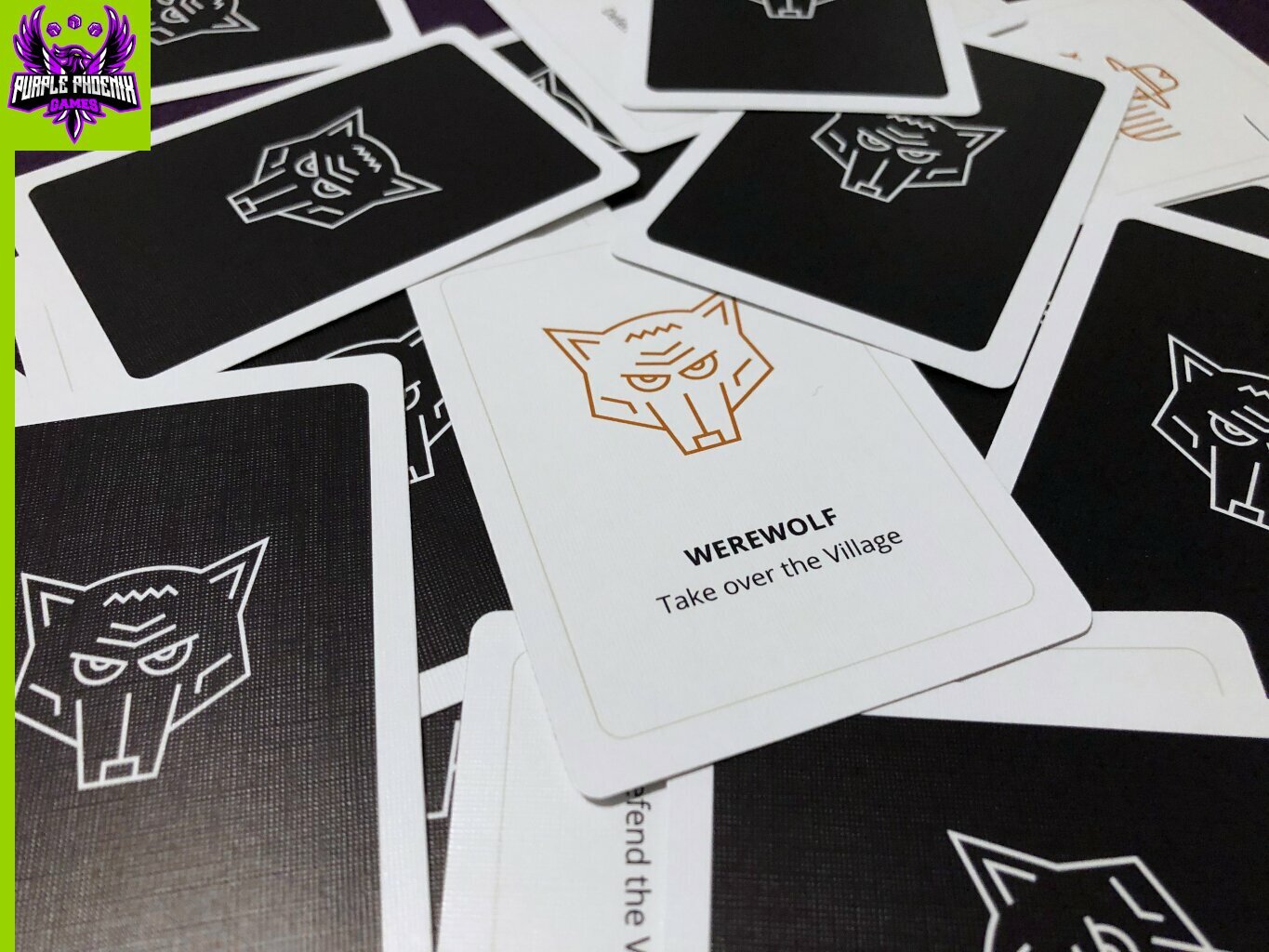
Components. This particular Werewolf consists of a deck of role cards, rules, and a guide for the Moderator. The quality of the cards is nice, and they are easy to manipulate and are sturdy. The artwork is very minimalistic in this game, and it actually works pretty well since Werewolf really isn’t a component-based game. All in all, a good quality deck of cards.
Overall, this is just a normal game of Werewolf. Honestly, you don’t really even need any components to play – as long as everyone knows the rules and roles, you are good to go. Does having a deck of cards help? In some ways, yes. But it kind of just feels redundant to me, since I already knew how to play the game. If you’re wanting to introduce someone to the Werewolf-type game, this little deck of cards would be a good way to do it. Personally, this type of game appealed to me more as a child/teen, and it kind of falls flat to me now as an adult, thus my low score. I don’t see this game staying in my collection forever, but it had a decent run while it was here. Purple Phoenix Games gives it a calculated 4 / 12. If you’ve played any variation of Werewolf before, there’s really no need to check out this particular iteration.


Real Steel
Games
App
Champions aren't born. They're made!! A Smash Hit with over 10 Million Downloads. – GIZMODO: "Game...
Survivalcraft 2
Games
App
What's new in the 2.1 update: - Play with up to 3 friends using split screen - Gamepads support -...
Purple Phoenix Games (2266 KP) rated Tiny Epic Western in Tabletop Games
Dec 30, 2021


Disclaimer: I do not intend to rehash the entire rulebook in this review, as there are just too many details, but will instead provide a more general overview of the rules and gameplay. -L
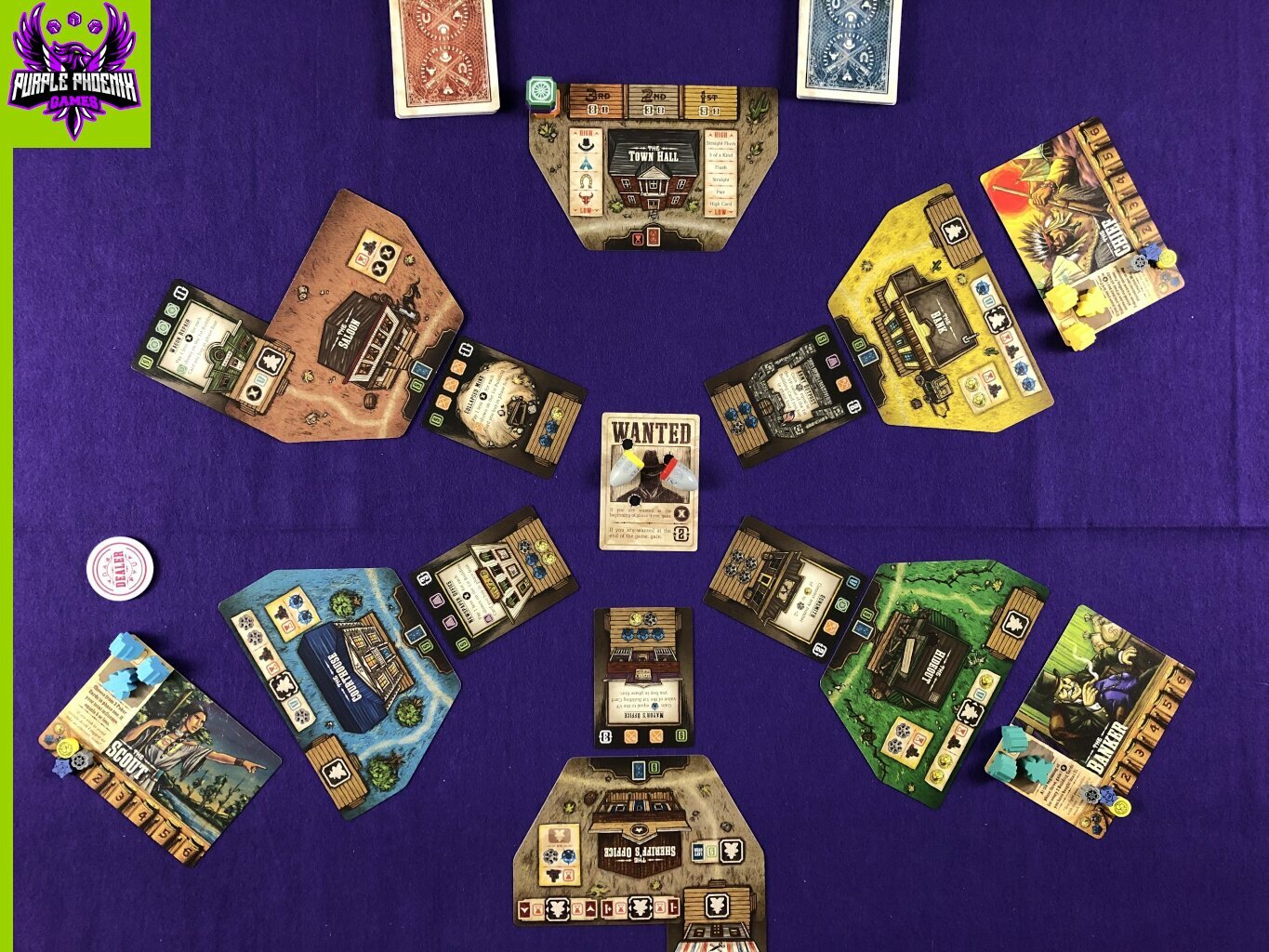
Tiny Epic Western is a game of worker placement and set collection in which players are trying to amass the most end-game victory points. Played over a series of rounds, players will be placing their Posse (Meeples), collecting Influence and taking actions, dueling opponents (if necessary), playing a bit of poker, and buying buildings in an effort to become the most powerful boss in this wild west town. To setup for a game, place the Location Mats as described in the rules, dealing a Building Card where appropriate. Each player receives a Boss card, 3 Posse tokens (Meeples), and one of each of the Influence trackers (Money, Law, and Force), placed on the 1 space of their card. Shuffle the decks of Building Cards and Poker Cards separately, choose a starting player (who receives the Dealer token), place the Wanted card/Gunslinger dice in the center of the play area, and the game is ready to begin! Pictured below is the starting setup for a 3-player game.
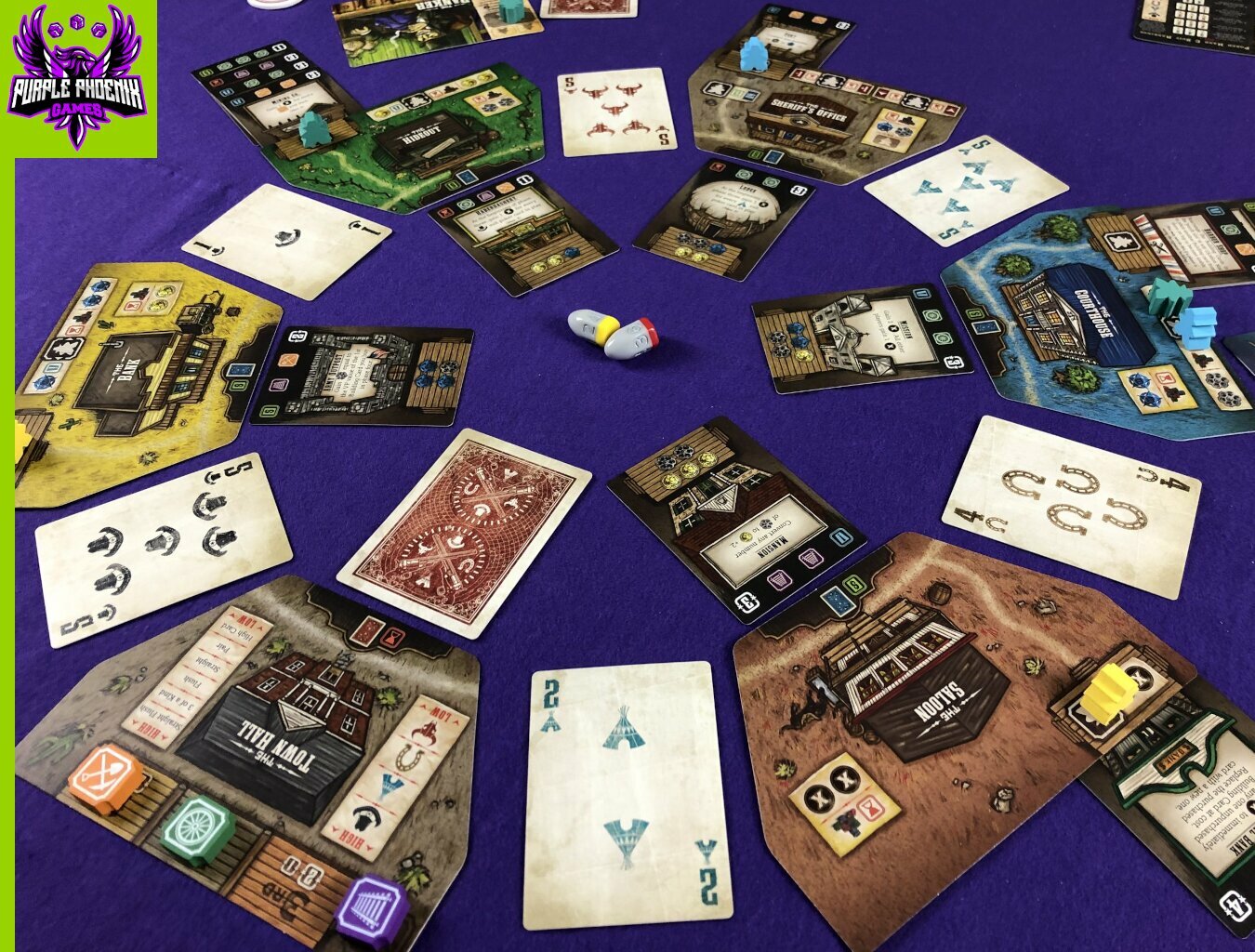
The game is played over 6 total rounds, each of which is broken into 4 phases: Shuffle and Deal, Posse Placement, Resolution, and Buy. To start a round, the Dealer shuffles the deck of Poker cards, and then deals 1 card face-up to the 6 empty spaces between the Location Mats. One Poker card is dealt face-down to the Rival Space (under the Town Hall Location Mat), and 2 Poker cards are dealt face-down to each player. Players look at both of their cards and pick 1 to keep, discarding the other. The round then moves to phase 2: Posse Placement. Starting with the Dealer, players will take turns placing Posse tokens onto the placement spots on any of the Location mats. All placement spots grant unique benefits (collecting different Influence or performing Building card actions) that are performed either immediately or during later phases of the round. What happens if an opponent took a placement spot that you wanted? Then it’s time for an old-fashioned duel! The dueling players each roll a Gunslinger die, modify it if they so choose, and determine a winner. Players continue taking turns placing Posse tokens until all available Posse tokens have been placed.
When all Posse tokens have been placed, the round moves to phase 3: Resolution. The first step of this phase is to reveal Poker cards – all players reveal their cards, and the card in the Rival Space is also revealed. Moving clockwise from the Town Hall, each Location will be resolved by ‘playing’ three-card poker. Each Location has 2 Poker cards directly adjacent to it (placed between the Locations in phase 1), and those 2 cards plus the one in your hand will form your Poker hand. Any players with Posse tokens on the Location will compare their Poker hands to determine a winner. If you win the hand, you collect the Winner’s Pot (extra benefits) and are able to collect any delayed benefits from placement spots in the Posse Placement phase. Losing the hand earns you nothing *womp womp*. If you are the only Posse on a Location (with no opponents) you will compare your hand to that of the Rival. The Rival’s hand uses the cards adjacent to the Town Hall, plus the revealed card in the Rival Space. If you have a better hand, you win the benefits on your Location. If the Rival wins, though, you do not collect these benefits. All Locations are resolved in this fashion before the last phase of the round, Buy, begins.
To start this phase, all players will compare their three-card Poker hands using the 2 Poker cards adjacent to the Town Hall. The player with the best hand will act first in this phase, followed by the next best hand, and so on. The first player may now choose to buy a Building card from any Location on which they have a Posse token. Pay the requisite amount of Influence to purchase a Building, and add it to the Porch Slot on your color-corresponding Location Mat. The power granted by this Building card is now available for use in future rounds. Once all players have had the option to purchase a Building, the player with the best hand will advance one of the Industry Tokens at Town Hall. The placements of Industry Tokens will affect end-game scoring, so keep that in mind as the game progresses. When all steps of the Buy phase are performed, the round now ends. Players collect all their Posse tokens back to their boss cards, all Poker cards are collected and re-shuffled, new Building cards are dealt to Locations from which they were purchased this round, and the Dealer token is passed to the next clockwise player. If a player did not buy a Building at all during the round, they have gained the Third Posse Benefit for the coming round – granting them an additional Posse token to place during phase 2. Otherwise, all players will only ever have 2 Posse tokens to place.
After a total of 6 complete rounds, the game ends and points are tallied. Victory Points are earned from Building cards bought throughout the game. Building cards have a specified VP amount, and also have a collection of Industry Icons on them. Using the final placement of the Industry Tokens on the board, players will earn points for Industry Icon sets they have collected. And finally, whomever holds the Wanted card (won the last duel) gains an additional 2 VP. Points are all counted, and the player with the highest score is the winner.
That all probably sounds pretty complicated. But I do have to say that verbally explaining/teaching the game (and being able to use components for examples) is waaaaay easier than doing so through a text review. So please do not let the seemingly complex gameplay turn you off from this game. Once you get a basic understanding of the phases of each round, the game moves along pretty seamlessly. Honestly, the biggest learning curve for me to conquer was playing three-card poker. As someone who has never played any form of poker before, this was probably what had me most hesitant about learning TEW. After having played it now, three-card poker really isn’t too complicated, and there are some nice player reference cards to help you figure it out.
Aside from the poker element, this game really comes down to worker placement and strategy. Each Location card only has a finite number of placement spots, and the resources required to buy Buildings are not exactly in abundance. This affects your strategy, as you must decide which resources to collect at what times, as well as deciding whether you need to duel someone for a coveted resource. Another element to your strategy? You may only buy Building cards from Locations on which you have a Posse token. Maybe none of those placement spots really appeal to you this round, but you reaaaaally want that specific Building card. Are you willing to ‘burn’ a Posse token for the chance to buy it? Or is there a different Location that offers a useful resources and a desirable Building card? Also, keep in mind how your poker hand will come into play. Since poker cards are dealt to each Location at the start of a round, you are able to see what your hand will be for each Location. Maybe you have a pretty strong hand at the Bank Location, but at the Courthouse the cards end up being a bust. Are you willing to risk a placement in hopes that you have the best hand of the bunch? Because remember – if you don’t have the best hand at a Location, you get no resources/rewards! There are so many elements to a successful strategy with this game, and it really keeps all players engaged at all times. Be warned though – the variety of strategic options could be difficult for some AP-prone players.
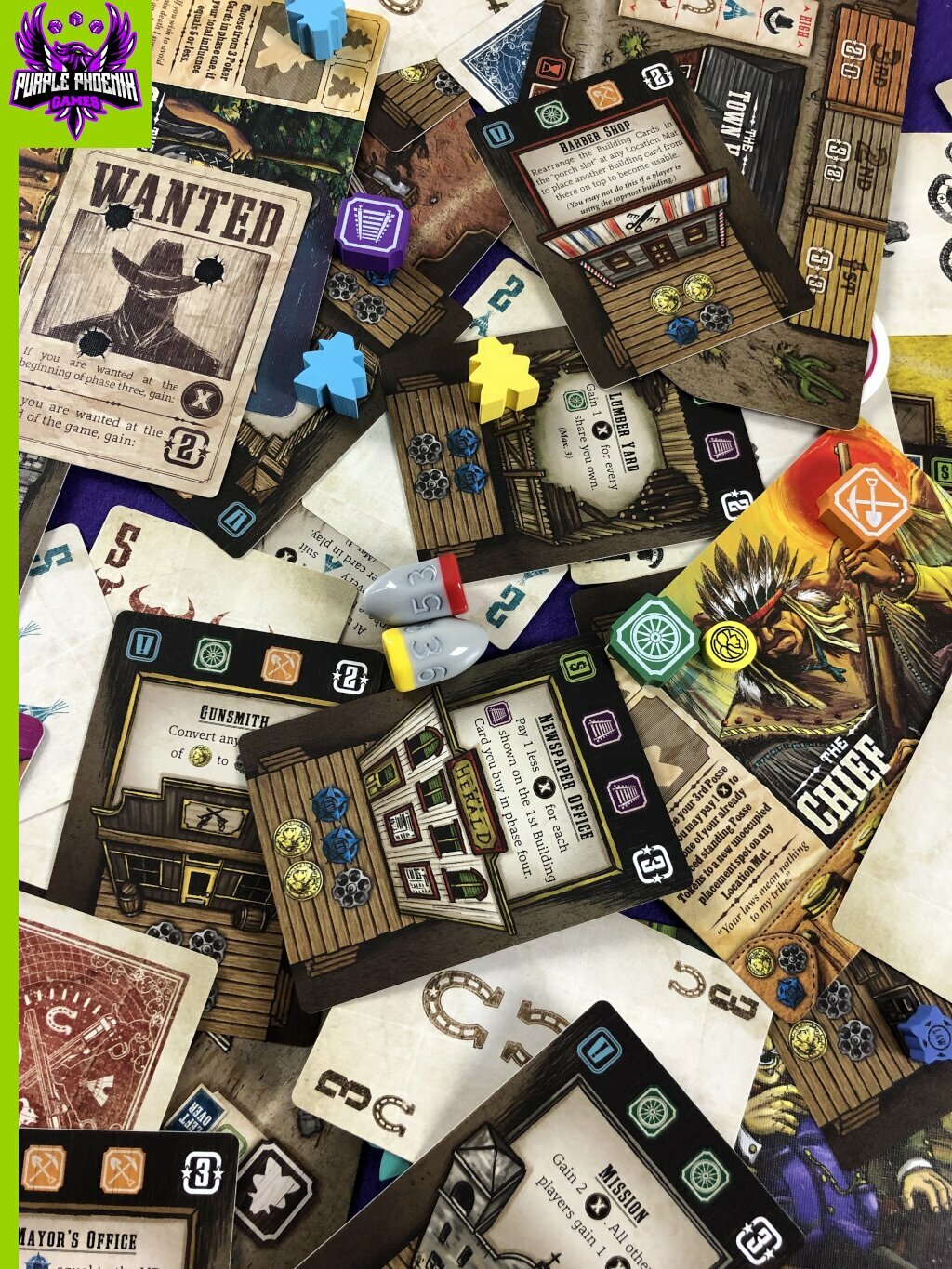
Let me touch on components for a minute. As with all Tiny Epic games, the production quality of TEW is pretty stellar. The cards are nice and sturdy, and the iconography is clear. The Posse tokens are cute Meeples with cowboy hats, and they are nice and chunky. The only thing I don’t really like about this game are the Gunslinger dice. In theory, they are super cool, but in actual execution, they leave much to be desired. The numbers aren’t really clearly define, so they’re a bit tricky to read. Aside from that, a pretty high quality game here.
So all in all, how does Tiny Epic Western stand up in the series? It is definitely one of the heavier games of the bunch, and there is so much more going on than initially meets the eye. It feels daunting for the first few plays, but once you get the phases under your belt, it really flows pretty well. I can’t say that it is my favorite Tiny Epic game, as I just personally feel like there are too many elements going on at the same time. You’re strategizing your worker placement, but also need to consider buying Buildings for VP and to collect sets of Industry Icons and for their specific abilities, as well as figuring out your poker hand for 5 different Locations, and dealing with duels. Some people might really be into that amount of strategic forethought, but it feels a bit cumbersome to me. That being said, Purple Phoenix Games gives this three-card poker game a 3/6. The gameplay is decent, just not really my kind of game.


Koltes Plays: v. 2: In the Solitude of Cotton Fields; Quai Quest; Sallinger; The Night Before the Forests
Book
A second collection of plays by the legendary French contemporary playwright IN THE SOLITUDE OF...

Kroetz Plays: v. 1: The Farmyard, Request Programme, The Nest, Tom Fool, Through the Leaves, Desire
Book
This is the first collection of plays available in the UK by Germany's most famous living...