
Search
Search results

Gareth von Kallenbach (980 KP) rated the PC version of Battlefield V in Video Games
Jun 19, 2019


The latest chapter in the long-running Battlefield series has arrived with the release of Battlefield V. The game looks to follow up the success of Battlefield 1 with a World War 2 based game that puts players directly into the action with large and highly-detailed maps.
The solo portion of the game has players battle in some diverse locales and focuses on situations form history where the participants were not well known and did not receive much glory or attention for their deeds.
After the introduction, players have the following options as described by E.A.
The stories were very enjoyable and thought provoking though I did get a few bugs while playing like a cut-scene lock up and some clipping issues where enemy characters were lodged in walls. Thankfully issues like this were few and I was able to complete the missions as they were engrossing and kept me riveted throughout.
I especially liked the Nordlys mission where I was able to don Skis and made my way around the frozen landscapes to complete my mission.
The missions were a mix of stealth, surviving waves of enemies, and capturing objectives which is what you would expect for a game of this type. The game does allow players to have a more diverse approach to completing missions as you can use vehicles and other objects found in the game to be creative. I was able to “borrow” a plane in Under No Flag to strafe the enemy locales. When my piloting skills were not up to snuff and I crashed in a lake; I redid the mission from a direct assault approach and things went much better for me.
The game uses a regenerative health system so should you take too much damage, simply take cover until you heal up and battle on. There is also an option to heal from time to time when battling online. Players will be able to pick up new weapons and ammunition off fallen enemies as well as at various points throughout the game.
Visually the game is very appealing from the open desert to the raging blizzard in the campaigns; there is plenty of eye candy to enjoy along with the action.
The online modes were very enjoyable as there were a variety of modes for players to enjoy.
The multiplay was good and what impressed me was how fair the hit detection was. You did not have to empty an entire clip into an enemy to take them down nor did glancing shots also produce a fatal result. The maps were large and highly detailed which allowed players to try a mixture of gameplay styles to best suit their needs.
It should be noted that additional content for the game will be coming as the menus made mention of solo missions and other features that were listed as “coming soon” and we know that the Battle Royale mode for the game is not due until 2019 as an example.
It should also be noted that I did not see the Female fighter with the prosthetic arm that was featured in the announcement trailers for the game and caused division amongst fans upon the reveal for the game. If she was edited out, planned for a later date, or simply included for demonstration purposes remains to be seen. What is clear is that although fans may expect more content and be disappointed in having to wait for parts of the game to release at a later date, the game is enjoyable for fans of the series and after my experiences with the Beta; even better than expected. I look forward to seeing what the game will look like in the future once the coming updates and patches are applied, but for now; Battlefield V is a solid WW2 game with solid visuals and sound and is a worthy entry into the series.
http://sknr.net/2018/11/12/battlefield-v/
The solo portion of the game has players battle in some diverse locales and focuses on situations form history where the participants were not well known and did not receive much glory or attention for their deeds.
After the introduction, players have the following options as described by E.A.
The stories were very enjoyable and thought provoking though I did get a few bugs while playing like a cut-scene lock up and some clipping issues where enemy characters were lodged in walls. Thankfully issues like this were few and I was able to complete the missions as they were engrossing and kept me riveted throughout.
I especially liked the Nordlys mission where I was able to don Skis and made my way around the frozen landscapes to complete my mission.
The missions were a mix of stealth, surviving waves of enemies, and capturing objectives which is what you would expect for a game of this type. The game does allow players to have a more diverse approach to completing missions as you can use vehicles and other objects found in the game to be creative. I was able to “borrow” a plane in Under No Flag to strafe the enemy locales. When my piloting skills were not up to snuff and I crashed in a lake; I redid the mission from a direct assault approach and things went much better for me.
The game uses a regenerative health system so should you take too much damage, simply take cover until you heal up and battle on. There is also an option to heal from time to time when battling online. Players will be able to pick up new weapons and ammunition off fallen enemies as well as at various points throughout the game.
Visually the game is very appealing from the open desert to the raging blizzard in the campaigns; there is plenty of eye candy to enjoy along with the action.
The online modes were very enjoyable as there were a variety of modes for players to enjoy.
The multiplay was good and what impressed me was how fair the hit detection was. You did not have to empty an entire clip into an enemy to take them down nor did glancing shots also produce a fatal result. The maps were large and highly detailed which allowed players to try a mixture of gameplay styles to best suit their needs.
It should be noted that additional content for the game will be coming as the menus made mention of solo missions and other features that were listed as “coming soon” and we know that the Battle Royale mode for the game is not due until 2019 as an example.
It should also be noted that I did not see the Female fighter with the prosthetic arm that was featured in the announcement trailers for the game and caused division amongst fans upon the reveal for the game. If she was edited out, planned for a later date, or simply included for demonstration purposes remains to be seen. What is clear is that although fans may expect more content and be disappointed in having to wait for parts of the game to release at a later date, the game is enjoyable for fans of the series and after my experiences with the Beta; even better than expected. I look forward to seeing what the game will look like in the future once the coming updates and patches are applied, but for now; Battlefield V is a solid WW2 game with solid visuals and sound and is a worthy entry into the series.
http://sknr.net/2018/11/12/battlefield-v/

Purple Phoenix Games (2266 KP) rated Battlestar Galactica: The Board Game in Tabletop Games
Feb 23, 2021
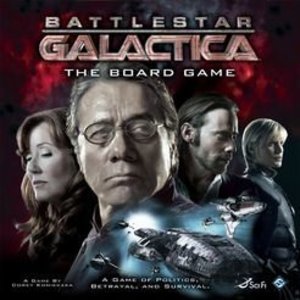

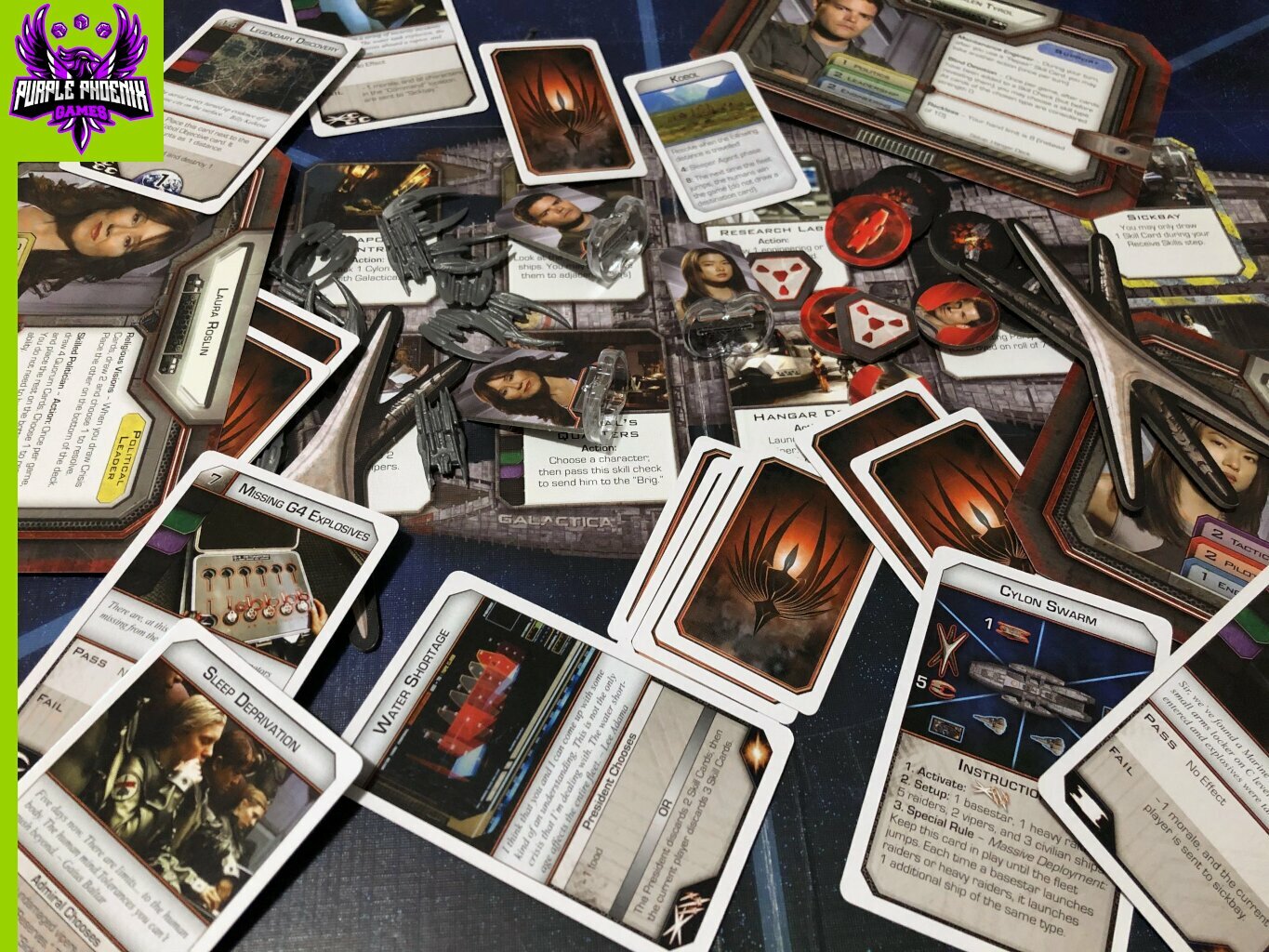
Welcome aboard the Battlestar Galactica, a ship home to the remnants of the human race. After an uprising and near-annihilation by the Cylons (cyborg workers/soldiers created by the humans), the human survivors have taken to space to outrun their mechanical enemies and search for a new world to inhabit. Hardly a walk in the park, this journey through space is filled with many challenges – from fuel and food shortages to mutiny and battles for power. The biggest challenge of all, however, is that the Cylons have advanced to such a high level that they actually appear to be human. Are the Galactica’s misfortunes just bad luck, or are they being orchestrated by a Cylon who has infiltrated the ship and is yet to be discovered? Who can you trust? Which race will end up victorious?
Disclaimer: There are several expansions for Battlestar Galactica. This review will not take any expansions into account, and will focus solely on the base game. Also, I do not intend to rehash the entire rulebook in this review, but rather provide an overview of the gameplay. – L
To setup for a game, follow the instructions in the rulebook – there are simply too many to detail here. Each player selects a Character, and receives the corresponding Character sheet and tokens. Based on the Characters selected, one player will receive the President title and another the Admiral title. Depending on how many players there are, a Loyalty deck is created and each player is secretly dealt a Loyalty card – either “You are not a Cylon” or “You Are a Cylon.” The Loyalty cards determine how you will play the game: human players win if they complete their given objective, and Cylon players win if they prevent the humans from completing their objective (by depleting resources, successfully invading the Galactica, or destroying the Galactica itself). The game is now ready to begin!
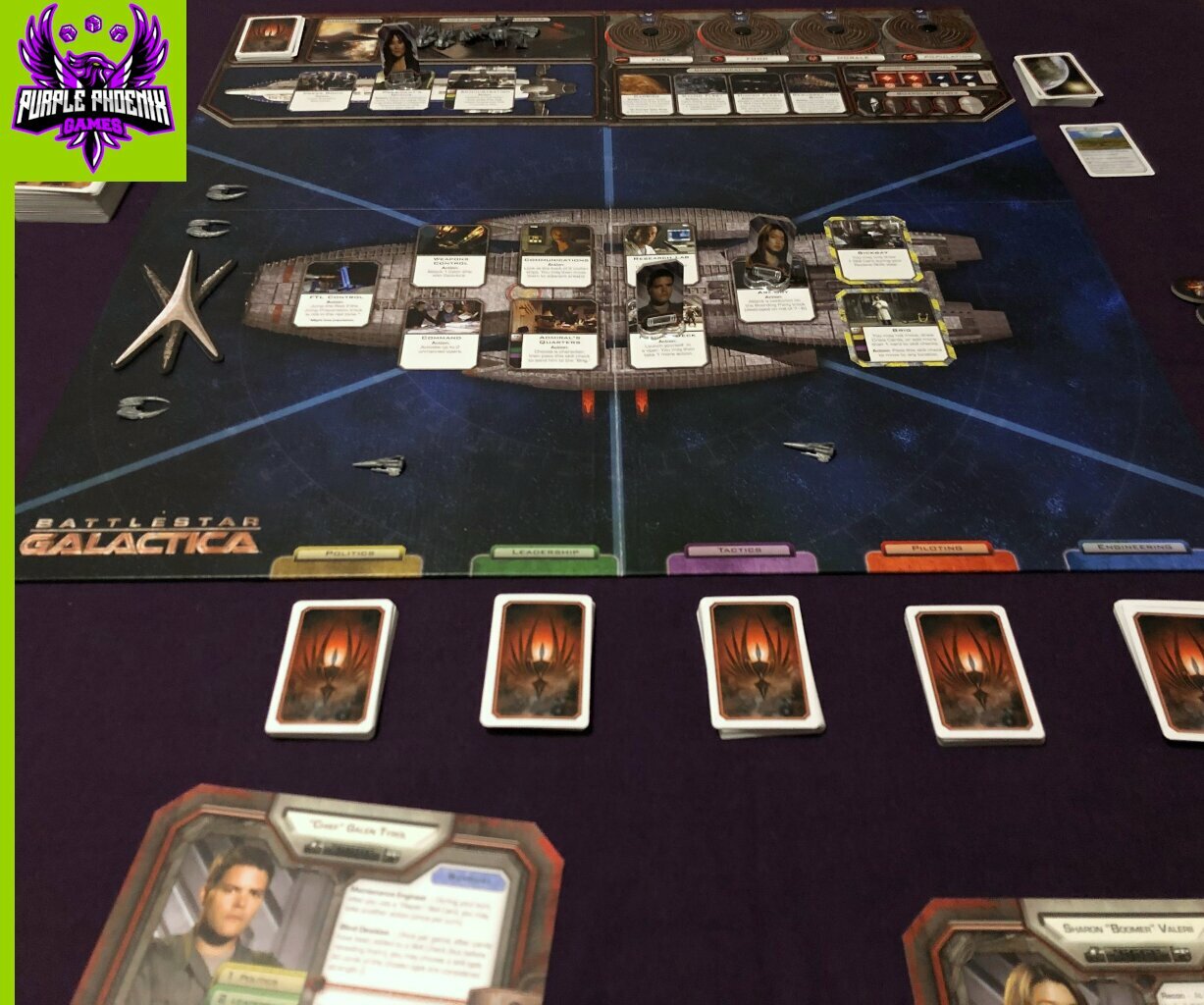
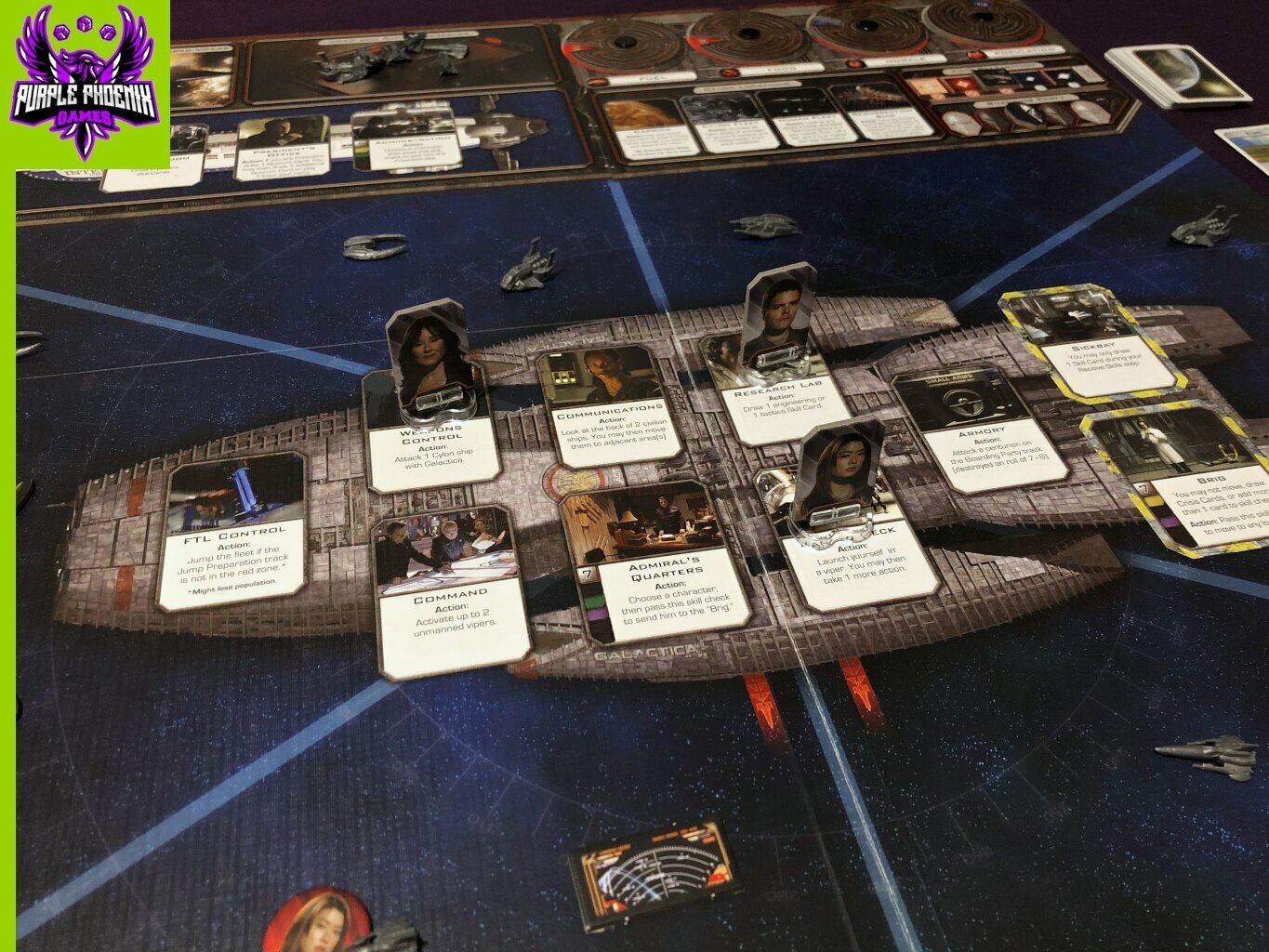
Battlestar Galactica is played over a series of rounds in which players take turns moving, performing actions, playing/drawing cards, etc. until either the human players or Cylon players have won the game. A player’s turn consists of 4 main steps, carried out in the following order: Receive Skills, Movement, Action, and Crisis. To begin your turn, you will draw Skill cards according to the skills listed on your Character sheet. Skill cards can be used to address crises or can provide special abilities. In the next step, Movement, you may move your Character to a different location/ship (all provide special actions). After moving, you will then choose one Action to perform – either listed on your current location, Character sheet, by using a Skill card, or you may choose to perform no action at all. Once you have completed your action, draw the top card of the Crisis deck, and resolve it. Depending on the Crisis card drawn, you may need to then Activate Cylon Ships or Prepare for Jump (more on this in a bit). If neither of those are listed on the Crisis card, then your turn ends and play moves to the next player.
I know that seems like a lot, but each turn of Battlestar Galactica can essentially be broken down into 2 phases: Player Actions and Space Combat. The first phase, Player Actions, is what is detailed above – drawing Skills, Movement, Actions, and drawing Crisis cards. This phase is where players make progress towards their objectives. Certain Actions or Skill cards earn specific rewards necessary to move forward in the game. Crisis cards can consist of Cylon attacks (activating and adding new Cylon ships to the board), Skill checks (all players secretly contribute Skill cards to either aid or sabotage the Skill check), or Events (resolved immediately). The second phase of play, Space Combat, takes place after the Crisis card has been drawn on each turn. Certain Crisis cards will show icons of Cylon ships, indicating that they are to be activated for combat, launched into play, or moved around the Galactica. Cylon ships will act based upon an action hierarchy, detailed in the rulebook. If the drawn Crisis card has the “Prepare for Jump” icon, move the fleet token forward on the Jump Preparation track, jumping the fleet if necessary (and moving the humans closer to their game-end objective). I have purposefully left out some elements of play, for you to discover on your own, or because they just provide intricate detail for the steps and actions described above. When the game-end objective is met by either the human players or the Cylons, the game is over and that respective race wins the game!
To say that there is a lot going on in Battlestar Galactica is quite an understatement. There are several rules and game elements that I did not touch upon, just because if I did then this review would be too long. With so many elements in play and of which to keep track, this game is not exactly for the faint of heart. The gameplay is very involved and requires a good amount of strategy – this is definitely a game that could take up most of a game night to play. That being said, I love this game. There is a lot going on, but that just provides players with so many different strategies to complete their objectives. Maybe you want to focus on dealing with Skill checks or Crisis cards, but maybe you’d rather think offensively and be prepared for any potential Space Combat. Can you help the crew efficiently manage its resources, or position its fleet to protect the Galactica itself? Your strategy must be adaptable at a moment’s notice to help you complete your objective….whatever it may be.
Speaking of which, the fact that there may or may not be secret Cylon players attempting to disrupt your plans really takes a hidden identity game to the next level. Cylons want to sabotage the humans, but in subtle ways as to not be found out – because once a Cylon is revealed, the humans can target and hinder their turns. Can you convince the humans that your previous actions were honest mistakes, or will they catch on that you are trying to undermine their efforts? The elements of deception and bluffing in this regard make the game much more immersive and make it feel realistic – there is a traitor among us and we have to find them, while also completing our own objectives. You really start to question who to trust and how your own actions can be perceived by your fellow players. There have been times, when playing this game, that we have taken breaks for dinner or snacks, and all players pocketed their cards rather than leave them on the table, vulnerable to sneaky opponents. Battlestar Galactica is definitely engaging for all players, and for such an involved and lengthy game, that is something to be applauded.
Let’s touch on components for a minute. The production quality of this game is great. The cardboard elements, including resource dials, are thick and sturdy. The cards and Character sheets are quality, colorful, and feel good in hand. And the plastic ships are well made too. The artwork consists mainly of screen caps from the TV show (which I admittedly have not yet seen…) but the theme and cohesiveness of the components makes for an immersive and engaging game overall.
In general, I am not a person who enjoys hidden identity games – simply because I am a bad liar and get found out almost immediately. However, the way this mechanic is incorporated into Battlestar Galactica makes it more a game of strategy than simple deception. And games of strategy are what I truly love. Managing your hand of Skill cards to best overcome Crisis cards, thinking tactically about how to deploy your fleet and battle Cylon ships, and having to determine who among the crew can actually be trusted keeps all players engaged across the board. Nobody can just sit back and relax, every single turn can drastically affect the outcome of the game. Everyone is in it, and that is what I love about this game. Purple Phoenix Games gives it a 11 / 12. This game has been out of print for a while now, but if you ever get a chance to play – jump on it! You don’t have to know the show to enjoy the game. Trust me, I haven’t seen a single episode yet.
Disclaimer: There are several expansions for Battlestar Galactica. This review will not take any expansions into account, and will focus solely on the base game. Also, I do not intend to rehash the entire rulebook in this review, but rather provide an overview of the gameplay. – L
To setup for a game, follow the instructions in the rulebook – there are simply too many to detail here. Each player selects a Character, and receives the corresponding Character sheet and tokens. Based on the Characters selected, one player will receive the President title and another the Admiral title. Depending on how many players there are, a Loyalty deck is created and each player is secretly dealt a Loyalty card – either “You are not a Cylon” or “You Are a Cylon.” The Loyalty cards determine how you will play the game: human players win if they complete their given objective, and Cylon players win if they prevent the humans from completing their objective (by depleting resources, successfully invading the Galactica, or destroying the Galactica itself). The game is now ready to begin!
Battlestar Galactica is played over a series of rounds in which players take turns moving, performing actions, playing/drawing cards, etc. until either the human players or Cylon players have won the game. A player’s turn consists of 4 main steps, carried out in the following order: Receive Skills, Movement, Action, and Crisis. To begin your turn, you will draw Skill cards according to the skills listed on your Character sheet. Skill cards can be used to address crises or can provide special abilities. In the next step, Movement, you may move your Character to a different location/ship (all provide special actions). After moving, you will then choose one Action to perform – either listed on your current location, Character sheet, by using a Skill card, or you may choose to perform no action at all. Once you have completed your action, draw the top card of the Crisis deck, and resolve it. Depending on the Crisis card drawn, you may need to then Activate Cylon Ships or Prepare for Jump (more on this in a bit). If neither of those are listed on the Crisis card, then your turn ends and play moves to the next player.
I know that seems like a lot, but each turn of Battlestar Galactica can essentially be broken down into 2 phases: Player Actions and Space Combat. The first phase, Player Actions, is what is detailed above – drawing Skills, Movement, Actions, and drawing Crisis cards. This phase is where players make progress towards their objectives. Certain Actions or Skill cards earn specific rewards necessary to move forward in the game. Crisis cards can consist of Cylon attacks (activating and adding new Cylon ships to the board), Skill checks (all players secretly contribute Skill cards to either aid or sabotage the Skill check), or Events (resolved immediately). The second phase of play, Space Combat, takes place after the Crisis card has been drawn on each turn. Certain Crisis cards will show icons of Cylon ships, indicating that they are to be activated for combat, launched into play, or moved around the Galactica. Cylon ships will act based upon an action hierarchy, detailed in the rulebook. If the drawn Crisis card has the “Prepare for Jump” icon, move the fleet token forward on the Jump Preparation track, jumping the fleet if necessary (and moving the humans closer to their game-end objective). I have purposefully left out some elements of play, for you to discover on your own, or because they just provide intricate detail for the steps and actions described above. When the game-end objective is met by either the human players or the Cylons, the game is over and that respective race wins the game!
To say that there is a lot going on in Battlestar Galactica is quite an understatement. There are several rules and game elements that I did not touch upon, just because if I did then this review would be too long. With so many elements in play and of which to keep track, this game is not exactly for the faint of heart. The gameplay is very involved and requires a good amount of strategy – this is definitely a game that could take up most of a game night to play. That being said, I love this game. There is a lot going on, but that just provides players with so many different strategies to complete their objectives. Maybe you want to focus on dealing with Skill checks or Crisis cards, but maybe you’d rather think offensively and be prepared for any potential Space Combat. Can you help the crew efficiently manage its resources, or position its fleet to protect the Galactica itself? Your strategy must be adaptable at a moment’s notice to help you complete your objective….whatever it may be.
Speaking of which, the fact that there may or may not be secret Cylon players attempting to disrupt your plans really takes a hidden identity game to the next level. Cylons want to sabotage the humans, but in subtle ways as to not be found out – because once a Cylon is revealed, the humans can target and hinder their turns. Can you convince the humans that your previous actions were honest mistakes, or will they catch on that you are trying to undermine their efforts? The elements of deception and bluffing in this regard make the game much more immersive and make it feel realistic – there is a traitor among us and we have to find them, while also completing our own objectives. You really start to question who to trust and how your own actions can be perceived by your fellow players. There have been times, when playing this game, that we have taken breaks for dinner or snacks, and all players pocketed their cards rather than leave them on the table, vulnerable to sneaky opponents. Battlestar Galactica is definitely engaging for all players, and for such an involved and lengthy game, that is something to be applauded.
Let’s touch on components for a minute. The production quality of this game is great. The cardboard elements, including resource dials, are thick and sturdy. The cards and Character sheets are quality, colorful, and feel good in hand. And the plastic ships are well made too. The artwork consists mainly of screen caps from the TV show (which I admittedly have not yet seen…) but the theme and cohesiveness of the components makes for an immersive and engaging game overall.
In general, I am not a person who enjoys hidden identity games – simply because I am a bad liar and get found out almost immediately. However, the way this mechanic is incorporated into Battlestar Galactica makes it more a game of strategy than simple deception. And games of strategy are what I truly love. Managing your hand of Skill cards to best overcome Crisis cards, thinking tactically about how to deploy your fleet and battle Cylon ships, and having to determine who among the crew can actually be trusted keeps all players engaged across the board. Nobody can just sit back and relax, every single turn can drastically affect the outcome of the game. Everyone is in it, and that is what I love about this game. Purple Phoenix Games gives it a 11 / 12. This game has been out of print for a while now, but if you ever get a chance to play – jump on it! You don’t have to know the show to enjoy the game. Trust me, I haven’t seen a single episode yet.
Purple Phoenix Games (2266 KP) rated Dreams of Tomorrow in Tabletop Games
Sep 17, 2020
Let’s talk about dreams. They can range from simply reliving a stressful day at work, to remembering THAT embarrassing moment from your past, to maybe even discovering that you have superpowers. In your dreams, there are endless possibilities – but what if they meant something more? According to Dreams of Tomorrow, our dreams actually serve a bigger purpose!
Dreams of Tomorrow is game of set collection that utilizes a shifting rondel (I had to look up the definition too) in which players are working to weave a series of dreams into a complete Dream Sequence. Set in the future, players take on the roles of Dream Engineers, who are tasked with creating Dream Sequences to be sent to the past in an effort to save the future. Can you weave the most powerful Dream Sequence to alter the path of your present life, or is the future doomed to fall?
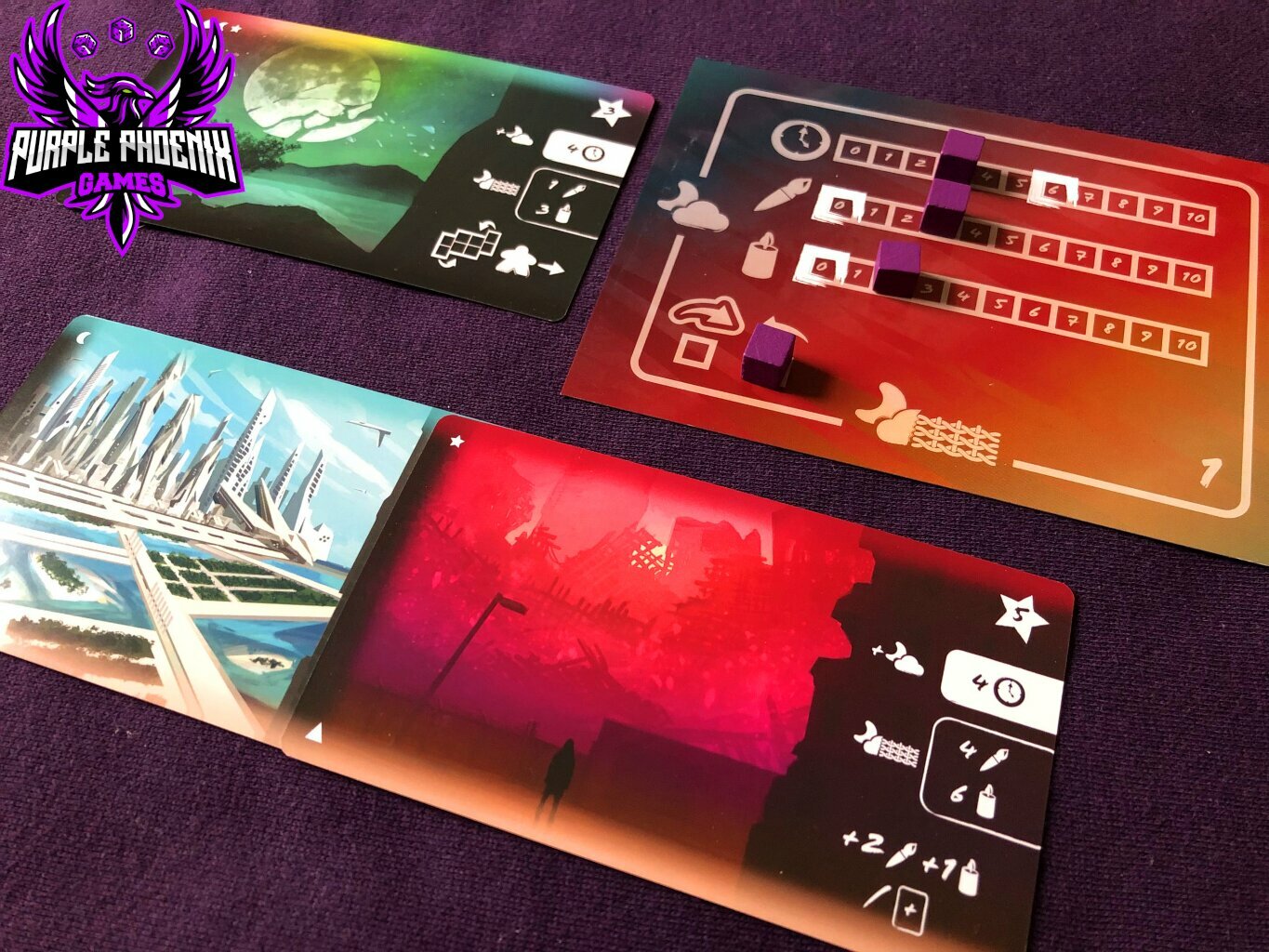
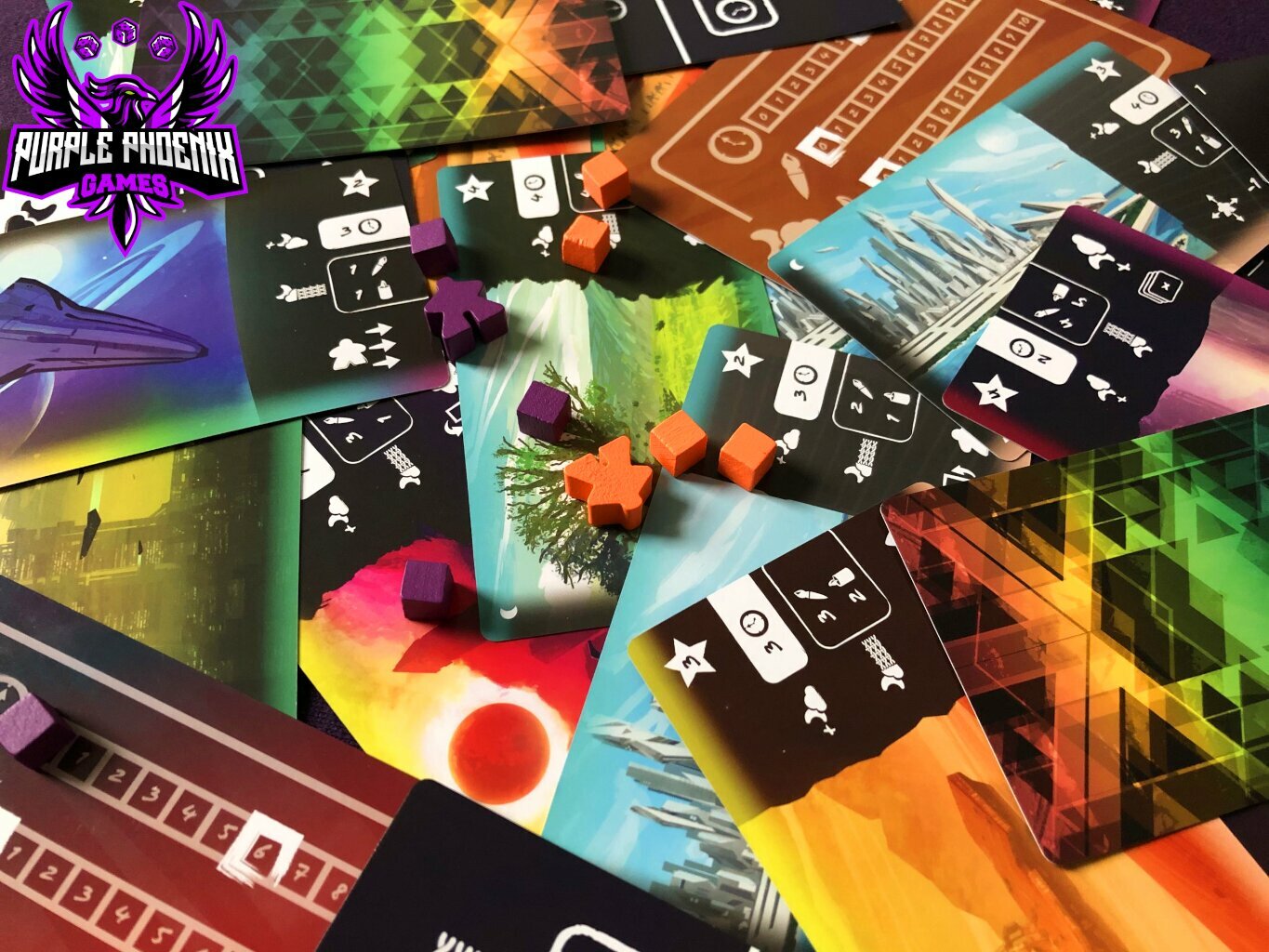
DISCLAIMER: We were provided a copy of this game for the purposes of this review. This is a retail copy of the game, so what you see in these photos is exactly what would be received in your box. I do not intend to cover every single rule included in the rulebook, but will describe the overall game flow and major rule set so that our readers may get a sense of how the game plays. For more in depth rules, you may purchase a copy online or from your FLGS. -L
To setup the game, place the Collective Consciousness (the rondel) in numerical order within reach of all players. Reveal a number of Dream cards from the Dream deck, based on the number of players, and these cards will create the communal Dreamscape. Each player receives a player card, cubes, and meeple in their chosen color, and sets their resources to the starting numbers, as described in the rulebook. All players begin with their meeples in the first space of the rondel, and in clockwise order, will select and pay for a Dream from the Dreamscape to be placed in their Dream Catcher (waiting area). Once all players have selected a Dream, and adjusted their resources accordingly, the game is ready to begin.
Dreams of Tomorrow is played over a series of rounds in which players will take turns performing 2 actions: Move and Take Action. Movement happens sequentially around the rondel, and players may choose how many spaces to move. To move 1-3 spaces is free, but to move more than 3 spaces will cost a number of resources. When a player decides to end their movement, they will then take the action indicated on the space on which they landed. These actions include: Gaining resources, Catching a Dream, Weaving a Dream, or Activating a Dream Ability. Gaining resources is pretty self-explanatory, and there is one neat thing to note: even if it is not your active turn, most of the rondel spaces have a Shared Effect, which grants an off-turn action to all non-active players. Catching a Dream means that you pay the requisite resources and select a Dream from the Dreamscape. Any caught Dreams go into your Dream Catcher until you are able to perform the Weave a Dream action. When you Weave a Dream, you again pay the requisite resources displayed on the Dream card and move the Dream from your Dream Catcher into your Dream Sequence (play area). To Activate a Dream Ability, you select a Dream card in your tableau, and use the ability printed on it. It is important to note that once Dreams are woven into your Dream Sequence, they will overlap each other, and only one Dream Ability will ever be available for use, so create that sequence wisely! Play continues in turns until one player has woven a Dream Sequence of five Dreams total. The round ends once all players have taken the same number of turns, and then final points are counted. The player with the highest score is the winner!
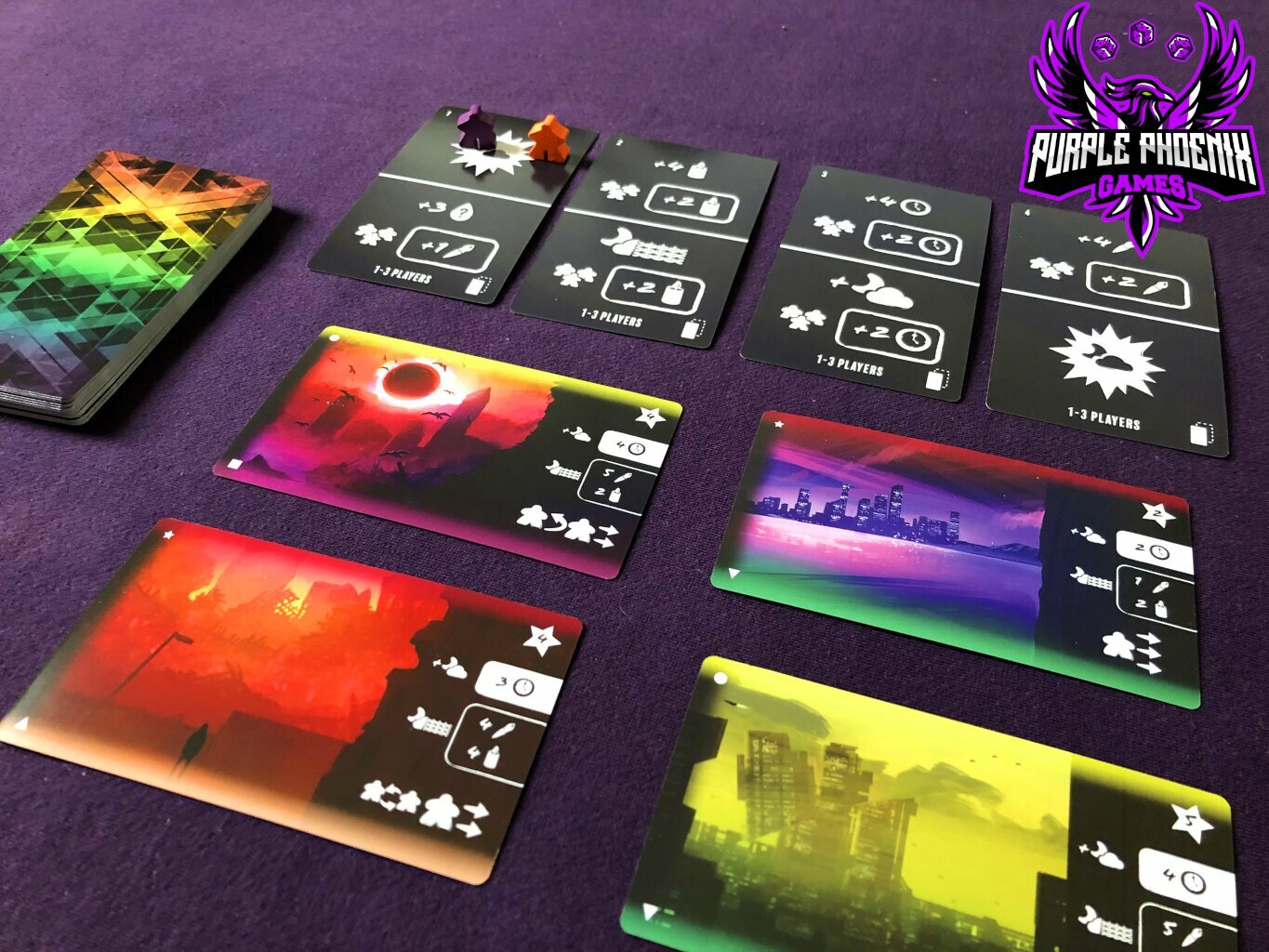
So all-in-all, how is Dreams of Tomorrow as a whole? I actually was very surprised at how much I enjoyed this game. When reading through the rules, it seemed kind of complicated and I was a bit worried before my first play. Once you actually get playing, however, the game is pretty intuitive and simple to play. One thing I particularly enjoyed about this game is its iconography. With only three resources and four actions, there are only seven icons of which to keep track. It keeps the cards from being cluttered with text, and makes the costs/abilities clear to understand. The iconography of the Dream Abilities, however, can be a liiiittle more complicated, but the game does come with Reference Cards which explain what every single icon means!
Another neat thing I enjoyed about this gameplay is the addition of Shared Effects. Even if you are not the active player, you will always gain some resource on everyone else’s turn. That adds an extra element of strategy because you have to amass your own resources for Dreams, but you have to be careful not to be giving your opponents too much extra help for themselves! Probably my favorite part of Dreams of Tomorrow are the actual Dream Abilities themselves. Performing the regular turn actions are pretty straight-forward, but Dream Abilities are more special and allow you to do even more on your turn. For example, some Dream Abilities allow you to change directions, move extra spaces, or even alter the Collective Consciousness, re-arranging the cards in a way to benefit you and hopefully hinder your opponents. The Dream Abilities are literal game-changers, and they really keep all players on their toes.
Talking about components, this game is of a pretty good quality. The cards are nice and sturdy, the player boards are decent, and the meeples and cubes are your standard wooden tokens. I’ve said in reviews before, but I always appreciate when games include Reference Cards for players, and Dreams of Tomorrow certainly delivered on theirs. The cards are clear, concise, and helpful during play. The artwork of this game is very vibrantly colorful and just plain pretty to look at. I found myself getting distracted by admiring the artwork, or catching Dreams based on their artwork, instead of taking their point-values or resources requirements into consideration. Oops. That’s just my bad, but the artwork really helps make the game more immersive.
Overall, I would say that Dreams of Tomorrow is a great little game. Admittedly, the rulebook is kind of daunting and seems a little overly complicated at first, but once you get into an actual game, it flows very quickly and easily. After just one turn, I got exactly what was happening and had no further questions about the gameplay. It really went above and beyond my expectations, and is one that I definitely look forward to bringing out in future game nights. Purple Phoenix Games gives it a dreamy 10 / 12. Check this one out if you haven’t before, it may just be the game of your dreams. (Ha, get it?)
Dreams of Tomorrow is game of set collection that utilizes a shifting rondel (I had to look up the definition too) in which players are working to weave a series of dreams into a complete Dream Sequence. Set in the future, players take on the roles of Dream Engineers, who are tasked with creating Dream Sequences to be sent to the past in an effort to save the future. Can you weave the most powerful Dream Sequence to alter the path of your present life, or is the future doomed to fall?
DISCLAIMER: We were provided a copy of this game for the purposes of this review. This is a retail copy of the game, so what you see in these photos is exactly what would be received in your box. I do not intend to cover every single rule included in the rulebook, but will describe the overall game flow and major rule set so that our readers may get a sense of how the game plays. For more in depth rules, you may purchase a copy online or from your FLGS. -L
To setup the game, place the Collective Consciousness (the rondel) in numerical order within reach of all players. Reveal a number of Dream cards from the Dream deck, based on the number of players, and these cards will create the communal Dreamscape. Each player receives a player card, cubes, and meeple in their chosen color, and sets their resources to the starting numbers, as described in the rulebook. All players begin with their meeples in the first space of the rondel, and in clockwise order, will select and pay for a Dream from the Dreamscape to be placed in their Dream Catcher (waiting area). Once all players have selected a Dream, and adjusted their resources accordingly, the game is ready to begin.
Dreams of Tomorrow is played over a series of rounds in which players will take turns performing 2 actions: Move and Take Action. Movement happens sequentially around the rondel, and players may choose how many spaces to move. To move 1-3 spaces is free, but to move more than 3 spaces will cost a number of resources. When a player decides to end their movement, they will then take the action indicated on the space on which they landed. These actions include: Gaining resources, Catching a Dream, Weaving a Dream, or Activating a Dream Ability. Gaining resources is pretty self-explanatory, and there is one neat thing to note: even if it is not your active turn, most of the rondel spaces have a Shared Effect, which grants an off-turn action to all non-active players. Catching a Dream means that you pay the requisite resources and select a Dream from the Dreamscape. Any caught Dreams go into your Dream Catcher until you are able to perform the Weave a Dream action. When you Weave a Dream, you again pay the requisite resources displayed on the Dream card and move the Dream from your Dream Catcher into your Dream Sequence (play area). To Activate a Dream Ability, you select a Dream card in your tableau, and use the ability printed on it. It is important to note that once Dreams are woven into your Dream Sequence, they will overlap each other, and only one Dream Ability will ever be available for use, so create that sequence wisely! Play continues in turns until one player has woven a Dream Sequence of five Dreams total. The round ends once all players have taken the same number of turns, and then final points are counted. The player with the highest score is the winner!
So all-in-all, how is Dreams of Tomorrow as a whole? I actually was very surprised at how much I enjoyed this game. When reading through the rules, it seemed kind of complicated and I was a bit worried before my first play. Once you actually get playing, however, the game is pretty intuitive and simple to play. One thing I particularly enjoyed about this game is its iconography. With only three resources and four actions, there are only seven icons of which to keep track. It keeps the cards from being cluttered with text, and makes the costs/abilities clear to understand. The iconography of the Dream Abilities, however, can be a liiiittle more complicated, but the game does come with Reference Cards which explain what every single icon means!
Another neat thing I enjoyed about this gameplay is the addition of Shared Effects. Even if you are not the active player, you will always gain some resource on everyone else’s turn. That adds an extra element of strategy because you have to amass your own resources for Dreams, but you have to be careful not to be giving your opponents too much extra help for themselves! Probably my favorite part of Dreams of Tomorrow are the actual Dream Abilities themselves. Performing the regular turn actions are pretty straight-forward, but Dream Abilities are more special and allow you to do even more on your turn. For example, some Dream Abilities allow you to change directions, move extra spaces, or even alter the Collective Consciousness, re-arranging the cards in a way to benefit you and hopefully hinder your opponents. The Dream Abilities are literal game-changers, and they really keep all players on their toes.
Talking about components, this game is of a pretty good quality. The cards are nice and sturdy, the player boards are decent, and the meeples and cubes are your standard wooden tokens. I’ve said in reviews before, but I always appreciate when games include Reference Cards for players, and Dreams of Tomorrow certainly delivered on theirs. The cards are clear, concise, and helpful during play. The artwork of this game is very vibrantly colorful and just plain pretty to look at. I found myself getting distracted by admiring the artwork, or catching Dreams based on their artwork, instead of taking their point-values or resources requirements into consideration. Oops. That’s just my bad, but the artwork really helps make the game more immersive.
Overall, I would say that Dreams of Tomorrow is a great little game. Admittedly, the rulebook is kind of daunting and seems a little overly complicated at first, but once you get into an actual game, it flows very quickly and easily. After just one turn, I got exactly what was happening and had no further questions about the gameplay. It really went above and beyond my expectations, and is one that I definitely look forward to bringing out in future game nights. Purple Phoenix Games gives it a dreamy 10 / 12. Check this one out if you haven’t before, it may just be the game of your dreams. (Ha, get it?)

Kristy H (1252 KP) rated The Woman in Blue (Ruth Galloway, #8) in Books
Feb 8, 2018


The eighth book in Elly Griffths' Ruth Galloway series finds much of the action taking place in Walsingham, an English town famous for its religion. Cathbad, Ruth's druid friend, is in town housesitting for a friend, when he sees a lovely woman in a dress and cloak in the nearby cemetery. Cathbad believes he's had a vision of the Virgin Mary, but something doesn't seem right about the whole episode. In the morning, a young woman is found dead in Walsingham - wrapped in blue cloth. At the same time, Ruth is receiving emails from an old friend, Hilary, now a priest. She's receiving threatening letters from someone who clearly isn't happy about women in the priesthood and wants Ruth's help. Are the letters and the death connected? When Hilary comes to Walsingham to attend a conference for women priests, Ruth finds herself in the middle of it all. As does DCI Harry Nelson, of course, who is tracking not only the woman's killer, but Hilary's letter writer. A religious zealot? An angry misogynist? What really is happening in Walsingham?
I've made it clear by now that I'm a huge fan of Griffths' Galloway series. I think of Ruth as an old friend. Curling up with one of these books is like going home, or talking to a familiar and beloved friend. The characters' quirks make you laugh simply because you know them so well. Crazy Cathbad, Nelson and his mannerisms (and uptight ways), and, of course, Ruth's wit and sarcastic observances. A simple mention of Ruth being unable to find anything in her pocketbook, or how shared food doesn't have calories - somehow Griffiths can make straightforward sentences like these only add to Ruth's lovable character. She's created a cast of characters who are so well-done, so simply "them," that you look forward to returning to their world. (That's not to say you couldn't pick up this book first, without reading the others in the series. They do stand alone. You'd just be missing out, in my opinion, on lots of wonderful earlier Ruth and Nelson.)
The eight installment differed a bit, to me, as it focused a bit more on the personal side of things, mainly the Ruth and Nelson story (or, truly, the Ruth, Nelson, and Michelle triangle). This was certainly good, albeit stressful, as it's difficult when you're favorite characters aren't getting along. Still, the developments in this novel are necessary in the trajectory to move all three characters forward. The religious plot was a little confusing for me, at times - between a lot of British references I don't always quite get (I wasn't reading this one in my Nook, so it was harder to look things up) and just my overall lack of religious knowledge - but the mystery was still enjoyable and plotted well. The supporting cast of characters introduced in this tale rounded out the story well, and I was truly left wondering until nearly the end about "whodunit."
All in all, another great Ruth tale, which made me laugh out loud several times (I still wish Ruth could just be my friend, and my twins could play with Kate). Combined with a strong mystery, it's hard to go wrong here.
I received an ARC of this novel from Netgalley (thank you!); it is available for publication on 02/04. You can check out a review of this novel and many others on my <a href="http://justacatandabookatherside.blogspot.com/">blog</a>;.
I've made it clear by now that I'm a huge fan of Griffths' Galloway series. I think of Ruth as an old friend. Curling up with one of these books is like going home, or talking to a familiar and beloved friend. The characters' quirks make you laugh simply because you know them so well. Crazy Cathbad, Nelson and his mannerisms (and uptight ways), and, of course, Ruth's wit and sarcastic observances. A simple mention of Ruth being unable to find anything in her pocketbook, or how shared food doesn't have calories - somehow Griffiths can make straightforward sentences like these only add to Ruth's lovable character. She's created a cast of characters who are so well-done, so simply "them," that you look forward to returning to their world. (That's not to say you couldn't pick up this book first, without reading the others in the series. They do stand alone. You'd just be missing out, in my opinion, on lots of wonderful earlier Ruth and Nelson.)
The eight installment differed a bit, to me, as it focused a bit more on the personal side of things, mainly the Ruth and Nelson story (or, truly, the Ruth, Nelson, and Michelle triangle). This was certainly good, albeit stressful, as it's difficult when you're favorite characters aren't getting along. Still, the developments in this novel are necessary in the trajectory to move all three characters forward. The religious plot was a little confusing for me, at times - between a lot of British references I don't always quite get (I wasn't reading this one in my Nook, so it was harder to look things up) and just my overall lack of religious knowledge - but the mystery was still enjoyable and plotted well. The supporting cast of characters introduced in this tale rounded out the story well, and I was truly left wondering until nearly the end about "whodunit."
All in all, another great Ruth tale, which made me laugh out loud several times (I still wish Ruth could just be my friend, and my twins could play with Kate). Combined with a strong mystery, it's hard to go wrong here.
I received an ARC of this novel from Netgalley (thank you!); it is available for publication on 02/04. You can check out a review of this novel and many others on my <a href="http://justacatandabookatherside.blogspot.com/">blog</a>;.

Phillip McSween (751 KP) rated Toy Story 4 (2019) in Movies
Jul 29, 2019

About Life and Letting Go...
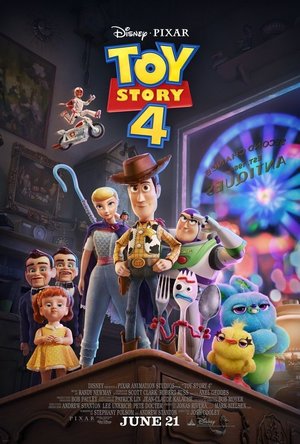
In yet another crazy adventure, Toy Story 4 sees Woody and the gang protecting Forky, Bonnie’s new toy she created from a spork in Kindergarten class.
Acting: 10
I mentioned this in my review of Toy Story 3, but it bears repeating: the ability to bring back the same cast from one movie to the next guarantees stellar voice-acting performances. Tom Hanks and Tim Allen have perfected their roles as Woody and Buzz and their performances take you out of the realm of thinking these are mere toys, but actual sentient beings. Beyond these two and the rest of the traditional gang you have rib-splitting performances from Keegan-Michael Key and Jordan Peele as Bunny and Ducky along with more hilarity from Keanu Reeves playing Duke Caboom, a stunt toy. Their ability to make their characters as endearing as they are funny makes the viewing experience that much more enjoyable.
Beginning: 10
Characters: 10
To expand on the above, it’s not just about the characters but how they develop as the story progresses. These are animated movies meant for kids yet these characters manage to grow as they would in a typical (great) movie. Characters like Woody are faced with difficult choices they have to make and I found myself wondering if they would have made those same choice two or three movies ago.
On another note, I appreciate that the movies have grown since the first in the way of their villains. It’s always refreshing when villains aren’t just innately bad and they have a backstory of some sort. Gabby Gabby, the babydoll with a broken voicebox, is no exception here.
Cinematography/Visuals: 10
Conflict: 10
Like its predecessors, Toy Story 4 is meant to take you on an adventure and it doesn’t disappoint. Continuing from a similar motif of the third movie, the gang is involved in a heist that includes great stakes. From the planning to the execution of it all, it’s nonstop great fun.
Entertainment Value: 10
Some of the most fun I’ve had in the theater in 2019. This movie has everything you want. There’s action, laughter, and yes maybe a tear or two. This movie doesn’t disappoint in the slightest.
Memorability: 8
From the beautiful visuals (seriously, it’s not even fair at this point) to a number of hilarious and touching moments, this one is absolutely one to remember. In a message that spoke to me directly, it’s all about being willing to let go and start new chapters of your life, getting out of your comfort zone and starting fresh. I dig it.
Pace: 10
For the most part, things are smooth sailing here as this film very rarely gets boring. There is a minor blip where I felt like they could have sped things along a little quicker, but big emphasis on “minor”. I was invested the whole way.
Plot: 10
Yet another great story that’s believable and doesn’t harbor any major holes. Seriously, how do they keep doing this? How do they keep creating brand new experiences that are vastly different from the last? Beyond impressed.
Resolution: 10
Overall: 98
This series truly answers the question: How long should a movie series go before you call it quits? The answer: As long as you have a good story, tell it! What was once one of the greatest trilogies of all time is now one of the greatest quadrilogies of all time. Toy Story 4 is a masterpiece.
Acting: 10
I mentioned this in my review of Toy Story 3, but it bears repeating: the ability to bring back the same cast from one movie to the next guarantees stellar voice-acting performances. Tom Hanks and Tim Allen have perfected their roles as Woody and Buzz and their performances take you out of the realm of thinking these are mere toys, but actual sentient beings. Beyond these two and the rest of the traditional gang you have rib-splitting performances from Keegan-Michael Key and Jordan Peele as Bunny and Ducky along with more hilarity from Keanu Reeves playing Duke Caboom, a stunt toy. Their ability to make their characters as endearing as they are funny makes the viewing experience that much more enjoyable.
Beginning: 10
Characters: 10
To expand on the above, it’s not just about the characters but how they develop as the story progresses. These are animated movies meant for kids yet these characters manage to grow as they would in a typical (great) movie. Characters like Woody are faced with difficult choices they have to make and I found myself wondering if they would have made those same choice two or three movies ago.
On another note, I appreciate that the movies have grown since the first in the way of their villains. It’s always refreshing when villains aren’t just innately bad and they have a backstory of some sort. Gabby Gabby, the babydoll with a broken voicebox, is no exception here.
Cinematography/Visuals: 10
Conflict: 10
Like its predecessors, Toy Story 4 is meant to take you on an adventure and it doesn’t disappoint. Continuing from a similar motif of the third movie, the gang is involved in a heist that includes great stakes. From the planning to the execution of it all, it’s nonstop great fun.
Entertainment Value: 10
Some of the most fun I’ve had in the theater in 2019. This movie has everything you want. There’s action, laughter, and yes maybe a tear or two. This movie doesn’t disappoint in the slightest.
Memorability: 8
From the beautiful visuals (seriously, it’s not even fair at this point) to a number of hilarious and touching moments, this one is absolutely one to remember. In a message that spoke to me directly, it’s all about being willing to let go and start new chapters of your life, getting out of your comfort zone and starting fresh. I dig it.
Pace: 10
For the most part, things are smooth sailing here as this film very rarely gets boring. There is a minor blip where I felt like they could have sped things along a little quicker, but big emphasis on “minor”. I was invested the whole way.
Plot: 10
Yet another great story that’s believable and doesn’t harbor any major holes. Seriously, how do they keep doing this? How do they keep creating brand new experiences that are vastly different from the last? Beyond impressed.
Resolution: 10
Overall: 98
This series truly answers the question: How long should a movie series go before you call it quits? The answer: As long as you have a good story, tell it! What was once one of the greatest trilogies of all time is now one of the greatest quadrilogies of all time. Toy Story 4 is a masterpiece.

Smobile Lite - For Craigslist
Catalogs
App
*Supports iPad Pro https://www.youtube.com/watch?v=9Uad64SledM Customer Quotes: This is the best...

SMobile - For Craigslist
Catalogs
App
*Supports iPad Pro https://www.youtube.com/watch?v=9Uad64SledM Customer Quotes: This is the best...

BookblogbyCari (345 KP) rated Origin in Books
Aug 14, 2018
Book Review by Cari Mayhew.
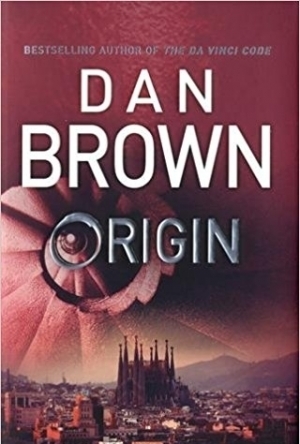
This is arguably the best Dan Brown book yet! I had been a big Dan Brown fan up until I read The Lost Symbol, which is his most tedious Robert Langdon book. But The Origin has made me a fan once again!
In the prologue, an accomplished computer scientist and atheist secretly meets up with 3 religious leaders, and there are 100 pages of build up before the scientist makes his announcement public – only to be assassinated a moment before his discovery is announced.
Central character Robert Langdon and his companion, the future queen of Spain, set out to unravel the mystery and make it public. But, halfway through the book, conspiracy theorists go wild - Robert is made out to be a kidnapper and becomes a wanted man.
As you might imagine, Dan Brown enabled the scientist’s message to be revealed, and this involved a science lesson for the reader. It was 2 chapters long, and to be honest I thoroughly enjoyed it.
Dan Brown’s Robert Landon books usually contain a profound, revelatory lesson, but in this book, the message didn’t feel particularly revelatory, and the nature of it could well be guessed at during the early stages of the book. (No spoilers!)
Right at the very end, however, was a disturbing twist when the identity of the individual leaking info to conspiracy.net is finally revealed. (Again no spoilers!)
I like how Dan Brown tells his tales through the minds of several of his characters in turn. It really adds depth to the story, giving insight into the bad characters as well as the good.
This time around, the best elements of the story were told in the personal sides of the events, rather than the main thread of the story, for example in the relationships between the prince and his father and the prince and his fiancé.
Sometimes Dan Brown’s scenes are done an injustice by being described in words, when the architectural pieces really belong on the big screen. Whilst I don’t find fault in the descriptions as such, I found it hard to picture the details.
Although the book has just over 100 chapters, these chapters are very brief, and you’ll likely read them in quick succession. If you decide to give the book a try, please stick it out to the end!
For more of my reviews, check out www.bookblogbycari.com
This is arguably the best Dan Brown book yet! I had been a big Dan Brown fan up until I read The Lost Symbol, which is his most tedious Robert Langdon book. But The Origin has made me a fan once again!
In the prologue, an accomplished computer scientist and atheist secretly meets up with 3 religious leaders, and there are 100 pages of build up before the scientist makes his announcement public – only to be assassinated a moment before his discovery is announced.
Central character Robert Langdon and his companion, the future queen of Spain, set out to unravel the mystery and make it public. But, halfway through the book, conspiracy theorists go wild - Robert is made out to be a kidnapper and becomes a wanted man.
As you might imagine, Dan Brown enabled the scientist’s message to be revealed, and this involved a science lesson for the reader. It was 2 chapters long, and to be honest I thoroughly enjoyed it.
Dan Brown’s Robert Landon books usually contain a profound, revelatory lesson, but in this book, the message didn’t feel particularly revelatory, and the nature of it could well be guessed at during the early stages of the book. (No spoilers!)
Right at the very end, however, was a disturbing twist when the identity of the individual leaking info to conspiracy.net is finally revealed. (Again no spoilers!)
I like how Dan Brown tells his tales through the minds of several of his characters in turn. It really adds depth to the story, giving insight into the bad characters as well as the good.
This time around, the best elements of the story were told in the personal sides of the events, rather than the main thread of the story, for example in the relationships between the prince and his father and the prince and his fiancé.
Sometimes Dan Brown’s scenes are done an injustice by being described in words, when the architectural pieces really belong on the big screen. Whilst I don’t find fault in the descriptions as such, I found it hard to picture the details.
Although the book has just over 100 chapters, these chapters are very brief, and you’ll likely read them in quick succession. If you decide to give the book a try, please stick it out to the end!
For more of my reviews, check out www.bookblogbycari.com

BookwormMama14 (18 KP) rated The Curiosity Keeper (Treasures of Surrey, #1) in Books
Jan 2, 2019
The year is 1812, and the search for a missing treasure commences. Mystery and intrigue are found around every corner. A thrilling new regency book!
Jonathan Gilchrist is on a mission to recover The Bevoy, a ruby of immense value, stolen from his father. Jonathan's family needs The Bevoy in order to save their home. But the last thing he expected was Camille Iverness. Camille has grown up in a shady part of London and has learned how to fend for herself. Running her father's curiosity shop, she has encountered many people of different characters. When strange and threatening events occur, she must rely on the help of Mr. Gilchrist, a stranger. But can she trust him? Running from her past, Camille seeks refuge in the village of Fellsworth. As her attachment for the village grows, she begins to feel as though she can begin a new life at last. But when her past literally shows up in Fellsworth, her hopes for a new life are dashed to pieces. Will Jonathan and Camille ever be able to find peace? Will events that unfold push them apart or draw them closer together?
"It is not just a ruby, as you say. It is large as a quail's egg, still untouched and unpolished. And it is rumored to either bless or curse whomever possess it."
The Curiosity Keeper was a book that I had been looking forward to reading for quite a while. And I was not disappointed! It is a thrilling story that kept me engaged from beginning to end. It has all of the elements expected for a regency romance, with a few interesting surprises, mystery being one of them. Sarah Ladd does a brilliant job of drawing you into the story. I could feel my heart racing when tensions rose and sighed with relief on more than one occasion. Throughout the book we can clearly see the underlying message: And we know that in all things, God works for the good of those who love Him, who have been called according to His purpose (Romans 8:28 NIV) I highly recommend The Curiosity Keeper, and I look forward to the next book in the Treasures of Surrey series.
I received a free digital copy of The Curiosity Keeper from NetGalley courtesy of Thomas Nelson, Inc. in exchange for my honest review.
Jonathan Gilchrist is on a mission to recover The Bevoy, a ruby of immense value, stolen from his father. Jonathan's family needs The Bevoy in order to save their home. But the last thing he expected was Camille Iverness. Camille has grown up in a shady part of London and has learned how to fend for herself. Running her father's curiosity shop, she has encountered many people of different characters. When strange and threatening events occur, she must rely on the help of Mr. Gilchrist, a stranger. But can she trust him? Running from her past, Camille seeks refuge in the village of Fellsworth. As her attachment for the village grows, she begins to feel as though she can begin a new life at last. But when her past literally shows up in Fellsworth, her hopes for a new life are dashed to pieces. Will Jonathan and Camille ever be able to find peace? Will events that unfold push them apart or draw them closer together?
"It is not just a ruby, as you say. It is large as a quail's egg, still untouched and unpolished. And it is rumored to either bless or curse whomever possess it."
The Curiosity Keeper was a book that I had been looking forward to reading for quite a while. And I was not disappointed! It is a thrilling story that kept me engaged from beginning to end. It has all of the elements expected for a regency romance, with a few interesting surprises, mystery being one of them. Sarah Ladd does a brilliant job of drawing you into the story. I could feel my heart racing when tensions rose and sighed with relief on more than one occasion. Throughout the book we can clearly see the underlying message: And we know that in all things, God works for the good of those who love Him, who have been called according to His purpose (Romans 8:28 NIV) I highly recommend The Curiosity Keeper, and I look forward to the next book in the Treasures of Surrey series.
I received a free digital copy of The Curiosity Keeper from NetGalley courtesy of Thomas Nelson, Inc. in exchange for my honest review.

Heather Cranmer (2721 KP) rated Don't Stop Believin' in Books
May 28, 2019


I was obsessed with Olivia Newton-John as a little girl. As a little girl, I knew all of her songs by heart, and I had watched all of her movies over and over. I do admit that as I grew up, my obsession faded. However, when I saw Olivia's autobiography, Don't Stop Believin', on the shelf at my local library, I decided to give it a read. While it was enjoyable, it just came across as kind of preachy.
Olivia Newton-John rose to fame in the United States as the character of Sandy in the movie Grease. She also had a bunch of hit songs and records afterwards. Olivia's autobiography does mention her rise to fame although I felt as if there wasn't enough time spent on her rise to fame. She does write about her time with Grease and other films as well as recording her songs throughout the book. I felt the movies and songs were written about well.
We get a taste of her life as a child in England and Australia, although I felt she didn't discuss her pre-fame life too much. I would have liked to read more about her childhood instead of just being rushed into when she started performing. I know Olivia Newton-John likes to keep her private life out of the limelight, but when writing an autobiography, it's important to give the reader a little more details than what Don't Stop Believin' gave us.
There was so much name dropping throughout this book! While I understand that famous people know other famous people, sometimes I felt as if Olivia was dropping names just for show instead of because it fit the story. You have a lot of famous friends. We get it!
Another thing that annoyed me about the book was how some parts seemed like an advertisement for her Olivia Newton-John Cancer Wellness and Research Centre as well as for her husband, John Easterling's, herb company. I know she's done so much for her cancer center, (which I give her mad props for), but she goes on and on about how great and lovely of a place it was especially after she was an inpatient there. Of course the staff would treat her better when her name is on the building! There's more than one chapter devoted to how great the place is. I'm sure it is lovely, but I felt like I didn't need to a chapter (and more) about how great it is. As for her husband's herb company, she went on and on towards the end of the book how his herbs really helped her out which is great, but again, does the reader really need the specifics and being told over and over again how helpful it was?
The major thing that annoyed me was how preachy Don't Stop Believin' was in a lot of chapters. In fact, it made me feel guilty sometimes that I rely on modern medicine. Olivia writes how she'd rather take the natural approach to fighting off viruses and diseases, and I get that because I don't like to take medicine needlessly either, but sometimes, it's the best thing. However, I just felt that Olivia was berating those who choose to go the medicinal route. I felt like she was implying that natural remedies work better than modern medicine. This can be dangerous especially if someone gets off their medicines they need to survive to try the natural approach. People should always discuss any changes of medication with their doctors.
To me, Don't Stop Believin' writes like someone who's always been privileged and sheltered throughout their life. A lot of it feels like Olivia Newton-John is out of touch with reality and like she's living in La-La Land. I just found it hard to relate to her throughout the book. Yes, she has gone through some hardships such as deaths in the family, her cancer diagnoses, and her ex-boyfriend disappearing, but for the most part, her autobiography is just too sunshine and rainbows for me to truly relate.
Don't Stop Believin' flows beautifully though, and the writing is done very well, so it has that going for it. I did find myself enjoying the book most of the time when Olivia wasn't been preachy or advertising something. There were some interesting tidbits about her life throughout the book.
Trigger warnings include some profanity use, death, cancer, drinking, and smoking.
Overall, Don't Stop Believin' isn't a bad book, quite the contrary. It's just a bit too hippie dippy for me to have truly enjoyed it to its fullest. I did find the book interesting though despite some flaws. I would recommend Don't Stop Believin' by Olivia Newton-John especially to those who have been diagnosed with cancer as this book does come with a bunch of positivity when it comes to dealing with cancer.
Olivia Newton-John rose to fame in the United States as the character of Sandy in the movie Grease. She also had a bunch of hit songs and records afterwards. Olivia's autobiography does mention her rise to fame although I felt as if there wasn't enough time spent on her rise to fame. She does write about her time with Grease and other films as well as recording her songs throughout the book. I felt the movies and songs were written about well.
We get a taste of her life as a child in England and Australia, although I felt she didn't discuss her pre-fame life too much. I would have liked to read more about her childhood instead of just being rushed into when she started performing. I know Olivia Newton-John likes to keep her private life out of the limelight, but when writing an autobiography, it's important to give the reader a little more details than what Don't Stop Believin' gave us.
There was so much name dropping throughout this book! While I understand that famous people know other famous people, sometimes I felt as if Olivia was dropping names just for show instead of because it fit the story. You have a lot of famous friends. We get it!
Another thing that annoyed me about the book was how some parts seemed like an advertisement for her Olivia Newton-John Cancer Wellness and Research Centre as well as for her husband, John Easterling's, herb company. I know she's done so much for her cancer center, (which I give her mad props for), but she goes on and on about how great and lovely of a place it was especially after she was an inpatient there. Of course the staff would treat her better when her name is on the building! There's more than one chapter devoted to how great the place is. I'm sure it is lovely, but I felt like I didn't need to a chapter (and more) about how great it is. As for her husband's herb company, she went on and on towards the end of the book how his herbs really helped her out which is great, but again, does the reader really need the specifics and being told over and over again how helpful it was?
The major thing that annoyed me was how preachy Don't Stop Believin' was in a lot of chapters. In fact, it made me feel guilty sometimes that I rely on modern medicine. Olivia writes how she'd rather take the natural approach to fighting off viruses and diseases, and I get that because I don't like to take medicine needlessly either, but sometimes, it's the best thing. However, I just felt that Olivia was berating those who choose to go the medicinal route. I felt like she was implying that natural remedies work better than modern medicine. This can be dangerous especially if someone gets off their medicines they need to survive to try the natural approach. People should always discuss any changes of medication with their doctors.
To me, Don't Stop Believin' writes like someone who's always been privileged and sheltered throughout their life. A lot of it feels like Olivia Newton-John is out of touch with reality and like she's living in La-La Land. I just found it hard to relate to her throughout the book. Yes, she has gone through some hardships such as deaths in the family, her cancer diagnoses, and her ex-boyfriend disappearing, but for the most part, her autobiography is just too sunshine and rainbows for me to truly relate.
Don't Stop Believin' flows beautifully though, and the writing is done very well, so it has that going for it. I did find myself enjoying the book most of the time when Olivia wasn't been preachy or advertising something. There were some interesting tidbits about her life throughout the book.
Trigger warnings include some profanity use, death, cancer, drinking, and smoking.
Overall, Don't Stop Believin' isn't a bad book, quite the contrary. It's just a bit too hippie dippy for me to have truly enjoyed it to its fullest. I did find the book interesting though despite some flaws. I would recommend Don't Stop Believin' by Olivia Newton-John especially to those who have been diagnosed with cancer as this book does come with a bunch of positivity when it comes to dealing with cancer.