
Search
Search results

Purple Phoenix Games (2266 KP) rated King of the Castle in Tabletop Games
Jul 2, 2020

The King is dead! As the kingdom reels from this sudden turn of events, those eager for power see their opportunity to pounce. Amassing personal armies, the war for the throne begins! Storm the castle, collect potions, capture towers, and conquer your opponents to claim the throne for yourself. Which tactic will lead to success – brute strength or sly strategy? Only one way to find out!
Disclaimer: We were provided a prototype copy of this game for the purposes of this preview. The components pictured are not final. Also, I do not plan to detail the entire rulebook in this review, but rather discuss the main rules and overall flow of the game. Keep an eye out for the Kickstarter launching later this fall! -L
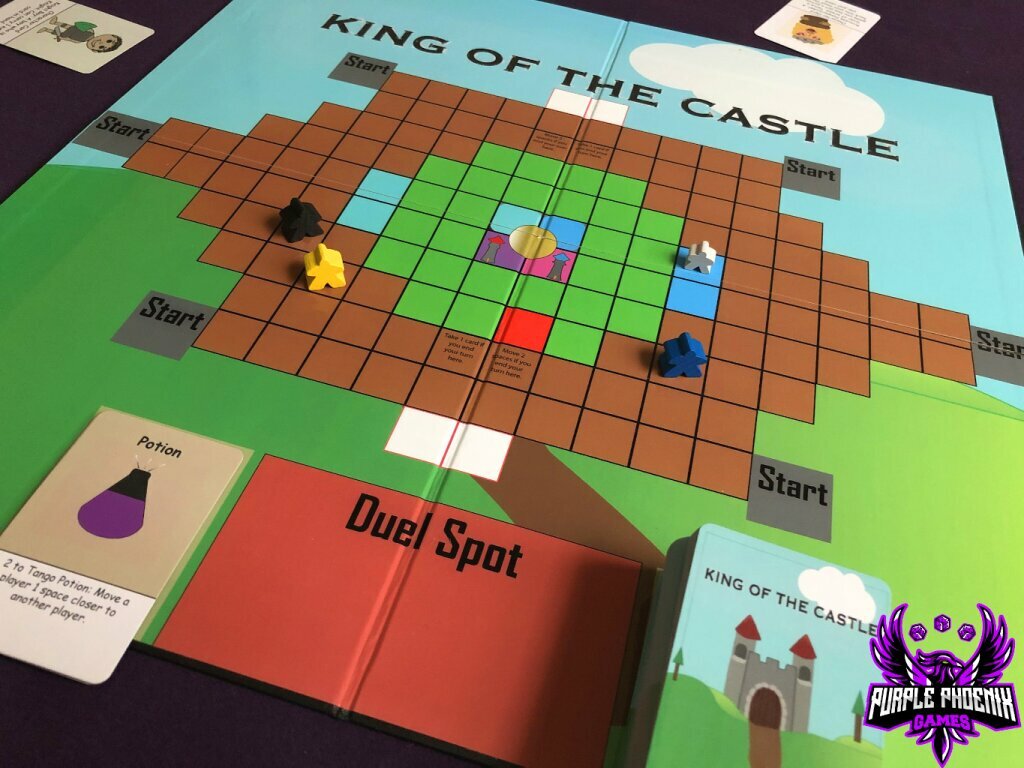
King of the Castle is a game of hand management, grid movement, and take that in which players are battling to be the first to capture and hold the throne. Played over a series of turns, players will move around the board, draw cards, and battle opponents to hinder their progress. To setup, each player is given a Character card at random, selects a Meeple in their chosen color, and places it on one of the various Start spaces on the game board. Shuffle all other cards and place them in a draw deck. Select a player to be the first player, and you are ready to begin!
On your turn, you will take a combination of 2 actions. Those combos are: Move 1 space and draw 1 card, Move 2 spaces, or Draw 2 cards. It is important to note that diagonal movement is not allowed! There are 2 types of cards that can be drawn: Potion cards (special powers/abilities) and Army cards (strength points for duels). Once you have performed your 2 actions, and played any Potion cards from your hand that you want, your turn ends. The game moves on to the next player. If you land on the same space as an opponent, you must duel each other. The dueling players will select as many Army cards from their hand as they wish to play, and will lay them down simultaneously. They may then play up to 3 Potion cards from their hand to influence the strength points of either player, as stated on the Potion cards. Whomever has the most strength points wins the duel, and gets to remain on that space. The loser must discard a card, and is knocked back to the nearest Exit space (depending on their current placement on the board).
In the center of the board are 2 Tower spaces. You must ‘capture’ a Tower in order to fulfill the win conditions. To capture a Tower, you must land on that space and occupy it for one full turn. Once you have captured a Tower, you may move to capture the Throne. The centermost space of the board is the Throne. To capture the Throne, you must first have captured a Tower, and you must enter the Throne space and occupy it for 3 complete and consecutive turns. When you are capturing a Tower or the Throne, you can still be attacked by opponents – so it is important to have a strong hand of cards to ward off enemies and continue your occupation of these valuable spaces. Once a player has occupied the Throne space for 3 consecutive turns, the game ends and that player is named King!
So with all of that said, how does King of the Castle play? Overall, I would say it’s a nice and simple little game. The concept itself is easy to comprehend – draw cards, duel opponents, capture a Tower, and ultimately, the Throne. There is a decent amount of strategy required for success. Not only are you racing to the center of the board, but you also need to amass a strong hand of cards with which you can hinder your opponents. Choosing when to use your Potion cards can affect not only your strategy, but those of your enemies as well. Is your strategy to skirt around your opponents and try to sneak by unnoticed? Or will you duel enemies at every opportunity, building up your Army and continually kicking the other players to the Exit spaces on the board? The idea of having to ‘capture’ certain spaces by occupying them for consecutive turns is an interesting one, and adds a unique twist to this game. You must be able to defend yourself in those spaces, or risk being kicked back to an Exit, requiring you to start that journey over again. It is a simple game to play, but not necessarily one that is easy to win, and I really like that.
Components. As I stated earlier, this is only a prototype version of the game, and I anticipate that there will be some changes for final production. That being said, the board in this prototype is nice and sturdy, the cards are easy to manipulate, and the Meeples are your standard wooden bits. So overall, these prototype components are off to a great start. The artwork and overall style of the game are a different story. The current artwork is pretty childish and unrefined. Again, this being only a prototype, I anticipate that the artwork will be overhauled and revised for final production. The artwork on the board is pretty basic as well, which is not necessarily a bad thing, it just doesn’t feel immersive or engaging for players. The spaces of the board are different colors to denote different areas of play, but nothing is labeled on the board, which can create some confusion at first as to the flow of movement around the board. The rules themselves need to be revised and edited for clarity. There is just a bit of ambiguity that leaves questions unanswered, but nothing that cannot be fixed.
All in all, the concept of King of the Castle is a solid one. It combines hand management, grid movement, and take that in a way that all 3 mechanics complement and work well with each other. The gameplay is lighthearted and relatively simple, which results in a fun and fast game. With some refining of the style and editing of the rules, I am sure that this game will truly shine. I look forward to following its progress, and am eager to see the Kickstarter campaign later this year. Keep your eyes on King of the Castle, because it’s shaping up to be a solid game.
Disclaimer: We were provided a prototype copy of this game for the purposes of this preview. The components pictured are not final. Also, I do not plan to detail the entire rulebook in this review, but rather discuss the main rules and overall flow of the game. Keep an eye out for the Kickstarter launching later this fall! -L
King of the Castle is a game of hand management, grid movement, and take that in which players are battling to be the first to capture and hold the throne. Played over a series of turns, players will move around the board, draw cards, and battle opponents to hinder their progress. To setup, each player is given a Character card at random, selects a Meeple in their chosen color, and places it on one of the various Start spaces on the game board. Shuffle all other cards and place them in a draw deck. Select a player to be the first player, and you are ready to begin!
On your turn, you will take a combination of 2 actions. Those combos are: Move 1 space and draw 1 card, Move 2 spaces, or Draw 2 cards. It is important to note that diagonal movement is not allowed! There are 2 types of cards that can be drawn: Potion cards (special powers/abilities) and Army cards (strength points for duels). Once you have performed your 2 actions, and played any Potion cards from your hand that you want, your turn ends. The game moves on to the next player. If you land on the same space as an opponent, you must duel each other. The dueling players will select as many Army cards from their hand as they wish to play, and will lay them down simultaneously. They may then play up to 3 Potion cards from their hand to influence the strength points of either player, as stated on the Potion cards. Whomever has the most strength points wins the duel, and gets to remain on that space. The loser must discard a card, and is knocked back to the nearest Exit space (depending on their current placement on the board).
In the center of the board are 2 Tower spaces. You must ‘capture’ a Tower in order to fulfill the win conditions. To capture a Tower, you must land on that space and occupy it for one full turn. Once you have captured a Tower, you may move to capture the Throne. The centermost space of the board is the Throne. To capture the Throne, you must first have captured a Tower, and you must enter the Throne space and occupy it for 3 complete and consecutive turns. When you are capturing a Tower or the Throne, you can still be attacked by opponents – so it is important to have a strong hand of cards to ward off enemies and continue your occupation of these valuable spaces. Once a player has occupied the Throne space for 3 consecutive turns, the game ends and that player is named King!
So with all of that said, how does King of the Castle play? Overall, I would say it’s a nice and simple little game. The concept itself is easy to comprehend – draw cards, duel opponents, capture a Tower, and ultimately, the Throne. There is a decent amount of strategy required for success. Not only are you racing to the center of the board, but you also need to amass a strong hand of cards with which you can hinder your opponents. Choosing when to use your Potion cards can affect not only your strategy, but those of your enemies as well. Is your strategy to skirt around your opponents and try to sneak by unnoticed? Or will you duel enemies at every opportunity, building up your Army and continually kicking the other players to the Exit spaces on the board? The idea of having to ‘capture’ certain spaces by occupying them for consecutive turns is an interesting one, and adds a unique twist to this game. You must be able to defend yourself in those spaces, or risk being kicked back to an Exit, requiring you to start that journey over again. It is a simple game to play, but not necessarily one that is easy to win, and I really like that.
Components. As I stated earlier, this is only a prototype version of the game, and I anticipate that there will be some changes for final production. That being said, the board in this prototype is nice and sturdy, the cards are easy to manipulate, and the Meeples are your standard wooden bits. So overall, these prototype components are off to a great start. The artwork and overall style of the game are a different story. The current artwork is pretty childish and unrefined. Again, this being only a prototype, I anticipate that the artwork will be overhauled and revised for final production. The artwork on the board is pretty basic as well, which is not necessarily a bad thing, it just doesn’t feel immersive or engaging for players. The spaces of the board are different colors to denote different areas of play, but nothing is labeled on the board, which can create some confusion at first as to the flow of movement around the board. The rules themselves need to be revised and edited for clarity. There is just a bit of ambiguity that leaves questions unanswered, but nothing that cannot be fixed.
All in all, the concept of King of the Castle is a solid one. It combines hand management, grid movement, and take that in a way that all 3 mechanics complement and work well with each other. The gameplay is lighthearted and relatively simple, which results in a fun and fast game. With some refining of the style and editing of the rules, I am sure that this game will truly shine. I look forward to following its progress, and am eager to see the Kickstarter campaign later this year. Keep your eyes on King of the Castle, because it’s shaping up to be a solid game.

Purple Phoenix Games (2266 KP) rated Viceroy in Tabletop Games
Jun 12, 2019


One of the best parts of the board gaming experience is finding a fun group of people with whom to play! Sometimes, though, coordinating a game night is easier said than done. We all must occasionally forego the group experience and face the world as the Lonely Only. But fear not! The world of solo-play is a vast and exciting realm! What follows is a chronicle of my journey into the solo-playing world – notes on gameplay, mechanics, rules, difficulty, and overall experience with solo variations of commonly multiplayer games! I hope this will provide some insight as you continue to grow your collection, or explore your already owned games!
Power. That’s what everyone wants, isn’t it? Well, at least it is in Viceroy! As an inhabitant of the world of Laar, you are fighting to become the ultimate ruler. Recruit allies who provide strategic advantages and enact laws that solidify your claim for power. Do you have what it takes to build and maintain a powerful kingdom, or will your attempts fall short?
DISCLAIMER: There is an expansion to this game, but we are not reviewing it at this time. Should we review it in the future we will either update this review or post a link to the new material here. -T
Viceroy, a game of card drafting and tile placement, is played over 12 turns in which players build a pyramid with their cards – paying to place each card and collecting rewards based upon which level of the pyramid a card is placed. Each turn is divided into two phases: Auction and Development. During the Auction Phase, players bid gemstones to buy a card from the auction line. Once every player has either collected 1 card from auction or passed, play moves to the Development Phase. During the Development Phase, players can either play a card into their pyramid, pass, or discard a card and take 2 gemstones from the reserve. To play a Law card into your pyramid, you place it for free. To play a Character card into your pyramid, you have to pay for it with gems. The cost is dependent upon which level of the pyramid the card is to be placed. You must pay for the level the card will sit on, as well as pay the cost for every level beneath it. For example, to add a card to the third level of the pyramid, you must pay the cost for the 3rd level, AND 2nd level, AND 1st level. The rewards gained from adding a card to the pyramid, however, are taken only for the level on which the card sits. In the earlier example, you would only get the reward for the third level alone, since that is the level on which the card sits. The Development Phase is played over 3 rounds, so a player could play up to 3 cards into their pyramid during 1 Development Phase. After the 3 rounds are up, the next turn begins again in the Auction Phase. When all cards are gone from the Auction Deck, the game ends. Players count up all of their Power Points, and the player with the highest Power value wins!
The only change in Viceroy between a group and solo game is during the Auction Phase. Obviously, if you are playing solo, there is nobody to bid against for cards. How that is alleviated is that you still bid your gemstone as normal, and you randomly draw an unused gemstone from the box as an AI bid. If the colors match, you lose your gem and go on to the next auction. If the colors do not match, you collect your choice card, and the card the AI would have collected gets discarded. If the AI color does not match an available card, you just discard one of the remaining cards. This mimics group play in the sense that you might not always get the card you want from auction! The Development Phase is played as normal. At the end of the game, count points as normal and try to beat your own high score.
Viceroy is a neat game. Every card has so many options that there is no one single strategy that is a sure-win every time. Maybe one game I’ll go for Magic tokens. And maybe the next I’ll try to go for raw Power Point tokens. The possibilities really are endless, and that keeps this game fresh for me. I don’t feel like I’m just going through the motions because every card will act differently depending on where it is played. Strategy really is everything here. On the flip-side of that, however, is that sometimes the options can be a little overwhelming. With so many possibilities for each card, it can get hard for me to decide on what strategy I really want to use. It should also be noted that a card can only be played onto a level if it can sit on exactly 2 cards on the level beneath it. So sometimes I buy a card to play on a certain level only to get to the Development Phase and realize I don’t have a legal place to which I can play it. So do I sacrifice other cards/gemstones to build a slot for this one card, or do I play it to a different level and change my strategy a bit? There’s a little bit of a learning curve, but the more I play, the better I get (or at least, the better I think I get).
Another grievance with Viceroy is that I find myself running out of cards in my hand a lot. The only opportunity to draw cards is if you play a card into your pyramid that allows you to do so. And since I’m usually focused on other strategic routes, I don’t use those cards for those purposes. So then I play all of the cards in my hand (leaving me empty-handed), get 1 card at the next auction, play it, and am again left with no cards in my hand. To fix this issue, I wish one of the actions you could take during the Development Phase was to draw 1 card. I’m not sure if other people have this issue, or if it’s just me, but it’s a problem I run into almost every game.
Overall, I think Viceroy is a good game. It’s unique in the sense that there are so many possibilities that you’ll probably never play the same game twice, even if you decide to play by the same strategy. The mechanics and gameplay are cool too – it’s fun to watch your pyramid literally grow in front of you as the game progresses. This game takes a little more focus and thought than you might think, so it’s not one I’d necessarily just pull out for some light fun. I think Viceroy is as exciting as a solo game as it is as a group game since there really aren’t any differences between the two settings. If you like Viceroy, give it a try solo! If you’ve never played Viceroy, try it either solo or in a group – it’s the same game after all!
https://purplephoenixgames.wordpress.com/2019/04/18/solo-chronicles-viceroy/
Power. That’s what everyone wants, isn’t it? Well, at least it is in Viceroy! As an inhabitant of the world of Laar, you are fighting to become the ultimate ruler. Recruit allies who provide strategic advantages and enact laws that solidify your claim for power. Do you have what it takes to build and maintain a powerful kingdom, or will your attempts fall short?
DISCLAIMER: There is an expansion to this game, but we are not reviewing it at this time. Should we review it in the future we will either update this review or post a link to the new material here. -T
Viceroy, a game of card drafting and tile placement, is played over 12 turns in which players build a pyramid with their cards – paying to place each card and collecting rewards based upon which level of the pyramid a card is placed. Each turn is divided into two phases: Auction and Development. During the Auction Phase, players bid gemstones to buy a card from the auction line. Once every player has either collected 1 card from auction or passed, play moves to the Development Phase. During the Development Phase, players can either play a card into their pyramid, pass, or discard a card and take 2 gemstones from the reserve. To play a Law card into your pyramid, you place it for free. To play a Character card into your pyramid, you have to pay for it with gems. The cost is dependent upon which level of the pyramid the card is to be placed. You must pay for the level the card will sit on, as well as pay the cost for every level beneath it. For example, to add a card to the third level of the pyramid, you must pay the cost for the 3rd level, AND 2nd level, AND 1st level. The rewards gained from adding a card to the pyramid, however, are taken only for the level on which the card sits. In the earlier example, you would only get the reward for the third level alone, since that is the level on which the card sits. The Development Phase is played over 3 rounds, so a player could play up to 3 cards into their pyramid during 1 Development Phase. After the 3 rounds are up, the next turn begins again in the Auction Phase. When all cards are gone from the Auction Deck, the game ends. Players count up all of their Power Points, and the player with the highest Power value wins!
The only change in Viceroy between a group and solo game is during the Auction Phase. Obviously, if you are playing solo, there is nobody to bid against for cards. How that is alleviated is that you still bid your gemstone as normal, and you randomly draw an unused gemstone from the box as an AI bid. If the colors match, you lose your gem and go on to the next auction. If the colors do not match, you collect your choice card, and the card the AI would have collected gets discarded. If the AI color does not match an available card, you just discard one of the remaining cards. This mimics group play in the sense that you might not always get the card you want from auction! The Development Phase is played as normal. At the end of the game, count points as normal and try to beat your own high score.
Viceroy is a neat game. Every card has so many options that there is no one single strategy that is a sure-win every time. Maybe one game I’ll go for Magic tokens. And maybe the next I’ll try to go for raw Power Point tokens. The possibilities really are endless, and that keeps this game fresh for me. I don’t feel like I’m just going through the motions because every card will act differently depending on where it is played. Strategy really is everything here. On the flip-side of that, however, is that sometimes the options can be a little overwhelming. With so many possibilities for each card, it can get hard for me to decide on what strategy I really want to use. It should also be noted that a card can only be played onto a level if it can sit on exactly 2 cards on the level beneath it. So sometimes I buy a card to play on a certain level only to get to the Development Phase and realize I don’t have a legal place to which I can play it. So do I sacrifice other cards/gemstones to build a slot for this one card, or do I play it to a different level and change my strategy a bit? There’s a little bit of a learning curve, but the more I play, the better I get (or at least, the better I think I get).
Another grievance with Viceroy is that I find myself running out of cards in my hand a lot. The only opportunity to draw cards is if you play a card into your pyramid that allows you to do so. And since I’m usually focused on other strategic routes, I don’t use those cards for those purposes. So then I play all of the cards in my hand (leaving me empty-handed), get 1 card at the next auction, play it, and am again left with no cards in my hand. To fix this issue, I wish one of the actions you could take during the Development Phase was to draw 1 card. I’m not sure if other people have this issue, or if it’s just me, but it’s a problem I run into almost every game.
Overall, I think Viceroy is a good game. It’s unique in the sense that there are so many possibilities that you’ll probably never play the same game twice, even if you decide to play by the same strategy. The mechanics and gameplay are cool too – it’s fun to watch your pyramid literally grow in front of you as the game progresses. This game takes a little more focus and thought than you might think, so it’s not one I’d necessarily just pull out for some light fun. I think Viceroy is as exciting as a solo game as it is as a group game since there really aren’t any differences between the two settings. If you like Viceroy, give it a try solo! If you’ve never played Viceroy, try it either solo or in a group – it’s the same game after all!
https://purplephoenixgames.wordpress.com/2019/04/18/solo-chronicles-viceroy/

Cody Cook (8 KP) rated Everlasting Dominion: A Theology of the Old Testament in Books
Jun 29, 2018

In Everlasting Dominion: A Theology of the Old Testament (Nashville: Broadman and Holman, 2006), Eugene H. Merrill sets out to provide a theology of the Old Testament which represents the O.T. as a consistent whole that has God as its ultimate source. As such, he supports a high view of biblical inspiration as verbal: “The word of God to the prophets was verbal; and what they spoke and wrote, therefore, was also verbal. The means by which the verbalizing was effected is never disclosed, nor is it necessary to know. The point is that the prophetic word, the highest form of divine revelation, was recognized at the time to be the words of God, a view maintained by virtually unanimous consensus in Jewish and Christian tradition until the inroads of modern criticism.”
Insofar as Merrill is a Christian writing about the Old Testament's theology, this creates a dilemma in regard to the role the New Testament is allowed to play in his interpretation. Merrill acknowledges this from the get go:
“Old Testament theology is the study of biblical theology that employs the methods of that discipline to the Old Testament alone while being aware of the limitations inherent in not addressing the New Testament witness in any comprehensive way. This delimitation can be justified on the grounds that the Old Testament speaks its own message, one that is legitimate and authoritative in every sense of the term even if, from the Christian viewpoint, its message is not ultimately complete.”
As such, his work attempts to focus on what the Old Testament says on its own, though he occasionally appeals to New Testament ideas as a means of providing an additional witness to his interpretation.
Merrill tends to provide basic level interpretation in the canonical order of the Old Testament books. As such, little of his exegesis is particularly creative. However, he does have one unique idea which comes up throughout the book and indeed inspired the title-- the idea that man was made by God as an intermediary for God's dominion over the world:
“The crowning work of creation was the appearance of mankind on the sixth day (Gen. 1:26–28). He is said to be in the image and likeness of God, but the grammar permits and theology favors the idea that he was created as his image and likeness, that is, as God's representative on earth... [This passage] is also the clearest expression of the divine purpose in creation. After all things else had been made and put into their several positions of function and interrelationship, the Lord said, 'Let Us make man [as] Our image, according to Our likeness. They will rule' (Gen. 1:26). The significance of this for communicating a (if not the) major theme of Old Testament theology cannot be overstated, and the fact that it is the first divinely articulated expression of the reason for man's existence makes it doubly significant. What is lacking apparently after the whole cosmos has been spoken into existence is its management, a caretaker as it were who will govern it all according to the will of the Creator. He could have done it himself without mediation, but for reasons never revealed in the sacred record, God elected to reign through a subordinate, a surrogate king responsible only to him.”
Merrill explains what had been lost in this divine intention after the Fall: “No longer did man have dominion over all things; instead, he abdicated his role as sovereign and worshipped what he should have ruled.” However, he still highlights partial fulfillments of the divine plan even after the Fall, such as in the Israelite monarchy:
“The creation mandate that mankind should 'be fruitful, multiply, fill the earth, and subdue it' and 'rule the fish of the sea, the birds of the sky, and every creature that crawls on the earth' (Gen. 1:28) finds tangible expression even if only in a highly preliminary and anticipatory manner. David and his dynastic successors never exhibited this kind of universal dominion, of course, but the limited success they did enjoy, especially under Solomon (cf. 1 Kings 4:20–34), was a foretaste of the splendor, glory, and power of his descendants yet to come at the end of human history.”
Of course, this idea of human dominion as a vice-regent of God would only find its final fulfillment in Christ, the second Adam and the second David:
“If paradise was lost at the fall, it will be regained at the re-creation, not least in the restoration of man's glory as the vice-regent of the King of kings.”
The book seems to go out of its way to contrast the wild speculation of liberal theology, resulting in a work which is so straight-forward as to be dull. This is by no means always the case with Merrill's writings, as his Historical Survey of the Old Testament was one of the most interesting books I read as a new Christian. In Everlasting Dominion, however, where skeptical scholarship always assumes that the text is hiding something, Merrill takes it at face value. The result is a theology of the Old Testament which is more grounded, but that also often fails to soar to the heights that the text might allow for. Instead of elucidation and theologizing, Merrill tends to resort to extended (and I do mean extended) summary of the Hebrew canon.
The one major exception to this tendency is in Merrill's discussion of dominion, which we discussed above in detail. However, more work could certainly have been done on this topic, particularly in regard to how Jesus brings the idea to its fulfillment. Since it is Merrill's goal to explain the Old Testament with as little light from the New as possible, it is difficult to fault him for this. But it's also hard to fault the reader for wanting more when he reads tantalizing sections like this:
“What we propose in the following comments is done with a great deal of tentativeness since, as far as we can determine, we are virtually alone in making the case that Jesus, in his earthly ministry, frequently performed miraculous works to demonstrate not just his full deity but also his role as Urmensch, the second Adam who came to display in character and life what God had intended as the ideal for the whole human race. Without pursuing the biblical arguments for a full-blown Christology that is sensitive to both his divine and human natures, let it be said that there is universal consensus that the New Testament presents Jesus not only as God but also as perfect man.”
That being said, it does seem like an exaggeration to claim that Genesis 1:26 is the key text to understanding Old Testament theology. That it is a major theme, particularly in relation to its underemphasis by most biblical commentators, does not by any means strain credulity. It also seems to be in the back of the mind of many New Testament authors who emphasize restoration of the Kingdom of God involving our reigning with Christ and inheriting the eternal life and dominion over the world which was originally connected with our Edenic charge.
In the final analysis, Everlasting Dominion provides a good straight-forward overview of the Old Testament, but simply doesn't provide enough insight to warrant its nearly 700 pages.
Insofar as Merrill is a Christian writing about the Old Testament's theology, this creates a dilemma in regard to the role the New Testament is allowed to play in his interpretation. Merrill acknowledges this from the get go:
“Old Testament theology is the study of biblical theology that employs the methods of that discipline to the Old Testament alone while being aware of the limitations inherent in not addressing the New Testament witness in any comprehensive way. This delimitation can be justified on the grounds that the Old Testament speaks its own message, one that is legitimate and authoritative in every sense of the term even if, from the Christian viewpoint, its message is not ultimately complete.”
As such, his work attempts to focus on what the Old Testament says on its own, though he occasionally appeals to New Testament ideas as a means of providing an additional witness to his interpretation.
Merrill tends to provide basic level interpretation in the canonical order of the Old Testament books. As such, little of his exegesis is particularly creative. However, he does have one unique idea which comes up throughout the book and indeed inspired the title-- the idea that man was made by God as an intermediary for God's dominion over the world:
“The crowning work of creation was the appearance of mankind on the sixth day (Gen. 1:26–28). He is said to be in the image and likeness of God, but the grammar permits and theology favors the idea that he was created as his image and likeness, that is, as God's representative on earth... [This passage] is also the clearest expression of the divine purpose in creation. After all things else had been made and put into their several positions of function and interrelationship, the Lord said, 'Let Us make man [as] Our image, according to Our likeness. They will rule' (Gen. 1:26). The significance of this for communicating a (if not the) major theme of Old Testament theology cannot be overstated, and the fact that it is the first divinely articulated expression of the reason for man's existence makes it doubly significant. What is lacking apparently after the whole cosmos has been spoken into existence is its management, a caretaker as it were who will govern it all according to the will of the Creator. He could have done it himself without mediation, but for reasons never revealed in the sacred record, God elected to reign through a subordinate, a surrogate king responsible only to him.”
Merrill explains what had been lost in this divine intention after the Fall: “No longer did man have dominion over all things; instead, he abdicated his role as sovereign and worshipped what he should have ruled.” However, he still highlights partial fulfillments of the divine plan even after the Fall, such as in the Israelite monarchy:
“The creation mandate that mankind should 'be fruitful, multiply, fill the earth, and subdue it' and 'rule the fish of the sea, the birds of the sky, and every creature that crawls on the earth' (Gen. 1:28) finds tangible expression even if only in a highly preliminary and anticipatory manner. David and his dynastic successors never exhibited this kind of universal dominion, of course, but the limited success they did enjoy, especially under Solomon (cf. 1 Kings 4:20–34), was a foretaste of the splendor, glory, and power of his descendants yet to come at the end of human history.”
Of course, this idea of human dominion as a vice-regent of God would only find its final fulfillment in Christ, the second Adam and the second David:
“If paradise was lost at the fall, it will be regained at the re-creation, not least in the restoration of man's glory as the vice-regent of the King of kings.”
The book seems to go out of its way to contrast the wild speculation of liberal theology, resulting in a work which is so straight-forward as to be dull. This is by no means always the case with Merrill's writings, as his Historical Survey of the Old Testament was one of the most interesting books I read as a new Christian. In Everlasting Dominion, however, where skeptical scholarship always assumes that the text is hiding something, Merrill takes it at face value. The result is a theology of the Old Testament which is more grounded, but that also often fails to soar to the heights that the text might allow for. Instead of elucidation and theologizing, Merrill tends to resort to extended (and I do mean extended) summary of the Hebrew canon.
The one major exception to this tendency is in Merrill's discussion of dominion, which we discussed above in detail. However, more work could certainly have been done on this topic, particularly in regard to how Jesus brings the idea to its fulfillment. Since it is Merrill's goal to explain the Old Testament with as little light from the New as possible, it is difficult to fault him for this. But it's also hard to fault the reader for wanting more when he reads tantalizing sections like this:
“What we propose in the following comments is done with a great deal of tentativeness since, as far as we can determine, we are virtually alone in making the case that Jesus, in his earthly ministry, frequently performed miraculous works to demonstrate not just his full deity but also his role as Urmensch, the second Adam who came to display in character and life what God had intended as the ideal for the whole human race. Without pursuing the biblical arguments for a full-blown Christology that is sensitive to both his divine and human natures, let it be said that there is universal consensus that the New Testament presents Jesus not only as God but also as perfect man.”
That being said, it does seem like an exaggeration to claim that Genesis 1:26 is the key text to understanding Old Testament theology. That it is a major theme, particularly in relation to its underemphasis by most biblical commentators, does not by any means strain credulity. It also seems to be in the back of the mind of many New Testament authors who emphasize restoration of the Kingdom of God involving our reigning with Christ and inheriting the eternal life and dominion over the world which was originally connected with our Edenic charge.
In the final analysis, Everlasting Dominion provides a good straight-forward overview of the Old Testament, but simply doesn't provide enough insight to warrant its nearly 700 pages.

Chris Sawin (602 KP) rated Batman Begins (2005) in Movies
Jun 18, 2019

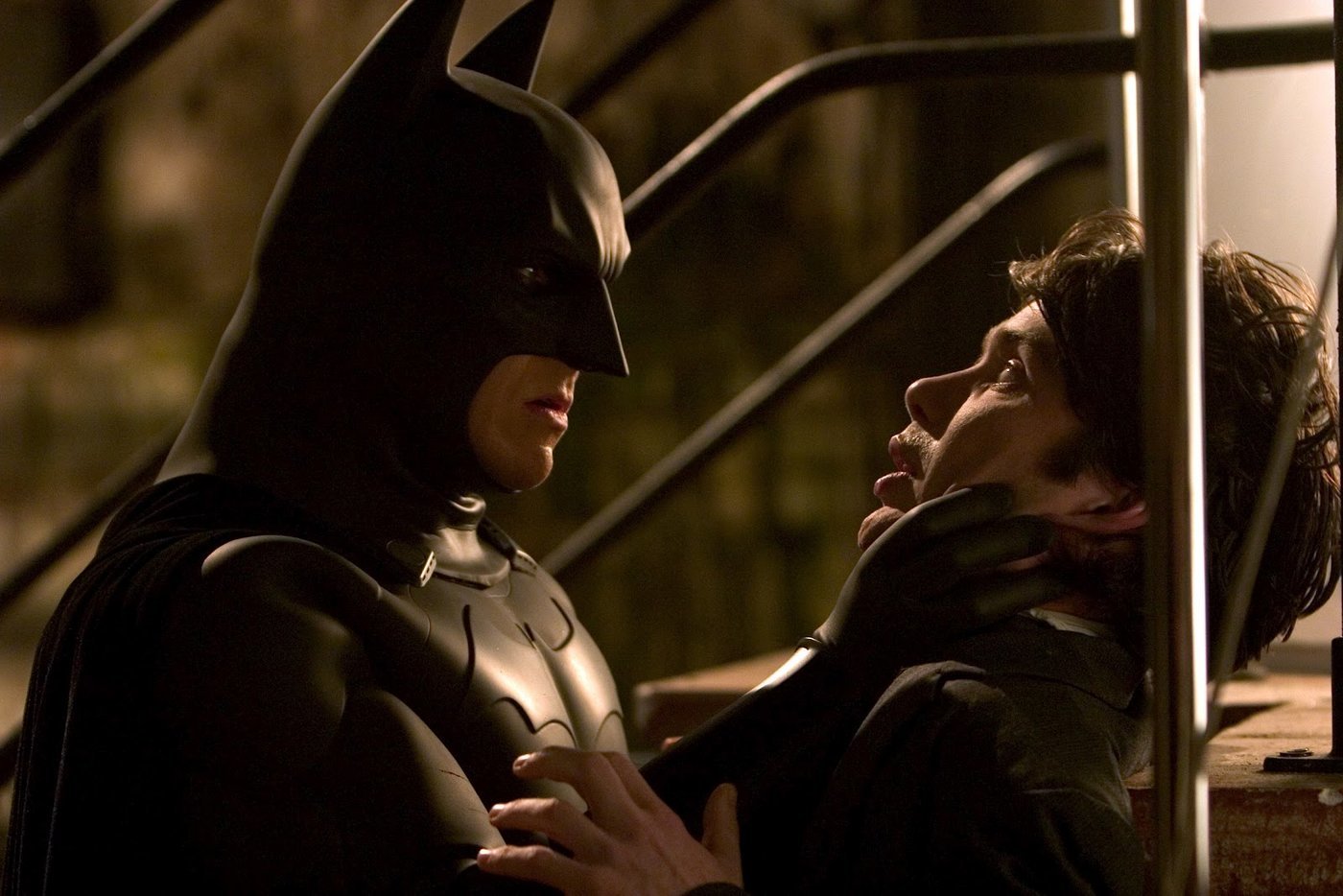
Before Ben Affleck, but after Adam West, Michael Keaton, Kevin Conroy, Val Kilmer, and George Clooney, Christian Bale was Batman for at least two of the best Batman films out there. With a screenplay by director Christopher Nolan and his brother Jonathan and a story by David S. Goyer, Batman Begins is an origin story. Gotham City is dying since criminals like Carmine Falcone (Tom Wilkinson) are able to get away with murder since, “he keeps the bad people rich and the good people scared,” as Rachel Dawes (Katie Holmes) puts it. Bruce Wayne (Christian Bale) trains with Henri Ducard (Liam Neeson), the right hand of Ra’s Al Ghul (Ken Watanabe), and The League of Shadows.
But The League of Shadows has a skewed view of justice since they believe that more serious crimes should be punishable by death (usually by their hand) while Bruce believes in compassion and the right to a fair trial before passing judgment. Leaving The League of Shadows in shambles, Bruce makes his way back to Gotham after a seven year absence. In Bruce’s own words, “As a man, I’m flesh and blood. I can be ignored. I can be destroyed. But as a symbol I can be incorruptible. I can be everlasting.” This is the story of Batman’s uprising; how a young Bruce Wayne conquered his fear of bats and the death of his parents to become the ominous and fearsome dark knight.
Even when you look back at what Christopher Nolan accomplished in his Dark Knight Trilogy, Batman Begins still holds its own and should be considered one of the best Batman films to date. Before Batman v Superman took the dark and gritty aspects of serious superhero films too far, Batman Begins was the first Batman film since Tim Burton’s Batman to favor a more serious tone in comparison to the campiness that overloads the likes of Batman Forever and Batman & Robin. Christopher Nolan always had the intention of keeping Batman grounded in realism and that concept reflected in its incredibly well-written storyline. Batman Begins is a lot like the Year One comic book storyline with Bruce Wayne returning to Gotham City after training in martial arts and being gone for several years, the inclusion of Carmine Falcone, a blossoming relationship between Batman and Jim Gordon, and The Joker tease on the rooftop even ends the story in similar fashion.
The realistic quality Christopher Nolan was aiming for also translates into the dialogue as nothing seems forced or out of place and everything seems to take place in consistent and reasonable fashion. Aside from Christian Bale, the rest of the cast is far more impressive than it had any right to be with the likes of Michael Caine, Morgan Freeman, Gary Oldman, Cillian Murphy, and Rutger Hauer. Caine adds a level of tenderness to the Alfred character we haven’t really seen before while Cillian Murphy is brilliantly sinister as Jonathan Crane/Scarecrow. Thanks to frequent Christopher Nolan collaborator, director of photography Wally Pfister, Batman Begins is beautifully shot. Colors are always bright and vibrant outside of the Batcave as the dark visuals of the film seem to slowly swallow their colorful surroundings piece by piece.
The inclusion of Liam Neeson in the film is an interesting one for statistical purposes. Prior to Taken, Neeson was known for taking on roles where his character died; Star Wars: Episode I – The Phantom Menace, Gangs of New York, Kingdom of Heaven, and The Chronicles of Narnia: The Lion, The Witch, and The Wardrobe are all prime examples. Neeson’s character Ducard is also the main ingredient in the surprise Nolan often includes in the finale of his films. Neeson has this calm demeanor about him as Ducard that portrays just how in control he is of the training he’s passing onto Bruce. The cast to Batman films are usually packed with stars that are relevant to the time it’s released, but Batman Begins can boast that its supporting cast is just as strong as the leads in the film.
The reasoning behind Christian Bale’s Batman voice is legitimate and you certainly understand why it’s utilized, but the awkward transition between normal voice and rough and raspy vigilante takes some getting used to since you immediately think of the ridiculousness in The Lego Batman Movie or the handful of Deadpool 2 jokes whenever he’s Batman now. Katie Holmes is dull dishwater as an actress. She is the least memorable of the entire cast and is basically that person at a party that everyone knows that’s there but they don’t say anything to anybody before leaving when no one is looking. Maggie Gyllenhaal is able to add some depth with the Rachel Dawes character in The Dark Knight, but it’s as if you can still hear the sound of the Dawson’s Creek theme song echoing in your head whenever Gyllenhaal is on-screen; Katie Holmes is like a huge fart that is still smelt after she’s gone in the sequel she’s not even a part of. There was an overwhelming amount of complaints in the online community regarding how ugly Batman’s new Batmobile, The Tumblr, is in the film. While the vehicle is ugly, at least that ugliness is maintained throughout Nolan’s entire trilogy. Batman likes ugly things in this universe, but at least they’re functional and serve their purpose.
Even with how most individuals feel about The Dark Knight, Batman Begins is still an incredible superhero film that is more than capable as a standalone feature as well as the jumpstart to a new set of Batman films. Christopher Nolan practically reinvented the Batman franchise to a certain extent starting with this film. Depending on how you feel about Ben Affleck’s Batman, Christian Bale was the last satisfying Batman.
Batman Begins feels more like a crime film first and a superhero film second where Batman is an unstoppable force of nature. Stripping the film of its origin retelling, one would think this is what Todd McFarlane is going for with his new Spawn film only to an R-rated extent; a superhero that flourishes in the darkness and has a reputation as this spiritual incarnation of vengeance. Christopher Nolan made something special with his Batman films and it feels like Batman Begins is often overlooked due to the reputation of The Dark Knight. While that perspective isn’t necessarily wrong, fans should at least appreciate Batman Begins in a similar light if not a slightly brighter one.
Batman Begins is currently available to stream for $2.99 on Amazon Prime, YouTube, Vudu, and Google Play and for $3.99 on iTunes. The film is available for a variety of formats on Amazon including 4K/Blu-ray ($24.49), DVD ($9.43), and Multi-Format Blu-ray ($11.49). The Blu-ray is currently $5.22 (5% off its normal $5.50 price) in brand new condition and $3.42 pre-owned on eBay with free shipping on both. You can also get the film as part of a three-disc DVD trilogy pack with The Dark Knight and The Dark Knight Rises or as The Dark Knight Trilogy box set on DVD or Blu-ray. Both options are available on both Amazon and eBay (DVD set is running $11.97 on eBay and $19.72 on Amazon while The Dark Knight Trilogy is available in a variety of formats (regular, ultimate, and special editions) on both sites between $12 and $18.99 unless you want the $69.99 ultimate set.
But The League of Shadows has a skewed view of justice since they believe that more serious crimes should be punishable by death (usually by their hand) while Bruce believes in compassion and the right to a fair trial before passing judgment. Leaving The League of Shadows in shambles, Bruce makes his way back to Gotham after a seven year absence. In Bruce’s own words, “As a man, I’m flesh and blood. I can be ignored. I can be destroyed. But as a symbol I can be incorruptible. I can be everlasting.” This is the story of Batman’s uprising; how a young Bruce Wayne conquered his fear of bats and the death of his parents to become the ominous and fearsome dark knight.
Even when you look back at what Christopher Nolan accomplished in his Dark Knight Trilogy, Batman Begins still holds its own and should be considered one of the best Batman films to date. Before Batman v Superman took the dark and gritty aspects of serious superhero films too far, Batman Begins was the first Batman film since Tim Burton’s Batman to favor a more serious tone in comparison to the campiness that overloads the likes of Batman Forever and Batman & Robin. Christopher Nolan always had the intention of keeping Batman grounded in realism and that concept reflected in its incredibly well-written storyline. Batman Begins is a lot like the Year One comic book storyline with Bruce Wayne returning to Gotham City after training in martial arts and being gone for several years, the inclusion of Carmine Falcone, a blossoming relationship between Batman and Jim Gordon, and The Joker tease on the rooftop even ends the story in similar fashion.
The realistic quality Christopher Nolan was aiming for also translates into the dialogue as nothing seems forced or out of place and everything seems to take place in consistent and reasonable fashion. Aside from Christian Bale, the rest of the cast is far more impressive than it had any right to be with the likes of Michael Caine, Morgan Freeman, Gary Oldman, Cillian Murphy, and Rutger Hauer. Caine adds a level of tenderness to the Alfred character we haven’t really seen before while Cillian Murphy is brilliantly sinister as Jonathan Crane/Scarecrow. Thanks to frequent Christopher Nolan collaborator, director of photography Wally Pfister, Batman Begins is beautifully shot. Colors are always bright and vibrant outside of the Batcave as the dark visuals of the film seem to slowly swallow their colorful surroundings piece by piece.
The inclusion of Liam Neeson in the film is an interesting one for statistical purposes. Prior to Taken, Neeson was known for taking on roles where his character died; Star Wars: Episode I – The Phantom Menace, Gangs of New York, Kingdom of Heaven, and The Chronicles of Narnia: The Lion, The Witch, and The Wardrobe are all prime examples. Neeson’s character Ducard is also the main ingredient in the surprise Nolan often includes in the finale of his films. Neeson has this calm demeanor about him as Ducard that portrays just how in control he is of the training he’s passing onto Bruce. The cast to Batman films are usually packed with stars that are relevant to the time it’s released, but Batman Begins can boast that its supporting cast is just as strong as the leads in the film.
The reasoning behind Christian Bale’s Batman voice is legitimate and you certainly understand why it’s utilized, but the awkward transition between normal voice and rough and raspy vigilante takes some getting used to since you immediately think of the ridiculousness in The Lego Batman Movie or the handful of Deadpool 2 jokes whenever he’s Batman now. Katie Holmes is dull dishwater as an actress. She is the least memorable of the entire cast and is basically that person at a party that everyone knows that’s there but they don’t say anything to anybody before leaving when no one is looking. Maggie Gyllenhaal is able to add some depth with the Rachel Dawes character in The Dark Knight, but it’s as if you can still hear the sound of the Dawson’s Creek theme song echoing in your head whenever Gyllenhaal is on-screen; Katie Holmes is like a huge fart that is still smelt after she’s gone in the sequel she’s not even a part of. There was an overwhelming amount of complaints in the online community regarding how ugly Batman’s new Batmobile, The Tumblr, is in the film. While the vehicle is ugly, at least that ugliness is maintained throughout Nolan’s entire trilogy. Batman likes ugly things in this universe, but at least they’re functional and serve their purpose.
Even with how most individuals feel about The Dark Knight, Batman Begins is still an incredible superhero film that is more than capable as a standalone feature as well as the jumpstart to a new set of Batman films. Christopher Nolan practically reinvented the Batman franchise to a certain extent starting with this film. Depending on how you feel about Ben Affleck’s Batman, Christian Bale was the last satisfying Batman.
Batman Begins feels more like a crime film first and a superhero film second where Batman is an unstoppable force of nature. Stripping the film of its origin retelling, one would think this is what Todd McFarlane is going for with his new Spawn film only to an R-rated extent; a superhero that flourishes in the darkness and has a reputation as this spiritual incarnation of vengeance. Christopher Nolan made something special with his Batman films and it feels like Batman Begins is often overlooked due to the reputation of The Dark Knight. While that perspective isn’t necessarily wrong, fans should at least appreciate Batman Begins in a similar light if not a slightly brighter one.
Batman Begins is currently available to stream for $2.99 on Amazon Prime, YouTube, Vudu, and Google Play and for $3.99 on iTunes. The film is available for a variety of formats on Amazon including 4K/Blu-ray ($24.49), DVD ($9.43), and Multi-Format Blu-ray ($11.49). The Blu-ray is currently $5.22 (5% off its normal $5.50 price) in brand new condition and $3.42 pre-owned on eBay with free shipping on both. You can also get the film as part of a three-disc DVD trilogy pack with The Dark Knight and The Dark Knight Rises or as The Dark Knight Trilogy box set on DVD or Blu-ray. Both options are available on both Amazon and eBay (DVD set is running $11.97 on eBay and $19.72 on Amazon while The Dark Knight Trilogy is available in a variety of formats (regular, ultimate, and special editions) on both sites between $12 and $18.99 unless you want the $69.99 ultimate set.


Purple Phoenix Games (2266 KP) rated Questeros in Tabletop Games
Jan 21, 2021
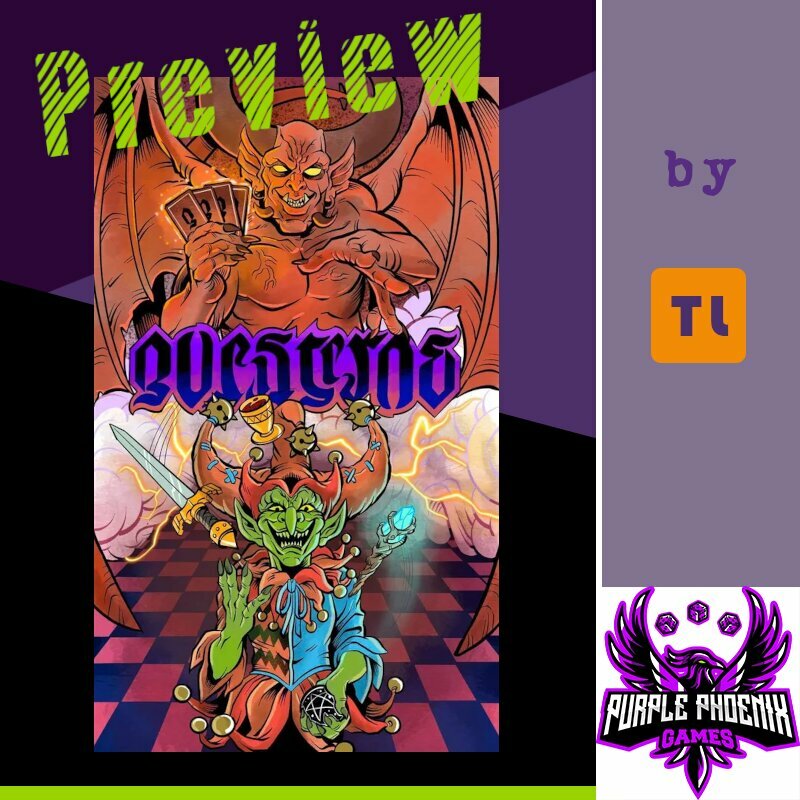
You know that messed up deal when you are just chillin’ in the forest doing goblin-y things when you are caught and forced into a life of servitude by the king of the realm, and then when he needs someone to go on a dangerous quest he calls upon you, the now court jester, to fulfill said quest? Doesn’t that just chap your hide? Such is exactly the setting in which our hero(?) finds themselves in Questeros, or more fitting, Ero’s Quest (the solo adventure variant).
Ero is the goblin court jester from the open who has been “chosen” to quest about the land to rid it of the ne’er-do-wells of the realm. In this solo adventure mode of Questeros the player will be donning the visage and character of Ero as they travel about developing their skills and having encounters with powerful beings. It is up to the player to guide Ero through the kingdom and rid it of the foul that is plaguing it.
DISCLAIMER: We were provided a prototype copy of this game for the purposes of this review. These are preview copy components, and I do not know for sure if the final components will be any different from these shown. Also, it is not my intention to detail every rule in the game, as there are just too many. You are invited to download the rulebook, back the game through the Kickstarter campaign, or through any retailers stocking it after fulfillment. -T
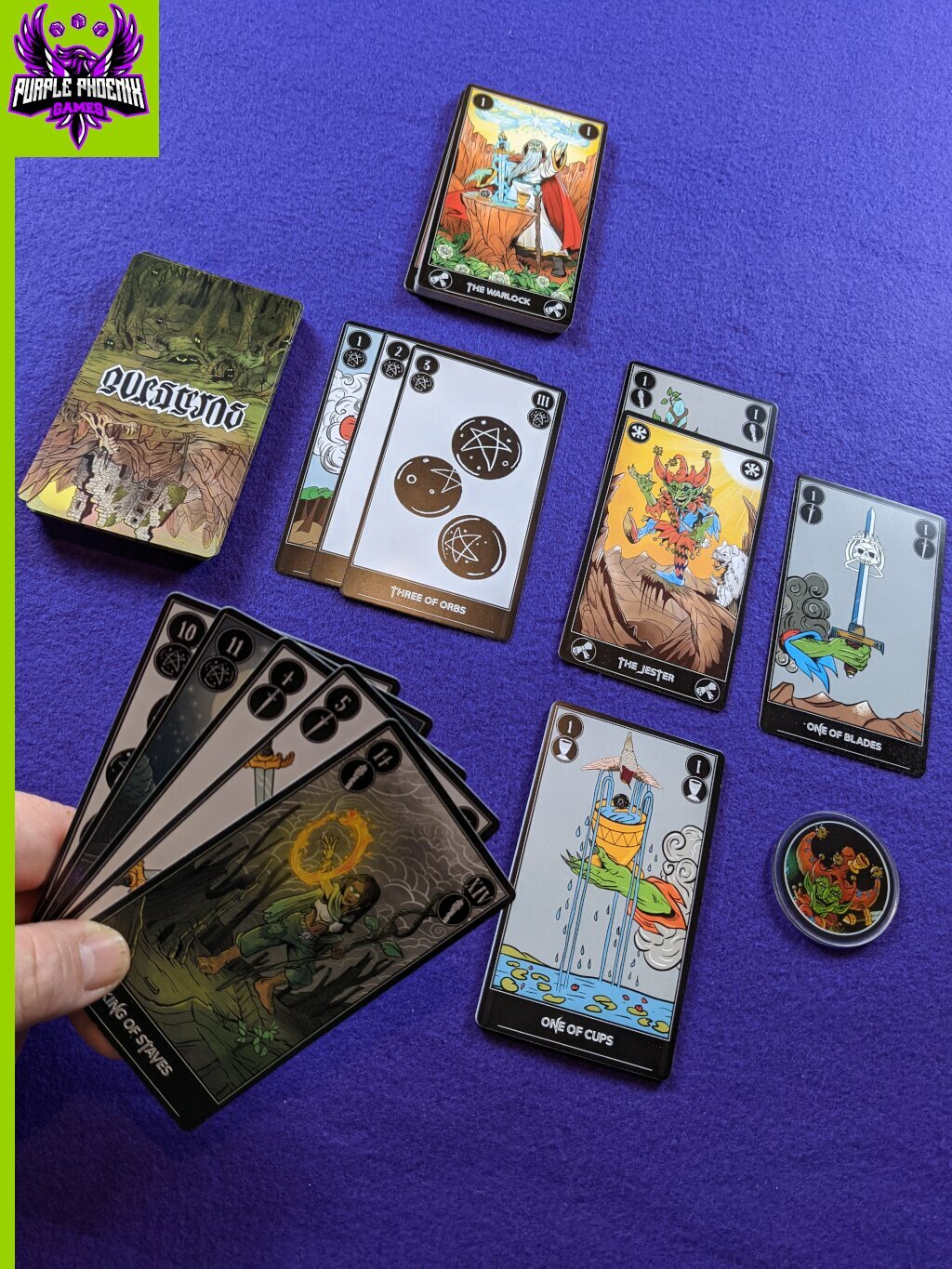
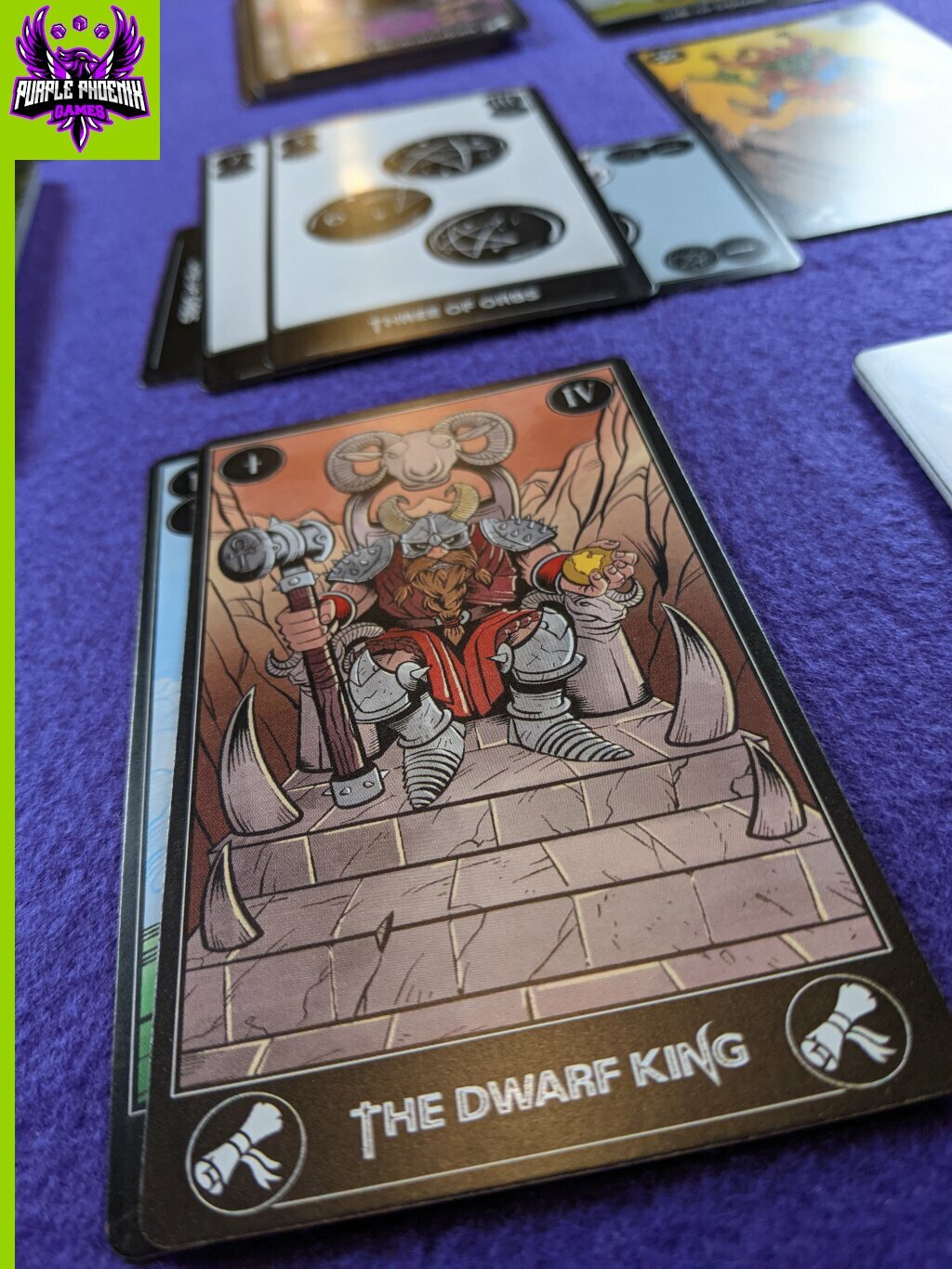
To setup the solo game, fondly and ingeniously-named “Ero’s Quest,” follow the rulebook to divide the tarot cards into their specific stacks and splays so that it roughly imitates the photo below. Draw a hand of five cards from the deck and the game may begin.
On a turn the player has a choice of seven actions that may be performed in any order. Each action may only be performed once per turn and when the turn is over the final action is Rest. To use the Develop action the player will place a card from their hand onto the Blades, Staves, or Orbs stacks in next-numerical order. This increases Ero’s attack and spending power. To Puchase cards Ero will spend Orb cards to look at the spent Orb value worth of cards from the draw deck, add one to their hand, and place the others at the bottom of the draw deck. At times Ero will need to Forget cards from hand in order to make room for more cards to enter it via the Learn action. Forgetting simply discards cards from hand while learning draws cards into hand from the draw deck. Recover is used to stand any kneeling/turned/rotated cards into an unused state by destroying cards of higher value from hand. As stated previously, to Rest is to end the turn by discarding the top card of the draw deck to setup the next turn.
I purposely left out the final action choice, Encounter, for a specific reason. Ero’s Quest is won when the entire deck of 21 Encounter cards is defeated. Each of these cards depicts a person or persons that Ero meets in his travels. Some require Ero to give them cards in order to pass. Some require Ero to succeed in battle against them in order to progress. In either case, Ero will need to get through the entire deck before his draw deck runs out in order to win the game.
Battle in Ero’s Quest is turn-based, where the Encounter persona attacks first, thus handing Ero wounds immediately. Wounds are suffered by spending Cups cards in value of the wound taken. For example, the Assassin is a value of 12, so they immediately wound Ero for 12 damage at the start of the encounter. Ero will spend a value of 12 Cups cards to simulate damage taken. Ero may then attack with a combination of available Blades, Staves, and any Ally cards obtained – one of each per attack turn. If the Encounter is defeated, Ero lives on. If the Encounter is not yet defeated, the battle continues with the Encounter card dealing damage and Ero responding with damage until one is defeated.
As mentioned earlier, the Encounter deck contains 21 cards with six of these being combat encounters. Ero has a ton of work to do and when each turn requires a card to be discarded before a new round may begin, they also have an in-game clock ticking and ticking each turn. However, if Ero is able to Develop their skills and overcome all the Encounters, the game is won and Ero becomes a Hero.
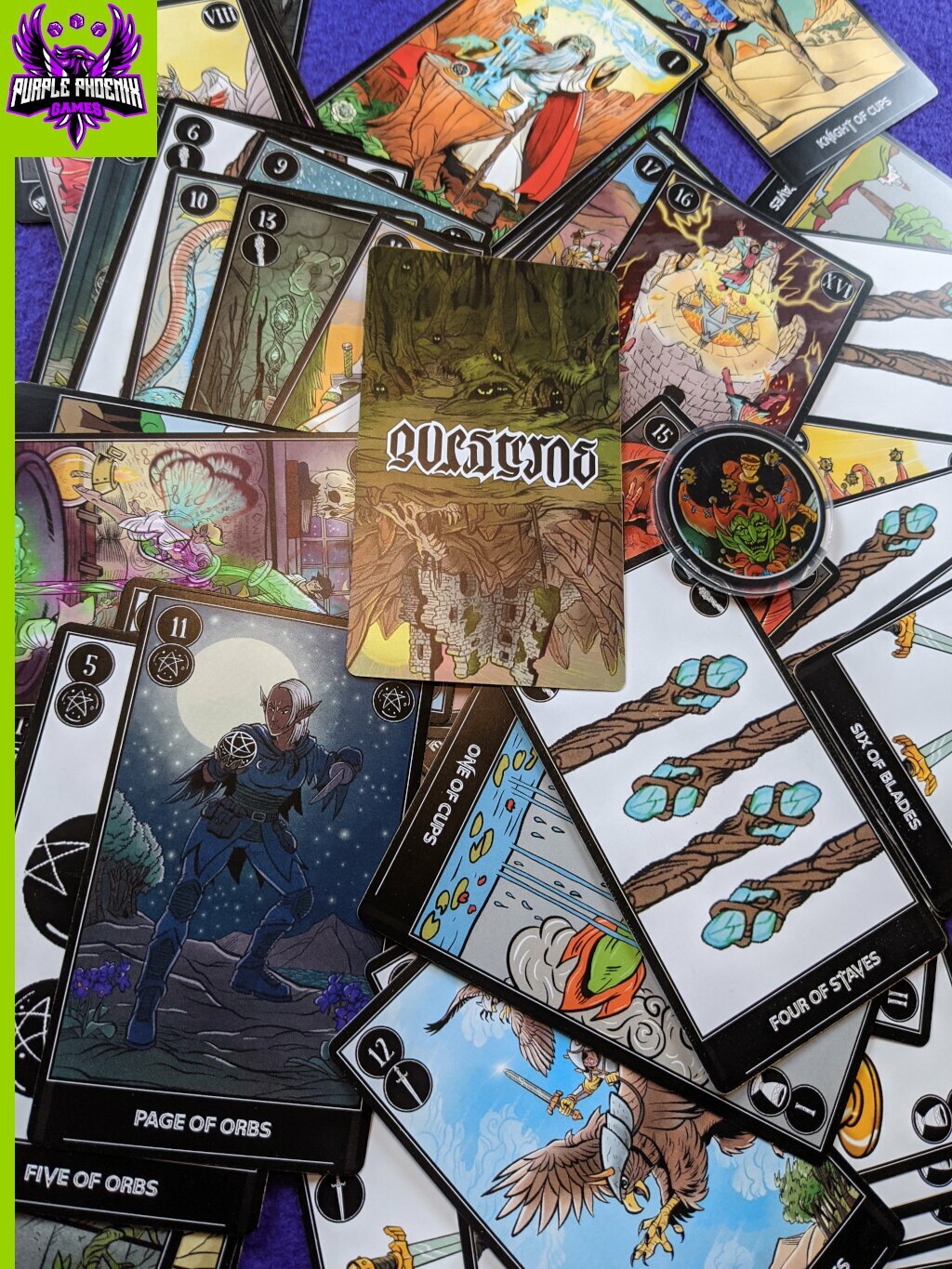
Components. Again, this is a prototype copy of the game, and many items are not fully completed in this version. That said, what we were provided is a large stack of tarot-sized cards, a first player Ero token (for multiplayer games), and a large pad of scoring sheets (also for multiplayer use). The cards are great quality and feature some really excellent artwork (on the cards that have the completed artwork on them). I do like the art style employed here, as I am a fan of fantasy themes, and I know that the game will probably ship with similar iconography, but may also be color-coded for ease of reference. All in all I believe Questeros is headed in the right direction for components, and a successful Kickstarter campaign may improve that even further.
The gameplay for the solo adventure of Ero’s Quest is really decent and engaging. So often I have found myself crunching numbers in my head and attempting to utilize my horrible card-counting “skills” to determine my next actions to take. Turns can be very intense and fruitful, or very frustrating and minimal, especially when you are waiting to draw that 3 of Blades so you can place it on the 2 of Blades sitting there, but it just won’t come up. And here you are sitting with the 4, 5, and 6 of Blades in hand and a Necromancer staring right at you awaiting combat. That is the definition of frustrating, but games usually take less than an hour, so even if an entire game is chock full of these turns, you can always setup a new game quickly and hope for better luck.
I like this one. I really do. It is interesting, has a great theme, so many delicious choices, and multiple ways to use the cards for game modes or tarot decks or even RPG FATE decks! On versatility alone I would rate this one high. If you are looking for a little card game to satisfy your mid-weight solo thirst, then check out Questeros. If you need a tarot game in your collection (as I look at mine and see no others), consider this one. It takes up very little shelf space, but looks great on the table and offers a great little solo experience. I have yet to beat the solo adventure, but Ero is calling my name for another go, and I might just have to give in. Again. And again.
Ero is the goblin court jester from the open who has been “chosen” to quest about the land to rid it of the ne’er-do-wells of the realm. In this solo adventure mode of Questeros the player will be donning the visage and character of Ero as they travel about developing their skills and having encounters with powerful beings. It is up to the player to guide Ero through the kingdom and rid it of the foul that is plaguing it.
DISCLAIMER: We were provided a prototype copy of this game for the purposes of this review. These are preview copy components, and I do not know for sure if the final components will be any different from these shown. Also, it is not my intention to detail every rule in the game, as there are just too many. You are invited to download the rulebook, back the game through the Kickstarter campaign, or through any retailers stocking it after fulfillment. -T
To setup the solo game, fondly and ingeniously-named “Ero’s Quest,” follow the rulebook to divide the tarot cards into their specific stacks and splays so that it roughly imitates the photo below. Draw a hand of five cards from the deck and the game may begin.
On a turn the player has a choice of seven actions that may be performed in any order. Each action may only be performed once per turn and when the turn is over the final action is Rest. To use the Develop action the player will place a card from their hand onto the Blades, Staves, or Orbs stacks in next-numerical order. This increases Ero’s attack and spending power. To Puchase cards Ero will spend Orb cards to look at the spent Orb value worth of cards from the draw deck, add one to their hand, and place the others at the bottom of the draw deck. At times Ero will need to Forget cards from hand in order to make room for more cards to enter it via the Learn action. Forgetting simply discards cards from hand while learning draws cards into hand from the draw deck. Recover is used to stand any kneeling/turned/rotated cards into an unused state by destroying cards of higher value from hand. As stated previously, to Rest is to end the turn by discarding the top card of the draw deck to setup the next turn.
I purposely left out the final action choice, Encounter, for a specific reason. Ero’s Quest is won when the entire deck of 21 Encounter cards is defeated. Each of these cards depicts a person or persons that Ero meets in his travels. Some require Ero to give them cards in order to pass. Some require Ero to succeed in battle against them in order to progress. In either case, Ero will need to get through the entire deck before his draw deck runs out in order to win the game.
Battle in Ero’s Quest is turn-based, where the Encounter persona attacks first, thus handing Ero wounds immediately. Wounds are suffered by spending Cups cards in value of the wound taken. For example, the Assassin is a value of 12, so they immediately wound Ero for 12 damage at the start of the encounter. Ero will spend a value of 12 Cups cards to simulate damage taken. Ero may then attack with a combination of available Blades, Staves, and any Ally cards obtained – one of each per attack turn. If the Encounter is defeated, Ero lives on. If the Encounter is not yet defeated, the battle continues with the Encounter card dealing damage and Ero responding with damage until one is defeated.
As mentioned earlier, the Encounter deck contains 21 cards with six of these being combat encounters. Ero has a ton of work to do and when each turn requires a card to be discarded before a new round may begin, they also have an in-game clock ticking and ticking each turn. However, if Ero is able to Develop their skills and overcome all the Encounters, the game is won and Ero becomes a Hero.
Components. Again, this is a prototype copy of the game, and many items are not fully completed in this version. That said, what we were provided is a large stack of tarot-sized cards, a first player Ero token (for multiplayer games), and a large pad of scoring sheets (also for multiplayer use). The cards are great quality and feature some really excellent artwork (on the cards that have the completed artwork on them). I do like the art style employed here, as I am a fan of fantasy themes, and I know that the game will probably ship with similar iconography, but may also be color-coded for ease of reference. All in all I believe Questeros is headed in the right direction for components, and a successful Kickstarter campaign may improve that even further.
The gameplay for the solo adventure of Ero’s Quest is really decent and engaging. So often I have found myself crunching numbers in my head and attempting to utilize my horrible card-counting “skills” to determine my next actions to take. Turns can be very intense and fruitful, or very frustrating and minimal, especially when you are waiting to draw that 3 of Blades so you can place it on the 2 of Blades sitting there, but it just won’t come up. And here you are sitting with the 4, 5, and 6 of Blades in hand and a Necromancer staring right at you awaiting combat. That is the definition of frustrating, but games usually take less than an hour, so even if an entire game is chock full of these turns, you can always setup a new game quickly and hope for better luck.
I like this one. I really do. It is interesting, has a great theme, so many delicious choices, and multiple ways to use the cards for game modes or tarot decks or even RPG FATE decks! On versatility alone I would rate this one high. If you are looking for a little card game to satisfy your mid-weight solo thirst, then check out Questeros. If you need a tarot game in your collection (as I look at mine and see no others), consider this one. It takes up very little shelf space, but looks great on the table and offers a great little solo experience. I have yet to beat the solo adventure, but Ero is calling my name for another go, and I might just have to give in. Again. And again.

Bob Mann (459 KP) rated Tenet (2020) in Movies
Aug 28, 2020
Spectacular action set pieces done "in camera" (1 more)
Branagh and Debecki, both superb
Sound mix makes dialogue unintelligible (1 more)
In the words of Huey Lewis, "You're too darn loud"
Only Nolan and Schrödinger’s cat knows what’s going on.
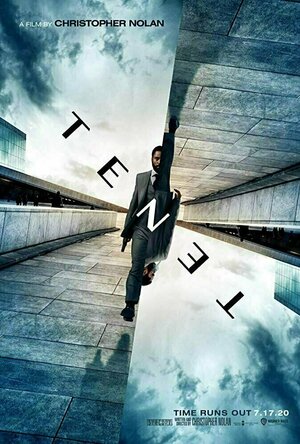
Tenet is the long awaited new movie from Christopher Nolan. The movie that's set to reboot the multiplexes post-Covid. It's a manic, extremely loud, extremely baffling sci-fi cum spy rollercoaster that will please a lot of Nolan fan-boys but which left me with very mixed views.
How to write a spoiler-free plot summary? John David Washington (Denzel's lad) plays "The Protagonist" - a crack-CIA field operative who is an unstoppable one-man army in the style of Hobbs or Shaw. Recruited into an even more shadowy organisation, he's on the trail of an international arms dealer, Andrei Sator (Kenneth Branagh in full villain mode). Sator is bullying his estranged wife Kat (Elizabeth Debicki) over custody of their son (and the film unusually has a BBFC warning about "Domestic Abuse"). Our hero jets the world to try to prevent a very particular kind of Armageddon while also keeping the vulnerable and attractive Kat alive.
This is cinema at its biggest and boldest. Nolan has taken a cinema 'splurge' gun, filled it with money, set it on rapid fire, removed the safety and let rip at the screen. Given that Nolan is famous for doing all of his 'effects' for real and 'in camera', some of what you see performed is almost unbelievable. You thought crashing a train through rush-hour traffic in "Inception" was crazy? You ain't seen nothing yet with the airport scene! And for lovers of Chinooks (I must admit I am one and rush out of the house to see one if I hear it coming!) there is positively Chinook-p*rn on offer in the film's ridiculously huge finale.
The 'inversion' aspects of the story also lends itself to some fight scenes - one in particular in an airport 'freeport' - which are both bizarre to watch and, I imagine, technically extremely challenging to pull off. In this regard John David Washington is an acrobatic and talented stunt performer in his own right, and must have trained for months for this role.
Nolan's crew also certainly racked up their air miles pre-lockdown, since the locations range far and wide across the world. The locations encompassed Denmark, Estonia, India, Italy, Norway, the United Kingdom, and United States. Hoyte Van Hoytema's cinematography is lush in introducing these, especially the beautiful Italian coast scenes. Although I did miss the David Arnold strings that would typically introduce these in a Bond movie: it felt like that was missing.
The 'timey-wimey' aspects of the plot are also intriguing and very cleverly done. There are numerous points at which you think "Oh, that's a sloppy continuity error" or "Shame the production design team missed that cracked wing mirror". Then later in the movie, you get at least a dozen "Aha!" moments. Some of them (no spoilers) are jaw-droppingly spectacular.
Perhaps the best twist is hidden in the final line of the movie. I only processed it on the way home.
And so to the first of my significant gripes with Tenet. The sound mix in the movie is all over the place. I'd go stronger than that... it's truly awful (expletive deleted)! Nolan often implements Shakespeare's trick of having characters in the play provide exposition of the plot to aid comprehension. But unfortunately, all of this exposition dialogue was largely incomprehensible. This was due to:
- the ear-splitting volume of the sound: 2020 movie audiences are going to be suffering from 'Tenetis'! (that joke © David Moody, 2020);
- the dialogue is poorly mixed with the thumping music by Ludwig Göransson (Wot? No Hans Zimmer?);
- a large proportion of the dialogue was through masks of varying description (#covid-appropriate). Aaron Taylor-Johnson was particularly unintelligible to my ears.
Overall, watching this with subtitles at a special showing might be advisable!
OK, so I only have a PhD in Physics... but at times I was completely lost as to the intricacies of the plot. It made "Inception" look like "The Tiger Who Came to Tea". There was an obvious 'McGuffin' in "Inception" - - ("These 'dream levels'... how exactly are they architected??".... "Don't worry... they'll never notice". And we didn't!) In "Tenet" there are McGuffins nested in McGuffins. So much of this is casually waved away as "future stuff... you're not qualified" that it feels vaguely condescending to the audience. At one point Kat says "I don't understand what's going on" - darn right luv.
There are also gaps in the storyline that jar. The word "Tenet"? What does it mean. Is it just a password? I'm none the wiser.
The manic pace of Tenet and the constant din means that the movie gallops along like a series of disconnected (albeit brilliant) action set pieces. For me, it has none of the emotional heart of the Cobb's marriage problems from "Inception" or the father/daughter separation of "Interstellar". In fact, you barely care for anyone in the movie, perhaps with the exception of Kat.
It's a talented cast. As mentioned above, John David Washington is muscular and athletic in the role. It's a big load for the actor to carry in such a tent-pole movie, given his only significant starring role before was in the excellent BlacKkKlansman. But he carries it off well. A worthy successor to Gerard Butler and Jason Statham for action roles in the next 10 years.
This is also a great performance by Robert Pattinson, in his most high-profile film in a long time, playing the vaguely alcoholic and Carré-esque support guy. Pattinson's Potter co-star Clemence Poésy also pops up - rather more un-glam that usual - as the scientist plot-expositor early in the movie.
Nolan's regular Michael Caine also pops up. although the 87-year old legend is starting to show his age: His speech was obviously affected at the time of filming (though nice try Mr Nolan in trying to disguise that with a mouth full of food!). But in my book, any amount of Caine in a movie is a plus. He also gets to deliver the best killer line in the film about snobbery!
However, it's Kenneth Branagh and Elizabeth Debicki that really stand out. They were both fabulous, especially when they were bouncing off each other in their marital battle royale.
So, given this was my most anticipated movie of the year, it's a bit of a curate's egg for me. A mixture of being awe-struck at times and slightly disappointed at others. It's a movie which needs a second watch, so I'm heading back today to give my ear drums another bashing! And this is one where I reserve the right to revisit my rating after that second watch... it's not likely to go down... but it might go up.
(For the full graphical review, check out One Mann's Movies here - https://bob-the-movie-man.com/2020/08/28/tenet-only-nolan-and-schrodingers-cat-knows-whats-going-on/ .)
How to write a spoiler-free plot summary? John David Washington (Denzel's lad) plays "The Protagonist" - a crack-CIA field operative who is an unstoppable one-man army in the style of Hobbs or Shaw. Recruited into an even more shadowy organisation, he's on the trail of an international arms dealer, Andrei Sator (Kenneth Branagh in full villain mode). Sator is bullying his estranged wife Kat (Elizabeth Debicki) over custody of their son (and the film unusually has a BBFC warning about "Domestic Abuse"). Our hero jets the world to try to prevent a very particular kind of Armageddon while also keeping the vulnerable and attractive Kat alive.
This is cinema at its biggest and boldest. Nolan has taken a cinema 'splurge' gun, filled it with money, set it on rapid fire, removed the safety and let rip at the screen. Given that Nolan is famous for doing all of his 'effects' for real and 'in camera', some of what you see performed is almost unbelievable. You thought crashing a train through rush-hour traffic in "Inception" was crazy? You ain't seen nothing yet with the airport scene! And for lovers of Chinooks (I must admit I am one and rush out of the house to see one if I hear it coming!) there is positively Chinook-p*rn on offer in the film's ridiculously huge finale.
The 'inversion' aspects of the story also lends itself to some fight scenes - one in particular in an airport 'freeport' - which are both bizarre to watch and, I imagine, technically extremely challenging to pull off. In this regard John David Washington is an acrobatic and talented stunt performer in his own right, and must have trained for months for this role.
Nolan's crew also certainly racked up their air miles pre-lockdown, since the locations range far and wide across the world. The locations encompassed Denmark, Estonia, India, Italy, Norway, the United Kingdom, and United States. Hoyte Van Hoytema's cinematography is lush in introducing these, especially the beautiful Italian coast scenes. Although I did miss the David Arnold strings that would typically introduce these in a Bond movie: it felt like that was missing.
The 'timey-wimey' aspects of the plot are also intriguing and very cleverly done. There are numerous points at which you think "Oh, that's a sloppy continuity error" or "Shame the production design team missed that cracked wing mirror". Then later in the movie, you get at least a dozen "Aha!" moments. Some of them (no spoilers) are jaw-droppingly spectacular.
Perhaps the best twist is hidden in the final line of the movie. I only processed it on the way home.
And so to the first of my significant gripes with Tenet. The sound mix in the movie is all over the place. I'd go stronger than that... it's truly awful (expletive deleted)! Nolan often implements Shakespeare's trick of having characters in the play provide exposition of the plot to aid comprehension. But unfortunately, all of this exposition dialogue was largely incomprehensible. This was due to:
- the ear-splitting volume of the sound: 2020 movie audiences are going to be suffering from 'Tenetis'! (that joke © David Moody, 2020);
- the dialogue is poorly mixed with the thumping music by Ludwig Göransson (Wot? No Hans Zimmer?);
- a large proportion of the dialogue was through masks of varying description (#covid-appropriate). Aaron Taylor-Johnson was particularly unintelligible to my ears.
Overall, watching this with subtitles at a special showing might be advisable!
OK, so I only have a PhD in Physics... but at times I was completely lost as to the intricacies of the plot. It made "Inception" look like "The Tiger Who Came to Tea". There was an obvious 'McGuffin' in "Inception" - - ("These 'dream levels'... how exactly are they architected??".... "Don't worry... they'll never notice". And we didn't!) In "Tenet" there are McGuffins nested in McGuffins. So much of this is casually waved away as "future stuff... you're not qualified" that it feels vaguely condescending to the audience. At one point Kat says "I don't understand what's going on" - darn right luv.
There are also gaps in the storyline that jar. The word "Tenet"? What does it mean. Is it just a password? I'm none the wiser.
The manic pace of Tenet and the constant din means that the movie gallops along like a series of disconnected (albeit brilliant) action set pieces. For me, it has none of the emotional heart of the Cobb's marriage problems from "Inception" or the father/daughter separation of "Interstellar". In fact, you barely care for anyone in the movie, perhaps with the exception of Kat.
It's a talented cast. As mentioned above, John David Washington is muscular and athletic in the role. It's a big load for the actor to carry in such a tent-pole movie, given his only significant starring role before was in the excellent BlacKkKlansman. But he carries it off well. A worthy successor to Gerard Butler and Jason Statham for action roles in the next 10 years.
This is also a great performance by Robert Pattinson, in his most high-profile film in a long time, playing the vaguely alcoholic and Carré-esque support guy. Pattinson's Potter co-star Clemence Poésy also pops up - rather more un-glam that usual - as the scientist plot-expositor early in the movie.
Nolan's regular Michael Caine also pops up. although the 87-year old legend is starting to show his age: His speech was obviously affected at the time of filming (though nice try Mr Nolan in trying to disguise that with a mouth full of food!). But in my book, any amount of Caine in a movie is a plus. He also gets to deliver the best killer line in the film about snobbery!
However, it's Kenneth Branagh and Elizabeth Debicki that really stand out. They were both fabulous, especially when they were bouncing off each other in their marital battle royale.
So, given this was my most anticipated movie of the year, it's a bit of a curate's egg for me. A mixture of being awe-struck at times and slightly disappointed at others. It's a movie which needs a second watch, so I'm heading back today to give my ear drums another bashing! And this is one where I reserve the right to revisit my rating after that second watch... it's not likely to go down... but it might go up.
(For the full graphical review, check out One Mann's Movies here - https://bob-the-movie-man.com/2020/08/28/tenet-only-nolan-and-schrodingers-cat-knows-whats-going-on/ .)

Kyera (8 KP) rated Empire of Storms in Books
Feb 1, 2018
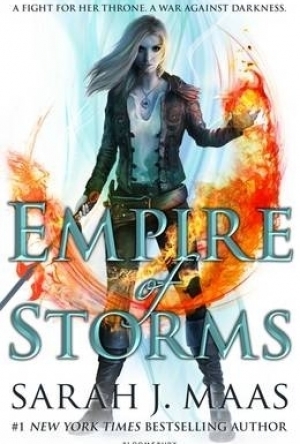

Re-Read Update:
This book destroyed me. I cheered when my baby, Abraxos, appeared (legitimately out loud cheered) and wanted to cry at those fateful words. If you've read this book, you know which ones I'm referring to and if not, I can't say because there would be spoilers. Despite the issues and shift in the characterization of some of our leads, this book takes you on an incredible emotional journey with highs that make you cheer (see above) and lows that bring you to tears (almost).
Despite the length of the book, I didn't feel as though the story lagged or the pacing was poor. Any free minute I had, I immediately turned to the book to continue where I left off. Even knowing what was going to happen, it managed to enthrall me.
One of the problems that I have with this book is its portrayal of relationships. There are aspects of it that are so swoon-worthy and make your heart hurt, but there are some that are not healthy. It's nice to see diverse portrayals of love and relationships, but my concern is that a young adult reader might see the territorial Fae nonsense in the book and not realize that it's an extreme. It might seem normalized. As I am not a teenager, I am aware of the intricacies and can roll my eyes at the "nonsense" without putting any weight on the idea. That may not be the same for teen readers.
There are aspects of the character development that seems off and others that, although regrettable, are completely valid. For example, Dorian has gone through an incredible amount of turmoil and emotional upheaval in the last two books. It's understandable that his personality would not quite be the same carefree, flirty scholar that we met in the first book who wished to stand up to his father but could never garner the courage to do so.
In a similar vein, we watch other characters develop into multi-faceted people and understand them more. Manon and Lysandra have become much more interesting characters as they were expanded upon, and at least for me have become some of my favourites. Despite the huge cast of fairly main characters, each is still given the time to shine and grow.
Finally, the world building continues in this book to an immense degree. A combination of the book's size and the various viewpoints has allowed Sarah J Maas to expand the world we have come to know. Erilea has been developed and we are able to see more pieces of Nehemia's homeland, Aelin's kingdom, and so much in between.
I still love this series and highly recommend it to young adult/teen readers who enjoy fantasy books.
Original Review:
These novels are so addicting, emotional and indescribable - but I'm going to try to do them justice. If you've not yet read up to Empire of Storms, please avoid this review as it has spoilers. I try to leave out the major plot points and just focus on the characters/world, but it's not free from them. Please read on only if you've read the series.
Our main cast of beloved and some tolerated, main/supporting characters grows throughout the series. Although we lose Nehemia, which I am still so sad about - we are introduced to the Fae. Their inclusion in the series brings the genre into high fantasy and makes it even more enjoyable. Prior to this series, I hadn't read many novels in which the supernatural creatures were the Fae but now I am obsessed. The world of the Fae isn't experienced or explained much, but I would love to see more of it. Their powers or abilities are so intriguing and well written. Just enough information is given that you can understand what is going on, then beautifully populate the world and battles in your mind.
Sarah J Maas makes you fall in love with each of the characters, whether you liked them when they were first introduced or not. One of the first perspective shifts we experience is when we are introduced to the bloodthirsty Manon Blackbeak. At first, you wish her scenes weren't there as they take away from time with our main characters but by the fifth novel she's one of the characters you're rooting for. Although she's a witch and over one hundred years old, she is given the ability to develop and change over the course of the novels. It takes time because she's learning that things she believed her entire life aren't true and don't need to affect how she views life.
Even characters that we were originally introduced to, like Lysandre are able to evolve and change over the course of the books. She and Celaena start off butting heads and competing, but that doesn't last. They join together and made a formidable pair (especially once magic is restored to the land). Lysandre grows into one of my favourite characters and her wholehearted commitment to the cause is inspiring.
Seeking more information about the Wyrdkeys, Celaena seeks knowledge from the Fae Queen Maeve. Unwilling to give her information away for nothing, Queen Maeve makes a deal that Celaena must train with and impress one of her trusted warriors, Rowan. Prince Rowan is able to manipulate ice and wind, whilst also transforming into a hawk. Her inner circle are sworn to her with a blood oath and a group of Fae warriors that include Rowan, Lorcan, Gavriel, Vaughen, Fenrys and Connall. Later on, this group is affectionately titled Rowan's cadre and some join our heroes on their journey.
Unsurprisingly, we discover that Celaena is actually the Princess (or Queen) of Terrasen and that revelation brings with it some people from her past. Her cousin, Aedion was forced for years to do the bidding of the King of Adarlan whilst secretly helping his people. He is a general and his legion of warriors called the Bane are loyal to him rather than the King. We also meet another person from Terrasen, the daughter of the woman who sacrificed herself to allow Aelin to escape as a child - Elide. She was mistreated by her Uncle for years, until Manon Blackbeak helped her escape. After only a few days, she crosses paths with Lorcan who is a member of Rowan's cadre and they begin to journey together.
Lorcan is not well liked by Rowan or Aelin when we first come across him in Rifthold. He is still bound to Queen Maeve and is seeking to find and destroy the Wyrdkeys. Throughout his journey across Erilea, he discovers that he has a soft spot for Elide and protects her. Some of the other cadre are viewed in a more favourable light by Aelin and her friends, as they attempt to delay their orders from Maeve to help on the quest.
Sarah J Maas writes the best pairings that fill your heart with so much feeling then she rips it out and stomps all over it. Rowan loves Aelin with his whole heart, every part, the good, the bad, the broken and beaten, the assassin, the Queen, the Fae and no one else has ever done that for her. Their love is true and enduring. Heartwrenching and pure. Even though they didn't start off on the best footing, after training her for a time and even breaking his blood oath to Maeve - Rowan is completely enamored. Plus, they're mates so there's nothing more important and bonding. Each relationship is authentic and pulls at your heartstrings.
Throughout the novels, you are able to experience more of the lands with Erilea from the dark, twisted towers of Morath to the Queen's home of Terrasen. They are welcome additions to our mental maps of the land and wonderfully illustrated through words.
This is one of my favourite series by far and is highly recommended to all - also specifically to young adult readers who enjoy well writen novels with developed characters, immersive world-building and fantasy.
This book destroyed me. I cheered when my baby, Abraxos, appeared (legitimately out loud cheered) and wanted to cry at those fateful words. If you've read this book, you know which ones I'm referring to and if not, I can't say because there would be spoilers. Despite the issues and shift in the characterization of some of our leads, this book takes you on an incredible emotional journey with highs that make you cheer (see above) and lows that bring you to tears (almost).
Despite the length of the book, I didn't feel as though the story lagged or the pacing was poor. Any free minute I had, I immediately turned to the book to continue where I left off. Even knowing what was going to happen, it managed to enthrall me.
One of the problems that I have with this book is its portrayal of relationships. There are aspects of it that are so swoon-worthy and make your heart hurt, but there are some that are not healthy. It's nice to see diverse portrayals of love and relationships, but my concern is that a young adult reader might see the territorial Fae nonsense in the book and not realize that it's an extreme. It might seem normalized. As I am not a teenager, I am aware of the intricacies and can roll my eyes at the "nonsense" without putting any weight on the idea. That may not be the same for teen readers.
There are aspects of the character development that seems off and others that, although regrettable, are completely valid. For example, Dorian has gone through an incredible amount of turmoil and emotional upheaval in the last two books. It's understandable that his personality would not quite be the same carefree, flirty scholar that we met in the first book who wished to stand up to his father but could never garner the courage to do so.
In a similar vein, we watch other characters develop into multi-faceted people and understand them more. Manon and Lysandra have become much more interesting characters as they were expanded upon, and at least for me have become some of my favourites. Despite the huge cast of fairly main characters, each is still given the time to shine and grow.
Finally, the world building continues in this book to an immense degree. A combination of the book's size and the various viewpoints has allowed Sarah J Maas to expand the world we have come to know. Erilea has been developed and we are able to see more pieces of Nehemia's homeland, Aelin's kingdom, and so much in between.
I still love this series and highly recommend it to young adult/teen readers who enjoy fantasy books.
Original Review:
These novels are so addicting, emotional and indescribable - but I'm going to try to do them justice. If you've not yet read up to Empire of Storms, please avoid this review as it has spoilers. I try to leave out the major plot points and just focus on the characters/world, but it's not free from them. Please read on only if you've read the series.
Our main cast of beloved and some tolerated, main/supporting characters grows throughout the series. Although we lose Nehemia, which I am still so sad about - we are introduced to the Fae. Their inclusion in the series brings the genre into high fantasy and makes it even more enjoyable. Prior to this series, I hadn't read many novels in which the supernatural creatures were the Fae but now I am obsessed. The world of the Fae isn't experienced or explained much, but I would love to see more of it. Their powers or abilities are so intriguing and well written. Just enough information is given that you can understand what is going on, then beautifully populate the world and battles in your mind.
Sarah J Maas makes you fall in love with each of the characters, whether you liked them when they were first introduced or not. One of the first perspective shifts we experience is when we are introduced to the bloodthirsty Manon Blackbeak. At first, you wish her scenes weren't there as they take away from time with our main characters but by the fifth novel she's one of the characters you're rooting for. Although she's a witch and over one hundred years old, she is given the ability to develop and change over the course of the novels. It takes time because she's learning that things she believed her entire life aren't true and don't need to affect how she views life.
Even characters that we were originally introduced to, like Lysandre are able to evolve and change over the course of the books. She and Celaena start off butting heads and competing, but that doesn't last. They join together and made a formidable pair (especially once magic is restored to the land). Lysandre grows into one of my favourite characters and her wholehearted commitment to the cause is inspiring.
Seeking more information about the Wyrdkeys, Celaena seeks knowledge from the Fae Queen Maeve. Unwilling to give her information away for nothing, Queen Maeve makes a deal that Celaena must train with and impress one of her trusted warriors, Rowan. Prince Rowan is able to manipulate ice and wind, whilst also transforming into a hawk. Her inner circle are sworn to her with a blood oath and a group of Fae warriors that include Rowan, Lorcan, Gavriel, Vaughen, Fenrys and Connall. Later on, this group is affectionately titled Rowan's cadre and some join our heroes on their journey.
Unsurprisingly, we discover that Celaena is actually the Princess (or Queen) of Terrasen and that revelation brings with it some people from her past. Her cousin, Aedion was forced for years to do the bidding of the King of Adarlan whilst secretly helping his people. He is a general and his legion of warriors called the Bane are loyal to him rather than the King. We also meet another person from Terrasen, the daughter of the woman who sacrificed herself to allow Aelin to escape as a child - Elide. She was mistreated by her Uncle for years, until Manon Blackbeak helped her escape. After only a few days, she crosses paths with Lorcan who is a member of Rowan's cadre and they begin to journey together.
Lorcan is not well liked by Rowan or Aelin when we first come across him in Rifthold. He is still bound to Queen Maeve and is seeking to find and destroy the Wyrdkeys. Throughout his journey across Erilea, he discovers that he has a soft spot for Elide and protects her. Some of the other cadre are viewed in a more favourable light by Aelin and her friends, as they attempt to delay their orders from Maeve to help on the quest.
Sarah J Maas writes the best pairings that fill your heart with so much feeling then she rips it out and stomps all over it. Rowan loves Aelin with his whole heart, every part, the good, the bad, the broken and beaten, the assassin, the Queen, the Fae and no one else has ever done that for her. Their love is true and enduring. Heartwrenching and pure. Even though they didn't start off on the best footing, after training her for a time and even breaking his blood oath to Maeve - Rowan is completely enamored. Plus, they're mates so there's nothing more important and bonding. Each relationship is authentic and pulls at your heartstrings.
Throughout the novels, you are able to experience more of the lands with Erilea from the dark, twisted towers of Morath to the Queen's home of Terrasen. They are welcome additions to our mental maps of the land and wonderfully illustrated through words.
This is one of my favourite series by far and is highly recommended to all - also specifically to young adult readers who enjoy well writen novels with developed characters, immersive world-building and fantasy.
Purple Phoenix Games (2266 KP) rated Festival! in Tabletop Games
Nov 24, 2020

Remember music festivals, or concerts of any kind? I most certainly do. I used to perform almost every weekend with my band pre-COVID. Well, I haven’t performed in over eight months as of this writing. I miss it so much. So when I heard that a designer was working on a game about musicians putting on music festivals I just had to check it out.
Festival! is a competitive set collection game for larger groups, three to seven players. It is set in a medieval kingdom and the game lasts for four festivals. During the game players will be collecting sets of cards to be scored immediately and collecting other cards to be scored at the game’s end.
DISCLAIMER: We were provided a prototype copy of this game for the purposes of this review. These are preview copy components, and I do not know for sure if the final components will be any different from these shown. Also, it is not my intention to detail every rule in the game, but give an idea of how the game plays. You are invited to download the rulebook, back the game through the forthcoming Kickstarter campaign, or through any retailers stocking it after fulfillment. -T
To setup, place the board in the middle of the table. Each player chooses a color of pawn to represent them and places one pawn on the 0 space upon the scoring track and the other pawn in the Festival! area upon the board. The game comes with four different types of cards and each type will be shuffled and placed face-down in stacks as in the photo below. Place the festival marker on either the 0 or 4 space (the rules are not clear, but it is to track the number of festivals, so just choose one) and give the first player busteeple to the youngest player. The game may now begin.
Festival! is played over several turns, but the first three turns will see players taking turns to travel to the different areas of the board and collect cards once they arrive. The initial Festival! area is located between the City and Village areas so a player can choose to move their pawn into either of those areas. As is printed on the board areas themselves, when players arrive in the Country they will immediately draw three Ensemble (green) cards to their hand and their turn is over. A trip to the Village affords the player two Ensemble cards to be drawn, while a visit to the City will allow a player to either draw one Ensemble card OR play as many cards from their hand as they choose. Finally, should the player’s wanderlust urge them to the Palace, they may draw a Palace card to be played to their tableau immediately. Movement from one area to the next is always done to the adjacent area. So if in the Village a player may only move to either the Country or the City. If in the Country a player may only move to the Village.
As I mentioned, the first three turns are head start rounds where players are merely collecting cards to amass a hand (of limit 7) of cards that can be played in sets in their personal tableau. These cards are divided into Exotic, Percussion, Melodic, and Choir cards. Players may play as many cards as they like when in the City, but will score bonus set and superset points if they are able to lay down multiple unique cards in each group. For example, a Horn card is worth one VP alone, but with three other unique Melodic cards earns bonus points for the entire set.
After the first three turns have been played, the first player will then flip a Festival card (stacked on the game board) at the beginning of each turn. It is from this stack that the four “Festival!” cards are located, and they are the time trackers for the game. If the result is “Preparation,” the turns continue as normal with no change. However, should the flipped card be a “Festival!” face, then players within range of the Festival Stages may claim a stage and participate in the festival. Participation in the festival simply means that players may play cards as normally played in the City, but then are entitled to one of the drawn Finale cards. These cards are scored at the end of the game and typically award bonus points for various reasons.
Play continues in this fashion of traveling the board areas to collect cards, performing in festivals, and earning the most amount of VP at game end, which is immediately following the fourth festival. The player with the most VP is the winner!
Components. Again, this is a prototype copy of the game, so the components may be different upon completion of a successful Kickstarter campaign. What we were provided, however, is a good-looking, though muted, game board, a ton of cards, and some painted wooden tokens. The tokens are fine, and I am sure will look different once the game is finalized. The cards are good, an interesting dimension, and the art upon them is good and simple. In fact, the cards’ art remind me of several computer icon sets, specifically Shadow or Sardi (though I use Sweet-Rainbow).
But how does it play? Okay, every time I get a new game I always play it solo multi-handed. During this initial play I had several questions for the designer about scenarios and other oddities that were not covered in the rulebook. He graciously, and immediately, answered my questions and the next play through ran quite smoothly. So I am sure the rulebook will be tweaked quite a bit before final production.
Once I was playing the right way the game ran smoothly and quickly. I found myself planning my turn in advance, however your success truly is dependent on the cards you draw. Ensemble cards are just the instruments, voices, and Minstrel (wild) cards, while the Palace cards are the rule-breaking fun cards. They allow increased travel, protection from certain cards in the deck, and other goodies I won’t spoil here. So having a nice collection of Palace cards can alleviate a lot of the random card draw issues that will plague players who refuse to grab the Palace cards. As I played more and more I found that I generally follow one strategy, but have to switch up tactics depending on my card draws. This is good and okay (not “bad”). Going in with a plan of attack is great, and being able to become flexible mid-game is enjoyable.
Overall this one is surprising to me because I was initially frustrated with the vague rulebook, but once I truly knew the real rules and how everything played together I found a real fondness for it. Festival! will probably never make it close to my Top 10 Games of All Time list, but for larger groups who are tiring of the hidden traitor or social deduction games, this one is a breath of fresh air. It can handle up to seven players, and is an easier teach than many other games for mid-to-large groups.
So if you are looking for something different for a weird player count, and you need some more medieval rock star games in your collection please check out Festival!. (Do I need the period there or am I covered with the exclamation point from the title of the game? I was not an English major.) I think you will be pleasantly surprised at how this unassuming set collection game (with aspects of take-that which I did not explore here) will perform. I am looking forward to following the Kickstarter campaign set to launch in Spring 2021, so keep it on your radars, people.
Festival! is a competitive set collection game for larger groups, three to seven players. It is set in a medieval kingdom and the game lasts for four festivals. During the game players will be collecting sets of cards to be scored immediately and collecting other cards to be scored at the game’s end.
DISCLAIMER: We were provided a prototype copy of this game for the purposes of this review. These are preview copy components, and I do not know for sure if the final components will be any different from these shown. Also, it is not my intention to detail every rule in the game, but give an idea of how the game plays. You are invited to download the rulebook, back the game through the forthcoming Kickstarter campaign, or through any retailers stocking it after fulfillment. -T
To setup, place the board in the middle of the table. Each player chooses a color of pawn to represent them and places one pawn on the 0 space upon the scoring track and the other pawn in the Festival! area upon the board. The game comes with four different types of cards and each type will be shuffled and placed face-down in stacks as in the photo below. Place the festival marker on either the 0 or 4 space (the rules are not clear, but it is to track the number of festivals, so just choose one) and give the first player busteeple to the youngest player. The game may now begin.
Festival! is played over several turns, but the first three turns will see players taking turns to travel to the different areas of the board and collect cards once they arrive. The initial Festival! area is located between the City and Village areas so a player can choose to move their pawn into either of those areas. As is printed on the board areas themselves, when players arrive in the Country they will immediately draw three Ensemble (green) cards to their hand and their turn is over. A trip to the Village affords the player two Ensemble cards to be drawn, while a visit to the City will allow a player to either draw one Ensemble card OR play as many cards from their hand as they choose. Finally, should the player’s wanderlust urge them to the Palace, they may draw a Palace card to be played to their tableau immediately. Movement from one area to the next is always done to the adjacent area. So if in the Village a player may only move to either the Country or the City. If in the Country a player may only move to the Village.
As I mentioned, the first three turns are head start rounds where players are merely collecting cards to amass a hand (of limit 7) of cards that can be played in sets in their personal tableau. These cards are divided into Exotic, Percussion, Melodic, and Choir cards. Players may play as many cards as they like when in the City, but will score bonus set and superset points if they are able to lay down multiple unique cards in each group. For example, a Horn card is worth one VP alone, but with three other unique Melodic cards earns bonus points for the entire set.
After the first three turns have been played, the first player will then flip a Festival card (stacked on the game board) at the beginning of each turn. It is from this stack that the four “Festival!” cards are located, and they are the time trackers for the game. If the result is “Preparation,” the turns continue as normal with no change. However, should the flipped card be a “Festival!” face, then players within range of the Festival Stages may claim a stage and participate in the festival. Participation in the festival simply means that players may play cards as normally played in the City, but then are entitled to one of the drawn Finale cards. These cards are scored at the end of the game and typically award bonus points for various reasons.
Play continues in this fashion of traveling the board areas to collect cards, performing in festivals, and earning the most amount of VP at game end, which is immediately following the fourth festival. The player with the most VP is the winner!
Components. Again, this is a prototype copy of the game, so the components may be different upon completion of a successful Kickstarter campaign. What we were provided, however, is a good-looking, though muted, game board, a ton of cards, and some painted wooden tokens. The tokens are fine, and I am sure will look different once the game is finalized. The cards are good, an interesting dimension, and the art upon them is good and simple. In fact, the cards’ art remind me of several computer icon sets, specifically Shadow or Sardi (though I use Sweet-Rainbow).
But how does it play? Okay, every time I get a new game I always play it solo multi-handed. During this initial play I had several questions for the designer about scenarios and other oddities that were not covered in the rulebook. He graciously, and immediately, answered my questions and the next play through ran quite smoothly. So I am sure the rulebook will be tweaked quite a bit before final production.
Once I was playing the right way the game ran smoothly and quickly. I found myself planning my turn in advance, however your success truly is dependent on the cards you draw. Ensemble cards are just the instruments, voices, and Minstrel (wild) cards, while the Palace cards are the rule-breaking fun cards. They allow increased travel, protection from certain cards in the deck, and other goodies I won’t spoil here. So having a nice collection of Palace cards can alleviate a lot of the random card draw issues that will plague players who refuse to grab the Palace cards. As I played more and more I found that I generally follow one strategy, but have to switch up tactics depending on my card draws. This is good and okay (not “bad”). Going in with a plan of attack is great, and being able to become flexible mid-game is enjoyable.
Overall this one is surprising to me because I was initially frustrated with the vague rulebook, but once I truly knew the real rules and how everything played together I found a real fondness for it. Festival! will probably never make it close to my Top 10 Games of All Time list, but for larger groups who are tiring of the hidden traitor or social deduction games, this one is a breath of fresh air. It can handle up to seven players, and is an easier teach than many other games for mid-to-large groups.
So if you are looking for something different for a weird player count, and you need some more medieval rock star games in your collection please check out Festival!. (Do I need the period there or am I covered with the exclamation point from the title of the game? I was not an English major.) I think you will be pleasantly surprised at how this unassuming set collection game (with aspects of take-that which I did not explore here) will perform. I am looking forward to following the Kickstarter campaign set to launch in Spring 2021, so keep it on your radars, people.

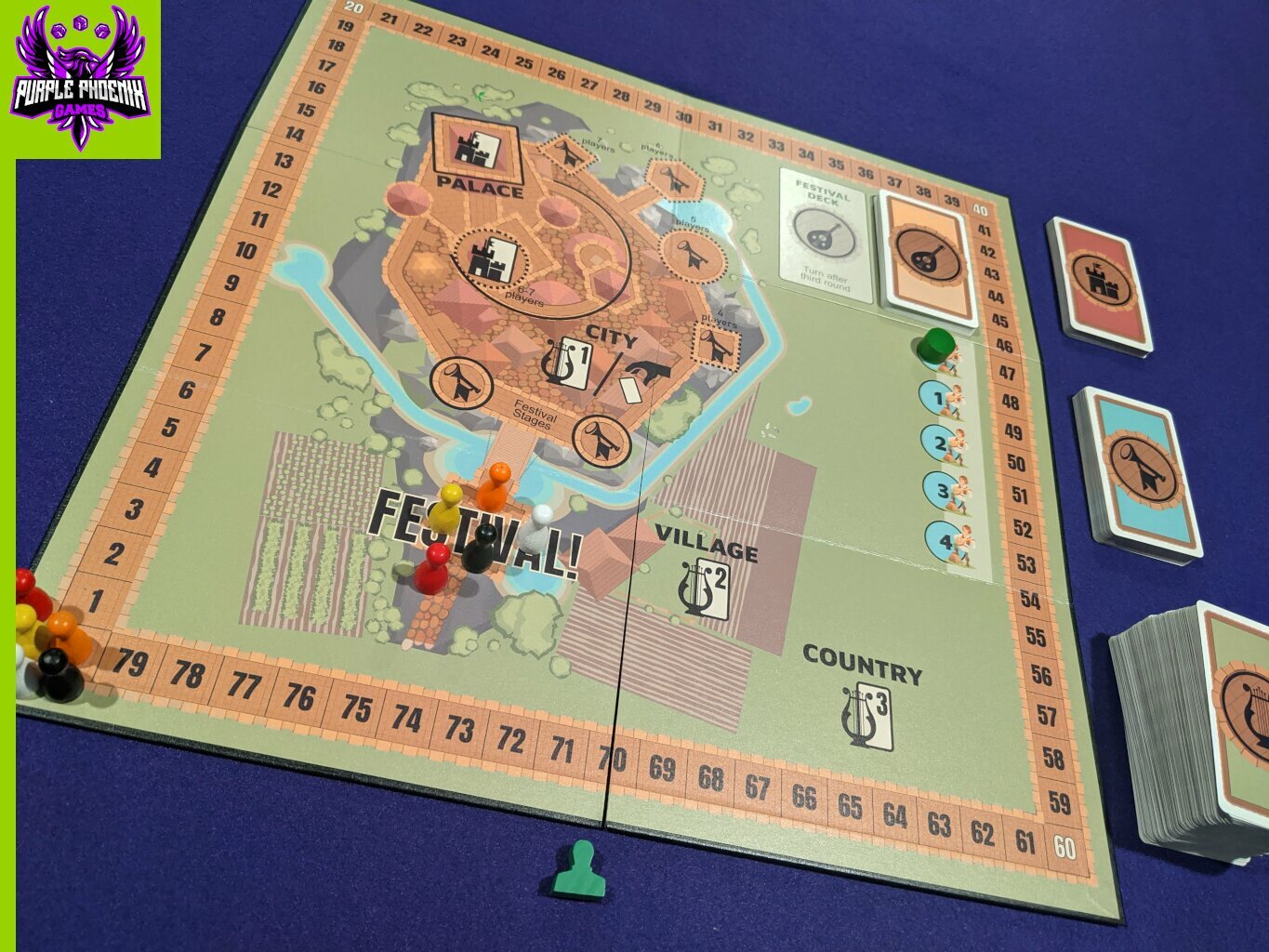
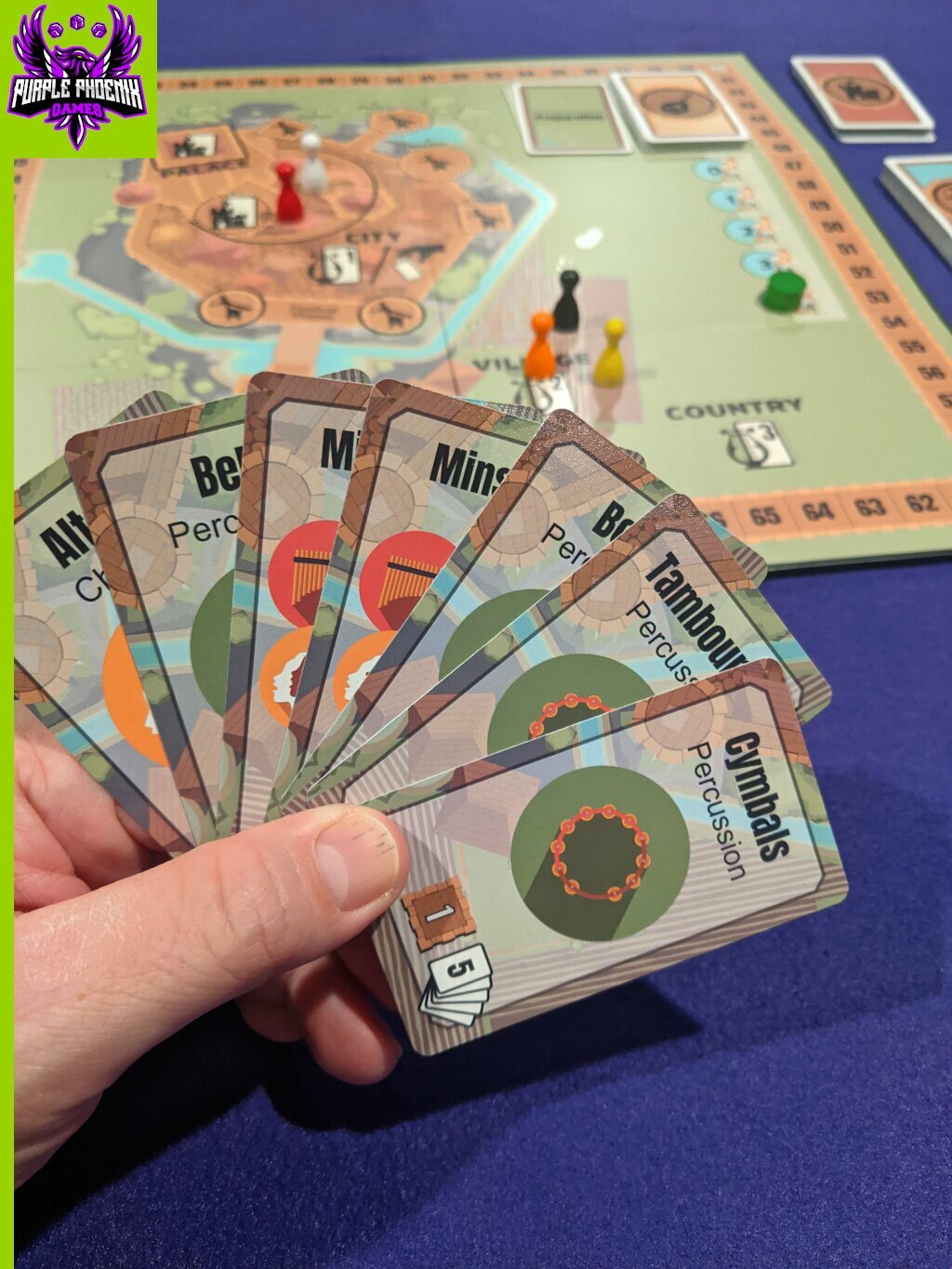
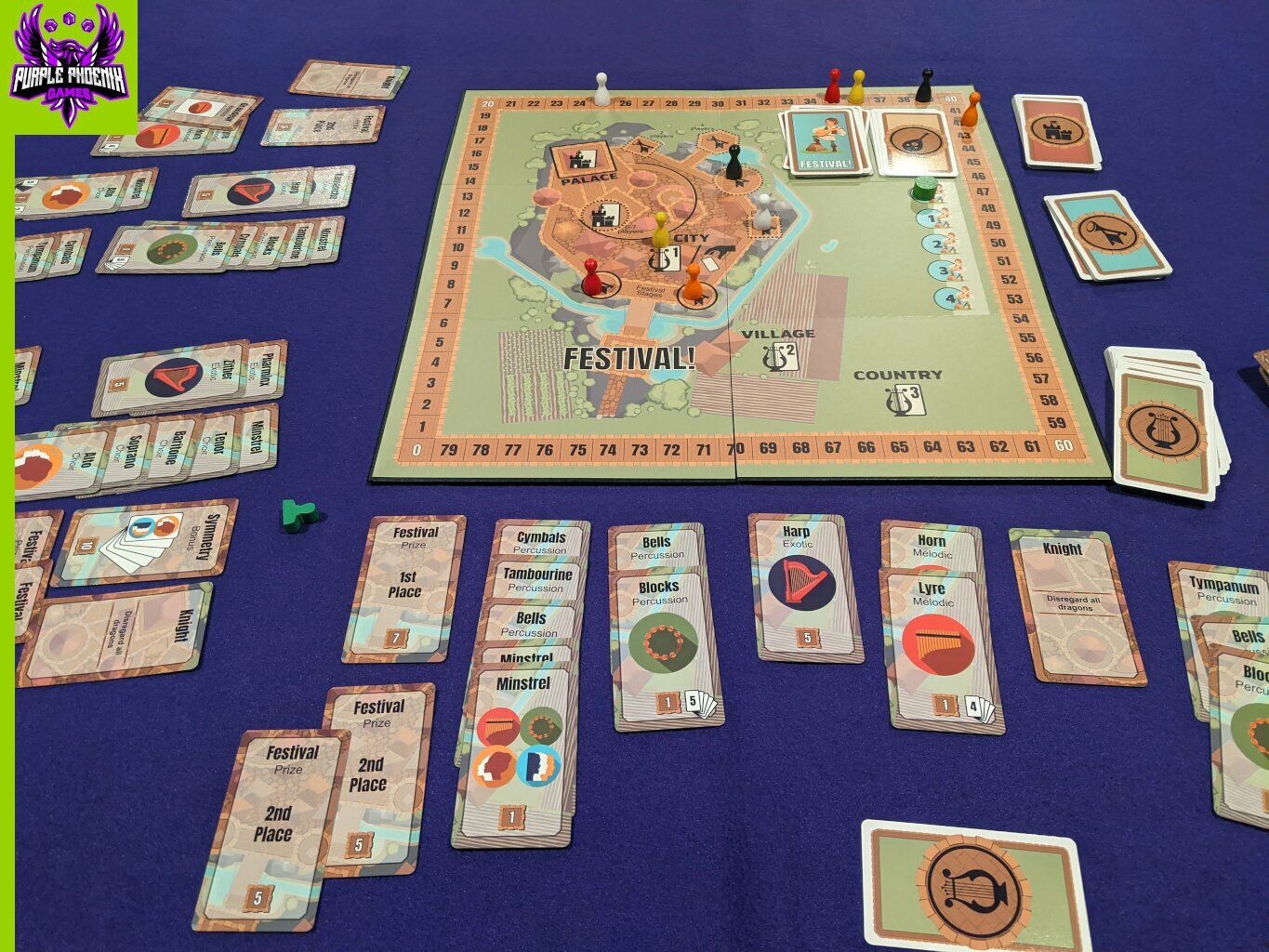
Purple Phoenix Games (2266 KP) rated Seasons in Tabletop Games
Jul 6, 2019 (Updated Nov 4, 2021)
I have mentioned before that I have a bad habit. Well several, but this one pertains to board games. You see, I once had a collection of games that I loved, but was pulled into the BGG Auctions and would engage in auctioning off many of games that I deemed of good return value. But then I would start to miss them. And then I would start to reacquire them. Then my wife stepped in and made me see how foolish I was to rid myself of them in the first place. Well, next up in this line is a game I recently reacquired and never should have let go in the first place – Seasons!
Seasons is a fantastical dice rolling, card drafting, hand management game for two to four players. In it, players are sorcerers competing in a legendary magical tournament that spans three years in an attempt to be crowned the next Archmage of the kingdom. As the seasons change, sorcerers may draw power from changing mana sources, and utilizing these sources most efficiently and effectively will earn victory over all. So tighten up your belt and get to casting, young mage!
To setup, follow the rules in the rulebook (there are many steps, and I have feeble and weak fingers) until the table looks somewhat similar to the photo below – except for the obvious oversight in placing the orange cube on the zero space of bonus actions. The main areas of interest are the main game board where the years and seasons are tracked, the Crystal score track, and player board/tableau area. Players will be dealt a hand of nine cards to start, and then draft one card at a time, passing to their neighbor each time, and deciding which three cards they would like to start the game with, and assigning three more cards each into the Library for rounds two and three. The game begins in Winter, and the black cube is placed on the number 1 of the seasons board. The game is now setup and ready to begin with the first player!
Each turn the active player will roll all dice in the current season (this game is setup for two players, so three total dice are used each turn). They will choose one die to use for the turn, and other players will choose theirs. The players then gather the resources present on the die face. These could be element tokens, crystals (VP), summon gauge stars, cards drawn from the deck, or even transmutation powers. Once resources are gained, the active player may then choose to play a card from their hand to their personal tableau, given they have adequate summoning power (the number of cards that can be played) available on their board. The cost to play the card is found under the illustration, and is usually paid in crystals, element tokens, or a combination of both. These Power Cards may allow the player immediate benefits, ongoing benefits, or benefits that may be activated at certain times during the game.
Another option players have from their chosen die is the ability to transmutate. When a player chooses a die with this option, they are able to consult the current season on the main board and exchange element tokens for crystals, depending on the provided exchange system. For example, a player wishing to exchange earth tokens (the green plant) during Winter will be provided with three crystals each, while attempting the same transmutation during Spring will only provide one crystal each.
Once each player has taken their turn to collect their resources, complete their turn actions, and pass onto the next player, the unchosen die is resolved. Each die face also shows a number of dotted pips at the bottom. The number of pips shown on the unchosen die refers to the number of spaces the cube on the main board season tracker is to be moved forward around the board. One pip, one space forward. This could result in the current season continuing or progressing into the next season. When the cube progresses from Fall to Winter, players will collect their cards set aside for year two or three, respectively. These cards are added to their hand and available to be used immediately on their turn. If, however, on their turn a player has little they can do, or simply wish to boost their turn, they may use one of four bonus actions, as printed on their player board. These actions allow the player to trade two element tokens from their reserves for any other two element tokens from the main supply, allow transmutation if the symbol is not present on their chosen die face, increase their summoning gauge by one, or draw two power cards from the deck and choose one to add to their hand instead of drawing one, per their die face. Each player can use three total bonus actions for each game at a cost of crystals for each usage. Certainly a trade-off.
Play continues in this fashion of choosing and resolving dice, playing cards, and transmuting tokens for crystals until the cube has completed its three year journey around the main board. At that time crystals are scored from cards and added to the tracker, with five points deducted for each card remaining in hand and points deducted for the usage of bonus actions. The player with the most crystals at the end of the game is the winner!
Components. I have a lot to say here, but will attempt to be as succinct as I can. The components in Seasons are simply phenomenal. Yes, the boards, cards, and cubes are all fine quality and unimpressive. However, the art style throughout the game and those big chunky dice are the real standouts to me. I mean, who DOESN’T like to roll big, chunky dice? And the player colors? Oh man, I love them! Players can choose orange, purple, gray, or lime green. Those are some great color options, and such a simple upgrade from primary colors used on many other games. The dice are primary colors, but I still enjoy them and I will let it slide. No real complaints on components from me. I have heard complaints about people not vibing on the color choices associate with the elements/energy, but I applaud the mold-breaking here. Why can’t Fall be red and associated with a feather? Why can’t Summer be yellow and associated with a flame? Fire doesn’t always have to be red. Go on, Seasons! Be you!
Our thoughts on each game should never be a surprise. I will say this for Seasons – I believe that when I auctioned it off the first time, part of the reasoning was because I did not fully understand the rules. I was a newer gamer at the time and was lured in by colors and art style (which are still stunning). More than likely I thought I was smarter than I truly am and included all the cards in my first plays instead of heeding the suggestions given by the rulebook for easier first games. Now, being a more seasoned (I couldn’t resist) gamer, I can better appreciate what is in this box. The unique card play, the dice drafting for resources and actions, the progression of time as a result of the rejected die, all come together to make a very solid and different game. I am trying to think my way through my collection to find a parallel that uses all these mechanics together as well as Seasons does and I am finding it difficult. It is so easy to just throw mechanics into a blender and see the goo that results, but everything with Seasons feels right and I am just in love.
Why did I ever get rid of Seasons? I will claim young and dumb, though I wasn’t very young. Do not emulate my decision to shed this one out of your collection. You don’t have a copy? I would recommend visiting your FLGS to see if they might have a copy in stock. It’s a great one, and one that I will treasure from here on out. Purple Phoenix Games officially gives this one an amazingly colorful 5 / 6. I know the others will enjoy it too, but until they play it, I will be giddy with excitement each time I am able to play my copy. Why are you still here? Go get Seasons!
Seasons is a fantastical dice rolling, card drafting, hand management game for two to four players. In it, players are sorcerers competing in a legendary magical tournament that spans three years in an attempt to be crowned the next Archmage of the kingdom. As the seasons change, sorcerers may draw power from changing mana sources, and utilizing these sources most efficiently and effectively will earn victory over all. So tighten up your belt and get to casting, young mage!
To setup, follow the rules in the rulebook (there are many steps, and I have feeble and weak fingers) until the table looks somewhat similar to the photo below – except for the obvious oversight in placing the orange cube on the zero space of bonus actions. The main areas of interest are the main game board where the years and seasons are tracked, the Crystal score track, and player board/tableau area. Players will be dealt a hand of nine cards to start, and then draft one card at a time, passing to their neighbor each time, and deciding which three cards they would like to start the game with, and assigning three more cards each into the Library for rounds two and three. The game begins in Winter, and the black cube is placed on the number 1 of the seasons board. The game is now setup and ready to begin with the first player!
Each turn the active player will roll all dice in the current season (this game is setup for two players, so three total dice are used each turn). They will choose one die to use for the turn, and other players will choose theirs. The players then gather the resources present on the die face. These could be element tokens, crystals (VP), summon gauge stars, cards drawn from the deck, or even transmutation powers. Once resources are gained, the active player may then choose to play a card from their hand to their personal tableau, given they have adequate summoning power (the number of cards that can be played) available on their board. The cost to play the card is found under the illustration, and is usually paid in crystals, element tokens, or a combination of both. These Power Cards may allow the player immediate benefits, ongoing benefits, or benefits that may be activated at certain times during the game.
Another option players have from their chosen die is the ability to transmutate. When a player chooses a die with this option, they are able to consult the current season on the main board and exchange element tokens for crystals, depending on the provided exchange system. For example, a player wishing to exchange earth tokens (the green plant) during Winter will be provided with three crystals each, while attempting the same transmutation during Spring will only provide one crystal each.
Once each player has taken their turn to collect their resources, complete their turn actions, and pass onto the next player, the unchosen die is resolved. Each die face also shows a number of dotted pips at the bottom. The number of pips shown on the unchosen die refers to the number of spaces the cube on the main board season tracker is to be moved forward around the board. One pip, one space forward. This could result in the current season continuing or progressing into the next season. When the cube progresses from Fall to Winter, players will collect their cards set aside for year two or three, respectively. These cards are added to their hand and available to be used immediately on their turn. If, however, on their turn a player has little they can do, or simply wish to boost their turn, they may use one of four bonus actions, as printed on their player board. These actions allow the player to trade two element tokens from their reserves for any other two element tokens from the main supply, allow transmutation if the symbol is not present on their chosen die face, increase their summoning gauge by one, or draw two power cards from the deck and choose one to add to their hand instead of drawing one, per their die face. Each player can use three total bonus actions for each game at a cost of crystals for each usage. Certainly a trade-off.
Play continues in this fashion of choosing and resolving dice, playing cards, and transmuting tokens for crystals until the cube has completed its three year journey around the main board. At that time crystals are scored from cards and added to the tracker, with five points deducted for each card remaining in hand and points deducted for the usage of bonus actions. The player with the most crystals at the end of the game is the winner!
Components. I have a lot to say here, but will attempt to be as succinct as I can. The components in Seasons are simply phenomenal. Yes, the boards, cards, and cubes are all fine quality and unimpressive. However, the art style throughout the game and those big chunky dice are the real standouts to me. I mean, who DOESN’T like to roll big, chunky dice? And the player colors? Oh man, I love them! Players can choose orange, purple, gray, or lime green. Those are some great color options, and such a simple upgrade from primary colors used on many other games. The dice are primary colors, but I still enjoy them and I will let it slide. No real complaints on components from me. I have heard complaints about people not vibing on the color choices associate with the elements/energy, but I applaud the mold-breaking here. Why can’t Fall be red and associated with a feather? Why can’t Summer be yellow and associated with a flame? Fire doesn’t always have to be red. Go on, Seasons! Be you!
Our thoughts on each game should never be a surprise. I will say this for Seasons – I believe that when I auctioned it off the first time, part of the reasoning was because I did not fully understand the rules. I was a newer gamer at the time and was lured in by colors and art style (which are still stunning). More than likely I thought I was smarter than I truly am and included all the cards in my first plays instead of heeding the suggestions given by the rulebook for easier first games. Now, being a more seasoned (I couldn’t resist) gamer, I can better appreciate what is in this box. The unique card play, the dice drafting for resources and actions, the progression of time as a result of the rejected die, all come together to make a very solid and different game. I am trying to think my way through my collection to find a parallel that uses all these mechanics together as well as Seasons does and I am finding it difficult. It is so easy to just throw mechanics into a blender and see the goo that results, but everything with Seasons feels right and I am just in love.
Why did I ever get rid of Seasons? I will claim young and dumb, though I wasn’t very young. Do not emulate my decision to shed this one out of your collection. You don’t have a copy? I would recommend visiting your FLGS to see if they might have a copy in stock. It’s a great one, and one that I will treasure from here on out. Purple Phoenix Games officially gives this one an amazingly colorful 5 / 6. I know the others will enjoy it too, but until they play it, I will be giddy with excitement each time I am able to play my copy. Why are you still here? Go get Seasons!
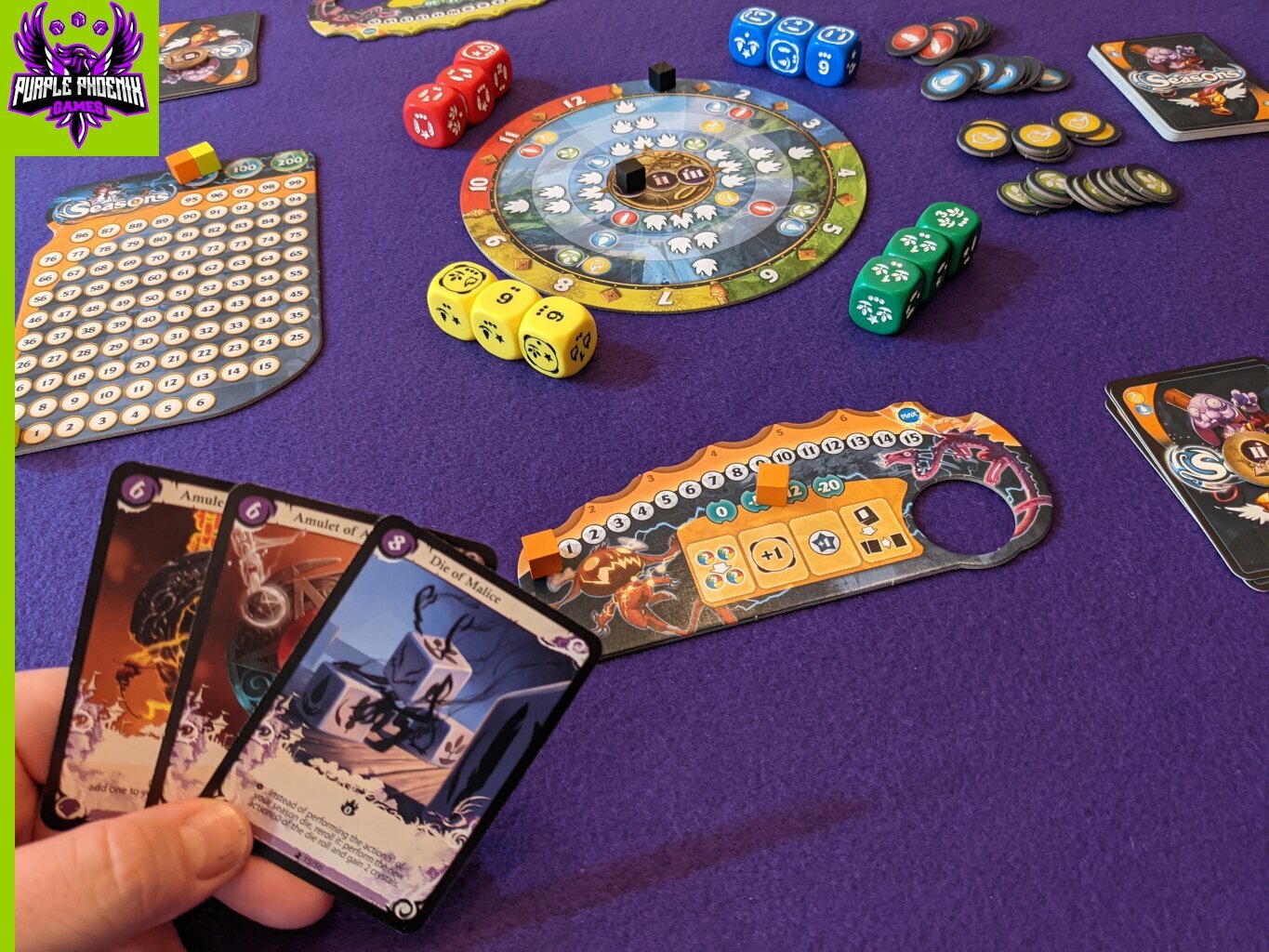
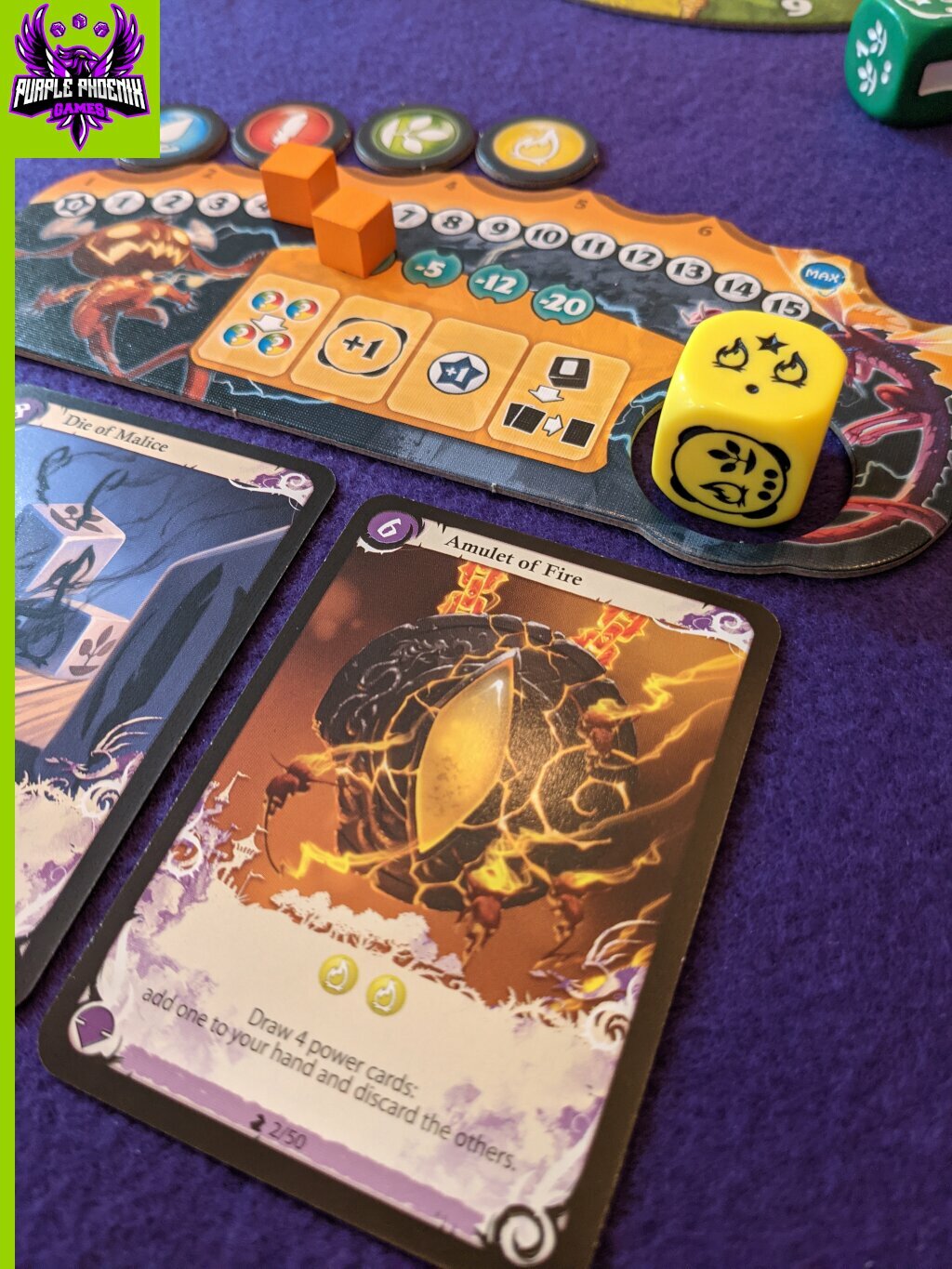
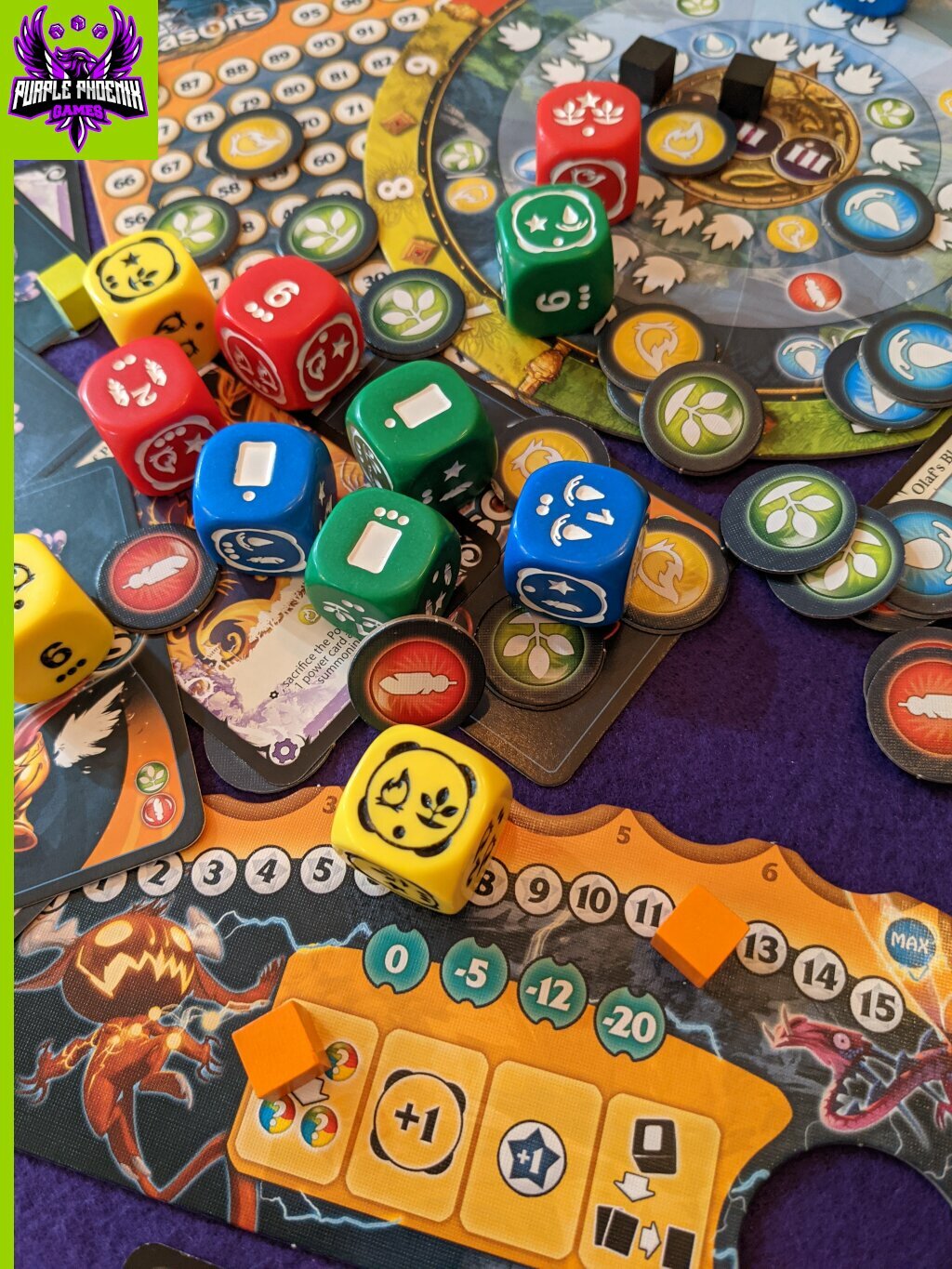

James P. Sumner (65 KP) rated Star Wars: Episode VII - The Force Awakens (2015) in Movies
Jun 5, 2019
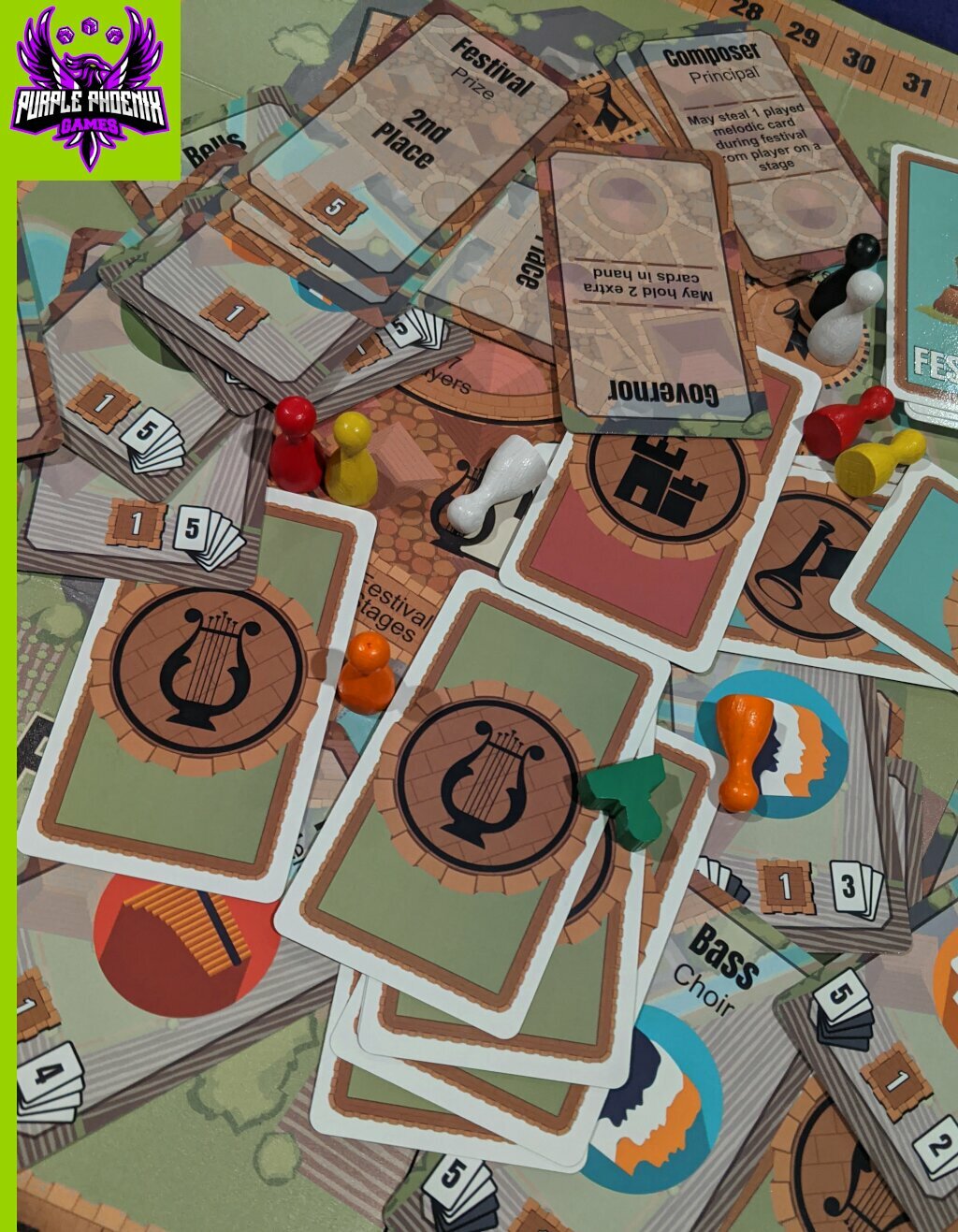
The Force is strong in this one...
Like so many of us, I had theorised what would happen in this movie based on the influx of teaser trailers online, and I'm happy to say, I was wrong on nearly everything! I like being surprised, and this film was just that. A very pleasant surprise. It's Star Wars, like Star Wars should be. Not too heavy on the CGI, plenty of action interlaced with character-driven dialogue and sub-plots, and yes, someone says "I have a bad feeling about this..." which is just ace!
So, the story. (No spoilers here, promise!) We join the action some 30 years after partying with the Ewoks on Endor. The Empire is no more, yet, like an evil phoenix, The First Order has risen from its ashes and is doing much the same thing—being awful to everyone and trying to rule the galaxy. Same old, same old.
There are plenty of new faces—the three main ones effectively being modern-day retellings of our old favourites. First up is Oscar Isaac's excellent Poe Dameron, who is this year's Han Solo. A hot-shot rebel fighter pilot, with rogue-ish good looks, a cheeky grin, and wise-cracking dialogue.
Then, we have the Stormtrooper with a conscience, played by John Boyega. A really good performance by him, and despite his character’s beginnings, it doesn't take long for you to genuinely care what happens to him. He's this year's Luke Skywalker, definitely.
And finally, there's the mysterious Rey, the tough-as-nails tomboy who's hotter than you first realise, brought to life by the uber-talented, destined-for-great-things, Daisy Ridley. Not much is known about who she is, but she's this year's Princess Leia, without a doubt.
And that was the first thing that really struck a chord with me—how the film acknowledges the original characters, but gives them a twist for the newer, younger audience. The comparisons are immediate and obvious, but they work. Instead of the kick-ass princess, you have the hard-done-by street kid... instead of the teenager dreaming of escaping his dead-end life, you have one who struggles to accept he's not meant for the exciting one he has. Kids today will relate to these things, yet the film manages to keep the essence of what made the main characters from the classic films so memorable.
We also have the new lovable droid, BB-8, who, like R2-D2 so many years ago, unwittingly finds itself with a garbled message in its memory banks, and in the possession of one of our heroes.
In much the same way that Episode IV didn’t hang about getting Darth Vader on the screen, it's not long before we're treated to our first look at the big bad—Kylo Ren. Let's run through the checklist:
• Looks cool wearing black? Check.
• Masked, with scary voice? Check.
• Mean? Check.
So, Mr. Ren starts out doing everything we would expect, which is nice. We know he's working with The First Order, we know he's looking for something... so far, so Star Wars.
The film moves along at a good pace. Plenty of action and fighting, slowed down by great interaction between the main cast where needed. Then we start getting drip-fed the old-timers, which is where the fanboy in you will get really excited. We first get a look of Han Solo and Chewbacca, which we already knew from the trailers, when Han says, "Chewy, we're home." Harrison Ford steps back into the role like putting on an old pair of shoes—a little awkward at first, but you soon remember how comfortable they are, and you're off and running in no time. It's almost like he's not played any other part since 1983 (and after Indiana Jones and the Kingdom of the Crystal Skull, I bet sometimes Mr. Ford wishes that were the case!). Accompanied by his long-time friend, he effortlessly goes through the motions as the scoundrel looking to make some money, but always ending up owing someone more than he has.
It's not long before a twist of fate puts him and Chewy alongside our new heroes, and they're on their way to see another familiar face, Princess Leia. Except she's not a Princess anymore, she's the General of the Resistance. I won't say too much about her, as her parts in the film are integral to the main storyline, and I don't want to ruin it. Suffice to say, like any couple reuniting after 30 years, her and Han are a joy to watch on screen together.
I don't want to delve into the storyline too much, because a) you've probably pieced together the gist of it from all the trailers, and b) it's hard to do without telling you things you won't know if you haven't already seen it. So I'll leave it there, but will finish by saying it's a pleasure from start to finish, it cues up the inevitable sequels well, and it does nothing more than what it should do—it gives you a Star Wars experience that leaves you wanting to watch it again the moment it finishes.
So, the downsides. There aren't many, but, for me, there are some. They don't take away from the movie as a whole, but they detracted from the experience enough to make them worth mentioning, so here goes.
Princess/General Leia - I'm sorry, but poor Carrie Fisher has had so much Botox, I genuinely thought it was a different actress when she first appeared on camera. We see her go through an emotional reunion, some heartache, some humorous banter, some thrilling, edge-of-the-seat action, and a nail-biting, jaw-dropping finale... and not once did her expression change! Probably because it couldn't. She's the only one who looked like they were struggling to revive their character, because she didn't look like a natural, older version of herself… she looked like she was trying to be a younger version of herself, and it made me not want to see her as much as other characters.
Kylo Ren - This guy starts out as being awesome. His mask is suitably evil, his voice is menacing, his lightsabre is just brilliant… But then he takes his mask off. He's doing something (which I won't detail, but is another obvious and much-appreciated nod to the film's predecessors) and he just takes off his mask. Now, no disrespect to Adam Driver, but... have you seen Harry Potter? Well, Kylo Ren, without his mask, kinda looks like he's related in some distant, in-bred way, to Neville Longbottom. He continues with his evil gestures and scary intentions, but without the mask, you just kinda think... Really? Am I meant to be scared here? When I was a kid, Darth Vader terrified the hell out of me! This guy... you could probably flush his head and steal his lunch money, if he doesn't force-choke you beforehand.
I think he’s another Hayden Christensen—horribly miscast for an important role that could’ve defined the right actor’s career. Let's hope it doesn't end up ruining it for him. Should've kept the mask on, Kylo!
Captain Phasma - The name might not mean much to casual fans, but I’m referring to the chrome Stormtrooper who has inexplicably developed somewhat of a cult following since their appearance in the trailers. They’re the tall, imposing, assumed leader of the Stormtroopers, and certainly looks the part. However, that part is so insignificant, it’s like it was written in as an after-thought. The character will apparently play a more significant role in later films, but that’s hardly the point. We first see him at the beginning, and they’re all evil and shooty, which is fine. But then we see him only a couple of times after that and, at one point, he’s taken hostage in possibly the most unimposing, least-threatening way imaginable, and he just goes along with it. What the hell?! Oh, and I say “He”, but the character is actually played by a woman—Gwendoline Christie, the tall, sword-wielding blonde from Game of Thrones. Anyway…
The final thing that annoyed me a little bit is tough to talk about, because it's riddled with spoilers. But I shall simply say this: the way a certain character (who I haven't mentioned previously) was handled could've been done so much better than it was. That's it. I'll say no more. Watch the film, then read this again. You'll know what I mean.
So, to sum up. This is a great addition to the franchise, no doubt. But, forgetting it's Star Wars for a moment, it's simply a great film. It provides everything you would want from this genre, and it leaves you wanting more at the end (with a clear indication it's going to provide it at some point in the future). Now go. Enjoy. Even if you don't like Star Wars, it's worth a watch. Though I'm pretty certain after seeing it, you'll want to watch the others.
So, the story. (No spoilers here, promise!) We join the action some 30 years after partying with the Ewoks on Endor. The Empire is no more, yet, like an evil phoenix, The First Order has risen from its ashes and is doing much the same thing—being awful to everyone and trying to rule the galaxy. Same old, same old.
There are plenty of new faces—the three main ones effectively being modern-day retellings of our old favourites. First up is Oscar Isaac's excellent Poe Dameron, who is this year's Han Solo. A hot-shot rebel fighter pilot, with rogue-ish good looks, a cheeky grin, and wise-cracking dialogue.
Then, we have the Stormtrooper with a conscience, played by John Boyega. A really good performance by him, and despite his character’s beginnings, it doesn't take long for you to genuinely care what happens to him. He's this year's Luke Skywalker, definitely.
And finally, there's the mysterious Rey, the tough-as-nails tomboy who's hotter than you first realise, brought to life by the uber-talented, destined-for-great-things, Daisy Ridley. Not much is known about who she is, but she's this year's Princess Leia, without a doubt.
And that was the first thing that really struck a chord with me—how the film acknowledges the original characters, but gives them a twist for the newer, younger audience. The comparisons are immediate and obvious, but they work. Instead of the kick-ass princess, you have the hard-done-by street kid... instead of the teenager dreaming of escaping his dead-end life, you have one who struggles to accept he's not meant for the exciting one he has. Kids today will relate to these things, yet the film manages to keep the essence of what made the main characters from the classic films so memorable.
We also have the new lovable droid, BB-8, who, like R2-D2 so many years ago, unwittingly finds itself with a garbled message in its memory banks, and in the possession of one of our heroes.
In much the same way that Episode IV didn’t hang about getting Darth Vader on the screen, it's not long before we're treated to our first look at the big bad—Kylo Ren. Let's run through the checklist:
• Looks cool wearing black? Check.
• Masked, with scary voice? Check.
• Mean? Check.
So, Mr. Ren starts out doing everything we would expect, which is nice. We know he's working with The First Order, we know he's looking for something... so far, so Star Wars.
The film moves along at a good pace. Plenty of action and fighting, slowed down by great interaction between the main cast where needed. Then we start getting drip-fed the old-timers, which is where the fanboy in you will get really excited. We first get a look of Han Solo and Chewbacca, which we already knew from the trailers, when Han says, "Chewy, we're home." Harrison Ford steps back into the role like putting on an old pair of shoes—a little awkward at first, but you soon remember how comfortable they are, and you're off and running in no time. It's almost like he's not played any other part since 1983 (and after Indiana Jones and the Kingdom of the Crystal Skull, I bet sometimes Mr. Ford wishes that were the case!). Accompanied by his long-time friend, he effortlessly goes through the motions as the scoundrel looking to make some money, but always ending up owing someone more than he has.
It's not long before a twist of fate puts him and Chewy alongside our new heroes, and they're on their way to see another familiar face, Princess Leia. Except she's not a Princess anymore, she's the General of the Resistance. I won't say too much about her, as her parts in the film are integral to the main storyline, and I don't want to ruin it. Suffice to say, like any couple reuniting after 30 years, her and Han are a joy to watch on screen together.
I don't want to delve into the storyline too much, because a) you've probably pieced together the gist of it from all the trailers, and b) it's hard to do without telling you things you won't know if you haven't already seen it. So I'll leave it there, but will finish by saying it's a pleasure from start to finish, it cues up the inevitable sequels well, and it does nothing more than what it should do—it gives you a Star Wars experience that leaves you wanting to watch it again the moment it finishes.
So, the downsides. There aren't many, but, for me, there are some. They don't take away from the movie as a whole, but they detracted from the experience enough to make them worth mentioning, so here goes.
Princess/General Leia - I'm sorry, but poor Carrie Fisher has had so much Botox, I genuinely thought it was a different actress when she first appeared on camera. We see her go through an emotional reunion, some heartache, some humorous banter, some thrilling, edge-of-the-seat action, and a nail-biting, jaw-dropping finale... and not once did her expression change! Probably because it couldn't. She's the only one who looked like they were struggling to revive their character, because she didn't look like a natural, older version of herself… she looked like she was trying to be a younger version of herself, and it made me not want to see her as much as other characters.
Kylo Ren - This guy starts out as being awesome. His mask is suitably evil, his voice is menacing, his lightsabre is just brilliant… But then he takes his mask off. He's doing something (which I won't detail, but is another obvious and much-appreciated nod to the film's predecessors) and he just takes off his mask. Now, no disrespect to Adam Driver, but... have you seen Harry Potter? Well, Kylo Ren, without his mask, kinda looks like he's related in some distant, in-bred way, to Neville Longbottom. He continues with his evil gestures and scary intentions, but without the mask, you just kinda think... Really? Am I meant to be scared here? When I was a kid, Darth Vader terrified the hell out of me! This guy... you could probably flush his head and steal his lunch money, if he doesn't force-choke you beforehand.
I think he’s another Hayden Christensen—horribly miscast for an important role that could’ve defined the right actor’s career. Let's hope it doesn't end up ruining it for him. Should've kept the mask on, Kylo!
Captain Phasma - The name might not mean much to casual fans, but I’m referring to the chrome Stormtrooper who has inexplicably developed somewhat of a cult following since their appearance in the trailers. They’re the tall, imposing, assumed leader of the Stormtroopers, and certainly looks the part. However, that part is so insignificant, it’s like it was written in as an after-thought. The character will apparently play a more significant role in later films, but that’s hardly the point. We first see him at the beginning, and they’re all evil and shooty, which is fine. But then we see him only a couple of times after that and, at one point, he’s taken hostage in possibly the most unimposing, least-threatening way imaginable, and he just goes along with it. What the hell?! Oh, and I say “He”, but the character is actually played by a woman—Gwendoline Christie, the tall, sword-wielding blonde from Game of Thrones. Anyway…
The final thing that annoyed me a little bit is tough to talk about, because it's riddled with spoilers. But I shall simply say this: the way a certain character (who I haven't mentioned previously) was handled could've been done so much better than it was. That's it. I'll say no more. Watch the film, then read this again. You'll know what I mean.
So, to sum up. This is a great addition to the franchise, no doubt. But, forgetting it's Star Wars for a moment, it's simply a great film. It provides everything you would want from this genre, and it leaves you wanting more at the end (with a clear indication it's going to provide it at some point in the future). Now go. Enjoy. Even if you don't like Star Wars, it's worth a watch. Though I'm pretty certain after seeing it, you'll want to watch the others.