

Purple Phoenix Games (2266 KP) rated Indigo in Tabletop Games
Jun 12, 2019


Indigo is a strategy game of tile placement and route building in which players are attempting to get various gems from the center of the board through their “gateways” on the edges of the board to score points. Players are each building their own pathways, in a maze-like sort of way, to maneuver the gems around the board, through their own gateways, and away from those of their opponents. Each player receives one tile, and on their turn, plays it to the board. Tiles can be placed anywhere on the board, they don’t necessarily need to be placed adjacent to other tiles. If you play a tile to extend an existing route with a gem on it, move the gem as far along that route as possible. After playing a tile, you draw a new tile to be played on your next turn. The game continues until all gems have been claimed, and then points are added! Gems are worth points depending on their color, and the player with the highest score wins!
I think Indigo is such a neat game. It is so simple, yet strategic, and that makes it so much fun for me to play. The board itself becomes a visual maze as tiles are added, and you must be diligent about watching which pathways are open and available to you, while also trying to make sure you keep pathways blocked off towards your opponents. The possibilities are endless with this game in terms of tile placement and strategy, and that keeps me engaged the entire game. I also love the fact that all players only have 1 tile to play at any given time – you’ve got to make your tile work, you don’t have a hand of tiles from which to choose your best option. That ups the strategy factor even more because one misplaced tile could be the difference between gaining a gem or accidentally giving one away!
Another thing I like about Indigo is just that it’s a pretty game to look at! I think it is so cool to see the board fill up as the game progresses, and you get to watch the maze come to life with each turn. What starts as a mostly blank board soon becomes filled with ribbon-like paths that can lead to anywhere! It’s a neat visual effect for me, and that’s something that drew me into this game in the first place.
Is Indigo the best strategy game I’ve ever played? No. But it is a fun one that keeps me on my toes. With so many possibilities for routes, and the board changing with every tile placed, players are constantly engaged and active in the game. Purple Phoenix Games gives Indigo a swirly 13 / 18.
https://purplephoenixgames.wordpress.com/2019/04/09/indigo-review/

Jurassic World™: The Game
Games and Entertainment
App
Return to Isla Nublar with the creators of the smash hit Jurassic Park™ Builder for your next...

Moto X Mayhem Lite
Games and Entertainment
App
Race, jump, and crash your way through a variety of treacherous terrain in the best mobile bike...

Gravity Guy
Games and Entertainment
App
In a world where gravity laws were broken, a brave guy, was held captive for defying the rules....
Purple Phoenix Games (2266 KP) rated Elder Sign in Tabletop Games
Jul 16, 2019 (Updated Aug 21, 2019)
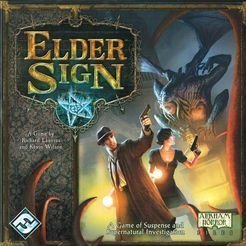

Disclaimer: There are many expansions for Elder Sign. I do not have any of them, nor do I have any gameplay experience with any of them. If and when I do get them added into my base game, I will either amend this review or write a new one! – L
In Elder Sign, players take on the roles of Investigators who must use their supernatural knowledge and keen wit to seal dimensional portals and prevent the Ancient Ones from entering our world and destroying humanity. Just another day at the office, right? Players take turns rolling dice to fight monsters and complete adventures that will reward them with artifacts, health and/or sanity, clues, or even Elder Signs – the symbols necessary for sealing away the Ancient Ones for good. Be careful, though – if you fail to complete an adventure, you will be harshly punished! I’m talking losing health and sanity, accidentally summoning monsters, or even bringing the Ancient One one step closer to our world! As a solo game, Elder Sign plays the same way as it would in a group setting. The only difference is that the solo player cannot use the ‘Assisting’ ability because there are no other players who can offer you aid. Besides that, gameplay remains the same – even a lone Investigator can put their dice to good use to ward off evil!
I enjoy playing Elder Sign as a solo game. Although mostly dominated by dice rolling, there is a fair amount of strategy required for this game. I don’t feel like I’m mindlessly rolling dice – I have to decide which adventures are attainable with my given items, and which rewards benefit me the most in my overall task. There are rewards and consequences to be weighed with every decision, so action must be taken with great thought. Because of the strategic implications, Elder Sign keeps me thoroughly engaged, even when playing solo, and that’s one reason why I keep coming back to it.
On the flip side, one thing that isn’t my favorite about Elder Sign is its reliance on dice rolls to progress in the game. Yeah, I know, it’s a dice game – what did I expect? Sometimes, though, you just can’t roll to save your life (quite literally, in this game) and that can make the game frustrating to play. A series of poor rolls can feel like they completely negate any strategy you’ve enacted and can unravel your entire plan. On a good dice-rolling day for me, I love this game! On a not-so-good dice-rolling day, I find it a little harder to enjoy myself. But hey – if it was totally easy, it wouldn’t be fun, right? One positive of this, I guess, is that I always have to be adjusting my strategy to take the current dice into account. I can’t just pick one strategy and run with it since almost all outcomes are dependent on the luck of the roll! Elder Sign keeps me on my toes, that’s for sure.
I got Elder Sign from Travis as a birthday present last year, and it has been a good addition to my collection. There is enough going on to keep me engaged the entire game, but not so much that I feel overwhelmed. And yeah, maybe I’m not always the greatest dice-roller, but that just makes me adapt my strategy to deal with the current situation. I have read that adding expansions makes the game even more enjoyable, and hopefully one of these days I’ll get to experience that for myself. For the time being, though, I’m content with the base game. If you enjoy Elder Sign, I recommend you try it solo – it doesn’t feel any different to play, and I think you’ll enjoy it just as much as a group game!
Purple Phoenix Games (2266 KP) rated Dreams of Tomorrow in Tabletop Games
Sep 17, 2020

Dreams of Tomorrow is game of set collection that utilizes a shifting rondel (I had to look up the definition too) in which players are working to weave a series of dreams into a complete Dream Sequence. Set in the future, players take on the roles of Dream Engineers, who are tasked with creating Dream Sequences to be sent to the past in an effort to save the future. Can you weave the most powerful Dream Sequence to alter the path of your present life, or is the future doomed to fall?
DISCLAIMER: We were provided a copy of this game for the purposes of this review. This is a retail copy of the game, so what you see in these photos is exactly what would be received in your box. I do not intend to cover every single rule included in the rulebook, but will describe the overall game flow and major rule set so that our readers may get a sense of how the game plays. For more in depth rules, you may purchase a copy online or from your FLGS. -L
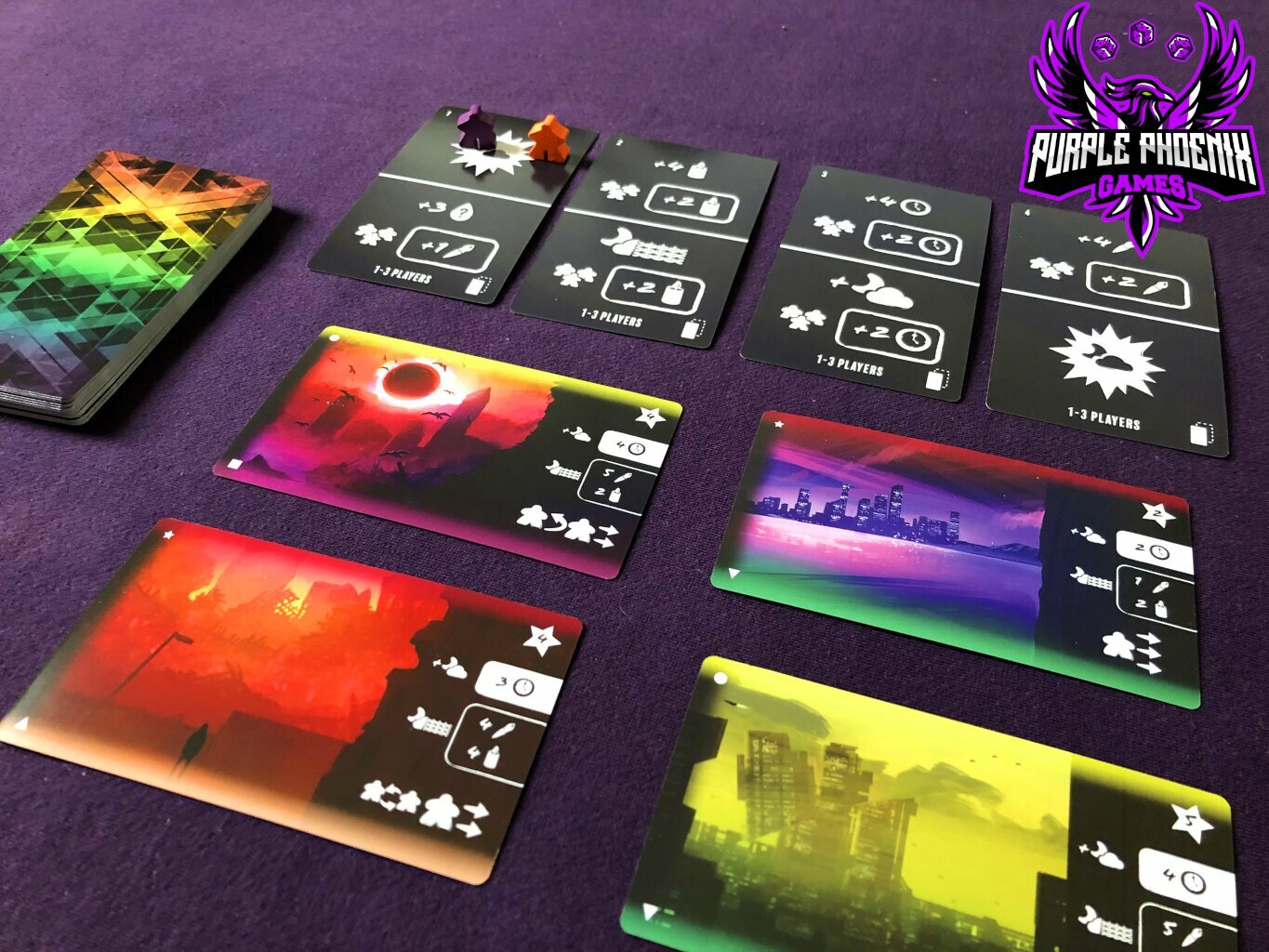
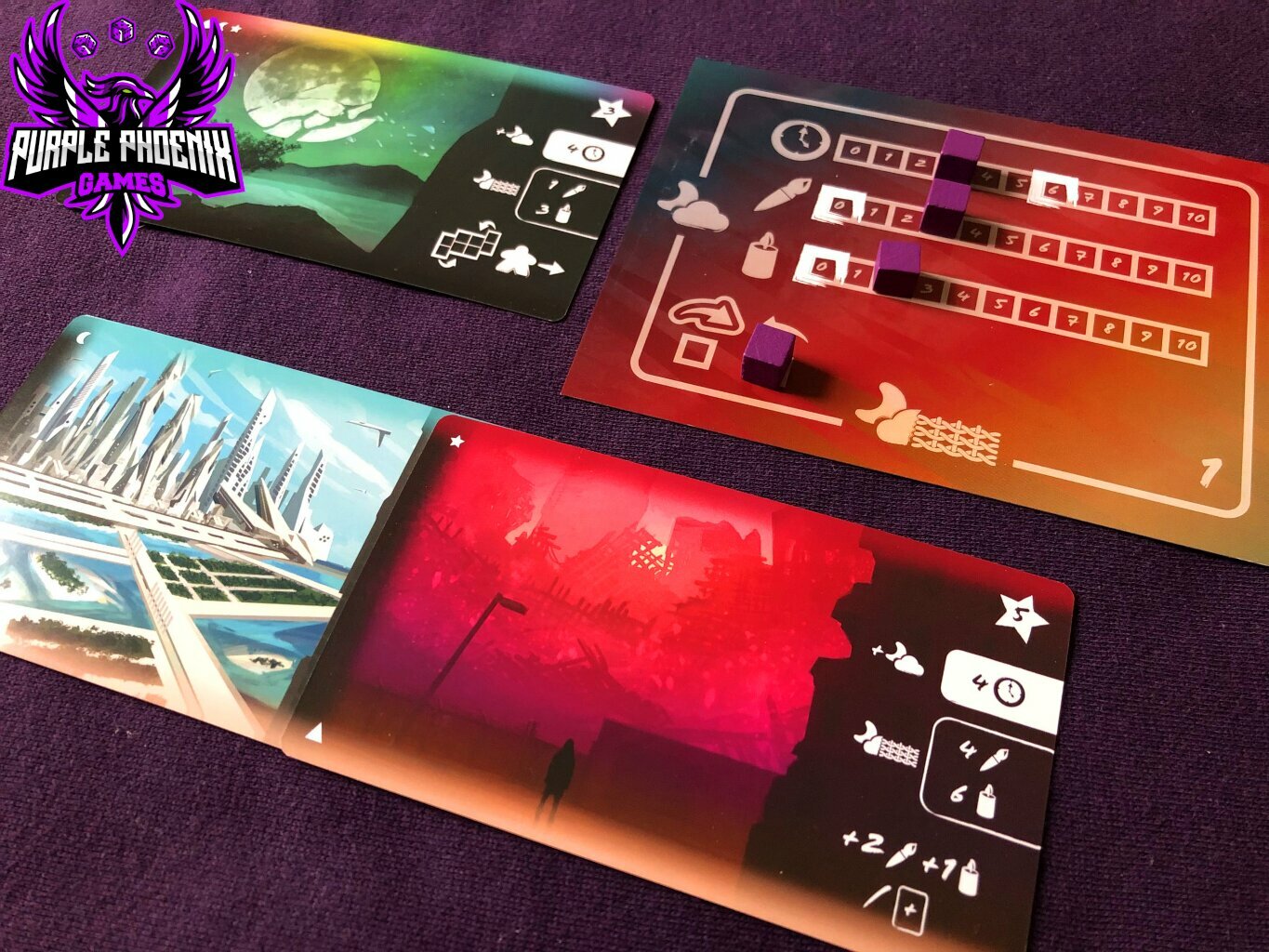
To setup the game, place the Collective Consciousness (the rondel) in numerical order within reach of all players. Reveal a number of Dream cards from the Dream deck, based on the number of players, and these cards will create the communal Dreamscape. Each player receives a player card, cubes, and meeple in their chosen color, and sets their resources to the starting numbers, as described in the rulebook. All players begin with their meeples in the first space of the rondel, and in clockwise order, will select and pay for a Dream from the Dreamscape to be placed in their Dream Catcher (waiting area). Once all players have selected a Dream, and adjusted their resources accordingly, the game is ready to begin.
Dreams of Tomorrow is played over a series of rounds in which players will take turns performing 2 actions: Move and Take Action. Movement happens sequentially around the rondel, and players may choose how many spaces to move. To move 1-3 spaces is free, but to move more than 3 spaces will cost a number of resources. When a player decides to end their movement, they will then take the action indicated on the space on which they landed. These actions include: Gaining resources, Catching a Dream, Weaving a Dream, or Activating a Dream Ability. Gaining resources is pretty self-explanatory, and there is one neat thing to note: even if it is not your active turn, most of the rondel spaces have a Shared Effect, which grants an off-turn action to all non-active players. Catching a Dream means that you pay the requisite resources and select a Dream from the Dreamscape. Any caught Dreams go into your Dream Catcher until you are able to perform the Weave a Dream action. When you Weave a Dream, you again pay the requisite resources displayed on the Dream card and move the Dream from your Dream Catcher into your Dream Sequence (play area). To Activate a Dream Ability, you select a Dream card in your tableau, and use the ability printed on it. It is important to note that once Dreams are woven into your Dream Sequence, they will overlap each other, and only one Dream Ability will ever be available for use, so create that sequence wisely! Play continues in turns until one player has woven a Dream Sequence of five Dreams total. The round ends once all players have taken the same number of turns, and then final points are counted. The player with the highest score is the winner!
So all-in-all, how is Dreams of Tomorrow as a whole? I actually was very surprised at how much I enjoyed this game. When reading through the rules, it seemed kind of complicated and I was a bit worried before my first play. Once you actually get playing, however, the game is pretty intuitive and simple to play. One thing I particularly enjoyed about this game is its iconography. With only three resources and four actions, there are only seven icons of which to keep track. It keeps the cards from being cluttered with text, and makes the costs/abilities clear to understand. The iconography of the Dream Abilities, however, can be a liiiittle more complicated, but the game does come with Reference Cards which explain what every single icon means!
Another neat thing I enjoyed about this gameplay is the addition of Shared Effects. Even if you are not the active player, you will always gain some resource on everyone else’s turn. That adds an extra element of strategy because you have to amass your own resources for Dreams, but you have to be careful not to be giving your opponents too much extra help for themselves! Probably my favorite part of Dreams of Tomorrow are the actual Dream Abilities themselves. Performing the regular turn actions are pretty straight-forward, but Dream Abilities are more special and allow you to do even more on your turn. For example, some Dream Abilities allow you to change directions, move extra spaces, or even alter the Collective Consciousness, re-arranging the cards in a way to benefit you and hopefully hinder your opponents. The Dream Abilities are literal game-changers, and they really keep all players on their toes.
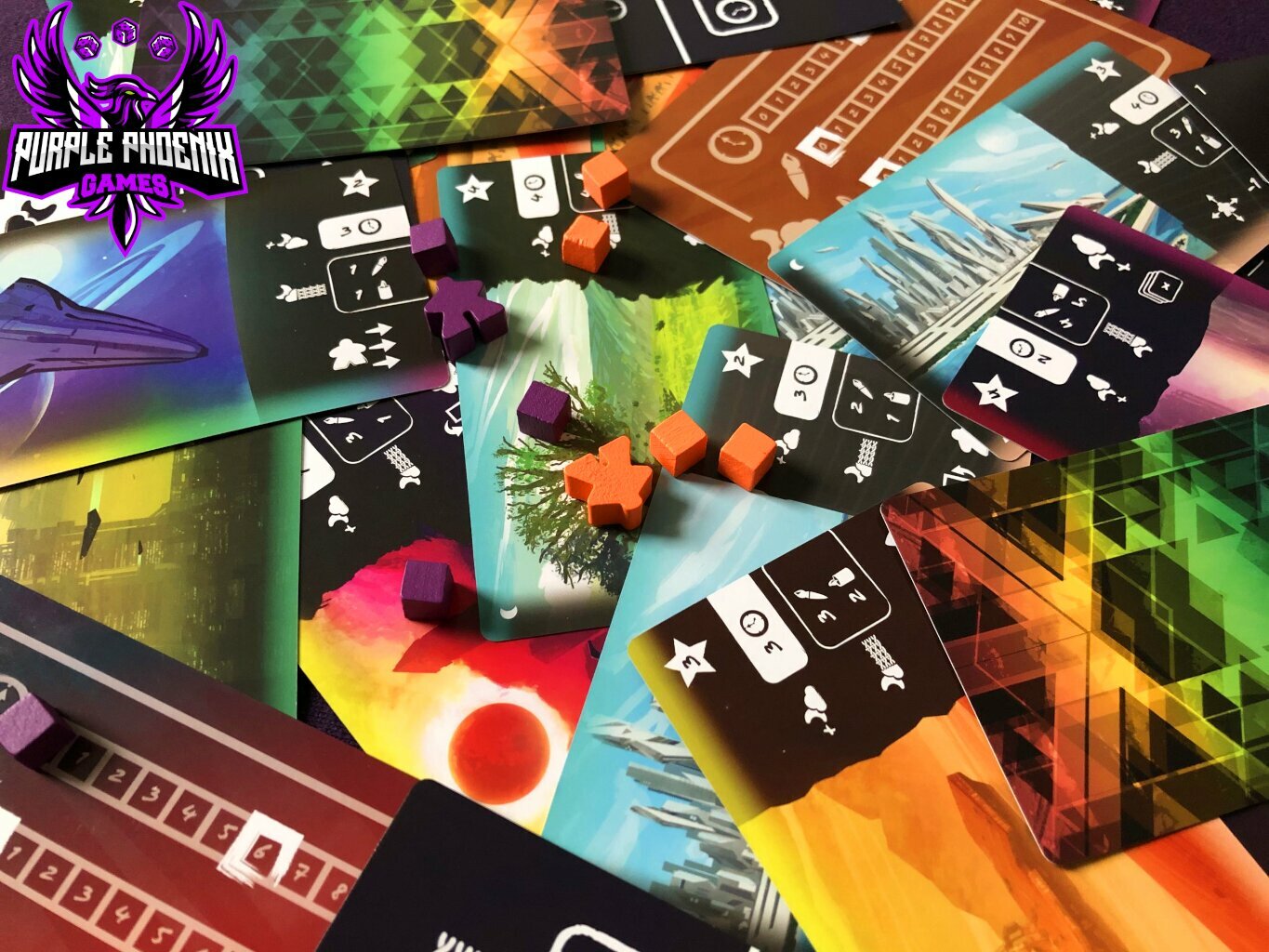
Talking about components, this game is of a pretty good quality. The cards are nice and sturdy, the player boards are decent, and the meeples and cubes are your standard wooden tokens. I’ve said in reviews before, but I always appreciate when games include Reference Cards for players, and Dreams of Tomorrow certainly delivered on theirs. The cards are clear, concise, and helpful during play. The artwork of this game is very vibrantly colorful and just plain pretty to look at. I found myself getting distracted by admiring the artwork, or catching Dreams based on their artwork, instead of taking their point-values or resources requirements into consideration. Oops. That’s just my bad, but the artwork really helps make the game more immersive.
Overall, I would say that Dreams of Tomorrow is a great little game. Admittedly, the rulebook is kind of daunting and seems a little overly complicated at first, but once you get into an actual game, it flows very quickly and easily. After just one turn, I got exactly what was happening and had no further questions about the gameplay. It really went above and beyond my expectations, and is one that I definitely look forward to bringing out in future game nights. Purple Phoenix Games gives it a dreamy 10 / 12. Check this one out if you haven’t before, it may just be the game of your dreams. (Ha, get it?)


Word Chums!
Games, Entertainment and Stickers
App
More fun than Words With Friends and more addicting than Scrabble, WORD CHUMS: the highest rated...

From A Jack To A King
10.0 Rate It
Book
New York Times best-selling mystery writer Bay Whitman leads the life of a celebrity—at least on...
male/male over 18 darker/grittier romance 5 star reads

Jonah Lomu Rugby Challenge: Gold Edition
Games and Sports
App
AN INTENSE RUGBY EXPERIENCE!!! The ultimate iPhone & iPad rugby experience! Tru Blu Entertainment...

Rugby League Live 2: Gold Edition
Games and Sports
App
AN INTENSE RUGBY LEAGUE EXPERIENCE!!! The ultimate iPhone & iPad rugby league experience! Tru...