Purple Phoenix Games (2266 KP) rated Cosmic Run: Express in Tabletop Games
Oct 27, 2021


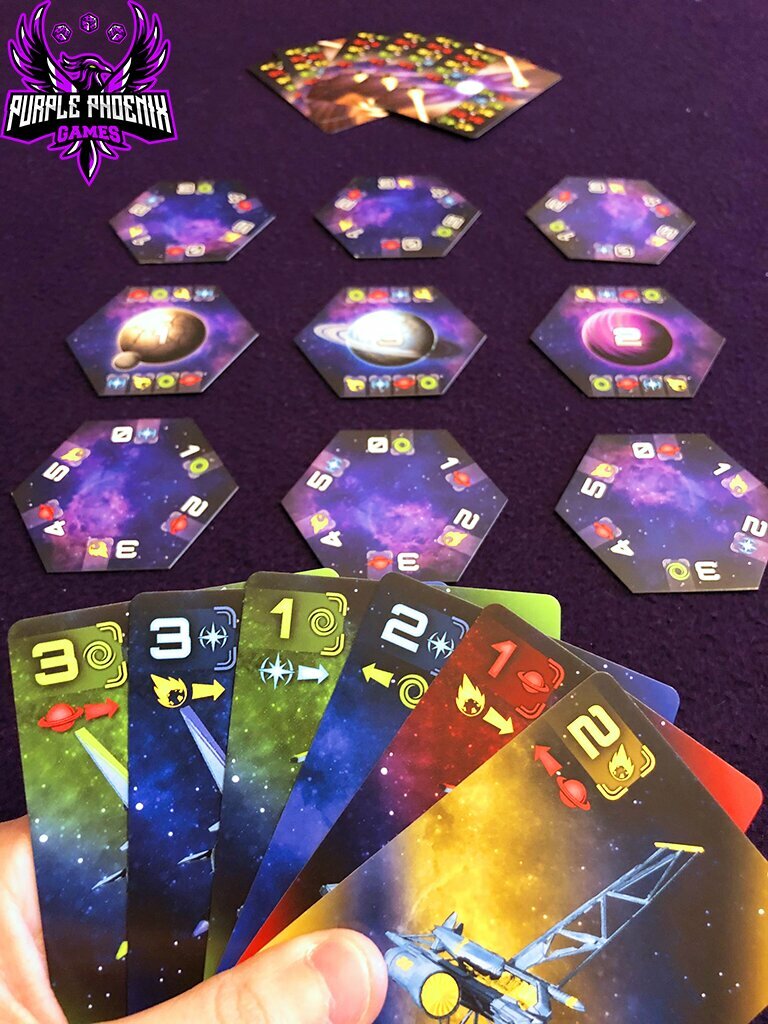
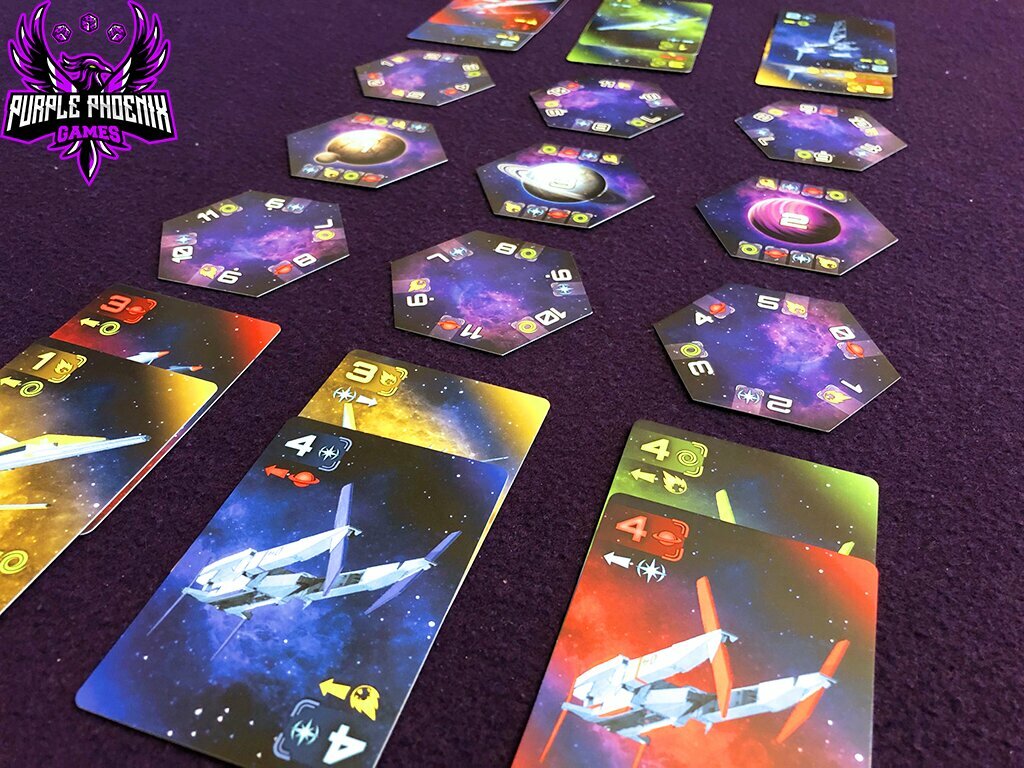
The latest game in Dr. Finn’s Cosmic Run universe, Cosmic Run: Express pits two players against each other, racing to be the first to reach 3 new planets. It is a game of area influence and simultaneous action selection played over a series of rounds in which players are playing cards to the 3 planets to advance their movement trackers the necessary 12 points to reach the planets. To setup the game, place the 3 planet cards in numerical order between the two players. Each player takes a set of 3 movement trackers in their chosen color and places one on their side of each planet card. All of the movement trackers are set to 0 for the start of the game. Players are dealt 6 ship cards, and the game is ready to play!
To begin a round, players look at their hand of 6 cards and choose 2 to pass to their opponent. Taking the new cards into your hand, you can decide to discard 1 card and draw a new card. This is not required, but can be performed by each player in each round. Next, players will simultaneously choose a card from their hand to be played face-up next to any planet, beneath their corresponding movement tracker. You can only play a maximum of 2 cards per planet.. If the color of the card you play at a planet matches the color at the top of your movement tracker, you may immediately move your tracker up by 1. Play continues, simultaneously playing cards, until all 6 cards in hand have been played and each movement tracker has 2 cards next to it.
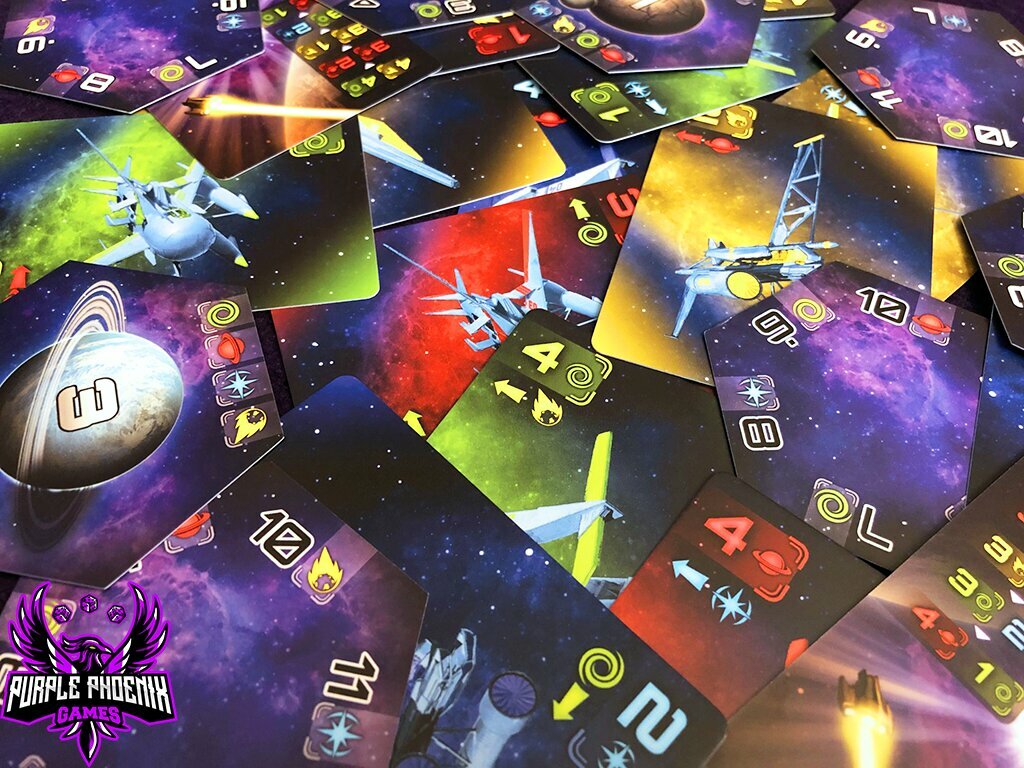
Now we move to the scoring/movement phase. Starting with Planet 1, compare the 2-card hands and determine which player played the best hand. The hierarchy for determining best hand is described in the rules, and that player earns 2 movement points for that planet, and adjusts their tracker accordingly. After scoring best hand, players score arrows. Underneath the number on each card is an arrow pointing either left or right, with a corresponding color. Beginning with the player who did not win best hand, look at the arrows on their 2-card hand, and score movement points if the arrows match any cards in their adjacent planets. Repeat these scoring steps for Planets 2 and 3. If, by the end of scoring, a player has earned 12 movement points and reached all 3 planets, that player is the winner! If not all 3 planets have been reached, collect all the cards, shuffle them, deal 6 to each player, and begin a new round. Rounds continue until one player has reached all 3 planets.
As a fan of the Cosmic Run universe, I was excited when I saw Cosmic Run: Express on Kickstarter. It seemed light, simple, and in the same universe as other games I loved, so I decided to back it. How does it fare? I think it’s great! For starters, I really appreciate that it is a small, portable game that can be played virtually anywhere. Lots of games these days are real table-hogs, and I enjoy the minimalistic approach of this game. Getting into the gameplay – it requires way more strategy than you initially think. There are 3 different ways in which you can score movement points (color matching, best hand, and arrow scoring) and you need to utilize all 3 for success. You are constantly evaluating your hand of cards and trying to determine which placements will yield the most points for you. Maybe you don’t have a color match, but the arrow on that card could make up for that and earn you up to 2 movement points. Another neat strategic point is that you have to pay attention to your opponent as well. The best hand points are a direct head-to-head between players, so not only do you have to maximize your own strategic points with card placement, you have to watch your opponent’s card placements and see if you can get a better hand than they do for a given planet. You are constantly engaged in this game, and that’s what I love about it.
Another great thing about Cosmic Run: Express is that it plays so quickly and effortlessly. Yes, at first there’s a tiny bit of a learning curve to remember the hierarchy for best hand, but after a couple of rounds the game flow is streamlined. It only takes 10-15 minutes to play, so it is easy to play “just one more” when you’re done. It’s light and fast enough to be a great filler between games, but it is also strategic enough to hold its own in a full game night.
So overall, how do we feel about this game? For being a nice and small 2-player game, it packs quite a punch! I was very pleasantly surprised by the amount of engagement and strategy in this game, and it is definitely one that I want to play multiple times in a row. So mission accomplished, Dr. Finn – in this case, less IS more. It’s a great little card game, and I highly recommend giving it a shot if you’re looking for something small but mighty. Purple Phoenix games gives Cosmic Run: Express a stellar 9 / 12.

Purple Phoenix Games (2266 KP) rated Mysterium in Tabletop Games
Jul 6, 2019

DISCLAIMER: There are several expansions to this game, but we are not reviewing them at this time. Should we review them in the future we will either update this review or post a link to the new material here. -T
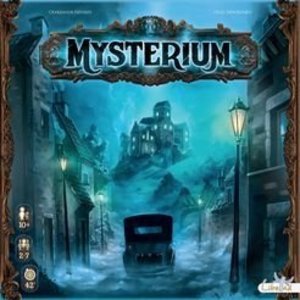
Mysterium is a cooperative game of deduction in which players take on the roles of mediums trying to solve the murder, and one player takes on the role of the ghost who is haunting the estate. Every turn, the ghost sends Visions (in the form of illustrated cards) to each medium in an attempt to guide them to investigate different suspects, locations, and potential murder weapons. The visions are not always clear, however, so the mediums must use their imaginations and deduction skills to decipher any hidden hints or clues contained in the visions. If all mediums are able to identify their suspects/locations/weapons before the 7th hour has passed, the ghost then sends one final Vision to all mediums to guide them to the true culprit. After receiving and deciphering this final Vision, the mediums must all vote on whom they believe the culprit to be. If the majority of the mediums select the correct culprit, the mystery has been solved and the ghost can be laid to rest! If not, however, the mystery remains and the ghost must wait an entire year before the magic ritual can be performed again…
I love Mysterium. I seriously think it’s a great game. One reason why I love it is because it’s a deduction game that is cooperative. Most of the deduction games I’ve played before are competitive or involve some form of bluffing. And I’m pretty terrible at lying, so I never really do well in those. What I like about Mysterium is that you’re still trying to figure out your own cards, but you’re allowed (and encouraged!) to ask your fellow mediums for their thoughts. It’s cool to see how everyone interprets the Vision cards because someone might notice or see something on your Vision card in a way you didn’t think of on your own. Your friends may be able to provide insight to help you through the game, just as you can help them decipher their clues. Especially since the game can’t be won unless everyone has found their cards, it really is in your best interest to cooperate and help everyone out.
Another thing I love about Mysterium is that it can be played with up to 7 players. I’ve probably mentioned this before, but I have 4 siblings, and sometimes finding engaging games for 5+ people can be pretty hard. Not an issue at all with Mysterium. It’s actually a favorite of my siblings to play, so I always bring it with me for holidays and family gatherings! I personally think Mysterium works better at higher player counts, so that really bodes well for me and my family!
One final thing I really like about Mysterium is the dynamic created between the mediums and the ghost player. The ghost is allowed to communicate with the mediums through visions only – no verbal communication at all! That means that as the ghost player, you’re trying to anticipate how each medium will interpret different visions so you can give them the one that will guide them to their specific card. When you’re a medium, you’re trying to think how the ghost player thinks – why did they give me this card and what did they want me to notice? In either role, you’re trying to get in the mind of your counterpart, and that just adds a fun little bonus twist for me.
I think Mysterium is a great game. Deduction drives the game and it keeps you constantly engaged, questioning every card you see. It’s an entertaining and lighthearted cooperative game for any player count, and it thrives with great non-confrontational player interaction. Mysterium was one of the first games in my collection – I was in my FLGS, picked it up off the shelf, and having done no research on it at all, I bought it. And boy oh boy am I glad I did. Definitely give Mysterium a try – it’s a good blend of mystery and fun! Purple Phoenix Games gives it an ethereal 11 / 12.
Purple Phoenix Games (2266 KP) rated Studies in Sorcery in Tabletop Games
Oct 6, 2020
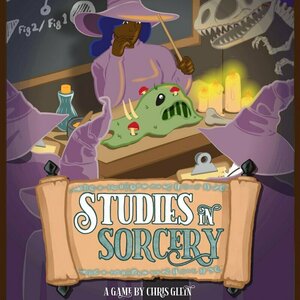
Studies in Sorcery is a competitive card game that uses elements from other well-loved games and puts them with a wonderful theme and some very interesting card synergies. The game takes place over four school semesters (rounds) and each semester lasts four weeks (turns). Can you students complete your thesis using the research grants you are given, or will you fall flat to repeat the program again?
DISCLAIMER: We were provided a prototype copy of this game for the purposes of this preview. These are preview copy components, and the final components may be different from these shown. Also, it is not my intention to detail every rule in the game, but to give our readers an idea of how the game plays. You are invited to back the game on Kickstarter launching October 6, 2020, order from your FLGS, or purchase through any retailers stocking it after it is fulfilled. -T
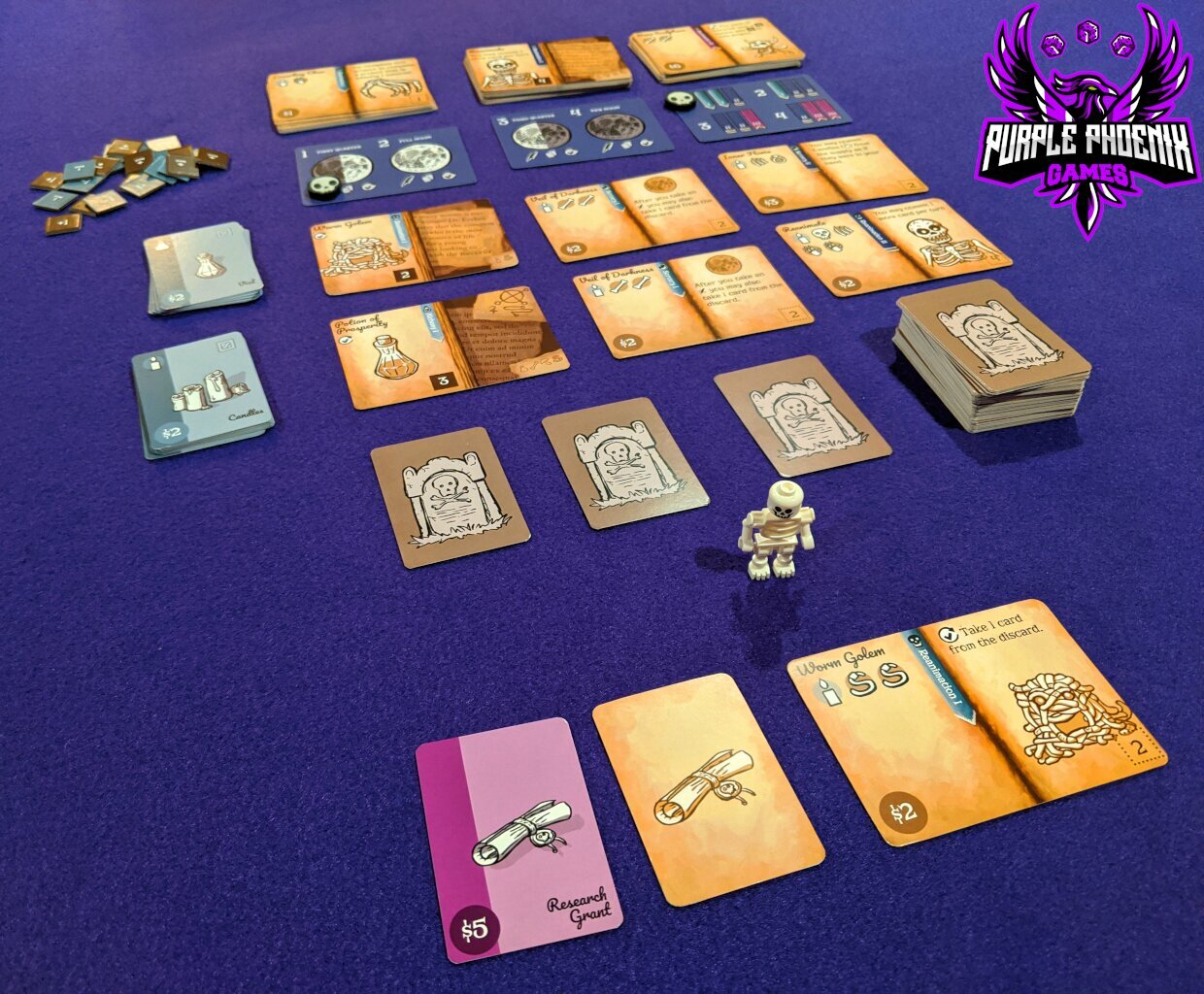
To setup, separate each deck of cards into like piles (Levels 100, 200, and 300 of the projects, graveyard cards, candles, vials) and shuffle them. Lay out the moon phase cards and semester tracker, placing the tracker tokens (skull erasers in the prototype) on the start of the cards to begin play. Set out the candles and vials in their own piles, as well as the point modifier tokens. Deal project cards according to the semester tracker in a 3×2 pattern under the moon phase and semester tracker cards like is shown in the photo below. Initially the graveyard pile will have three stacks of two cards each face-down next to the draw pile. Each player receives a research grant card, two thesis cards to choose one from, and two 100-level project cards from which the player will choose one. Give the first-player token (in this prototype it’s a cute LEGO skeleton) to the player who last attended school, and the game may begin!
Each player will be resolving actions, committing materials to their projects, and using completed project abilities each moon phase (turn). The actions one may take are: Dig, Buy, Cram, and Project Action. When a player uses the Dig action, they are searching for materials. A player can look at the items in the first pile of graveyard cards and take all the contents. If they do not like them, draw a card from the draw deck and place it on the first pile. Continue this for the next pile, and if unsatisfied the player may draw the top card from the draw pile OR either a candle or vial from the supply of stock cards.
Buy actions allow a player to use any unwanted materials or research grant monies to purchase additional candles, vials, or project cards from the middle of the table. To Cram, players may commit up to two materials from their hand to a project by placing the materials under the project cards. Project Actions allow players to use actions printed on any of their completed project cards. These can be very powerful.
Once each player has taken one of these actions, move the tracker token on the moon phase card to the next icon – Commit. To commit materials to projects, simply place the cards under the selected project (exactly like players do with the Cram action). Once all players have completed their commits, they may complete any projects that have sufficient materials by discarding the used materials and flipping the project card to its opposite side earning the printed points at the end of the game.
Play continues in this fashion for four turns each semester and the game lasts four semesters. Therefore the game will last 16 turns total. Whomever earns the most points for combinations of completed thesis cards, completed projects, bonus point modifier tokens, and one point for each $8 worth of materials in hand will be named Valedictorian of their class and winner of Studies in Sorcery!
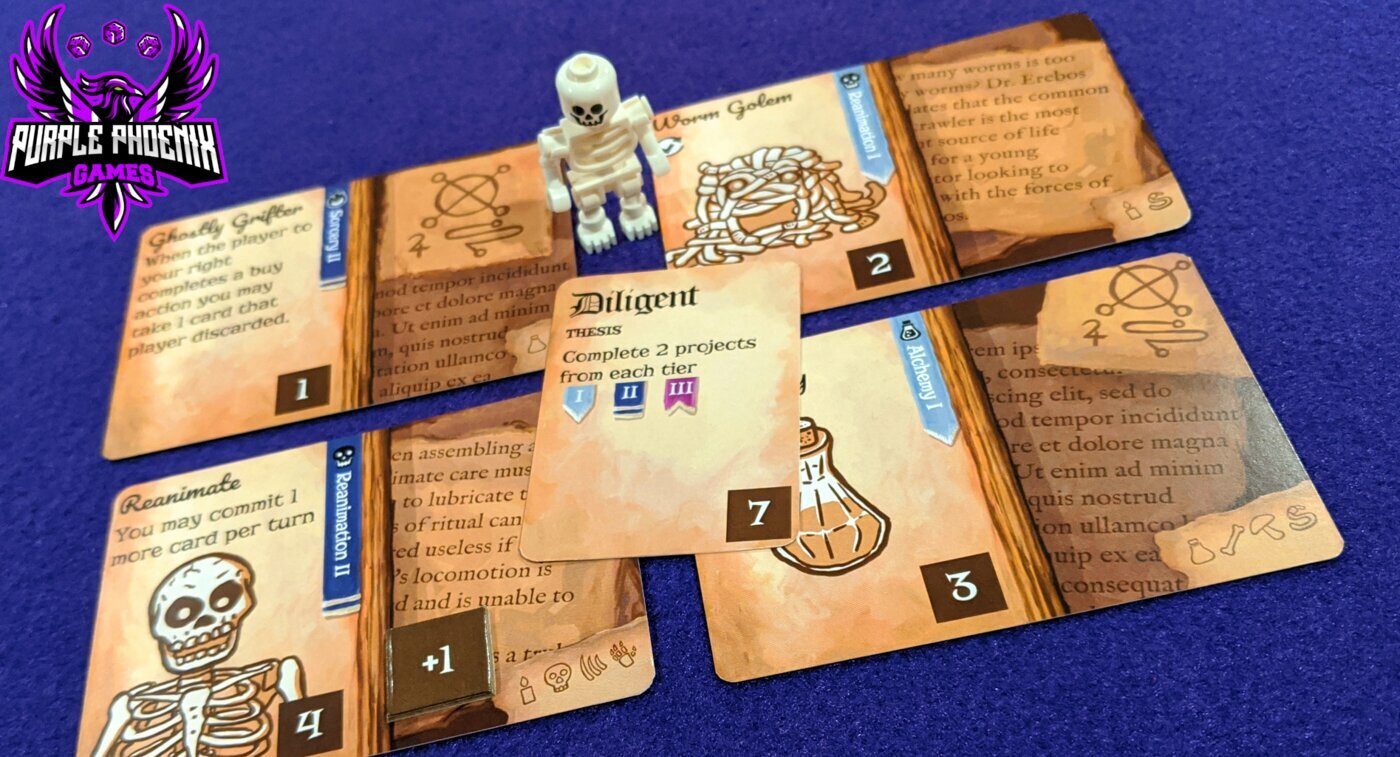
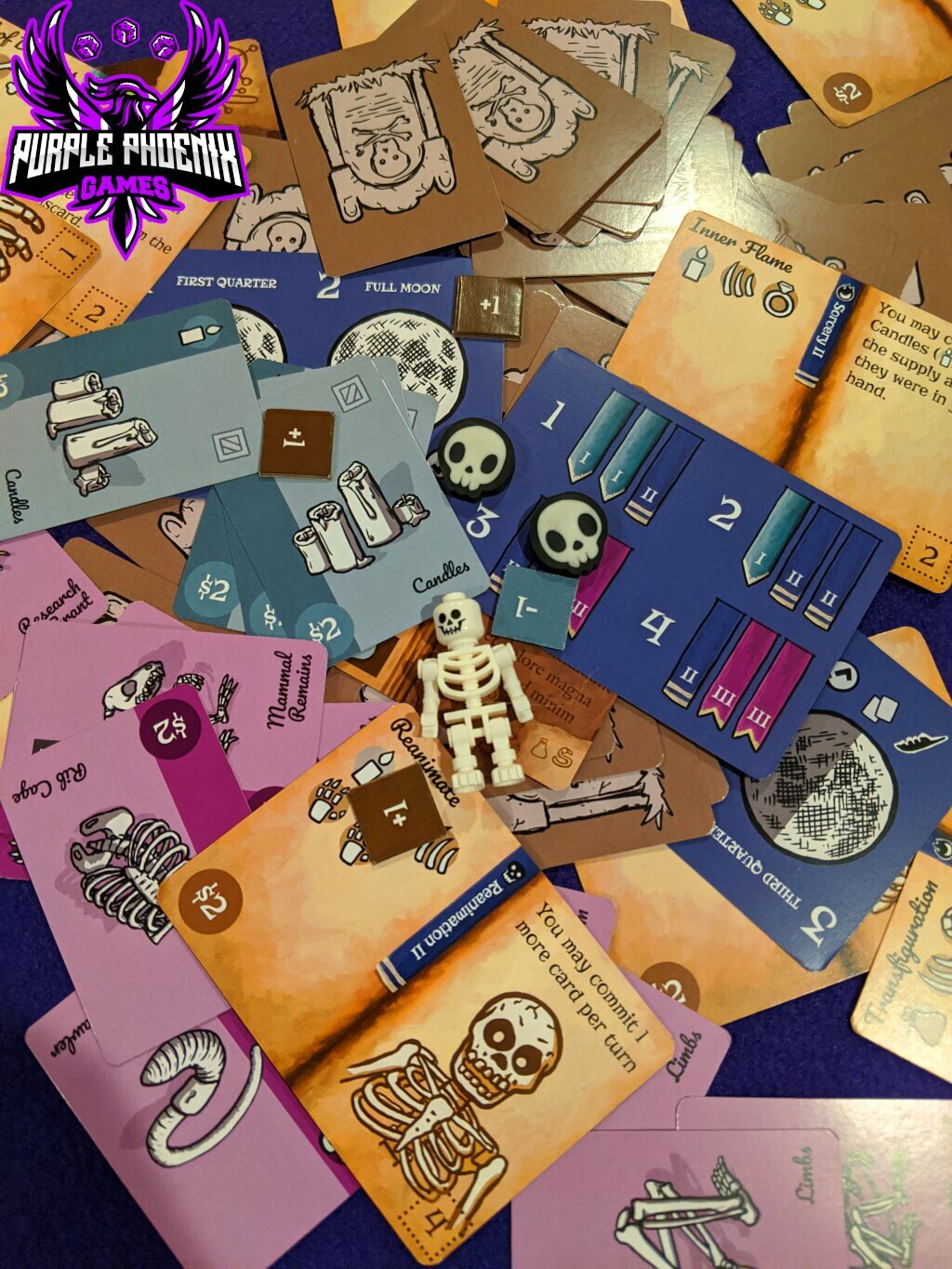
Components. Again, this is a prototype copy of the game, and I know some things will be different in the final version. However, what we were provided is a bunch of cards that have great art, are good quality, and are very easy to read and understand. The cute first player token will more than likely become a different component in the end, and the tracker tokens probably will be changed as well, but these are great bits to include in a game like this. The only negative I have about components is that I wish there was MORE color. Most of the cards are brown-heavy, and it’s completely fine, but I would love to have splashes of weird colors here and there. Overall, I am very pleased with the components in this game. Weird Giraffe Games always has great components in their prototypes AND final games.
It is probably no surprise that I love this game. The theme is wonderful, the wonky art is great, and it’s more thinky than one might imagine. The game play can be somewhat quick, or players can take excruciating amounts of time to think through their turns and chain together impressive actions. One thing remains constant – 16 turns to complete your thesis cards can be a huge undertaking. My first time playing I chose a thesis card worth 7 points (even though the rulebook advised me not to include those for the first play). I wasn’t even really that close to completing the thesis, but I may have with another two or three turns. But then again, that card is worth 7 points for a reason – it’s SUPPOSED to be difficult. My suggestion: take the rulebook’s advice and remove those thesis cards for the first play. Don’t try to be a hero.
Ahhhhhhh! I want to play it again right now just so I can attempt that thesis card again. But there are other thesis cards in the game. And other strategies to apply. And really, when you can’t wait to play a game, that’s a sign of a fantastic game for that specific gamer. Will this be a gem for everyone? I don’t know. It certainly works for me and my circle of gamers.
If you are a fan of the Harry Potter series (even though this is NOT a Harry Potter game) and need a thinky card game with that sort of fantasy classroom theme, or if your collection is begging for something new and quirky, or if you just love Weird Giraffe Games’ catalog and need every game they offer (I wouldn’t blame you), then you need to give Studies in Sorcery a look. Please consider backing it on Kickstarter launching October 6, 2020. I know my collection just got a lot cooler with this one.

Matthew Krueger (10051 KP) rated the Xbox One version of Blair Witch in Video Games
Mar 13, 2021 (Updated Mar 13, 2021)

The game is set two years after the events of the 1999 film The Blair Witch Project, which takes place in 1994. The game follows former police officer Ellis Lynch as he joins the search in Black Hills Forest for a missing boy.
The game focuses on survival horror mechanics and stealth and is played from a first person perspective, requiring the player to use items such as a camera, cellphone, flashlight or Ellis' dog, Bullet, to track and follow the trail of missing nine-year old Peter Shannon while fending off shadowy creatures. Along the way, players will find strange wooden dolls, photographs and cassette tapes and will also be tasked with solving puzzles. Like the film, it integrates the found-footage subgenre with the gameplay and story, often through the use of cassette tapes.
It is crucial for the player to keep Bullet close to them at all times, as being separated from him for some time can affect the state of the character. The game's ending is dependent on the relationship between the player and the dog, accounting for the actions the player has done.
The game roughly takes up to six hours to complete, with a possibility of four endings and an additional secret ending.
The ending cutscene varies and depends on players completing certain requirements; the endings can either reveal that Lanning's body was never found or was recovered and buried with top honors, the lumberer Todd Mackinnon was found nearly beyond identification or recovered by his family to be buried, and Peter's fate can be unknown or revealed that he was ultimately murdered at Carver's hands or safely found by the authorities and returned to his family unscathed.
Its good but forgettable.

iCAN Spell Grade 1 - Spelling
Games and Education
App
★★★★★ iCAN Spell 1 is an exciting and fun spelling application for Grade 1 kids that will...

Pixel Cup Soccer 16
Games
App
Pixel Cup Soccer 16 is a casual retro style soccer game, a great evolution from the first edition....

Dice Brewing
Tabletop Game
Dice Brewing is a dice-building game in which you manage resources and brew beer to become the beer...
Boardgames BeerGames DiceGames BrewingGames 2014Games Thirstygames
Tranquility
8.0 Rate It
Tabletop Game
Jump on board the good ship Tranquility and set sail for paradise. Take care, though, because in a...
Purple Phoenix Games (2266 KP) rated Niche in Tabletop Games
Mar 3, 2021
Niche is a puzzly abstracty Sudoku-y card sheddy game for two to seven players that can be played in as few as 10 minutes. In it players attempt to shed their hand and score the most points by adding cards to established lines of cards. As with most of Andy Hopwood’s games, though, there is a twist.
DISCLAIMER: We were provided a copy of this game for the purposes of this review. This is a retail copy of the game, so what you see in these photos is exactly what would be received in your box. I do not intend to cover every single rule included in the rulebook, but will describe the overall game flow and major rule set so that our readers may get a sense of how the game plays. For more in depth rules, you may purchase a copy online or from your FLGS. -T
To setup the dealer will shuffle the deck and, well, deal out seven cards to each player. The cards not dealt form a deck and from this deck a starter card is flipped to the table. Setup is complete and the game may now begin!
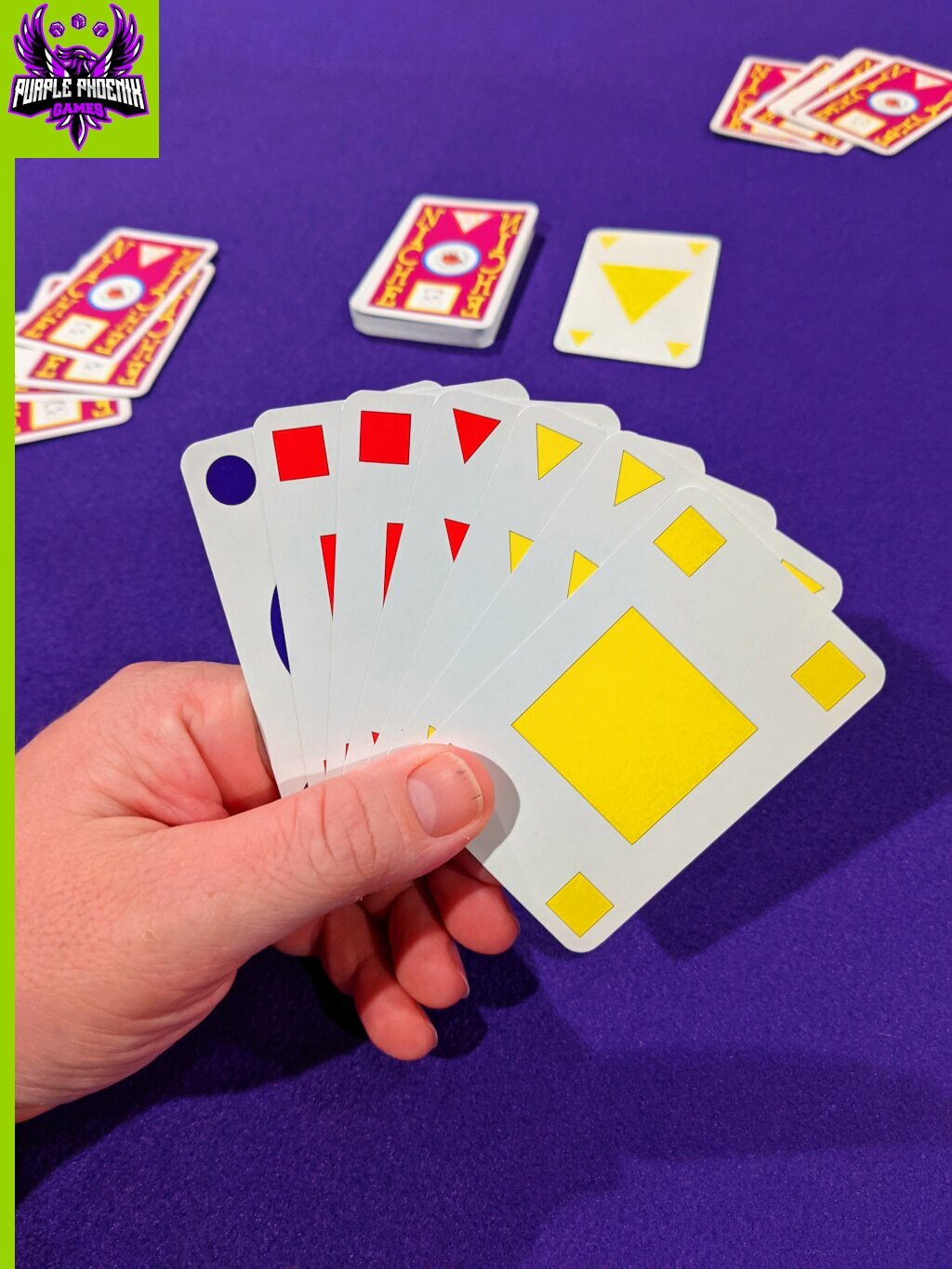
On a turn each player will need to perform three steps: Select, Place, Score. When Selecting a card from their hand the player will need to observe the last played card. This card will essentially inform the player of what CANNOT be played. For example (per the photo above), if a yellow triangle was just played, then the next card played can be NEITHER yellow nor a triangle. So from their hand the active player will select a group of cards that can be played this turn and choose one to add adjacently to the most recently played card.
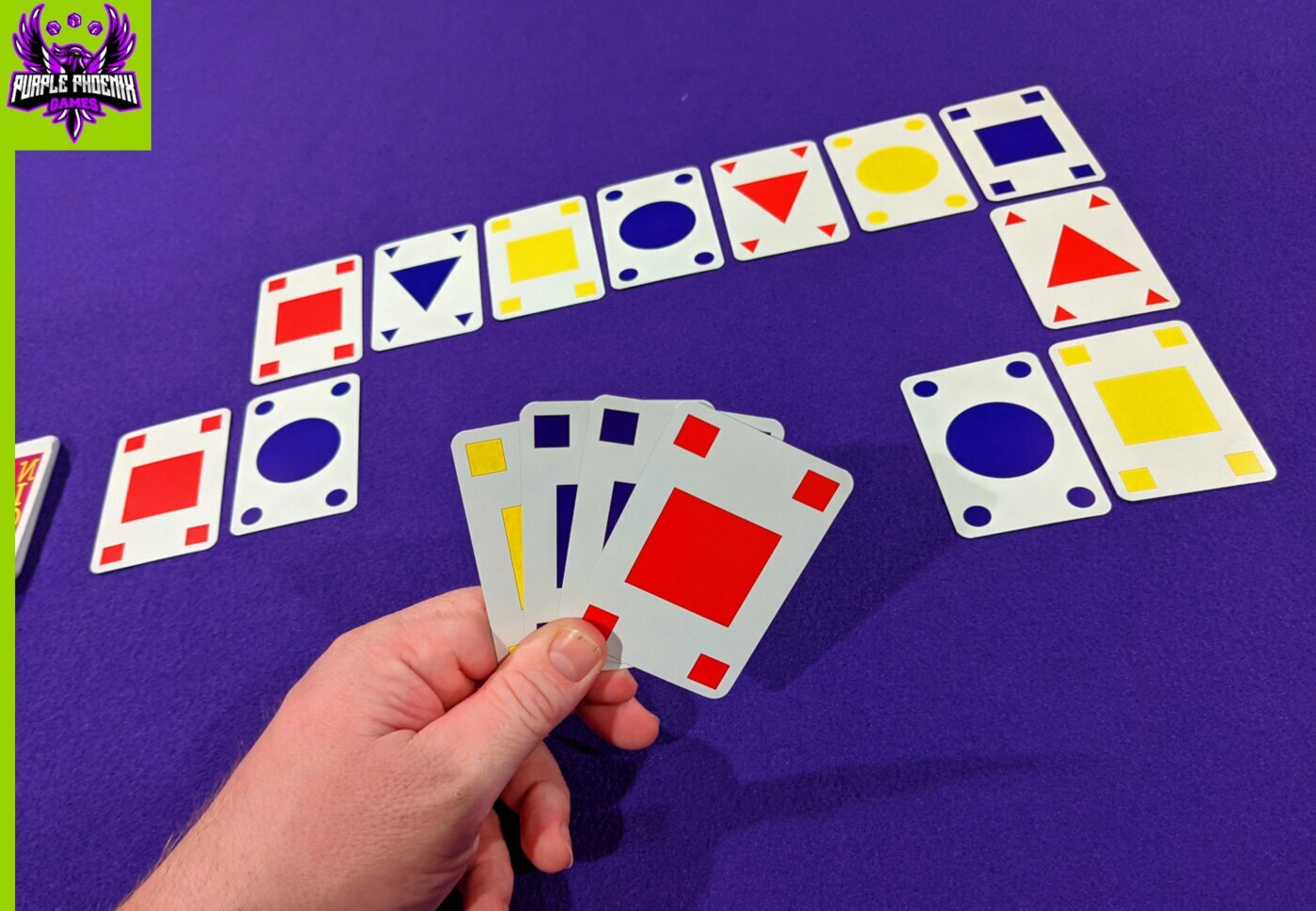
The player then must Place their card such that they do not add the same card to the line that already exists within the line. For an example here (per the photo below), the most recently played card is a blue circle. In hand are two blue squares, a yellow square, and a red square. As the previous card is blue the only choices left are the yellow and red square. However, the card played previous to the blue circle was a yellow square, so that leaves our player with only one choice: the red square connected to the blue circle. Now, the player could actually use the yellow square, but would need to place it below the blue circle forming the beginning of a new line. I will explain why that is a less strategic play.
When players perform the third step in a turn, Scoring, they will count up all cards in the lines extended by their card, both vertically and horizontally. In our previous example the red square continues a line of two cards so their score for that placement is three. Should they place the yellow square below they will only score two as they have added onto only one card. Fans of Azul will be familiar with this scoring system. Players are expected to keep track of their own scores each turn.
Should a player not have any legal plays using cards in their hand they must pass, and await their next turn. Play continues in this manner of players performing these three steps in a turn until a player sheds their entire hand of cards. All other players will have one more chance to play one card to score points. Players add up all the points they have scored throughout the game and the player with the most points is the winner!
Components. This is a deck of cards in a tuckbox. The cards are all fine quality, and the iconography could not be much clearer. I have zero qualms with the components here.
Gameplay is super quick and puzzly, with a great weight for its type of game. This will not be a centerpiece title of the game night, but will offer filler style gameplay for gamers mulling about or waiting for the next game to begin. I enjoy the simplicity of the rules coupled with the puzzly and thinky nature of each turn. Obviously the name of the game is scoring points, so you want to add to an already-long line instead of having to begin a new off-shoot somewhere, but it is near impossible to anticipate what other players will place on their turns. Therefore, more strategic players will find either solace or frustration from the more tactical style of play here.
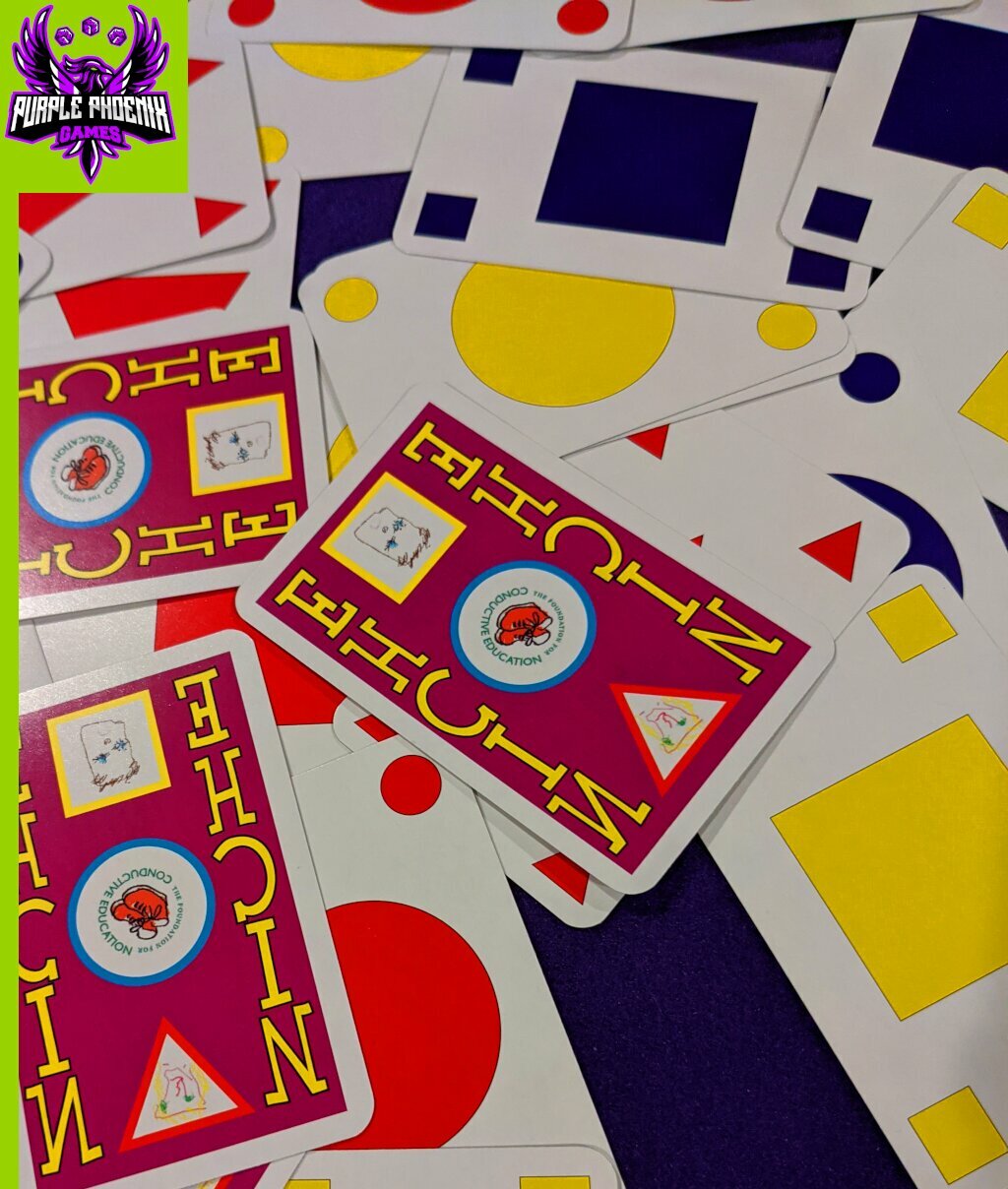
I do want to mention that this game was originally designed for an event benefiting The Foundation for Conductive Education in the UK. Quote taken from the BGG profile for Niche: “The game aims to promote and support The Foundation for Conductive Education. This method works with children and adults who have conditions such as Cerebral Palsy, Stroke, M.S. or Parkinsons, helping them to lead more independent lives.” I know this organization holds a special place in the designer’s heart and I just wanted to take a moment to give a shout-out to this amazing organization and this amazing person who created a game for the benefit of others. I applaud both entities, and hope for much success.
That said, Niche is a game that can be played with any type of gamer in almost any situation. It takes up little table space (at most nine cards in a line) and is rules-light. Purple Phoenix Games gives this one an extended 8 / 12. If you are a fan of Sudoku and would like to explore a little card game that gives this reviewer the same vibe (but infinitely more fun) then I urge you to grab a copy of Niche. Not only will you be purchasing a good little game, but your purchase also goes toward furthering an organization that is doing very important work in the UK. And if you would like to feel very smart, play Niche with me sometime and watch me struggle to play the right card.